Buri was the first of the Norse gods — the primordial ancestor of the entire divine race, freed from the salty ice at the dawn of creation by the licking of the great cow Audhumla, and the grandfather of Odin himself. From him descends the whole line of the Aesir, making him the very root of the family tree of the gods.
Before Anything Else Was
Norse cosmogony begins not with a birth but with an absence. Before Buri, before the gods, before even the giants had a name for themselves, there was only Ginnungagap — the yawning void between the fire of Muspelheim and the ice of Niflheim. Where the two met, the ice began to drip and thaw, and the meltwater quickened into the first living shape: the giant Ymir, ancestor of all the jotnar. Alongside Ymir, from that same thawing ice, came a second being — the primordial cow Audhumla. It is into this frost-bound, godless world that Buri arrives, and understanding him means understanding that he has no world to be born into yet — he is present at the making of the very first one. There is no sky, no earth, no sun to mark a day; time itself, in this account, only starts to matter once there is someone present to be shaped by it.
Last updated .
What Audhumla Found in the Ice
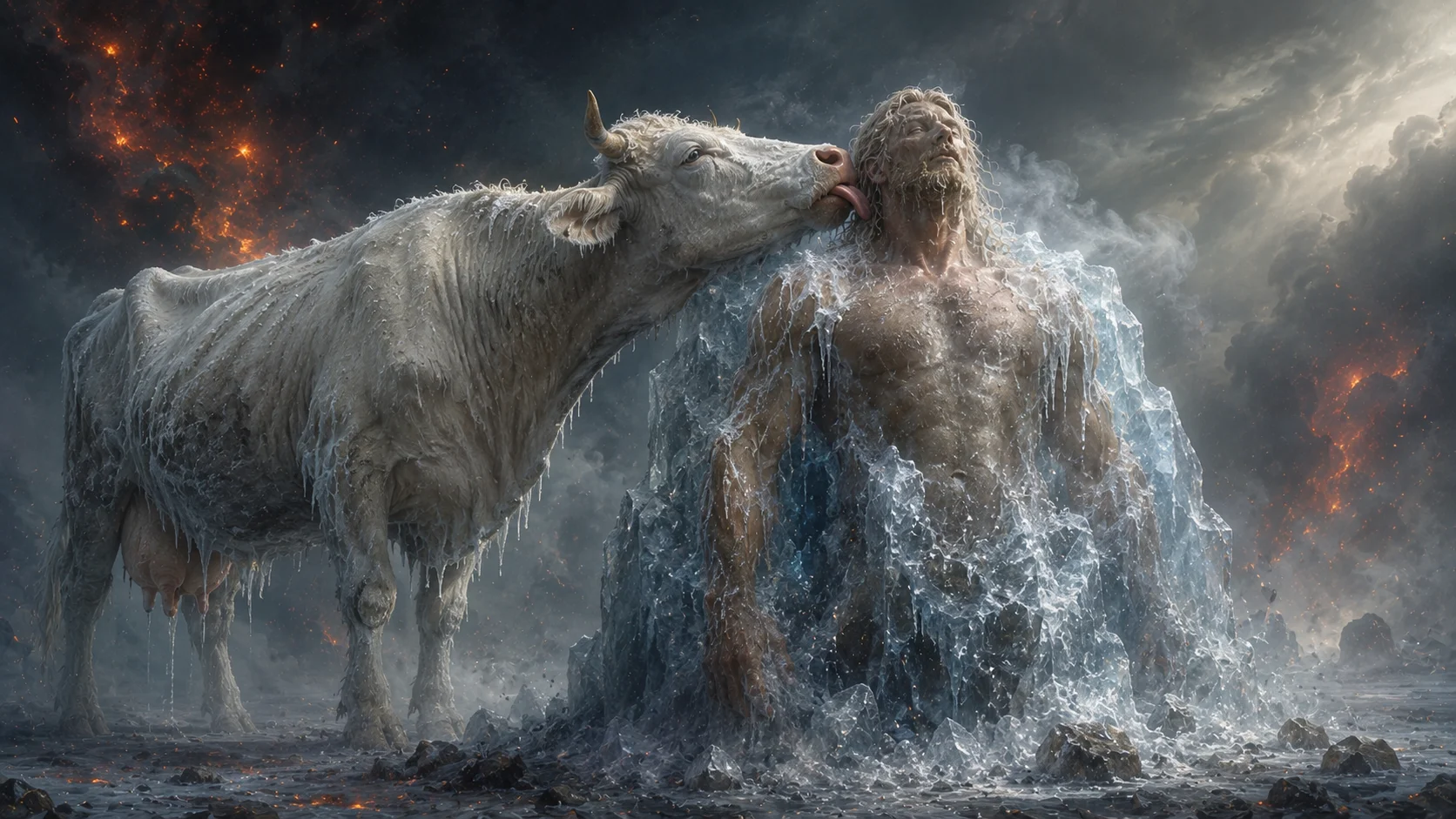
Audhumla began to lick the salty rime-stones that rose from the frozen ground of Ginnungagap. The account comes down to us through Snorri Sturluson, writing in the Gylfaginning section of his Prose Edda, and it is worth naming him directly — the Poetic Edda, the older verse collection, does not narrate Buri's origin at all. Everything known of how Buri came to be rests on Snorri's testimony alone, a single medieval hand recording what by his time was already old belief, likely drawing on oral tradition and skaldic verse that has not otherwise survived. As Audhumla licked, the story goes, something began to change beneath her tongue. The rime was not just rock. Buried in the salt and frost was the shape of a living being, and her licking, patient and continuous, was drawing it free. It is a strikingly domestic image to sit beside cosmic emptiness — a cow's tongue, an animal's ordinary hunger for salt, as the mechanism by which the first god comes into being.
Three Days Beneath the Tongue
The emergence did not happen at once. Over three days of Audhumla's licking, a complete being came loose from the rime-stone — where before there had been only frozen salt. This was Buri. He is described in the source as fagr — fair, handsome — and as mikill ok máttugr, great and mighty. No infancy is recorded for him, no childhood, no moment of first breath distinct from the moment of his freeing. He steps into the narrative already grown, already whole, in the same way that a stone is not built but uncovered. The counting of days — one, then two, then three, each revealing a little more of him — gives the account a rhythm closer to sculpture than to birth: existence arriving by increments, licked into definition rather than delivered whole.
A Being With No Parent
What sets Buri apart from every god who follows him is the plain fact that he was not born of anyone. He has no father, no mother, no divine lineage behind him to explain where he came from — he simply arises, licked out of ice by a cow. In a mythology otherwise dense with genealogy, where nearly every figure is introduced as someone's son or someone's daughter, Buri is a genuine point of origin. He does not continue a line; he starts one. This is precisely why later tradition remembers him at all — not for anything he did, but for the sheer fact of where the divine family tree begins. Every other named god in the surviving corpus can, in principle, be traced backward through parentage until the trail runs out at exactly this point.
Ymir's Counterpart, Ice's Two Children
Buri's emergence is bound to Ymir's in time, though the two could not be more different in what they represent. Both came from the same environment — the same salty, icy expanse of Ginnungagap. Ymir was the ancestor of the entire race of giants, generating offspring from his own body as he slept; Buri, in the myths as they survive, has no such deeds attributed to him at all — no independent acts, no myths, no spouse, no death recorded for him anywhere. Yet the two stand as parallel points of origin: Ymir the root of the jotnar, Buri the root of the Aesir, both emerging from that same icy dawn of the world, and both, in their different ways, present before the world as later ages would recognize it — sky, sea, and soil — had yet been made.
A Name That Means Nothing But Origin
Scholars connect the name Búri to the Old Norse burr or borr, meaning "son" or "the one born." It is a fitting name for a figure whose entire mythic function is to be the point from which sons proceed — even though, pointedly, no one bore him. The name does not describe a deed, a place, or a quality beyond the "fair and mighty" of Snorri's brief description. It describes a role: origin-point, first link, the one from whom being descends. Nothing in the surviving record suggests he carried any other title, any cultic epithet, or any name beyond this one — a economy of naming that matches the economy of everything else told about him.
The Son Without a Named Mother
In time, Buri had a son: Borr, sometimes spelled Bur. No mother is named for Borr anywhere in the surviving sources — Snorri simply states that Buri had a son called Borr, without explaining by what means or by whom. This absence sits comfortably alongside everything else about Buri's brief appearance in the myths: he is a figure defined by gaps as much as by the details that do survive, a name mentioned only for what descends from him rather than for any act of his own. The pattern recurs often enough in the earliest strata of the mythology that it reads less like an oversight than like a feature of how these origin-figures were remembered — sparingly, and only for their place in a line.
A Marriage That Joins Two Bloodlines
Borr, Buri's son, married Bestla, daughter of the giant (jötunn) Bölþorn. This marriage is the hinge on which the whole genealogy turns. Through it, the line that begins in Buri — self-generated, born of ice and a cow's tongue — is joined directly to the giant-kind. From the very first generation after Buri, the Aesir line is linked by blood to the jotnar, joined at exactly this marriage between Borr and Bestla. It means that Odin himself, the chief of the Aesir, is only half descended from the self-born line that starts with Buri; the other half of his ancestry runs straight back into the race his own sons will later war against.
Grandfather to the Brothers Who Made the World
From the marriage of Borr and Bestla came three sons: Odin, Vili, and Vé — the brothers who, in the next great act of Norse cosmogony, kill Ymir and shape the world from his body. Buri, then, is grandfather to the very brothers who end the age of the giants' first patriarch and begin the age of the ordered world. He never appears in that story himself. His role ends with the birth of Borr; everything that follows belongs to his descendants, not to him. The distance is worth noting: two generations separate the being licked from the ice and the sons who turn that same ice-born world into earth, sea, and sky.
Kinship Written Into the Foundations
The genealogy running from Buri down through Borr and Bestla to Odin, Vili, and Vé says something worth sitting with: gods and giants in Norse belief were never two hermetically sealed races. They share an origin in the same ice of Ginnungagap, and within two generations of that origin their bloodlines are already joined by marriage. Buri stands at the very root of that entanglement, present at the moment before it existed and gone before it played out, but responsible, by his single recorded act of fathering Borr, for setting it in motion. Later myth is full of further crossings between the two kindreds — marriages, rivalries, and outright wars — and this first union is the template that makes all of them possible in the same story-world.
Buri in the Wider Shape of the Cosmos
Placed within the larger architecture of Norse cosmology, Buri occupies a position that has no real counterpart elsewhere in the mythology: he belongs to the moment before the nine worlds existed to be counted, before Yggdrasil, before Midgard was shaped from Ymir's flesh. Everything that later literature treats as fixed geography — the halls, the realms, the paths between them — comes after him. In that sense Buri is less a resident of the cosmos than a precondition for it: his freeing from the ice marks the passage from a world containing only elemental extremes, fire and ice, to a world capable of containing a family, a lineage, and eventually a pantheon with names, functions, and rivalries. He is present at exactly one threshold and then steps back from the narrative entirely.
How Modern Scholarship Reads the Account
Because Buri's origin survives in only one telling, scholars treat the episode with particular caution, weighing how much of Snorri's prose reflects genuine pre-Christian belief and how much reflects a thirteenth-century Christian author shaping older material into a coherent narrative for his own purposes. The absence of any corresponding verse in the Poetic Edda means there is no independent check on the details — the three days, the exact wording "fair and mighty," the licking itself. Comparative approaches sometimes set the image of a primeval cow shaping a god from salt and ice alongside other Indo-European and Eurasian creation accounts that likewise begin with the interaction of extreme elements and a nourishing animal, though such comparisons remain suggestive rather than conclusive given how isolated the single source is. What scholarship agrees on is narrower and more solid: whatever its literary shaping, the genealogy Snorri records — Buri to Borr to Odin, Vili, and Vé — was taken as authoritative enough to anchor the entire divine family tree that follows it.
A Figure Known Only for Where He Stands
No myth records Buri speaking, acting, marrying, or dying. He has no attested cult, no medieval artistic tradition beyond Snorri's brief prose account, and no appearance in the Poetic Edda's older verses at all. Later scholarship treats him accordingly — not as a character with a story, but as a genealogical marker, the name that has to exist for the family tree to make sense. In recent centuries he has surfaced mainly in modern popular-culture adaptations of Norse myth — games and fiction — almost always in the same limited role he holds in the medieval source: a minor ancestral name near the top of Odin's line, mentioned and then left behind.
The Root That Remains a Root
Buri endures in the record as exactly what he was at the moment Audhumla's tongue freed him from the ice: an origin without an ancestry of his own, fair and mighty and without deeds, the first being of the divine line to stand apart from the frost that made him. He fathered Borr; Borr fathered Odin, Vili, and Vé by Bestla; and from that generation the whole shape of the Aesir's story follows. Buri himself takes no further part in it. He is remembered not for what he did but for the plain, foundational fact of what came after him — the first name in a line that ends, three generations later, with the brothers who reshaped the world from Ymir's body.
The great cow licked him free of the primordial ice over three days — and from this first god, emerged from the rime, descends the whole line of the Aesir, down to Odin and all his kin.