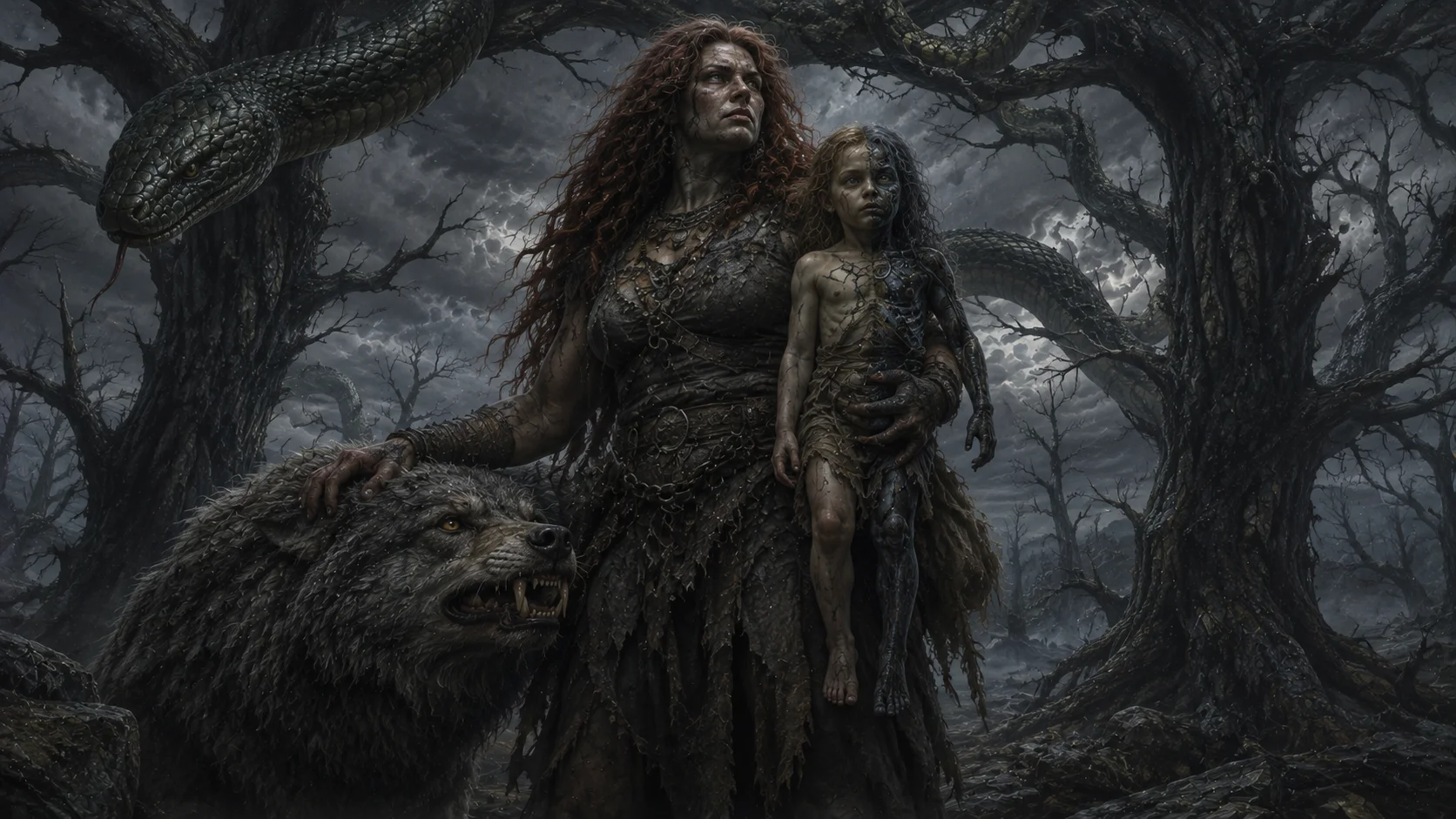
Angrboda was the fearsome giantess of Norse myth who, with Loki, gave birth to the three monsters fated to bring about the doom of the gods — the great wolf Fenrir, the world-serpent Jörmungandr, and Hel, queen of the dead. Her very name means "she who brings grief," and through her monstrous children she is, in a sense, the mother of Ragnarök itself.
The Bringer of Grief
Angrboda (Old Norse Angrboða) carries a name built from two plain Norse words: angr, "grief" or "sorrow," and boða, "to announce" or "to bring." Read together, the name means "the one who brings grief," or, as some translators render it, "anguish-boding" — a name that announces itself before any story has been told. She was a giantess, one of the jötnar, and her attested home lay in Jötunheimr, the land of giants, in a place named Járnviðr, the Ironwood. Snorri Sturluson names her in Gylfaginning, and she is referenced again in Völuspá hin skamma, the "short Völuspá," a poem embedded within the larger poem Hyndluljóð in some of the manuscript traditions that preserve it. Between these two sources — one prose, one verse — the whole of her direct textual attestation is contained.
Last updated .
A Name Given, Not Explained
Unlike many figures in the Eddas who receive a scene, a line of speech, or an action to perform, Angrboda receives only a name and a genealogy. She has no recorded dialogue, no episode in which she acts, no encounter with another god or giant that survives in any source. She exists in the texts purely as a point of origin — the woman from whom certain beings came — and everything else that might be said about her must be inferred rather than read. That absence is itself part of what the name does: it is a name that explains her entire narrative function in advance. She is grief announced, and what she announces is what she bears.
The Ironwood and Its Hag
Gylfaginning describes Járnviðr, the Ironwood, as inhabited by an old giantess who breeds wolf-kin there — a place where monstrous wolves are said to be raised up in a lineage of their own. Snorri does not explicitly state that this Ironwood hag is Angrboda herself; he places Angrboda's dwelling in Jötunheimr and separately describes the wolf-breeding hag of the Ironwood, and the identification between the two is an inference rather than a stated fact. Some readers of the text accept the connection as obvious, given that Angrboda is elsewhere named the mother of monstrous offspring; others treat it as unproven, a case of two separate passages being read together because they rhyme thematically rather than because the text says so. Both positions are defensible from what actually survives, and neither can be settled from Gylfaginning alone.
A Union with the Trickster
What is stated without ambiguity is her union with Loki. By him, Angrboda became the mother of three children, and the Eddic corpus does not record any other partner, any other union, or any other offspring for her. No independent adventures are attributed to her; no other named children appear anywhere in the primary sources. Her entire presence in the mythology is structured around this one relationship and its consequences — she stands, by that union, allied to the figure whose actions again and again unsettle the order the Æsir maintain, and her children become the clearest expression of what that alliance ultimately produces.
The Wolf Bred for Binding
The first of her three children was Fenrir, the wolf. Raised for a time among the gods themselves, Fenrir grew at a pace that alarmed them, until the gods judged him too dangerous to keep loose and had him bound with the fetter Gleipnir, a binding fashioned by craft rather than by ordinary strength. Bound, Fenrir did not cease to matter — the prophecies attached to him held that he would break free at Ragnarök, and that when he did, he would kill Odin, the highest of the gods, in the battle that ends the world as it stands. Völuspá hin skamma names Angrboda explicitly as the mother of "all wolves" through her union with Loki, and states plainly that Fenrir was the worst to come from that lineage — the poem's own judgment on which of her children posed the gravest threat.
The Serpent Cast into the Sea
The second child was Jörmungandr, the World Serpent. When the gods learned what the three children of Loki and Angrboda were fated to become, Odin had them brought before him in Asgard, and it was Jörmungandr who was cast into the surrounding sea. There the serpent grew without stopping until its body encircled the whole of Midgard, so vast that it could bite its own tail and hold that shape around the world of men. That fate, too, runs forward to Ragnarök: Jörmungandr is bound by prophecy to rise from the sea and face Thor, the two of them fated to kill one another in that final meeting, thunder-god and world-serpent destroying each other in the same hour.
The Queen Sent Below
The third child was Hel, cast down by Odin to rule the underworld realm that bears her own name — a realm of the dead separate from the halls reserved for the slain in battle. Where her brothers were given bodies built for violence, Hel was given a throne and a country to govern, and the sources do not describe her as posing the same kind of active threat as Fenrir or Jörmungandr. Her role is administrative rather than martial: she receives and rules the dead, and in doing so holds a place in the cosmic order every bit as permanent as her brothers' bindings. All three placements — sea, underworld, and captivity — were the gods' answer to prophecy, and all three were understood even at the time as delay rather than solution.
Prophecy Answered but Not Undone
The pattern across all three children is the same: the gods act on foreknowledge, and their action reshapes where each child is kept, but does not unmake what each child is fated to do. Jörmungandr in the sea still grows to encircle the world. Hel below still comes to rule the dead. Fenrir bound still waits for the day the fetter fails. Nothing in Gylfaginning suggests the gods believed they had solved the danger Angrboda's children represented — only that they had bought distance from it, arranging the world so that wolf, serpent, and death-queen were placed at its edges rather than at its center, until the day appointed for them to move back toward it.
A Mother Known Only by Her Offspring
What makes Angrboda unusual among the jötnar named in the Eddas is how completely her significance is carried by people other than herself. She is not recorded as intervening on her children's behalf, protesting their treatment, or appearing at any of the three moments when they were taken from her. The texts simply do not follow her after the fact of their birth. Her narrative function begins and ends at genealogy: she is the giantess through whom Loki's blood entered the wolf, the serpent, and the ruler of the dead, and the myths that matter are the myths that happen to her sons and daughter, not to her.
The Genealogy That Ends the World
Because Fenrir, Jörmungandr, and Hel occupy such central roles at Ragnarök — Fenrir killing Odin, Jörmungandr and Thor destroying each other, Hel's realm receiving the dead of both before and after the final battle — Angrboda's union with Loki reads, in retrospect, as the moment the mythology's ending was set in motion. She stands structurally opposed to the order the Æsir maintain, not because any text shows her acting against the gods, but because the beings she bore are, by prophecy, the instruments of that order's destruction. The grief her name announces is not a grief she causes directly; it is the grief that arrives, generations later, through what she brought into the world.
What the Later Retellings Add
Angrboda's sparse attestation — a dwelling place, a lover, three children, and a name — has made her fertile ground for modern fiction, particularly recent novels and feminist retellings of Norse myth that build out a fuller interior life, voice, and perspective for her than any surviving source provides. Such works are worth noting precisely because of how much they invent: the Eddas give a genealogical point of origin, not a character with recorded speech or motive, and any version of Angrboda with a personality, a plan, or a relationship beyond her bond to Loki belongs to that later literary tradition rather than to Gylfaginning or Völuspá hin skamma.
The Shape Left in the Ironwood
What remains, when the later inventions are set aside, is a name that means grief, a forest called Ironwood, a bond with the trickster god, and three children whose fates carry the mythology to its end. Angrboda is not given a voice in the sources that preserve her, and no surviving text shows her acting, mourning, or speaking. She is remembered instead as the place three catastrophes began — the wolf that will kill a god, the serpent that will kill and be killed by another, and the queen who already rules where the dead of both must eventually go.