Laufey is named in the Prose Edda as the mother of Loki, a jötunn known to the surviving sources only through her son and her consort. She has no myths of her own, no independent deeds, no recorded meeting with god or giant beyond the two figures who define her — yet her name is spoken more often, in more poems, than that of many giantesses who do have episodes to their credit. That paradox, and not any story, is what Laufey actually leaves behind.
A Name Given Twice
In chapter 33 of Gylfaginning, Snorri Sturluson states plainly that Loki's father is Fárbauti, and adds, almost as an aside, that his mother is called Laufey — or, alternatively, Nál. Two names for one figure is an unusual amount of textual attention for a being who otherwise receives none at all. Most minor jötnar in the genealogical passages of the Edda are given a single mention and nothing more; Laufey is given a double name, without explanation of why both were remembered or what distinguished one from the other. The text does not say whether Nál was an older name, a private one, a poetic epithet, or simply a variant tradition Snorri chose to preserve rather than discard. It simply states both and moves on.
Last updated .
The Son Named for the Mother
The detail that has secured Laufey's place in the textual record is not anything she did, but how her son was called. Throughout Old Norse poetry, Loki is overwhelmingly referred to as Loki Laufeyjarson — Loki, son of Laufey — rather than by a patronymic drawn from his father Fárbauti. This is the reverse of the ordinary Norse naming convention, in which a patronymic from the father was the norm and a matronymic was the exception requiring some particular reason. The usage is not a single passing line: it recurs across skaldic and eddic verse, including in Lokasenna, where Loki is again called Laufeyjar sonr. The repetition matters. A single unusual naming could be a scribal quirk or a poetic convenience; a naming pattern repeated across independent poems is something closer to settled tradition — Loki's mother's name, not his father's, was simply how he was known.
A Question the Sources Do Not Answer
Why Loki carried his mother's name instead of his father's has drawn attention from later scholars of Old Norse literature, including Rudolf Simek and John Lindow, who have proposed several possible explanations: that Laufey's lineage carried greater status or importance than Fárbauti's, or that something about Fárbauti's name or nature made a matronymic the more fitting choice. Neither explanation is confirmed by the primary sources. The Edda and the poems that use the matronymic do not themselves offer a reason — they simply use it, consistently, without comment, as though the convention needed no justification to a medieval audience that has since been lost to us. What remains is an open question rather than a settled answer, and it should be treated as such: a genuine gap in the record, not a puzzle later scholarship has solved.
The Needle's Meaning, If It Has One
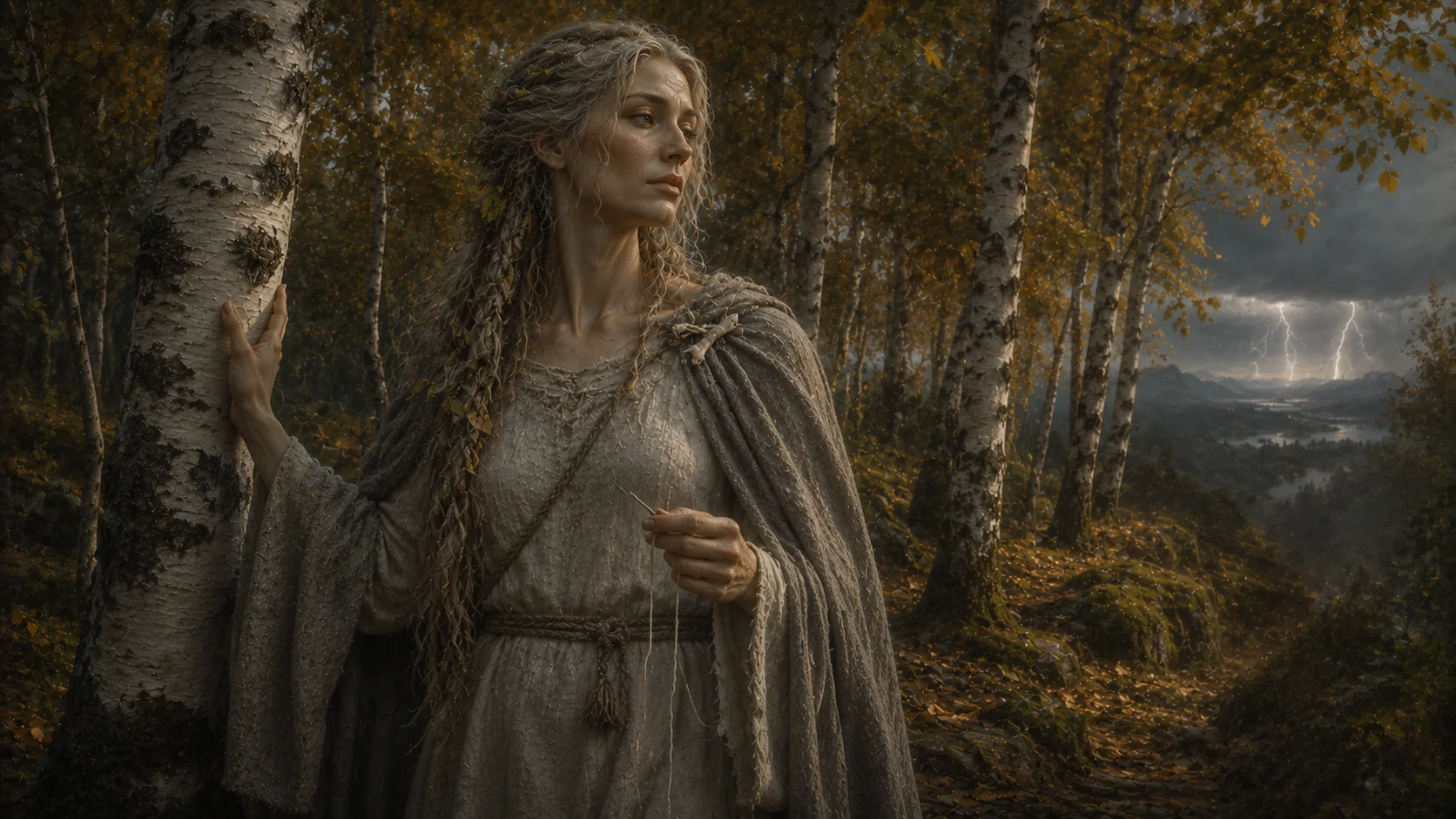
The alternate name Nál has been glossed by some scholars as meaning "needle," and it is tempting to read that as a description — slenderness, sharpness, something fine and piercing about the figure it names. But this etymological reading is not confirmed by any narrative content in the sources; there is no scene, no description, no episode in which Laufey is shown to be slender, sharp, or needle-like in any demonstrated sense. The name may carry that meaning, or may not, or may carry a meaning no longer recoverable. Anything beyond noting the proposed etymology and its uncertainty would be invention dressed as commentary.
Defined Entirely by Relation
No father is named for Laufey. No siblings, no wider genealogy, no lineage of her own reaching back into the older families of jötnar the way other giants' ancestries sometimes do. She exists in the surviving record purely in relation to two other beings: as the consort of Fárbauti, and as the mother of Loki. Strip away those two relationships and nothing remains — no independent identity, no standalone mention, no line of the Edda that speaks of Laufey without also speaking of one of them. This is not unusual for minor figures in the genealogical passages of Norse myth, but it is worth stating plainly rather than papering over: what is known of Laufey is entirely secondhand, borrowed from the men she is connected to.
No Deed, No Episode, No Voice
Unlike her son, who dominates episode after episode of Norse myth with his schemes, insults, and shifting loyalties, Laufey has no attested action of any kind. She does not speak in any surviving text. She does not appear in a scene. She is not present at any of the gatherings, feasts, or confrontations that fill the mythic corpus — not even Lokasenna, the poem most concerned with Loki's ancestry and character, where she is named only in the matronymic that identifies her son. Like Fárbauti, she exists in the textual record solely as a genealogical notice: a name placed beside other names to establish who belongs to whom. This should not be treated as a curious omission to be filled in — it is simply the whole of what the sources give.
A Status Inferred, Not Declared
That Laufey is a giantess is generally assumed, and reasonably so: she is named in a genealogical passage grouped among the jötnar, and both her consort and her son are giants or closely associated with Jötunheimar. But it is worth noting precisely what the text does and does not say. Snorri does not apply the word gýgr or jötunn directly to Laufey in the surviving passage. Her classification as a giantess is inferential — drawn from context and association — rather than a direct statement in the source. The inference is a reasonable one, but it remains an inference, and the distinction between "the text calls her this" and "the context implies this" is not a technicality; it is the difference between what is attested and what is deduced.
No Company Among the Æsir or the Jötnar
Laufey has no recorded relationship to any named being beyond Fárbauti and Loki. She does not appear alongside other giantesses of the Norse corpus, nor is she placed in any scene with the Æsir or Vanir. She remains fixed at the point of Loki's birth, untouched by the wider mythic action her son generates. No epithet beyond her two names, Laufey and Nál, is recorded for her either; there is no title, no honorific, no descriptive by-name of the kind attached to other giant figures.
The Modern Reworking, and Why It Does Not Belong Here
In recent decades, popular media — notably certain comics and films — has built an elaborate backstory around the name Laufey, going so far as to reimagine the figure as male and as a king of the Frost Giants. This reinterpretation has no basis whatsoever in the medieval sources: nothing in the Prose Edda, in skaldic verse, or in eddic poetry supports a male Laufey, a Frost Giant kingdom, or any of the narrative material built on that premise. It is a modern creative invention layered onto a name borrowed from myth, and it should not be conflated with the attested tradition. The Laufey of the Old Norse sources is, throughout, female, unnamed as a ruler, and defined only by her two relationships — nothing more, and nothing the modern reworking has added.
What the Record Actually Preserves
Set beside her consort Fárbauti, Laufey is in one sense his mirror — another figure known only through a single genealogical notice, with no myths of her own. But she is set apart by the unusual doubling of her name and, more strikingly, by how thoroughly her name outlasted her silence: carried forward in poem after poem not as her own designation but as her son's identifying mark. Loki Laufeyjarson is, in the end, the entire visible legacy of Laufey — a matronymic repeated by poets across generations who evidently felt no need to explain why the trickster god, alone among the beings of Norse myth, carried his mother's name rather than his father's. The reason for that choice did not survive. The naming itself did, and that is the whole of what remains to be said with confidence.