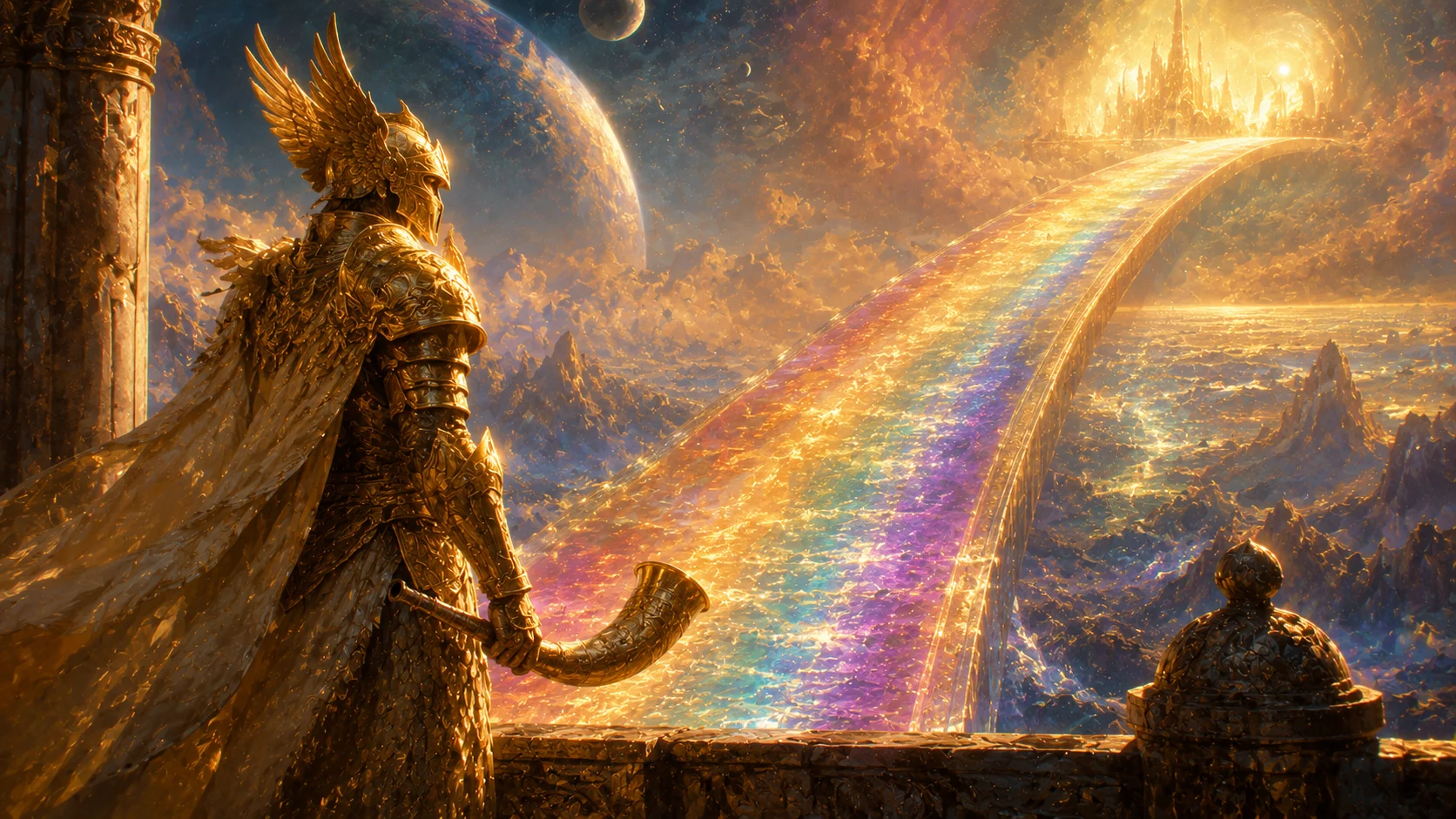
Heimdall stood at the edge of Asgard where the rainbow bridge met the sky, the watchman whose eyes never closed and whose ears caught sounds no other god could hear. Born in a manner unlike any of his kin, keeper of a horn whose single blast would announce the end of the world, he was at once the most vigilant of the Æsir and one of the strangest in origin — a guardian who also, by an old and half-remembered tradition, gave humankind its shape.
The Sentinel at the Bridge's Foot
Heimdall's post was Bifröst, the burning rainbow bridge that joined Asgard to the world below. The Gylfaginning names him the watchman of the gods — vörðr goða — stationed there precisely because no other could keep the post as he could. He required less sleep than a bird. By day or by night he could see a hundred leagues into the distance, and his hearing was so fine that he could catch the sound of grass pushing up through soil and wool lengthening on the backs of sheep. Giants and other enemies of the Æsir could not hope to cross unseen or unheard; Heimdall's senses covered the approach to Asgard the way a wall covers a city, except that walls sleep and Heimdall did not.
Himinbjörg, the Hall at Heaven's Edge
He did not watch from nowhere. The poem Grímnismál places his dwelling at Himinbjörg — "sky-cliffs" — a hall set near Bifröst itself, close enough to the bridge that its guardian never had to leave his charge for long. It is a fitting home for a god defined entirely by his post: not a hall of feasting first and residence second, but a lookout built into the architecture of the cosmos, standing where the road between worlds could be seen from end to end.
The Whitest of the Gods
Snorri's Gylfaginning calls Heimdall hvítastr ása — the whitest, or most shining, of the gods — and the epithet is not incidental. He is described with gleaming attributes throughout the tradition: teeth of gold, so renowned that skalds took to calling gold itself "Heimdall's teeth" in their kennings, and a horse named Gulltoppr, gold-tuft, that carried him as brilliantly as he carried himself. Where other gods are marked by weapons or by cunning, Heimdall is marked by radiance — a watchman whose very appearance seems built for being seen keeping watch, gleaming at the border between the ordered world and everything beyond it.
A Birth Unlike Any Other God's
Heimdall's origin is not told with one voice, and the fullest account, preserved in Hyndluljóð of the Poetic Edda, departs from the pattern followed by most of the Æsir. There, Heimdall is said to have been born of nine mothers, all sisters, and it is this nine-mothered birth, not any single parent's name, that the old sources dwell on when they speak of how he came to be. A minor, less-developed strand of tradition occasionally names Odin among his parentage, but the sources do not agree on this, and no fuller account of such a lineage survives; the nine-mothered birth is what the tradition actually elaborates, and what marks his origin as unlike that of any other god.
Born of Nine Sisters
The names of these nine mothers vary across the scattered sources that mention them, and they are sometimes identified with the wave-maidens, daughters of the sea itself, though the tradition is fragmentary and scholars treat it as an old and only partly preserved mytheme rather than a settled genealogy. What survives is the shape of the story more than its details: a god brought into being not by a single mother but by nine at once, sisters bound together, as though the sea in all nine of its moods contributed something to the making of the one who would watch over the border of Asgard. No fuller narrative of the event has come down; the fact of it is stated, almost in passing, and left to stand as one of the more enigmatic corners of the mythology.
Rig's Journey Among Mortal Households
A separate and distinct tradition survives in the poem Rígsþula, where a god named Rig travels through the world of men. The poem's prose introduction identifies this traveling god with Heimdall, though the identification rests on that preface rather than on the verse itself, and it is a connection scholars discuss with some caution rather than treat as certain. In the story as told, Rig visits three households in turn — a poor and humble home, one of modest comfort, and one of wealth and standing — and fathers a son in each. From these sons descend the three orders of human society: Þræll, ancestor of the thralls; Karl, ancestor of the free farmers; and Jarl, ancestor of the nobility. The poem is, at its heart, an origin story for the structure of human society rather than for humanity's existence altogether, and it is presented as a matter apart from Heimdall's place among the Æsir — he is not recorded as having married or fathered children within the society of the gods themselves. Whatever kinship he holds with mortals belongs to Rig's road through their doorways, not to any household in Asgard.
Guardian Against the Sea's Thief
Heimdall's watchfulness was not confined to Bifröst alone. Skáldskaparmál preserves, mostly through kennings that refer to "Heimdall's fight with Loki" rather than through any single connected narrative, a tale in which the two gods contend in the shapes of seals over Brísingamen, the necklace belonging to Freyja, after Loki had stolen it. The story survives only in fragments and allusions rather than as a full telling, but its outline is clear enough: Heimdall recovered what Loki had taken, guardian against thief even in a struggle fought far from his usual post at the bridge. It is one of the few tales that shows him in direct action rather than in the posture of watching, and it stands as an early instance of the enmity between the two that would only deepen with time.
An Old Wound Recalled in Riddling Speech
Skaldic diction preserves one more fragment concerning Heimdall that resists full explanation. His sword is spoken of, metaphorically, as "the head" — a kenning that Skáldskaparmál notes without narrating the story behind it, an allusion to some lost account of his death by a man's head that has not survived in any complete form. It is a reminder of how much of the old mythology exists only as its own shorthand now: a single riddling phrase standing in for a story that was once, presumably, well known enough not to need telling in full, and is now unrecoverable except as the phrase itself.
The Horn That Waits for the End
Among all of Heimdall's possessions, none carried greater weight than Gjallarhorn. Both Völuspá and Gylfaginning attest to its purpose: at the onset of Ragnarök, when the forces arrayed against the gods finally move against Asgard, it will be Heimdall who sees them coming, and Heimdall who raises Gjallarhorn and sounds the blast that wakes the gods to their final battle. Every other faculty he possesses — the sight that reaches a hundred leagues, the hearing that catches grass growing — exists in service of this single moment. He is not merely a guard stationed at a bridge; he is the mechanism by which the end of the world will be announced, the one figure whose entire purpose culminates in a sound rather than a blow.
Enemies Fated from the Beginning
Völuspá names the pairings of champions who will meet and kill one another when the final battle comes: Odin against Fenrir, Thor against Jörmungandr, Freyr against Surt — and Heimdall against Loki. Of all these fated confrontations, Heimdall and Loki's is the one with the longest history behind it, reaching back through the recovery of Brísingamen to whatever older enmity that struggle represented. At Ragnarök, the poem states plainly, watchman and trickster will kill each other — a mutual end, neither one outliving the other, closing out a rivalry that the mythology suggests had been building since long before the world's last day arrived.
Numbered Among the Twelve
Gylfaginning places Heimdall explicitly among the twelve chief Æsir, a formal reckoning that marks him as a figure of real standing among the gods rather than a minor watchman kept at the margins. It is a detail easy to pass over, but it matters: his entire identity is built around a single unglamorous duty — watching, listening, waiting — and yet the tradition still counts him among the most prominent of the gods' number, alongside Odin, Thor, and the rest of the ruling circle of Asgard.
A Duty Without Rest
What distinguishes Heimdall from nearly every other figure in the mythology is the totality of his function. He is not a god who watches when convenient and feasts when not; the sources describe him as needing almost no sleep at all, a being whose entire existence is calibrated to a single unbroken task. There is no myth of Heimdall resting, no tale of him elsewhere while danger approached. Everything recorded about his senses, his dwelling at the sky-cliffs, and his fated death all orbits the same fact: he was made, or at least is remembered, as the one who cannot fail to notice when the end begins.
Recognition Beyond the Old Sources
In more recent times Heimdall has found wide recognition through modern popular adaptations, most notably Marvel's portrayals, which depart significantly from the primary medieval sources in character and role. He also continues to appear in neopagan practice and in fantasy fiction more broadly, where the eternal watchman — the guardian who never sleeps and never misses what approaches — remains a durable and recognizable archetype, drawn from the same core image the old poems preserved: a figure standing at the border of the world, listening for what the rest cannot yet hear.
Sources & traditions
- EncyclopediaWikipedia — Heimdall
- TraditionNorse texts, inscriptions and later retellings (Scandinavia)
Myths change from area to area and from time to time. This chronicle follows the most widely told versions; tellings in other villages, regions and eras may differ.