Aegir was the Norse personification and lord of the sea — a mighty being of giant-kind who ruled the deep ocean and brewed ale for the gods in his great hall beneath the waves. Where Njord governed the gentle coast and fair winds, Aegir was the sea itself in its vastness and power: the host of the gods' grandest feasts, and the deep that swallows ships and men.
The Lord of the Sea
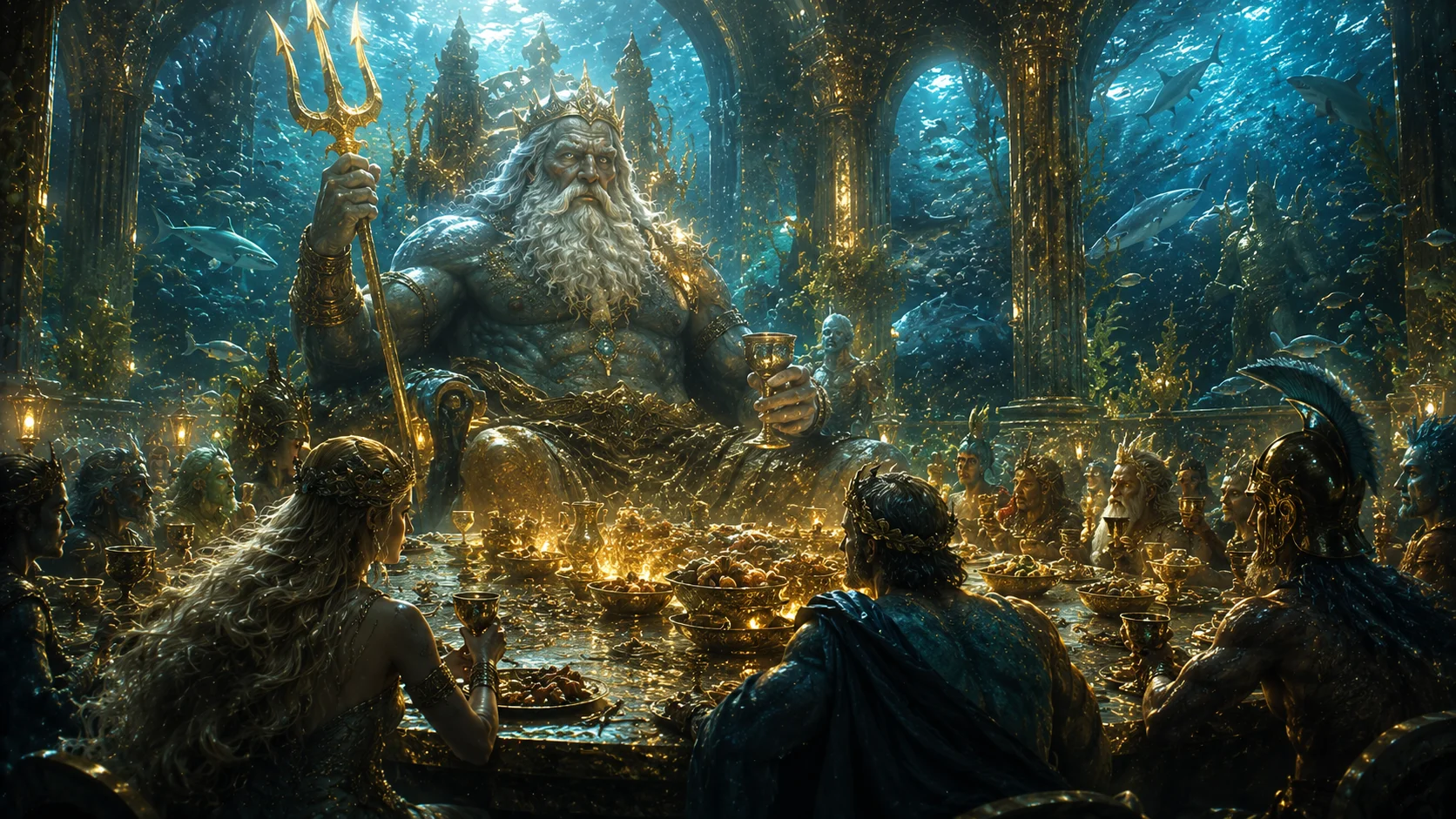
Aegir (Old Norse Ægir, a name connected to the sea and to awe) was the ruler of the ocean — a being usually reckoned among the giants (jötnar) yet on friendly terms with the gods, the personification of the sea in its calm bounty and its deadly might. With his wife Ran, who drew drowning men down into the deep with her net, he ruled the waters; and the two of them had nine daughters, the billow-maidens, who personified the waves of the sea. Aegir dwelt in a magnificent hall on the sea-floor, lit not by fire but by gleaming gold that shone like firelight across the feast.
The Brewer of the Gods
Aegir was famous above all as the great host and brewer of the gods. In his undersea hall he held splendid feasts for the Aesir, where the ale flowed freely — brewed in an enormous cauldron that the gods had to obtain especially for the purpose. The tale of Thor and Tyr's journey to the giant Hymir to fetch a cauldron a mile deep was undertaken precisely so that Aegir could brew ale enough for all the gods at once. His feasts were occasions of great fellowship — and, in one famous case, of great strife, for it was at Aegir's feast that Loki burst in and heaped vicious mockery upon every god and goddess present (the Lokasenna, “Loki's flyting”), in one of the most memorable scenes in Norse literature.
The Two Faces of the Deep
Aegir embodied the double nature of the sea as the Norse seafarers knew it. On the one hand he was the generous host, the lord of golden halls and flowing ale, the sea as a place of bounty and fellowship. On the other, he and his net-wielding wife Ran were the powers that claimed the drowned: to be “taken by Ran” or to “feast in Aegir's hall” were ways of speaking of death by drowning. The same sea that bore the ships and gave the feast could, in an instant, swallow them down — and Aegir was the lord of both faces.
The Ale-Lord Beneath the Waves
Aegir endures as the great personification of the sea in Norse myth — the giant ale-brewer in his gold-lit hall, host to the gods, lord of the waves, and one of the powers that claimed the drowned. He embodies the Norse seafarer's awe before the ocean: a vast and powerful being, splendid and generous when it pleased, terrible and devouring when it did not, in whose deep hall the gods themselves came to feast.
In a hall on the sea-floor lit by glowing gold, the lord of the ocean brewed ale for the gods — the same deep that, on a darker day, would draw their ships and sailors down forever.
The Name Is the Thing Itself
Old Norse did not need a god in order to say ægir. The word means the sea — plainly, in ordinary verse, the way a modern poet might write the deep. Its Old English relative survives in the compound égor-stréam, “ocean-stream”, so the root is older than Iceland and older than the Eddas that preserve him. This is the first thing worth understanding about Ægir: he is not a deity who acquired the sea as a portfolio. He is the sea, given a face, a wife, a household and a temper. When a skald said the word, the listener heard both at once.
There is a second sense hovering nearby. The verb œgja means to frighten or to make terrible, and the same syllable stands at the head of ægishjálmr, the “helm of awe” that the dragon Fáfnir boasts of wearing in Fáfnismál to freeze men where they stand. Whether the sea-word and the terror-word are truly one root is not settled, and this article will not pretend otherwise. But the ambiguity is exactly the kind a seafaring language would keep. To the crew of an open boat in the Norwegian Sea, awe and water were not separate categories.
He Had Another Name, and an Island
Ægir is also called Hlér, and Hlér has an address. Snorri places him on Hlésey — “Hlér's island” — which is the low, sand-fringed island of Læsø in the Kattegat, between Denmark and Sweden, still on the map today and still bearing the name. This is a rare and grounding detail. Most Norse divine geography floats free of the world; you cannot sail to Asgard. But you can take a ferry to the sea-giant's island, walk its salt meadows, and stand where medieval Scandinavians thought the lord of the ocean kept house.
A third name causes trouble. The prose introduction to Lokasenna says flatly that Ægir is also called Gymir — but elsewhere Gymir is the giant father of Gerðr, the radiant maiden whom Freyr sees from Odin's high seat in Skírnismál and cannot live without. Either two giants share a name, or a single figure has been split by transmission, or a later hand tidied two traditions into one. The honest answer is that the texts disagree with each other, and no amount of confident retelling will make them stop. What the disagreement does show is that what we call “Norse mythology” is not one tradition but several, written down centuries after belief and not always reconciled before they reached the page.
The Daughters Have Names, and Each One Is a Wave
The nine billow-maidens are not a vague chorus. The Norse listed them, and the list reads like a sailor's taxonomy of what water does to a hull. Himinglæva is the one you can see the sky through — the glassy swell. Dúfa is the pitching wave, the dip that drops the bow. Blóðughadda is bloody-haired, the red-crested surf. Hefring is the lifter. Uðr and Hrönn and Bylgja are wave, welling wave and billow. Dröfn (called Bára in some lists) is the foam-fleck. Kólga is the cold one.
Read them together and you get something more interesting than nine names: you get the sea broken into its behaviours by people who had to read those behaviours to survive. And several of them are not mythological words at all once you step outside the list — unnr, hrönn, bylgja and bára are simply the ordinary Norse nouns for a wave. The mythology and the vocabulary are the same material. To name the nine is to name what the water does; it is myth doing the job of a weather report.
An old temptation is to identify these nine with the nine mothers of Heimdallr, who is said to have been born of nine women at the edge of the earth — a birth from the sea's rim, which fits beautifully. But Hyndluljóð gives that second nine its own names, and they are giantess-names, not wave-names. The two lists do not match. It is a knot, and a genuine one; it deserves to be shown rather than smoothed over.
Gold Is Called Ægir's Fire
The detail that his hall was lit by glowing gold instead of fire is not decoration. It is the origin of a whole branch of poetic language. Because gold lay burning on the floor of the sea-lord's hall, skalds could call gold Ægir's fire, or the fire of the sea, or the flame of the waters — and a listener trained in the art heard the myth compress into two words. That is how the kenning system worked: not as ornament but as a shared memory palace, where knowing the story was the price of understanding the poem.
The same machinery ran in the other direction. Skaldic verse names the sea by naming its household: the ocean is the land of Rán and of Ægir's daughters, the waves are those daughters themselves, and the drowned are Rán's guests. A Norse poet did not describe the sea. He named its owner and let the audience do the rest. Losing that reflex is one reason skaldic verse reads as obscure today — the words survived, but the household they referred to did not.
Two Servants, a Sanctuary, and the Ale That Poured Itself
Ægir's feast had staff. His servants were Fimafengr, whose name suggests brisk and handy service, and Eldir, whose name belongs to fire and cooking. The ale in that hall carried itself round the benches — no cup-bearer needed, the drink simply came — and the hall was declared a place of peace, a sanctuary where no violence could be offered.
Which is precisely why the opening of Lokasenna is so shocking. The gods praise Ægir's servants for serving well, Loki cannot bear to hear another creature complimented, and he kills Fimafengr on the spot. The Æsir shake their shields, shout him out into the woods, and return to their drinking. It is Eldir, the second servant, who meets Loki at the door when he comes slinking back and warns him what the gods inside are saying. The entire flyting — the most savage exchange of insults in Norse literature — happens because a guest murdered a waiter under a truce. Ægir's hall matters to that scene not as scenery but as law: the outrage is measured against the safety the host had guaranteed.
The Host Who Tried to Get Out of It
It is worth saying plainly that Ægir did not volunteer. In Hymiskviða the gods want a feast, and Thor essentially stares the sea-giant into hosting one. Ægir's response is the oldest excuse in hospitality: he has no vessel large enough to brew for that many. It is a refusal dressed as a practical difficulty — and the gods call the bluff, because Týr knows where such a cauldron is, and off they go to take it.
That framing changes the flavour of the whole cycle. The famous journey to Hymir is not a heroic errand undertaken for a generous friend; it is the Æsir refusing to accept no from a power that would rather be left alone. And it fits the sea. The ocean does not want visitors. It is compelled to carry them.
The Giant Who Listens
There is a quieter role Ægir plays that is easy to miss, and it may be his most consequential. In Skáldskaparmál the sea-giant travels to the gods rather than the other way round, sits at their feast, and asks about the origins of poetry and the meanings of the poets' strange words. Bragi, the god of poetry, answers him — and those answers are the body of the text. Ægir is the reason the myths get explained at all.
He is, in other words, the reader's stand-in: the outsider at the table, curious, well-mannered, asking the question the audience wants asked. Medieval Icelandic prose made the ocean into a student of poetry, and it is hard to think of a stranger or more charming piece of literary casting. The deep that swallows ships wants to know why gold is called fire.
Rán's Net and the Coin in the Pocket
The net is worth pausing on, because its specificity is what makes it frightening. Rán does not raise storms or smash hulls; she fishes. She draws down what passes overhead, which recasts every voyage as a passage across the roof of someone's trap. Her name is simply the Old Norse word for plunder — she takes what is not hers — and the drowned were spoken of as going to her, guests in a hall they would not be leaving. Eyrbyggja saga pushes the idea to its limit: a drowned crew walks into its own funeral ale, and the mourners read it as a good omen, because Rán had evidently received them well.
Out of this grew a piece of practical superstition preserved in the legendary sagas. Men caught in a killing storm divided gold among the crew so that nobody arrived in Rán's hall empty-handed; in Friðþjófs saga the hero cuts up his gold arm-ring and shares out the pieces for exactly that reason. It is a small, unbearably human detail. Facing certain death, the concern is not salvation but manners — not turning up at a great household as a pauper. It tells you how thoroughly the Norse imagination had domesticated the sea: not an abyss, but a host with standards.
A Power Nobody Seems to Have Worshipped
Here is an absence worth stating rather than glossing. Njörðr, the god of harbours and sea-wealth, is written across the Scandinavian landscape — his name is buried in farm-names and sanctuary-names from Norway to Sweden, the fingerprints of real cult. Ægir leaves almost nothing of that kind. No temple, no securely attested festival, no body of place-names announcing a shrine.
What that suggests is a division of labour in the Norse religious imagination that we should not flatten. You made offerings to the powers you could bargain with — for catch, for wind, for safe harbour. Ægir and Rán were not in the bargaining business. They were the conditions themselves: the fact of the ocean, the fact of drowning. You do not build a temple to the fact of drowning. You give it a name, a hall, a wife and nine daughters, so that when it takes your son you have somewhere to send your grief.
Egill's Quarrel With the Sea
That is not an abstraction. The Icelandic poet Egill Skallagrímsson lost his son Böðvarr to drowning, and the poem he made of it, Sonatorrek — “the hard loss of sons” — is among the rawest things in medieval European literature. In it Egill turns on the sea directly. He calls Ægir the ale-smith and he names Rán, and he says that if he could carry a feud against them as he would against any man, he would go against the sea-god and the wave-woman himself. He knows he cannot. The poem's power lies in a father with the fiercest reputation in Iceland discovering the one enemy he is not permitted to kill.
Whatever Ægir was in theology, this is what he was for. Mythology gave a bereaved man an address to shout at. The alternative — that the water is simply water and the death simply happened — is a modern comfort, and it was not on offer.
What Survived
The name never really went out of use. In Icelandic, ægir still means the ocean, and the Icelandic Coast Guard has patrolled the North Atlantic in a vessel named Ægir, alongside ships named Óðinn and Þór — the old sea-lord conscripted into rescuing sailors from himself. Læsø still carries Hlér's name, worn down by a thousand years of Danish into something a ferry timetable can print.
And the shape of the idea outlived the belief. A sea that hosts and a sea that kills, personified as one being with a good table and a net — that is not primitive thinking. It is an unusually clear-eyed description of what the North Atlantic actually is to the people who work it. The gods feast in his hall because the sea feeds them. The drowned feast there too, because it takes them. Ægir's real achievement in Norse myth is that he never has to choose between those two roles. Neither does the ocean.
Sources & traditions
- EncyclopediaWikipedia — Ægir
- TraditionNorse texts, inscriptions and later retellings (Scandinavia)
Myths change from area to area and from time to time. This chronicle follows the most widely told versions; tellings in other villages, regions and eras may differ.