Ran was the Norse goddess of the sea's dark and deadly side — the wife of Aegir, who roamed the waters with a great net to catch drowning sailors and draw them down to her hall beneath the waves. She was the deep's hunger personified, the goddess who claimed those the ocean took, and the Norse seafarer's dread of the cold, drowning sea.
The Goddess of the Drowned
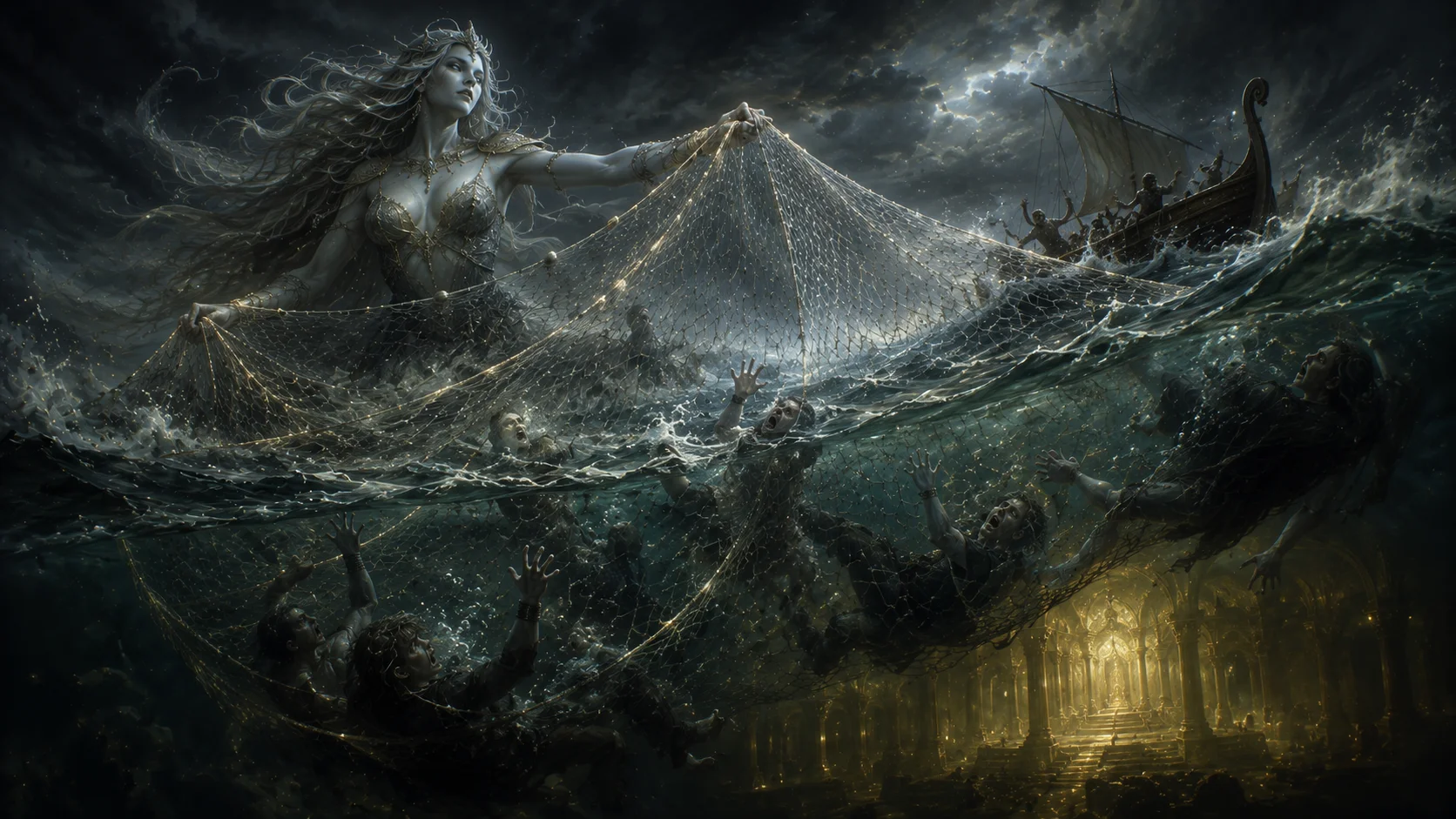
Ran (Old Norse Rán, a name connected to robbery or seizing) was the personification of the sea's deadly power and the wife of Aegir, the lord of the ocean. Together they ruled the deep, and they were the parents of nine daughters, the billow-maidens, who were the waves themselves. But where Aegir was the generous host of golden feasts, Ran was the darker power: the one who took the drowned. Her great possession was a net, with which she swept the waters and caught hold of seafarers who fell into the sea, dragging them down into her domain.
The Net and the Hall Beneath the Waves
To be “taken by Ran” was the Norse way of speaking of death by drowning. Those who perished at sea were said to go to Ran's hall beneath the waves — and it was thought a comfort, of sorts, that the drowned were received and given a place there, rather than simply lost. There was even a custom that a drowned person whose ghost appeared at their own funeral feast had been well received by Ran, a sign that the goddess had welcomed them into her deep halls. Seafarers were sometimes advised to carry gold with them on voyages, so that if they drowned they would come to Ran with a gift in hand and be received favourably — for Ran was said to love gold, and her hall, like Aegir's, was lit by it.
The Dark Face of the Sea
Ran completed, with Aegir, the Norse vision of the sea as a being of two faces. Aegir was the sea as host and provider, the golden hall and the flowing ale; Ran was the sea as taker and devourer, the net in the dark water, the cold deep that swallows ships and never gives them back. The Norse, a seafaring people who knew the ocean's dangers intimately, gave that danger a face and a name: the goddess with the net, waiting to gather the drowning down. She was not evil so much as inevitable — the personification of the simple, terrible fact that the sea takes those who sail it.
The Gatherer of the Sea-Dead
Ran endures as the Norse goddess of the drowned and the deadly deep — the net-wielding queen of the sea-dead, the dark counterpart to her ale-brewing husband. She embodies the seafarer's clear-eyed knowledge of the ocean's peril and the Norse habit of facing death by giving it a form: the cold goddess who waits beneath the waves with her net, gathering those the sea claims into her gold-lit hall below.
When a sailor fell into the cold sea and did not rise, the Norse said simply that Ran had cast her net — and drawn another guest down to her hall beneath the waves.
The Poet Who Cursed the Sea
One of the earliest mentions of Rán by name is not a myth at all but a father's grief. Around 960 CE the Icelandic warrior-poet Egill Skallagrímsson lost his son Böðvarr, drowned when a boat went down in a sudden storm, and answered the loss with Sonatorrek — “the irreparable loss of sons” — a lament preserved inside Egils saga and one of the rawest personal poems to survive from the Viking Age. In it Egill names Rán outright. She has dealt harshly with him, he says; she has stripped him of someone he loved. A later verse goes further: if only he could kill them, he would take the fight to Aegir and Rán themselves. That single conditional carries the whole weight of the poem. Egill had spent a lifetime answering injury with an axe, and here at last was an injury no axe could reach. Two and a half centuries before Snorri Sturluson arranged the myths into orderly prose, a grieving man reached for Rán's name as the most natural way to describe what had happened to his son — which tells us she was not a scholar's tidy invention, but a name real people used when the sea took someone.
The Nine Billow-Maidens
Snorri's Skáldskaparmál gives Rán and Aegir nine daughters, and the roll-call is nearly a poem in itself: Himinglæva (“that through which one can see the heavens”, for water clear enough to look through), Dúfa (“the pitching one”), Blóðughadda (“bloody-haired”, for red sea foam), Hefring (“riser”), Uðr (“frothing wave”), Hrönn (“welling wave”), Bylgja (“billow”), Kólga (“cool wave”) and Bára (“breaker”). Snorri sets the sisters down twice, and the second time Dröfn, “foam-fleck”, stands where Bára stood before — a small sign that these were living words for moving water long before they were fixed as names. Skalds treated them as ready-made poetic currency, so a verse about a storm at sea was, quite literally, a verse about Rán's daughters running wild. To a Norse audience the waves were never simply water, and rough weather was a family matter.
The Net That Cursed a Hoard
Rán's net appears in one myth far larger than her own story. Travelling with Odin and Hœnir, Loki killed an otter with a stone — and the otter turned out to be Otr, the shapeshifting son of Hreidmar, a man deep in magic. The weregild demanded was ruinous: gold enough to stuff the otter's skin and then bury it from sight. To raise it, Loki went to Rán and borrowed her net, then carried it to the falls where the dwarf Andvari lived in the shape of a pike. He caught the dwarf, stripped him of his entire hoard, and refused him the one ring he begged to keep — so Andvari cursed it where he stood. That ring, Andvaranaut, and the gold heaped around it became Fáfnir's treasure, the hoard at the centre of the Völsunga saga and the doom that finally destroys the hero Sigurd. Reading the saga a thousand years later, it is easy to miss that the whole chain of ruin begins with a borrowed piece of fishing tackle.
Rán in the Language of Poets
Skaldic verse ran on kennings — compressed, riddling substitutions for ordinary nouns — and Rán supplied several of the standard ones. The sea could be called Ránar land, “Rán's land”, or Ránar vegr, “Rán's way”; it could equally be her bed, Ránar beðr. Gold fell within her orbit too. Because glowing gold was said to light Aegir's hall in place of fire, skalds could call the metal the fire or the light of Aegir, of Rán, or of their daughters — and from there the habit spread to naming gold the fire of the sea itself. No poet had to explain any of this. Her name could be dropped into half a line as shorthand for the ocean's danger or its hidden wealth, much as a modern writer can invoke Poseidon without a footnote, and that casual fluency says more about how firmly she sat in the Norse imagination than any single myth could.
The Hand That Let Go of Helgi's Fleet
For a goddess so thoroughly worked into the vocabulary, Rán is named remarkably seldom in the Poetic Edda. One of the few appearances comes in Helgakviða Hundingsbana I, where Helgi's ships are caught in a storm and the valkyrie Sigrún comes from above to shield them: the fleet twists free of Rán's hand and makes for Gnipalund. She is given no speech and no scene of her own — she is simply the grip the ships escape, the moment the sea closes on a hull and does not quite hold it. That half-stanza says a great deal about how she worked in the Norse mind: less a figure to be met than a condition to be survived, named at the exact instant a crew feels the water take hold. Between Egill's lament, this rescue, a net lent to Loki and a scatter of kennings, everything that survives of Rán would fit on a single page — and it has been enough to keep her name fastened to the sea for a thousand years.
Sources & traditions
- EncyclopediaWikipedia — Rán
- TraditionNorse texts, inscriptions and later retellings (Scandinavia)
Myths change from area to area and from time to time. This chronicle follows the most widely told versions; tellings in other villages, regions and eras may differ.