Bragi was the Norse god of poetry, eloquence and the skaldic art — the divine bard of Asgard, wisest in words and most eloquent of all the gods, whose tongue was carved with runes and who welcomed the honoured dead to the halls of the gods with song. The husband of Idun, keeper of the apples of youth, he is the patron of the poets whose verses kept the deeds of gods and heroes alive.
The Bard of the Gods
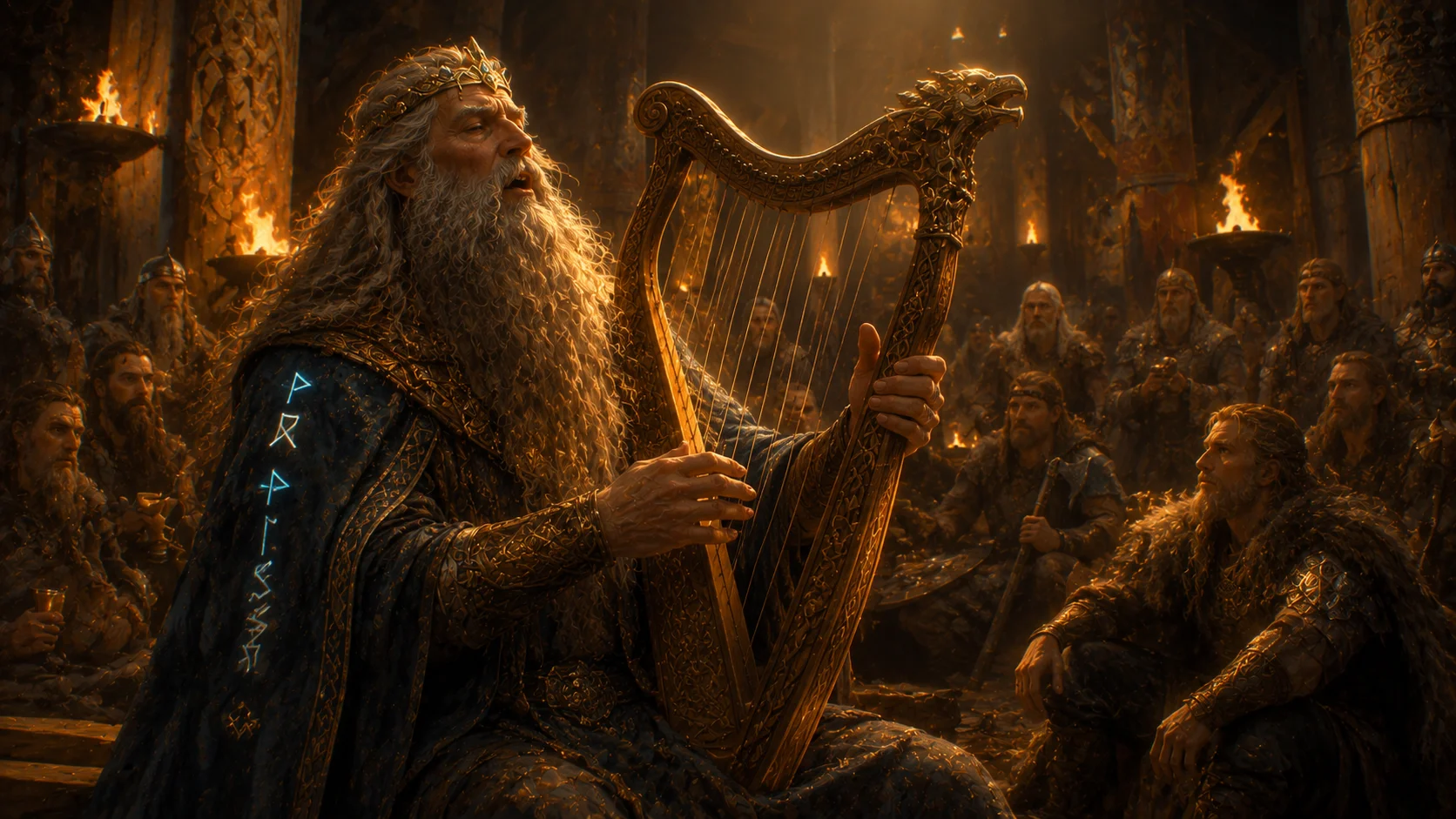
Bragi (Old Norse Bragi; the word bragr means “poetry” and “the best”) was the god of poetry and skilled speech, renowned for his wisdom and above all for his mastery of words and the music of verse. He was said to have runes carved upon his tongue, the very source of his eloquence, and he was the finest of all in the making of poetry — the divine model of the skald, the Norse court-poet whose art was prized above almost all others in a culture that loved a well-turned verse and the immortality that poetry confers. He was a son of Odin (himself the winner of the Mead of Poetry) and the husband of the goddess Idun.
The Welcomer of the Dead
One of Bragi's roles was to greet those who came to the halls of the gods — in particular, he welcomed the slain heroes who arrived at Valhalla, receiving them with honour and song. To be received by the god of poetry was a mark of glory, and it fit the deep Norse belief that a hero's truest reward was to have his deeds remembered in verse. Bragi, who turned great deeds into immortal song, was a fitting host for warriors who had died seeking exactly that: a name that would live in poetry forever.
The Bragarfull and the Vows
Bragi's name was linked to one of the most solemn customs of the Norse feast: the bragarfull, the “cup of Bragi” (or “the chieftain's cup”), a ceremonial toast over which warriors swore great vows and made boasts of the mighty deeds they would perform. To drink the cup of Bragi and swear upon it was to bind oneself to a sacred promise. Whether the cup was named for the god or the god for the cup, the link bound Bragi to the heart of the warrior feast, where words — vows, boasts, poems — carried the weight of honour and fate.
The Patron of the Poets
Bragi endures as the divine patron of poetry and eloquence — the god of the skalds, the carver of runes upon the tongue, the singer who turns deeds into deathless verse. He embodies the immense value the Norse placed upon poetry: not as mere entertainment, but as the very means by which glory was won and memory preserved, the art that lets a hero outlive his death. His name survives in the word brag, the boast of one who has something worth singing of.
The Norse hero died for a name that would live in verse — and at the door of the gods' hall stood Bragi, runes upon his tongue, ready to sing him into memory.
The God Who Does Nothing
Every other god in Asgard is known by an act. Thor swings the hammer; Odin hangs nine nights on the wind-swept tree; Tyr feeds his hand to the wolf; Baldr dies and the world begins to end. Bragi does none of it. He kills nothing, steals nothing, loses no eye and no hand, fathers no famous child, and is not named among the dead at Ragnarök. In the whole surviving body of Norse literature there is not one myth in which Bragi is the protagonist. What he has instead of a deed is a verb: he speaks.
That is not a gap in the record so much as the shape of the god. Snorri's Gylfaginning introduces him in a single breath — renowned for wisdom, and most of all for fluency of speech and skill with words — and then immediately turns from the person to the vocabulary: poetry is called bragr after him, and any man or woman of uncommon eloquence can be called a bragr-person. The god is defined by the noun, and the noun is defined by the god, and the circle closes without a story ever getting in.
The Eddic catalogue that names him does the same thing in one line. Grímnismál runs through a list of bests — Yggdrasil the best of trees, Sleipnir of horses, Bifröst of bridges, Odin of the Æsir — and slots Bragi in as the best of skalds. Not the best of gods. He is measured against human poets, and he wins, which is a strange compliment to pay a deity and a revealing one. Whether the line even means the god, or simply means the human poet of that name, is one of the things nobody has been able to settle — an ambiguity that will keep returning.
Bragi the Old, and the Question Underneath
There was also a man called Bragi. Bragi Boddason, known as inn gamli, “the Old”, was a Norwegian court poet of the ninth century, and the earliest skald whose verse survives in any quantity. His Ragnarsdrápa is a shield-poem: a composition describing the scenes painted on a decorated shield given to him by a patron named Ragnarr, whom later tradition identified with Ragnarr Loðbrók. The shield showed four pictures, and the poem walks around them — Hamðir and Sörli storming the hall of Jörmunrekkr; Thor hauling the Midgard Serpent up on his line; the everlasting battle of Heðinn and Högni, fought and refought each night over Hildr; and the goddess Gefjun ploughing the island of Zealand out of the body of Sweden. It is the oldest window we have into how a Viking-Age poet actually handled myth, and it is dense, allusive, and utterly confident that its audience already knows the stories.
So which came first — the god or the poet? The question has been argued since the nineteenth century. The majority position holds that the god is the poet raised to divinity: a historical master of the craft, remembered so completely that he drifted upward into Asgard. The alternative is quieter — that bragr was an ordinary Norse word carrying both “poetry” and “the foremost, the best” (it may be related to Old English brego, “chief”), so that a man could be named Bragi the way a man could be named Best, and a personified abstraction could carry the same name without either borrowing from the other.
The medieval sources are no help, because they do not keep the two apart. Snorri cites Bragi the Old as a poetic authority in the very book in which the god Bragi sits at a table and talks. It is one of the few places in Norse mythology where you can watch a god and a man wearing the same name at the same moment, and no one in the thirteenth century appears to have found it awkward.
Beside Ægir at the Table
Bragi's one indispensable appearance is not a myth but a frame. Skáldskaparmál, the long central treatise of Snorri's Edda, opens with the sea-giant Ægir arriving in Asgard as a guest. When evening comes and the drinking begins, Odin has swords carried into the hall, so bright that the light comes off the blades, and no other lamp is used the whole night. Twelve gods take the high seats. Ægir is placed beside Bragi, and Bragi begins to talk.
What follows is the myth of the Mead of Poetry, told in Bragi's voice: Kvasir, formed from the mingled spittle of two divine races and wiser than any being alive, murdered by two dwarfs who drain his blood and brew it with honey; the mead passing to the giant Suttungr, hidden inside the mountain Hnitbjörg under the guard of his daughter Gunnlöð; and Odin boring his way through the rock in the shape of a snake, drinking the three vessels dry in three swallows, and escaping in eagle-shape with the whole art of poetry inside him. A portion escapes him on the flight out, and that spillage, Snorri says, is the share that falls to bad poets — the tradition's private joke about where doggerel comes from.
From that one story descends an entire technical vocabulary. Poetry, in skaldic verse, can be called Kvasir's blood, the dwarfs' drink, Suttungr's mead, the liquid of Óðrerir, the ship of the dwarfs, Odin's cargo, Odin's find, Odin's gift. Every one of those phrases is a compressed reference to the tale Bragi tells Ægir over dinner. And because the treatise never leaves its frame, the effect is that the working handbook of Norse poetics — the kennings, the heiti, the rules of the art — is presented as one long stretch of Bragi's conversation. He may have no myth. He is, in the fiction of the text, the source of all the others.
Loki at the Door
A different feast, and this time Ægir is the host in his own hall. The light there is not fire but glowing gold, set out to shine like flame — which is why, ever after, gold can be called Ægir's fire. The ale pours itself, a truce holds over the benches, and Bragi is about to tell a guest he cannot come in.
Lokasenna is the poem in which Loki walks into a feast of the gods and insults every deity present until Thor drives him out. The first god to speak against him is Bragi, who declares flatly that the Æsir will never pick out a seat and a place for Loki at their table. Loki does not argue with the poet; he goes over his head, reminding Odin of an old oath sworn between them in the early days, when they mixed blood together and Odin undertook never to taste ale unless it was brought to them both. Odin — who does not break oaths, even bad ones — orders a place made. Bragi has been overruled in front of the whole company before the flyting has properly begun.
He then does the most characteristic thing he could do: he tries to buy peace with treasure. He offers Loki a horse and a sword from his own goods, and a ring on top of them, if Loki will stop slandering the gods. Loki's answer is that Bragi will always be short of both horse and rings, and the insult sharpens from there. He calls him bekkskrautuðr — bench-ornament, an epithet close enough to a word for a bride to carry a charge of unmanliness with it — and says that of all the Æsir and elves in the room he is the most cautious when it comes to fighting and the most easily startled by a shot: bold enough seated, useless standing. Bragi's reply, that if they were outside the hall he would be carrying Loki's head in his hands, is exactly the reply that proves the charge. Then Idun intervenes, begging her husband, for the sake of their children and all their kin, not to answer Loki with words of blame in Ægir's hall — whereupon Loki turns on her instead, accusing her of having laid her arms about her own brother's killer, an allusion to a story that has not survived, one of the small dark doors in the Eddic poems that opens onto nothing.
It is worth seeing what has just happened in craft terms. A senna or flyting is a formal contest of insult verse, a duel fought with metre and wit, and this one takes place in the god of poetry's own element. He loses it. He is out-spoken, out-timed, and after his wife's plea for peace he does not speak again for the rest of the poem — not one memorable line in the whole exchange. The Norse took verbal injury seriously enough to legislate against it: Icelandic law treated defamatory verse as an offence a man could be outlawed for. That is precisely why the scene stings. Loki is not merely being rude. He is demonstrating, in the presence of the specialist, that words are a weapon and that owning the art is not the same as being able to use it.
Runes upon the Tongue
The detail everyone remembers about Bragi — that runes were carved on his tongue — comes from a stranger context than his own worship. In Sigrdrífumál, a valkyrie wakes on a mountain and instructs Sigurd in the lore of runes, and part of that instruction is a list of the surfaces on which runes were cut before they were scraped off and scattered into the world. The list is deliberately unlike a list of objects: the bear's paw, the wolf's claws, the eagle's beak, Sleipnir's teeth, the straps of a sledge, the end of a bridge — and Bragi's tongue.
Every item is the working part of the thing named. The claw is where the wolf's wolfishness lives; the beak is where the eagle acts. To carve runes on Bragi's tongue is to inscribe the alphabet onto the organ of poetry itself, which is a far more physical idea than “god of eloquence” suggests. Whether the poem means the god or simply means “a poet” — bragi as a common noun — is genuinely uncertain, and the ambiguity is the same one that runs through everything about him. Either way the image survived the doubt, because it is the right image: a craft so exacting that it reads as something cut into flesh.
The Poems Written for Dead Kings
Two tenth-century poems put Bragi inside Odin's hall some two and a half centuries before Snorri wrote him down, which matters, because it shows the association is not a thirteenth-century invention.
Eiríksmál was composed in memory of Eiríkr Blóðøx, at the commission of his widow Gunnhildr. It opens inside Valhalla with Odin unsettled by a dream of clearing the hall for a great arrival — benches strewn, drinking-vessels rinsed, valkyries carrying wine as though a prince were coming. A din rises, as though a great host were on the move, and it is Bragi who speaks the guess: the benches are creaking as if Baldr were coming home. Odin rebukes him — wise Bragi should know better than to talk foolishly — and names the true guest. In Hákonarmál, Eyvindr skáldaspillir's memorial for Hákon the Good, it is Hermóðr and Bragi whom Odin sends out to meet the arriving king, and the poem's great unease is that Hákon, who had been raised a Christian, does not trust the look of Odin's temper and keeps his war-gear about him.
Both poems were paid for. They are funeral commissions, written by professionals for a grieving household, and in both the poet builds a scene at the threshold of the afterlife and stations the god of poetry there to receive his patron. It is not difficult to see the arrangement for what it also is. The greeting the dead king actually received was the poem itself; the man doing the welcoming was the skald, holding the door open with verse.
A God With No Temple
Here is the fact that makes Bragi genuinely unusual among the Æsir. There is no evidence that anyone ever worshipped him.
Scandinavian place-names are thick with gods. Odense in Denmark is Odin's sanctuary; Frösö in Sweden is Freyr's island; Ullevi is Ullr's holy place; Thor and Njörðr are scattered across farm and parish names from Jutland to the Uppland plain, and those names are the residue of real cult — places where people gathered, sacrificed, and swore. Bragi leaves none. No temple, no idol, no known sacrifice, no dedication to him on a runestone. The nearest thing to a trace is the bragarfull, the cup sworn over at the feast — and even that name may come from bragr in its other sense, the foremost, which would make it the chieftain's cup rather than the god's. Place-name survival is uneven and absence of evidence is not proof of absence of belief, but the silence around Bragi is loud compared with the noise around his neighbours, and it is one of the strongest cards in the hand of those who read him as a literary figure rather than an object of cult.
Which may simply mean his worship took a form that leaves no soil marks. The practice of skaldic poetry was the observance: composed for a lord, performed in his hall, paid for in arm-rings and reputation, and governed by rules as unforgiving as any liturgy. You do not need a temple for an art that has to be performed correctly in public or not at all.
How to Recognise Him
Snorri's instructions for referring to Bragi in verse are brisk: call him the husband of Idun, the first maker of poetry, or síðskeggi, the long-bearded god — and, he adds, it is from that epithet that a man with an impressive beard can be called a beard-Bragi. That is close to the whole of his medieval iconography. No surviving Viking-Age carving, bracteate or picture-stone is securely identified as Bragi, and no medieval source puts an instrument in his hands at all. The harp he is so often shown holding arrives only in the nineteenth century, handed to him by Scandinavian Romantic painters — it is Nils Blommér's canvas of Bragi and Idun that fixed the image — who needed the god of poetry to be recognisable at a glance and reached for the object a bard is supposed to hold.
Why a Culture Needed a God of Words
Norse court poetry is a memory machine, and its engineering is visible in its constraints. Dróttkvætt, the court metre, demands a fixed syllable count, a fixed pattern of alliteration binding each pair of lines, and internal rhymes falling in prescribed positions — a set of rules so tight that a single wrong word collapses the stanza and makes the error obvious to everyone in the room. That is not decoration. A verse that rigid is extremely difficult to compose and extremely difficult to corrupt, which is exactly what you want from a device whose job is to carry a man's name intact across generations.
And carrying the name was the whole point. The one consolation Hávamál offers against death is that while livestock die and kinsmen die and you die yourself, orðstírr — the fame carried in words — never dies for the man who earns a good one; what endures of him is the dómr, the judgement passed on him once he is gone. In a culture whose writing was runic and monumental, a name cut on a stone and little more, that judgement lived in one place only: in the memory of people who had learned a poem. The skald was therefore not an entertainer but the operator of the only immortality on offer, and the man who paid him was buying the single thing that outlasts a body.
Set against that, a god with no myth stops looking like an oversight. Bragi is what the anxiety looks like when it is given a face. He is the guarantee that the mechanism works — that somewhere the art itself is divine, that the words are not merely one man's opinion of another but something with a god behind them. The Norse feared oblivion more than they feared dying, and they built a deity out of the only tool they had against it. He never had to do anything. Being there was the job.
Sources & traditions
- EncyclopediaWikipedia — Bragi
- TraditionNorse texts, inscriptions and later retellings (Scandinavia)
Myths change from area to area and from time to time. This chronicle follows the most widely told versions; tellings in other villages, regions and eras may differ.