Thiazi was a powerful Norse giant who took eagle form — the jötunn who abducted the goddess Idun and her apples of immortality, bringing the gods to the edge of decay, and the father of the giantess Skadi. His theft of the goddess of youth and his fiery death are among the most consequential of the giant-tales, and his eyes were set in the sky as stars.
A Giant's Wealth and Blood
Thiazi was born of the giant Ölvaldi (also rendered Alvaldi), a figure remembered in the old skaldic sources chiefly for the gold he left behind. Thiazi had two brothers, Idi and Gangr, and when Ölvaldi died the three of them divided their father's hoard of gold between them, each taking an equal share by mouthfuls. This division became so well known among the skalds that gold itself came to be spoken of in kennings as "Thiazi's, Idi's, or Gangr's payment" — a portion measured out from a dead giant's fortune. Long after the tales of Thiazi's deeds had been told and retold, this linguistic trace endured in skaldic poetry, gold called by his name and his brothers' names, a giant's inheritance folded permanently into the vocabulary of Norse verse. The mother of Thiazi's own daughter, Skadi, is never named in the sources that survive; she vanishes from the record entirely, leaving only father and daughter as the acknowledged kin.
Last updated .
The Eagle-Cloak
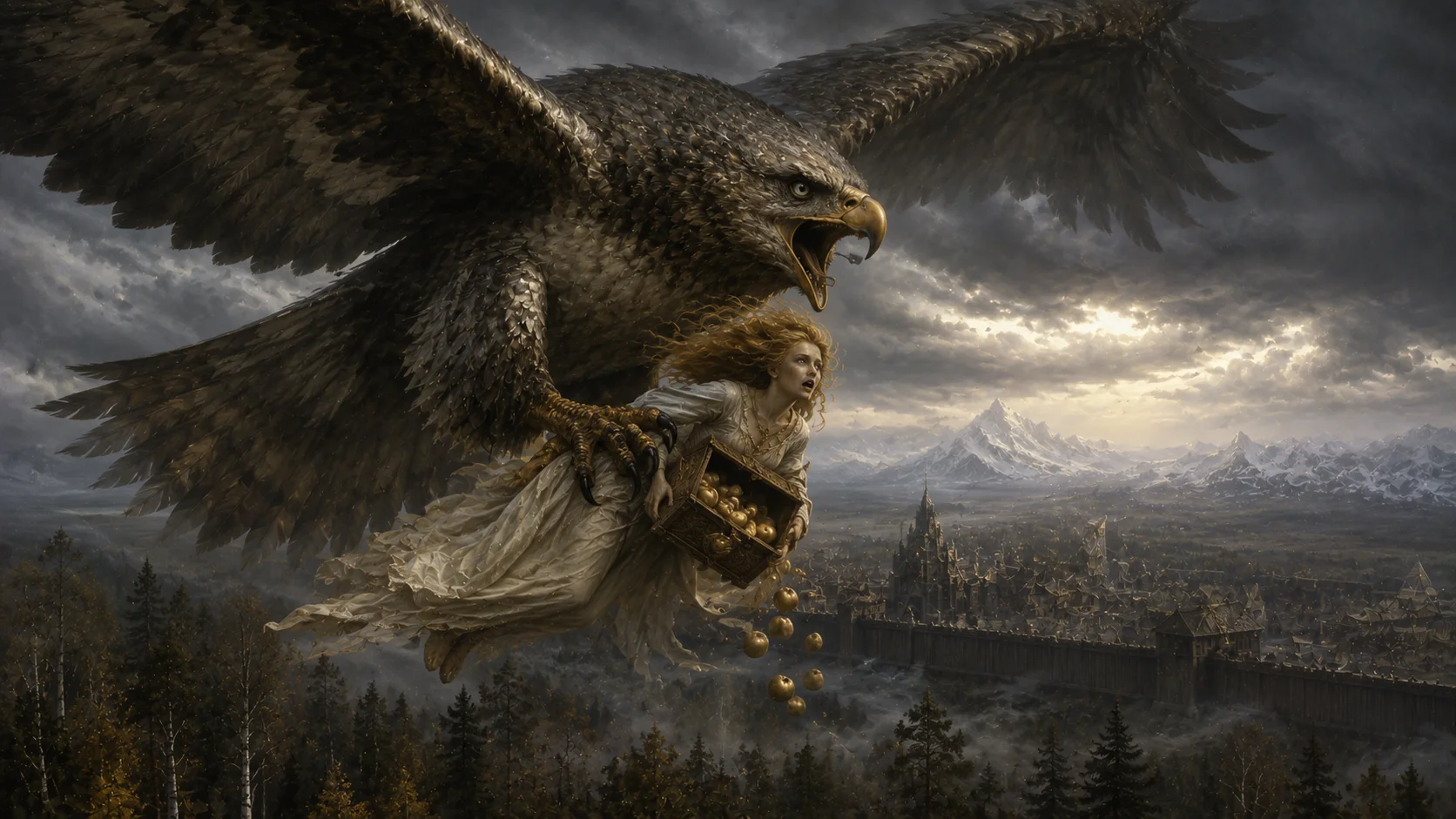
Among his kind, Thiazi was marked out by a particular power: he could take on the shape of a giant eagle, vast enough to seize a grown man in his talons and bear him off through the sky. This was not mere disguise but a true transformation, attested in the skaldic poem Haustlöng and reworked in prose in Skáldskaparmál, and it was in this form that Thiazi committed the deed for which he is best remembered. He made his home at Þrymheimr — "thunder-home," a name later remembered in Grímnismál as sitting high in the mountains, wild and exposed to storm. It was a fitting seat for a giant who moved through the sky as easily as other beings moved across the ground, and it would later pass to his daughter as her own dwelling, the one piece of her father's world that Skadi kept for herself.
Three Travelers and an Unwilling Feast
The tale that made Thiazi's name begins far from his mountain hall. Loki, Odin, and Hoenir were traveling together through a hard and hungry country when they came upon a herd of oxen and slaughtered one for their meal. They built a fire and set the meat to cook, but however long they waited, the meat would not cook — it stayed as raw as when it was first set upon the coals. Above them in a tree sat a great eagle, watching. The eagle spoke, and said that it was his doing that the meat would not cook, and that he would let it cook freely if he were given his fill from the ox in return. The travelers, unable to explain the enchantment any other way and eager to eat, agreed.
An Unfair Portion
The eagle — Thiazi in his transformed shape — flew down and helped himself, but he took far more than any reasonable share: the greater part of the ox's flesh and all four legs. Loki, hungry and furious at watching the meal disappear into the eagle's beak, snatched up a pole and struck at the bird with all his strength. The blow did not free the meat and did not drive the eagle off. Instead the pole stuck fast — one end lodged in the eagle's body, the other end fixed to Loki's own hands, so that striker and struck were bound together by the very weapon meant to separate them. Thiazi took to the air at once, and Loki went with him, unable to let go, dragged and battered against rocks and trees and the broken ground below as the giant flew low and vicious over the land. Loki's arms felt as if they would be torn from their sockets, and it was only when he begged for release, offering whatever ransom the giant demanded, that Thiazi agreed to set him down — but only on condition that Loki lure Idun and her apples out of Asgard and deliver her into Thiazi's power.
The Bargain Loki Could Not Refuse
Loki swore the oath the giant demanded, for there was no other way to be free of him, and Thiazi released his grip and let the battered god fall back to solid ground. Loki returned to Asgard nursing his injuries and his secret, and in time he found Idun and told her he had discovered, somewhere beyond the walls, apples that seemed to him just as good as her own — and urged her to bring her apples with her to compare them for herself. Idun, trusting the trick, followed Loki out of Asgard's protection and into the forest beyond. There Thiazi was waiting, once more in his eagle shape, and he swept down upon her without warning, seized her and her basket of apples together, and bore her away through the air to his hall at Þrymheimr, leaving Loki to walk back through the gates alone, his part of the bargain fulfilled.
The Gods Grow Old
The apples Idun kept were no ordinary fruit — they were what preserved the gods in their youth and vigor, and with Idun gone, the supply of them vanished from Asgard entirely. The effect was neither slow nor gentle. Grey hairs crept in, strength failed, skin wrinkled, and the whole company of gods began to age visibly and rapidly, the way any mortal body ages when nothing holds it back. It did not take long for the Æsir to notice, to search for Idun and find her missing, and to work out that Loki had been the last seen in her company before she disappeared. Confronted, and with his own life plainly on the line, Loki admitted what he had done and what it had cost.
A Debt Repaid by Trickery
Loki was given no choice but to undo what he had caused, and he agreed to fly to Þrymheimr and bring Idun back, on pain of death should he fail. He borrowed the goddess Freya's falcon-cloak, the garment that let its wearer take a bird's shape and travel the sky as Thiazi himself could, and flew north to the giant's hall. There he found Idun, and worked a transformation of his own: he turned her into the shape of a nut, small and easily carried, closed her within his claws, and took to the air again, flying hard for Asgard with his prize held safe against him.
The Chase Across the Sky
Thiazi discovered that Idun was gone and understood at once what had happened. He took eagle form and gave chase, flying after the falcon with a speed and fury that closed the distance fast — the two birds streaking across the sky, one desperate to reach safety and one desperate not to let his stolen prize slip free a second time. The gods, watching from the walls of Asgard, saw Loki-as-falcon nearing home with the giant eagle closing behind him, and understood exactly what was at stake if Thiazi caught him before he crossed the wall.
Fire at the Gate
The Æsir acted at once. They gathered wood shavings and kindling and built them high along the wall of Asgard, and as Loki, still bearing Idun in her transformed shape, flew low over the fortification and in through the gate, the gods set the pile alight behind him. Loki cleared the flames safely, but Thiazi, coming on too fast and too close behind to check his flight, could not pull away in time. The fire caught his feathers and his wings blazed up around him, and the great eagle that had carried off a goddess and aged the gods toward death lost the sky entirely, falling to the ground within the walls of Asgard itself. There, inside the gate he had chased his enemy through, the waiting Æsir killed him. The eagle-giant's end came by the same element that had made him so fearsome in flight — not strength overcoming him, but fire, and a trap sprung at exactly the moment his fury had made him careless.
A Daughter Comes for Reckoning
Thiazi's death did not end the matter. Word reached his daughter Skadi of what had befallen her father, and she armed herself for war and came to Asgard alone, seeking vengeance or, failing that, compensation for what the gods had taken from her. Rather than meet her as an enemy, the Æsir chose to settle with her. They offered her the right to choose a husband from among the gods themselves — but with a condition attached: she would see nothing of them but their feet, and must choose by that alone. Skadi, hoping by the beauty of the feet she saw to have chosen Baldr, picked instead the sea-god Njord. The gods further promised to make her laugh, something she had sworn could not be done in her grief and anger, and it was Loki — the very god whose trickery had set the whole chain of events in motion — who finally succeeded, by tying a rope between himself and a goat in a display so absurd that Skadi could not keep from laughing despite herself.
Eyes Cast Among the Stars
One further act completed the settlement, and it belonged to Odin alone. He took Thiazi's eyes and cast them up into the heavens, where they became two stars fixed in the sky. It was at once a further payment offered to Skadi for her father's death and a mark of respect paid to a slain enemy — an acknowledgment, however small, that the giant who had stolen a goddess and aged the gods toward ruin had also been formidable enough, and significant enough, to be remembered in the sky itself rather than simply erased. Even a jötunn who stood against the order of the gods was given that much.
What the Skalds Kept of Him
Thiazi's presence in the surviving sources is concentrated almost entirely in Skáldskaparmál, drawing on the older skaldic poem Haustlöng by Þjóðólfr of Hvinir, which treated the Idun episode as one of its central subjects — proof that this was already a well-known and often-retold tale among the skalds long before the Prose Edda set it down in the form now read. Beyond the narrative itself, his name lived on in the specialized vocabulary of skaldic poetry, where gold could be called by his name, or his brothers', as a reference back to the division of Ölvaldi's hoard. A poet invoking "Thiazi's payment" to mean gold was relying on an audience that already knew the whole story — the theft, the chase, the fire, and the stars — condensed into a single kenning.
The Giant Remembered in the Sky
Thiazi endures as one of the most consequential of the Norse giants — not through prolonged conflict or repeated appearances, but through a single episode with outsized consequences: a trick that nearly cost the gods their youth entirely, a fall from the sky that ended in fire at the gates of Asgard, and an aftermath that gave the Æsir a new god by marriage and a permanent reminder overhead. He is remembered as hostile and deceptive, as jötnar consistently are in conflict with the gods' order, catching Loki at his most vulnerable and turning that leverage into the abduction of Idun herself. Yet the gesture of his eyes cast into the stars complicates any simple reading of him as merely an obstacle to be destroyed and forgotten. In modern retellings of Norse mythology, Thiazi persists chiefly within the linked stories of Idun's abduction and Skadi's arrival in Asgard, and his name still surfaces wherever the technique of skaldic kenning-making is discussed — a giant whose wealth, whose daughter, and whose eyes each left their own separate mark on the tradition after his body had already fallen and burned.
He stole the goddess of youth and nearly let the gods wither into age — and when he burned to death chasing her back, his eyes were flung into the sky to shine forever as stars.