Idun was the Norse goddess of eternal youth — keeper of the apples that kept the gods themselves from aging. Her corpus in the surviving sources is narrow, almost startlingly so for a figure on whom the continued vitality of the Aesir depended, but what remains of her story is central to Norse cosmology: without her, even the gods grow old and grey.
The Rejuvenating One
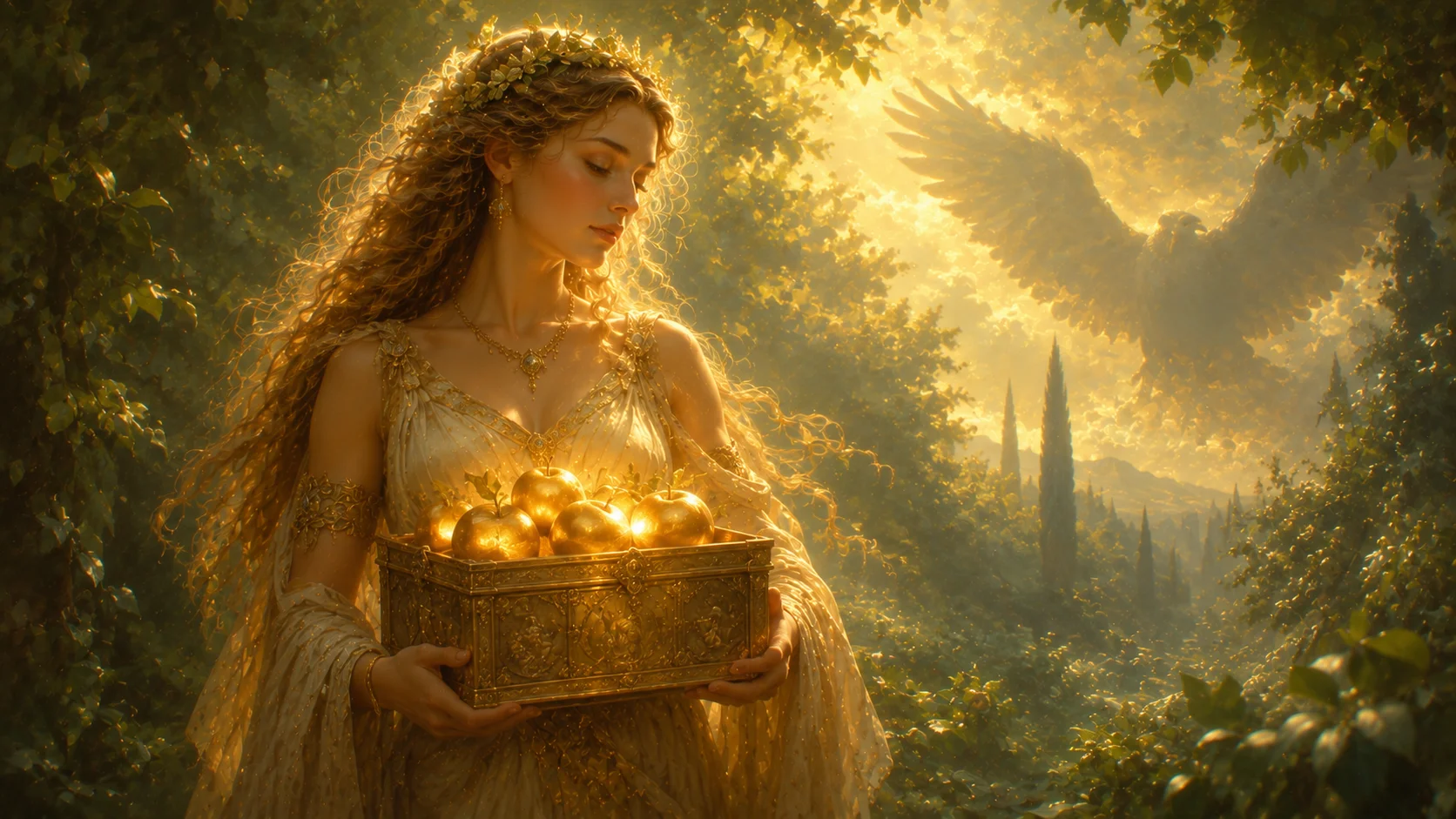
Idun (Old Norse Iðunn) appears in Snorri Sturluson's Gylfaginning and Skáldskaparmál as an Aesir goddess whose charge was a casket of apples — epli — that the gods tasted as they began to age. Snorri is explicit that the effect was immediate: the gods grew old, ate the apples, and their youth was restored on the spot. This makes Idun's role cosmologically load-bearing rather than ornamental. She was not simply associated with youth in some poetic or symbolic sense; the apples were the literal mechanism by which the Aesir avoided the fate of every other living thing, and Idun's careful tending of them was what stood between the gods and decrepitude.
No surviving source gives Idun's parentage. Unlike many of the other goddesses of the Norse pantheon, whose fathers or family lines are at least noted in passing, her origin is entirely unattested. She is likewise given no children in any surviving text. She arrives in the mythology, in effect, already in the role that defines her — keeper of the apples — with no genealogy attached.
Wife of the God of Poetry
Idun's marriage to Bragi, the god of poetry, is attested in both Skáldskaparmál and in the Poetic Edda poem Lokasenna. In the latter, she appears as Bragi's wife and defends him directly when Loki turns his tongue on him during the flyting at Aegir's hall — one of the few moments in the surviving corpus where Idun speaks or acts in her own right, rather than being spoken of.
It is in this same poem that Loki levels a strange accusation at her: that she has embraced her brother's slayer. No other surviving source explains who this brother was, or who his slayer might be. Scholars treat the line as a fragment of some other tradition now lost, not as a securely attested fact about Idun's life, and nothing in the rest of the corpus supplies the missing context. It stands as one of Norse mythology's small, permanent obscurities — a single sentence pointing at a story no one alive can finish.
An Eagle's Bargain
Idun's central myth survives because the tenth-century skald Þjóðólfr of Hvinir composed a poem called Haustlöng about it, which Snorri drew on directly in Skáldskaparmál. Its villain is the giant Thiazi, and its unwilling instrument is Loki. Thiazi, in eagle form, seizes Loki during his travels and will not release him until Loki swears to deliver Idun and her apples out of Asgard. Bound by the oath, Loki returns home and finds a pretext to lure her out through the gates and into a forest beyond the walls — the details of the ruse are Snorri's, built around apples Idun is told she must see to compare against her own. The moment she steps outside Asgard's protection, Thiazi swoops down in his eagle shape, seizes her, and carries her off to his home in the giants' land, Þrymheimr.
The Grey Sickness of the Gods
What follows is one of the starkest images anywhere in Norse myth. With Idun gone, the Aesir have no apples left to eat, and the effect is not slow decline but visible, alarming aging — the gods who had thought themselves beyond time begin to grey and stiffen like any mortal growing old. Snorri's account treats this as proof, if any were needed, of exactly how literal the apples' power was: remove the keeper, and the immortality she maintained stops functioning immediately. The gods do not have some reserve of youth to draw on. Their vitality was never a possession; it was upkeep, and upkeep had just been interrupted.
It does not take the Aesir long to work out what happened. Loki's absence at the crucial hour and his known dealings are enough to put suspicion on him, and the gods — visibly aging by the day — corner him and give him no room to maneuver: he is to bring Idun back, or die for what he has done.
Borrowed Wings
Loki's rescue is the myth's most famous sequence. He borrows Freya's fjaðrhamr, the falcon-cloak that lets its wearer take a bird's shape, and flies to Thiazi's hall in Þrymheimr. He finds Idun there and transforms her into a nut, small enough to be carried in his talons, before turning at once for Asgard. It is a rescue built entirely on speed: once Loki has her in hand, the only question left is whether he can outfly what comes after him.
The Chase Across the Sky
Thiazi returns to find Idun gone and gives chase in eagle form, and the pursuit becomes a race between two birds streaking toward Asgard's walls — Loki the falcon with his small, nut-shaped cargo, Thiazi the eagle closing the distance behind him. The Aesir, watching for Loki's return, see the chase coming and prepare accordingly: as Loki clears the wall, they kindle a great fire behind him, timed to catch the pursuing eagle. Thiazi, moving too fast to check his flight, cannot avoid it. His wings catch fire, he falls inside the walls of Asgard, and the waiting gods kill him there. Idun, restored to her own shape, gives the Aesir back their apples, and the aging that had begun to take hold reverses.
What Thiazi's Death Set in Motion
Idun's abduction is not a self-contained episode; it is the hinge on which a second, larger story turns. Thiazi's death at the gates of Asgard does not end the matter for the giants' side of the myth — it brings his daughter Skadi to Asgard, armed and demanding compensation for her father's killing, a confrontation that is eventually settled with her marriage to the god Njord. The chain is direct and causal: without Loki's theft of Idun, there is no pursuit; without the pursuit, no dead giant at the wall; without the dead giant, no aggrieved daughter arriving at Asgard's gates. Idun's myth, brief as her own part in it is, is the opening move of a much longer chapter of Norse mythology that plays out after she herself has gone back to quietly keeping her apples.
A Narrow but Essential Presence
Outside Lokasenna and the Haustlöng-derived material preserved in Skáldskaparmál, Idun barely appears in the major mythological poems. She is absent from Völuspá, the great seeress's survey of the cosmos from creation to Ragnarök, and from most of the other poems that name the Aesir's activities and possessions. Her attested corpus is, in effect, two stories: the abduction, and one sharp exchange in a hall full of insults. That narrowness has not diminished her importance within the mythology — if anything it sharpens it, since so much of the gods' condition rests on a figure who is barely described doing anything else.
A Keeper Read Alongside Other Renewals
Modern scholarship has sometimes discussed Idun alongside other goddesses connected to fertility or the turning of the seasons, given how naturally the apple and the promise of renewed youth suggest that kind of reading. It is worth being clear that this is an interpretive comparison rather than anything the primary sources state outright — Snorri and the Eddic poets never call Idun a fertility goddess or connect her apples to seasonal cycles in so many words. The comparison exists because the symbolism invites it, not because the medieval sources make the claim themselves.
The Apple as Afterlife
Idun's later life has been almost entirely as a symbol rather than a character. The keeper of the apples of immortality — often anglicized as Idunn or Iduna — became a natural figure for later fiction, for Germanic revivalist opera in the Wagnerian orbit, and for fantasy media drawn to the archetype of a goddess who holds age itself at bay. It is a fitting kind of afterlife for a figure whose one attested function was renewal: the apples that kept the Aesir young have, in their own way, kept Idun's name alive far longer than her narrow appearance in the actual medieval sources would suggest.
The Quiet Center of the Gods' Survival
Strip away the drama of eagles and burning wings and what remains is a simple, severe piece of Norse cosmology: the gods are not naturally immortal. They are immortal because someone tends to it, apple by apple, and that upkeep can be stolen in an afternoon. Idun herself is barely characterized beyond her devotion to Bragi and her stewardship of the casket, and yet the entire pantheon's continuity runs through her hands. When she was taken, the gods did not merely lose a companion — they began, visibly and immediately, to die. That is the measure of how essential this quietly drawn figure was to everything else in the Norse mythological world.
When the keeper of the golden apples was stolen away, the immortal gods themselves began to grey and wither — for even eternity, the Norse knew, must be renewed.
Sources & traditions
- EncyclopediaWikipedia — Iðunn
- TraditionNorse texts, inscriptions and later retellings (Scandinavia)
Myths change from area to area and from time to time. This chronicle follows the most widely told versions; tellings in other villages, regions and eras may differ.