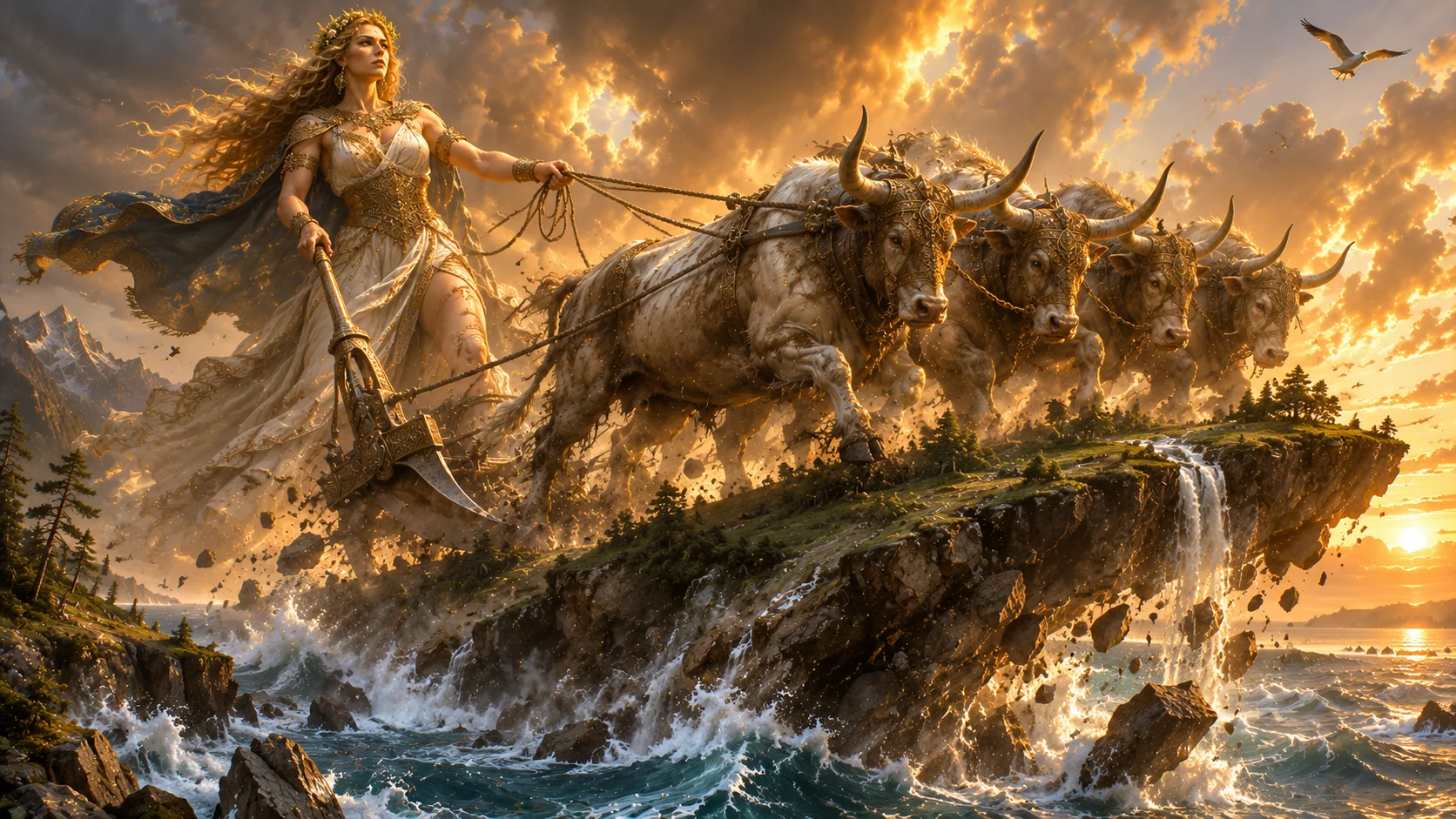
Gefjon was the Norse goddess of ploughing, agriculture, abundance and unmarried women — a powerful deity associated with foreknowledge and fertility, famous above all for the myth in which she ploughed the island of Zealand out of the land of Sweden using four oxen who were her own giant-born sons. A goddess of plenty and of the virgin maidens, she shaped the very map of the north with her plough.
The Goddess of the Plough
Gefjon (Old Norse Gefjun, “the giver”) was a goddess of agriculture, the plough, abundance and prosperity, and a giver of good things to those she favoured. She was counted among the Aesir and was, like Frigg, said to know the fates of all — for it was told that she knew the future as well as Odin himself. She was especially associated with virgins and unmarried women, and it was believed that those who died unwed went to serve in Gefjon's hall — making her a patroness of maidens as well as a goddess of the fertile, ploughed earth.
The Ploughing of Zealand
Gefjon's great myth tells how she created the Danish island of Zealand. The Swedish king Gylfi, pleased with her, promised Gefjon as much land as she could plough in a single day and night. Gefjon went to the land of the giants and there, by a giant, bore four sons; these she transformed into four mighty oxen, yoked them to an enormous plough, and set them to work. So deep and strong did the plough bite that it tore an entire vast section of land loose from Sweden; Gefjon and her ox-sons dragged it out into the sea, where it became the island of Zealand (on which Copenhagen now stands), and the great hollow left behind in Sweden filled with water to become a lake (Mälaren or Vänern). Thus the goddess of the plough reshaped the geography of Scandinavia in a single night with her four divine oxen.
The Giver of Plenty
Gefjon's name marks her as “the giver,” and giving was her nature — the bestowing of fertility, good harvests, prosperity and abundance upon the land and the people. As a goddess of the ploughed and cultivated earth, she stood for the wealth that comes from working the soil, the bounty drawn up from the ground by the plough. Her great myth is itself a story of giving and making: from her own body she bore the oxen, and with them she gave Denmark its very land, dragging an island up out of the sea.
The Shaper of the Land
Gefjon endures as the Norse goddess of agriculture, abundance and the plough — the giver of plenty, the patroness of maidens, the knower of fates, and the goddess who literally ploughed an island into being. She embodies the Norse reverence for the cultivated earth and its bounty, and the marvelous idea that the very landscape of the north — its islands and its lakes — was shaped by the labour of a goddess and her four ox-sons in a single mighty night of ploughing.
Given all the land she could plough in a day and a night, she turned her four sons into oxen and tore a whole island loose from Sweden — and so the goddess of the plough shaped the map of the north.
The Oldest Voice: Four Heads and Eight Brow-Moons
The Gefjon story is older than the book that made it famous. Long before Snorri Sturluson set it down in thirteenth-century Iceland, a ninth-century Norwegian poet had already put the ploughing into verse — and that poet, Bragi Boddason, called inn gamli, “the old”, is the earliest skald from whom any verse survives at all. Snorri quotes him at the very opening of Gylfaginning, and names him as he does it. The stanza is a strange, hard, glittering thing: Gefjon draws away from Gylfi, glad as she goes, the thing the verse calls Danmarkar auka — “Denmark’s increase” — and steam rises off the running beasts as they haul. Those beasts, it says, bore four heads and eight brow-moons. Ennitungl, “forehead-moons”, is the skaldic way of saying eyes, and the effect of counting them is deeply odd. The oxen are not described as four animals. They are given as an arithmetic: a mass of horn and eye and steam dragging a country out of the ground.
Almost nothing survives around that stanza. Bragi’s chief surviving work, Ragnarsdrápa, is a shield-poem — a description of scenes worked on a decorated shield he had been given — and older editors slotted the Gefjon verse into it as one of those scenes. Modern editors are more cautious and print it unattached, as a fragment, because the link cannot be proved. What is certain is smaller and still remarkable: nearly four hundred years before the Prose Edda, a poet expected an audience to recognise this story from four lines about steam and eyes.
Odin’s Envoy: The Second, Colder Version
Snorri tells the story twice, and the two tellings do not quite agree. In Gylfaginning she is a wandering woman who entertains King Gylfi and is paid in land. In Ynglinga saga, the opening book of Heimskringla, the same event is retold as political history with the magic filed down: Odin, established in the north, sends Gefjon across the sound to look for territory. She is not a beggar rewarded for a good story. She is an agent of a colonising power, dispatched to acquire ground.
That version keeps going where the famous one stops. Having dragged her island west out to sea, over against Óðinsey — Odense — Gefjon settles on it, marries Skjöldr, a son of Odin, and the two of them take their seat at Hleiðra, the Lejre of eastern Zealand. Lejre is not a random name. It is the legendary royal capital of the Danes, the hall-site of the Skjöldung dynasty whose kings shadow the poem Beowulf. So the myth is doing something more ambitious than explaining an island. It is installing a goddess at the root of the Danish royal line, and quietly asserting that the ground those kings ruled from was taken out of Sweden.
The Lake That Matches the Island
Snorri finishes the tale with a detail that is easy to skim past. The hollow torn in Sweden filled with water and became Lögrinn — the lake now called Mälaren, not Vänern — and, he says, the bays of that lake lie as the headlands lie in Zealand. The island fits its own scar.
This is aetiology at its most confident: a landscape read as evidence, a coastline offered as proof of a story. It is also not true — the two outlines do not correspond, and no amount of squinting at a map will make them — but that misses what the claim is for. Norse myth is full of geography explained by violence: mountains from a giant’s bones, the sky from his skull. Gefjon’s furrow belongs to that habit of mind, in which the land is not neutral scenery but the visible residue of something enormous that happened before anybody was there to see it.
A Trick Before the Tricking
There is a joke buried in where Snorri puts the story. He opens Gylfaginning — “the tricking of Gylfi” — with Gylfi being tricked by Gefjon, and the rest of the book follows that same king to Asgard, where he arrives disguised as an old man under the name Gangleri to learn how the Æsir came by such power, and is comprehensively deceived a second time. The whole compendium of Norse mythology, as most modern readers first meet it, is framed by a man who has already been outwitted once by a goddess with a plough and has not learned from it.
The Exact Wording of the Grant
The bargain is usually remembered loosely, as all the land she could plough in a day and a night. Snorri’s wording in Gylfaginning is tighter and far more interesting: Gylfi gave her one plough-land in his kingdom, as much as four oxen could plough up in a day and a night. The four is in the contract. Gefjon does not simply exceed the terms — she goes to Jötunheimar, bears four sons to a giant, and turns them into precisely the number of animals the king had specified. She satisfies the letter of the grant, with monsters.
Land measured by what someone can encircle or plough between one sunrise and the next is among the most widespread legal-legendary motifs there is, and it nearly always ends the same way: the clever party takes far more than the giver intended. Dido, promised as much ground as an oxhide would cover, has the hide cut into a single hair-thin thread and rings a citadel with it. The plough carries a legal weight of its own — Roman writers described the city’s sacred boundary as traced by its founder driving a bronze ploughshare, the animals yoked so that the turned earth fell inward. To plough a line was to make a border, not merely to mark one. Gefjon takes that idea to its logical extreme. She does not draw a boundary around land; she draws one under it, and takes the land away with her. It is a story about the terrifying literalism of a badly worded contract, told by a culture that took oaths and their exact wording very seriously indeed.
The Maiden Who Bore Four Sons
In his catalogue of the goddesses, Snorri gives Gefjon a single flat line: she is a maiden, and those women who die unwed attend her. It is one of the very few statements in Norse literature that assigns a particular class of the dead to a particular deity — and Snorri elaborates on it not at all. No hall is named, no place described, and nothing else in the surviving sources fills the gap. It also sits, without any apparent embarrassment, a few pages from the story in which she bears four sons to a giant.
The tradition itself seems to have felt the friction. In Lokasenna, the poem in which Loki works his way round the hall insulting every god in turn, the charge he throws at Gefjon is sexual: a fair boy gave her a jewel, and she laid her thigh across him. Odin cuts him off — and the defence he chooses is not a denial. He says instead that Gefjon knows the fates of all as fully as he does himself. That is an extraordinary thing for Odin to concede about anyone, and it is where her reputation for foreknowledge comes from. Whatever the accusation was worth, the answer to it was that she sees what he sees.
The Name, and the Givers
Her name is transparent in a way few divine names are. Gefjun is built on the ordinary verb “to give”: she is the Giver, and the name is a job description. The same root sits inside Gefn, which Snorri lists among the alternative names of Freyja — one reason the two are so persistently hard to keep apart, along with Freyja’s famous necklace and the jewel Loki throws in Gefjon’s face.
The root travels further and earlier than Scandinavia. In the Roman Rhineland, altars were raised to groups of mother-goddesses called the Matronae Gabiae, the giving ones — at Cologne and at half a dozen sites around it — and at Bürgel to the Alagabiae, the all-giving. They were set up by Germanic-speaking communities under Roman rule, roughly a thousand years before anyone wrote down Gylfaginning. Nothing links a Rhineland altar to an Icelandic manuscript directly, and no one should pretend otherwise. But the habit of addressing a female power simply as she who gives is demonstrably old, demonstrably Germanic, and demonstrably wider than one island in the Baltic.
Worship Without a Trace
Here is the honest difficulty with Gefjon. Thor, Odin, Freyr and Ull left their names scattered across Scandinavian farms, fields and headlands; centuries after conversion you can still read the old cult off a road atlas. Gefjon left almost nothing. No securely identified sanctuary, no festival described, no chain of place-names to follow.
What survives instead is a single fossil of ordinary speech. In Völsa þáttr, a short tale preserved only in the fourteenth-century Flateyjarbók, a farmer’s daughter swears an oath by Gefjon and the other gods — a formula, the kind of phrase people use without thinking about it. That is often how a genuinely familiar deity shows up in the record: not in the architecture, but in the reflexes of the language. The caution worth keeping is that the tale is a late Christian-era composition deliberately reaching for pagan colour, so the oath may be antiquarian rather than remembered.
She can at least be set beside something much older. Tacitus, writing at the end of the first century, describes a Germanic goddess he calls Nerthus, Mother Earth, carried in procession through the countryside in a wagon drawn by cows, bringing peace and plenty wherever she is received. That is not a line of descent — a Roman ethnographer and an Icelandic Christian are separated by more than a thousand years and no visible chain — but it does show that a female power over fertile ground, moved across the land by cattle, was not something the thirteenth century had to invent.
Gefion in Copenhagen
The myth’s most visible afterlife is not in a book. Near the Kastellet on Copenhagen’s harbour front stands the Gefion Fountain: the goddess braced above her team, whip raised, four vast oxen with their heads down and the water bursting past them. Its figures were modelled by Anders Bundgaard between 1897 and 1899, the basins finished nearly a decade later, and the fountain was first set flowing in July 1908 — a gift to the city from the Carlsberg Foundation, marking the brewery’s fiftieth anniversary. It is a national self-portrait as much as a mythological one: Denmark depicting its own foundation as an act of enormous, straining, slightly outrageous labour, performed by a woman who had been offered a smaller reward. Danish warships have carried the name since the nineteenth century, and Danes still spell her Gefion where Icelanders write Gefjun.
Why the Furrow Still Holds
Gefjon answers a question people genuinely used to ask: where did this ground come from, and by what right is it ours? Every field in the Norse world had been cut out of forest or bog by somebody’s back and somebody’s oxen, and the plough was the instrument by which wilderness became property. The myth enlarges that ordinary, exhausting experience until it reaches the horizon — one night, one team, one island — and it keeps the ambivalence intact. The land is not given to her. She takes it, from a king who thought he was being generous, using sons she had made into animals for the purpose. Denmark’s founding goddess is a bargainer, a shapechanger and a woman who out-thought a king — which is, in the end, a far more Norse thing to be than merely a giver of plenty.
Sources & traditions
- EncyclopediaWikipedia — Gefjon
- TraditionNorse texts, inscriptions and later retellings (Scandinavia)
Myths change from area to area and from time to time. This chronicle follows the most widely told versions; tellings in other villages, regions and eras may differ.