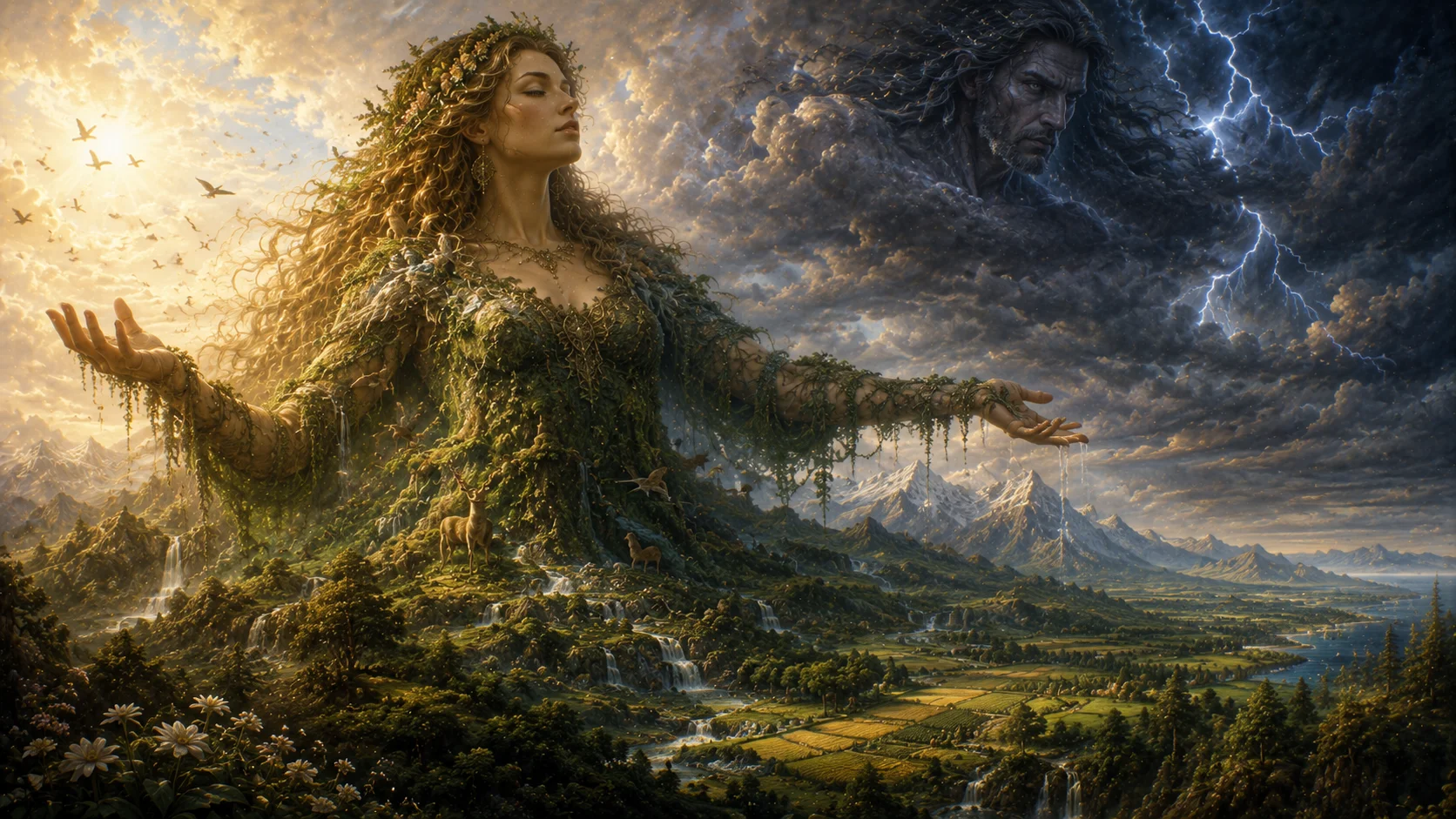
Jord was the Norse goddess and personification of the Earth — the primal, giant-born mother who, by Odin, bore the mighty thunder-god Thor. Less a goddess of stories than a fundamental power of the world, she is the earth itself given divine form: the mother-ground from which all life springs and to which the thunder-god owes his deepest strength.
Earth Given a Name
Jord (Old Norse Jörð, simply "earth") was the personification of the earth, attested in the Prose Edda — in both the Gylfaginning and the Skáldskaparmál — and in the surviving skaldic poetry that drew on her name. She was not a goddess who acted so much as a goddess who was: the soil, the ground, the fertile body of the world, standing among the oldest and most elemental figures in the Norse divine order. Where other gods and goddesses have deeds attached to their names, Jord has almost none — because she is not a character moving through the world but the very ground the world's characters move upon.
Daughter of the Night
The Prose Edda's genealogies place Jord within the family of Nótt, the personification of Night. Nótt is said to have married more than once, and her children by different husbands belong to different strands of that genealogy. By her second husband, named Annar (also given as Ónarr), Nótt bore Jord — making Jord a granddaughter of Night through this particular line. This is a distinct lineage from that of Dagr, the personification of Day, who is also Nótt's child but by a different husband, Dellingr. Jord and Dagr therefore share a mother in Nótt without sharing a father, a detail the sources preserve carefully even as they compress most of Jord's own story into a single genealogical fact: she was born of Night, and she was the earth.
Counted Among the Giant-Kind
Despite bearing a child to Odin himself, Jord is generally classified among the jötnar — the giants — in the Prose Edda's systematic account of the world's beings. This placement is not a contradiction so much as a reflection of how the Norse cosmology organized its oldest powers: the primal forces of earth, night, and the elemental world tended to be reckoned as giant-born, even when their offspring stood among the greatest of the gods. Jord's giant lineage sits alongside her role as mother to one of Asgard's mightiest defenders, and the sources make no attempt to smooth over or explain this pairing — it is simply stated as fact, the way her genealogy is stated as fact.
Chosen by the All-Father
Jord is named among the mistresses and wives of Odin, and by him she became the mother of Thor — a union recorded plainly in both the Gylfaginning and the Skáldskaparmál. No courtship, no meeting, no words exchanged between them survive in the sources; the union exists in the texts only as the fact that produces Thor. This spareness is characteristic of how Jord appears throughout the Norse corpus — she is present at the edges of the myths that matter, named at the moment she becomes someone's mother, and then the narrative moves on to her son.
The Mother Behind the Kennings
Jord's clearest presence in the surviving literature is not in narrative at all but in the language poets built around Thor's name. The Skáldskaparmál catalogues kennings for Thor that identify him through his mother — "son of Jörð" chief among them, alongside "son of Fjörgyn." In this context Fjörgyn is treated as another name for Jörð, another way of naming the earth that bore the thunder-god. Scholars have long noted that the identity and even the gender of Fjörgyn is not fully settled — in some readings Fjörgyn appears as a figure distinct from Jörð, possibly male — and the sources themselves do not resolve the question. What the kennings preserve, regardless of that uncertainty, is a single poetic habit: naming Thor by reference to the earth that mothered him, generation after generation of skalds reaching for "earth's son" as a way of grounding the sky-battling god in the soil beneath him.
One Mother, Several Names
Jord is not the only name attached to Thor's mother in the wider Norse corpus. The Völuspá names Hlóðyn in that role, and scholars treat Jörð, Fjörgyn, and Hlóðyn as likely referring to the same underlying figure — the earth conceived as mother — under different names drawn from different poetic traditions rather than as three separate goddesses with three separate stories. The sources do not fully agree with one another on this point, and no single surviving text reconciles the three names into one tidy account. What emerges instead is a picture of a mother-figure known to Norse tradition primarily through her son and referred to by whichever name a given poem or source preferred, all pointing toward the same idea: earth as mother, mother as earth.
Rooted in the Ground
Jord's significance to the wider mythology rests almost entirely on her motherhood. By Odin, the All-Father, she bore Thor, the mightiest of the gods and the tireless defender of both gods and mortals — so that the thunder-god was, by his very parentage, the offspring of sky and earth together. Thor's dominion over storm, rain, and thunder, the weather that makes the crops grow and the fields bear fruit, sits naturally beside a mother who is the ground those crops grow in. The sources never spell out this symbolism directly, but the pairing of sky-father and earth-mother, and the storm-god born between them, echoes a pattern found across many mythologies, here given its own Norse names and its own genealogy running back through Nótt.
A Goddess Without Adventures
Unlike gods who travel, fight, trick, or suffer across the sagas, Jord has no independent narrative episodes attributed to her anywhere in the surviving corpus. She does not appear as an active participant in any myth of her own; she exists in the texts as a genealogical fact and as the wellspring of Thor's kennings, nothing more. This absence is worth noting on its own terms rather than as an oversight — the Norse sources preserved a great deal about the gods who did things, and comparatively little about the primal forces, like earth and night, that simply were. Jord belongs to that second category: essential to the cosmology, present at its foundation, but never given a story of her own to inhabit.
Named in the Language of Poets
Beyond the kennings for Thor, skaldic poetry used "Jörð" and its synonyms more broadly as poetic terms for the earth itself — a habit that reflects her role as literal personification rather than merely a named goddess with a family tree. One recorded kenning calls the ocean "Jörð's girdle," picturing the sea as the belt that wraps the land — earth conceived as a body wearing the world's waters like clothing. This kind of usage shows that for Norse poets, Jord's name and the physical earth were close to interchangeable: to speak of her was, in large part, simply to speak of the ground itself in a more elevated register.
Absent from the World's Ending
Jord does not appear in the accounts of Ragnarök, the foretold destruction of the gods. Thor's own death in that final battle, fighting the great serpent Jörmungandr, is not tied in any surviving source to an active role played by his mother — she is simply absent from that part of the story, as she is absent from most of the corpus. Her place in the mythology ends where it largely began: at the fact of Thor's birth, rather than at the fate of her son.
An Old Idea, Given a Newer Life
In modern reception, Jord surfaces as a minor earth-mother figure within contemporary heathen and neopagan practice, and occasionally within fantasy fiction, where she is generally kept secondary to Thor rather than developed as a figure in her own right. This mirrors her place in the ancient sources closely — she was never the center of the story there either, and modern treatments have largely inherited that same balance, invoking her name for what it represents rather than building new adventures around her.
The Ground Beneath the Storm
Jord endures in the record as the Norse personification of the earth and the mother of Thor: a goddess of genealogy and kenning rather than of episode and deed, a granddaughter of Night through Annar, reckoned among the giants, chosen by Odin, and remembered above all in the poetic habit of calling the thunder-god "earth's son." She embodies one of the oldest and most widespread ideas found across the world's mythologies — the earth as mother, the ground that bears and sustains — given here a Norse name and made, quietly and without a single adventure of her own, the mother of the gods' mightiest champion.
The thunder-god who guards the world was born of the earth herself — for Thor's mother was the very ground beneath his feet.
Sources & traditions
- EncyclopediaWikipedia — Jörð
- TraditionNorse texts, inscriptions and later retellings (Scandinavia)
Myths change from area to area and from time to time. This chronicle follows the most widely told versions; tellings in other villages, regions and eras may differ.