Fulla was a Norse goddess who served as the trusted handmaiden and confidante of the queen Frigg — the keeper of Frigg's treasure-casket and the bearer of her most private secrets, a maiden goddess of golden hair crowned with a golden band. Though her myths are few, her position at the very side of the queen of the gods marks her as one of the most intimate and trusted figures in all of Asgard.
A Name That Means Plenty
The name Fulla is generally traced to an Old Norse root meaning “bountiful” or “fullness,” and later students of the myths have often read her as a goddess bound up, at least in name, with abundance and plenty. Nothing in the surviving sources spells out a cult of harvest or wealth attached to her directly — no rite, no offering, no season is named for her — but the etymology alone has been enough to fix her in the imagination as a figure of fullness standing beside a queen who herself represents the fullness of the sky and the hearth. A name is a small thing to build a portrait from, and the storytellers who first spoke of Fulla plainly felt no need to explain it further; whatever meaning it carried for them was understood without commentary, and it survives to us only as a suggestion rather than a certainty.
Attendant Without a Lineage
Unlike so many of the figures who crowd the genealogies of Asgard, Fulla is given no father, no mother, no clan. She is not woven into the family trees that bind the Aesir to one another through marriage and descent; she is introduced, every time, purely through her service. This is unusual enough to be worth noticing on its own terms — a goddess defined entirely by her closeness to another goddess, with no independent house of her own. Some who have studied the old texts have wondered whether this absence of lineage hints that Fulla was never meant to stand as a fully separate figure at all, but rather as an extension of Frigg herself, a personified aspect of the queen's own bounty given a name and a golden band to wear. That reading remains a theory, not a fact recorded in the sources, but the silence around her origins is real and worth sitting with.
The Golden Band and the Flowing Hair
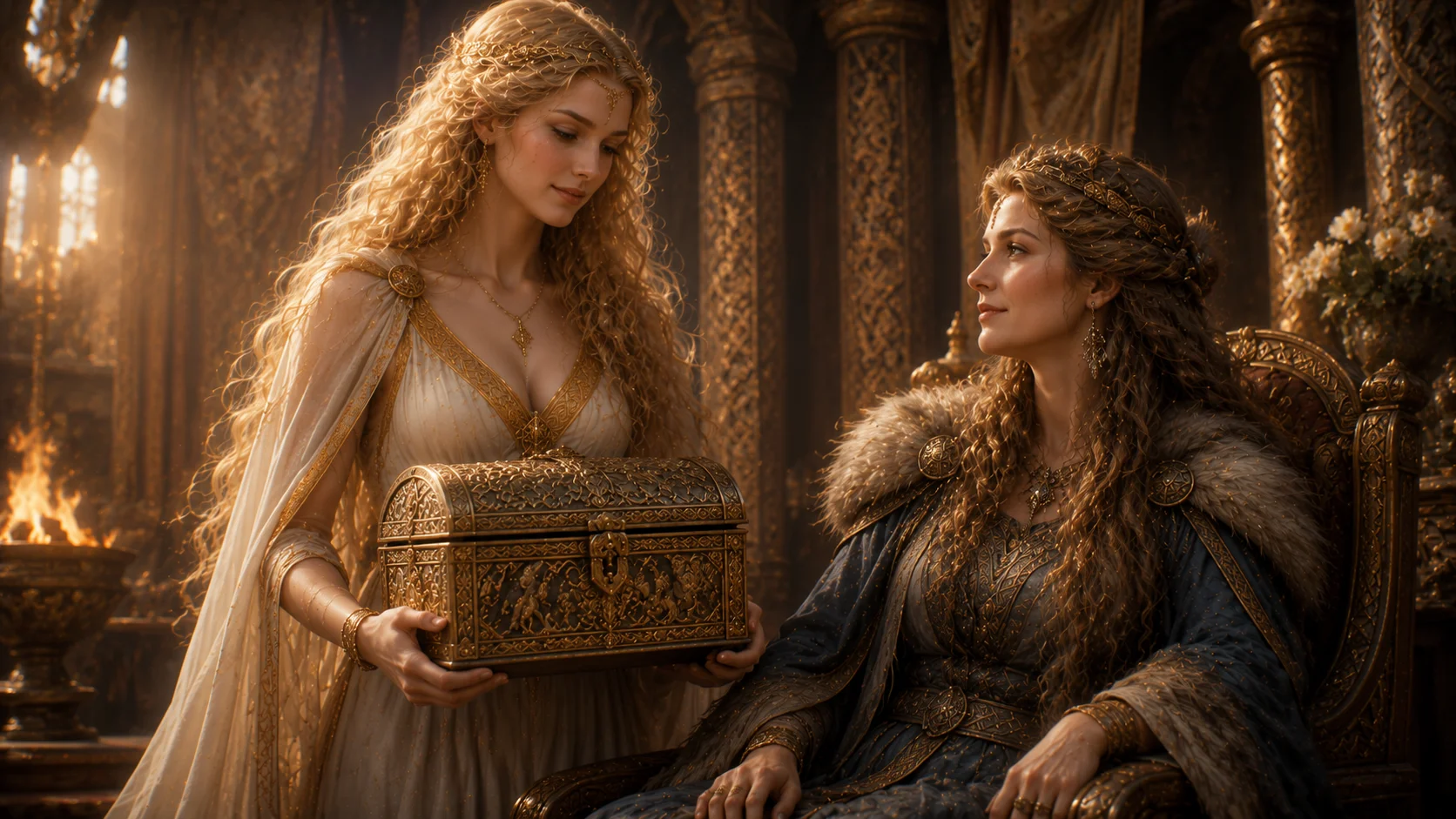
Where Fulla is described at all, she is described first by her appearance, and the picture given is consistent and striking. She wears her hair long and loose, unbound, falling free rather than gathered or braided — the traditional mark, in the old world, of an unmarried woman. Around her head she wears a band of gold, a simple ornament that sets her flowing hair in a kind of quiet frame. She is called a maiden, a virgin, in the old texts, a status that in the context of Frigg's household reads less as a statement about romance and more as a statement about her role: unattached, unclaimed by any household of her own, entirely given over to the service of the queen. The image is spare but memorable — gold against gold, loose hair and a bright circlet, a young woman standing quietly at the edge of every scene that belongs, properly, to someone else.
The Casket at Frigg's Side
Fulla's clearest duty, the one named plainly in the old prose accounts of the gods, is that she carries Frigg's eski — an ashen box, a casket of Frigg's own possessions. It is a small detail, almost domestic, and that is exactly what gives it weight. To be trusted with the queen's box is to be trusted with whatever the queen values enough to keep close and portable, whatever she does not leave behind in the halls of Asgard but carries with her, or has carried for her, wherever she goes. Fulla is also named as the one who looks after Frigg's shoes — another small, physical, intimate task, the kind of service given only to someone allowed inside the private routines of a great household. Neither duty is glamorous. Both are quietly enormous, because they place Fulla, again and again, in the same breath as the queen of the gods, at her elbow rather than at a distance.
What the Queen Would Tell No One Else
Beyond the casket and the shoes, the old sources say something rarer still: Fulla knew Frigg's secrets. She was the one in whom the queen confided, the keeper not just of objects but of counsel, of whatever private knowledge and private thought Frigg chose not to share more widely, even among the gathered gods of Asgard. This is the detail that lifts Fulla out of the ordinary run of attendants and handmaidens who populate the halls of the old myths. A servant who carries a box is trusted with property. A confidante who carries secrets is trusted with something far harder to replace, and far more dangerous to lose. That the myths give Fulla this role at all, in however few words, tells us that whoever first told these stories understood Frigg not simply as a queen surrounded by attendants, but as a woman who needed, and had, one person she could speak freely to.
A Word Carried Back to the Queen
In the verses where the god Odin, travelling in disguise and enduring hardship to test the hospitality of a mortal king, speaks of the gods and their households, Fulla is named among those who matter to him enough to mention. He speaks of her as one who will carry word back to Frigg — a messenger as much as a keeper, someone whose presence at Frigg's side means that news, once given to Fulla, reaches the queen. It is a brief mention, a single line in a longer catalogue of gods and their doings, but it confirms from a second, independent source what the prose account already suggested: Fulla stood close enough to Frigg, and was trusted enough by her, to be the conduit through which things reached the queen's ears.
A Sister Across the Sea
The clearest and strangest echo of Fulla comes not from the Norse world at all, but from a charm written down in Old High German, on the European continent, centuries before the Icelandic manuscripts that preserve most of what we know of the northern gods. In this charm, a figure named Volla is called the sister of Frigg — there named Fria — and she appears helping to heal the injured horse of a god named Phol, generally understood as an early continental name for the god later known in the north as Baldr. Scholars have long taken Volla to be the same figure as Fulla, carried across language and centuries in a slightly altered form, and the charm is treasured for being one of the very few glimpses of these northern gods recorded outside the later Icelandic tradition, closer in time to a living, spoken belief.
But the charm complicates the picture as much as it confirms it. In the north, Fulla is Frigg's handmaiden, her servant. On the continent, centuries earlier, Volla is Frigg's sister, her kin. Which relationship is older, or truer, or whether both existed side by side in different tellings told in different places, is not something the surviving evidence can settle. It is one of the genuine, acknowledged uncertainties in the study of this figure: the same goddess, named almost the same name, doing something recognisably similar — standing close to Frigg in a moment that matters — but described as two different kinds of relation in two different times and places.
A Hand in Healing
What the continental charm adds that the northern sources do not is a moment of action rather than simple attendance. Volla is not merely named as a companion; she takes part, alongside other figures, in working to heal the horse of a wounded god. It is a small scene, almost a fragment, but it is the one place in the whole surviving record where this figure is shown doing something rather than simply standing near someone who matters. Set beside the northern image of Fulla quietly carrying a casket and keeping a queen's shoes, the charm offers a rare glimpse of a more active, hands-on presence — a reminder that the few words we have of her may be only a small remainder of a much fuller figure once known and spoken of more widely.
No Cycle of Her Own
It is worth being honest about the shape of what survives. Fulla has no myth cycle in the way that Odin, Thor, or Frigg herself do — no sequence of adventures, no trials, no story that begins and ends with her at its centre. Every appearance she makes in the surviving sources is brief, and every one of them happens in the context of Frigg: carrying her casket, tending her shoes, keeping her secrets, carrying her word, standing at her sister's or her lady's side. This is not a flaw in the record so much as a fact about the kind of figure she was understood to be — not a god of a domain of her own, in the way a god of war or wisdom might be, but a presence defined entirely through relation, whose importance lies in whom she stands beside rather than in what she alone commands.
An Aspect of the Queen Herself
Among those who have studied these fragments closely, one theory recurs: that Fulla may not be, in the deepest sense, a separate goddess at all, but a hypostasis of Frigg — a split-off aspect of the queen's own nature, given a face, a name, and a golden band of her own so that a particular quality of Frigg, her bounty, her private counsel, her hidden knowledge, could be spoken of and pictured on its own terms. This is a scholarly proposal rather than a fact stated anywhere in the old texts themselves, and it should be held as exactly that: a way of making sense of a figure who has no lineage, no independent story, and a name that means almost the same thing the queen she serves is thought to embody. Whether Fulla began as her own goddess and was drawn ever closer to Frigg over time, or began as an aspect of Frigg and was given independent shape, the sources that survive do not say, and probably cannot say.
A Quiet Name in Later Retellings
Compared to the great names of the northern pantheon, Fulla's presence in later retellings, fiction, and games has stayed modest, almost always tied to Frigg's own appearances rather than standing on its own. Where she does appear, she tends to keep the shape the old sources gave her: a quiet, golden-haired presence at the edge of the queen's story, trusted, unbound, and unexplained. It is, in its own way, a faithful kind of afterlife for a figure who was never given more than a handful of lines to begin with — she remains, even now, exactly what she was in the oldest accounts: not the centre of the story, but the one person allowed to stand closest to it.
The Handmaiden Who Kept the Secrets of a Queen
Fulla endures, across every fragment that names her, as the trusted handmaiden of Frigg and the keeper of the queen's secrets and possessions — a golden-haired maiden goddess whose few appearances all point the same direction, toward an intimacy few others in Asgard were granted. She carried a casket whose contents we are never told. She kept shoes that carried a queen across worlds we are never shown. She held counsel that even the myths themselves declined to repeat. Across the sea, in an older charm, she may have stood not as a servant but as a sister, lending her hand to heal a wounded god. Both pictures agree on the one thing that matters most: wherever Frigg stood, Fulla stood beside her, trusted with what could not be given to anyone else.
Sources & traditions
- EncyclopediaWikipedia — Fulla
- TraditionNorse texts, inscriptions and later retellings (Scandinavia)
Myths change from area to area and from time to time. This chronicle follows the most widely told versions; tellings in other villages, regions and eras may differ.