Nanna was the gentle Norse goddess who was the devoted wife of the shining god Baldr — and who, in the supreme expression of love and grief in Norse myth, died of a broken heart at his funeral and was burned upon his pyre to join him in the realm of the dead. Her story is brief but among the most touching in all the northern tales: love so deep that it would not be parted even by death.
The Wife of Baldr
Nanna (Old Norse Nanna) was an Aesir goddess, the wife of Baldr the beautiful and the mother of Forseti, the god of justice. She was a goddess of gentleness, joy and devotion, the loving companion of the most radiant and beloved of the gods. Her life was bound to Baldr's, and so, inevitably, was her death — for when the shining god fell, Nanna could not bear to live on without him.
Death of a Broken Heart
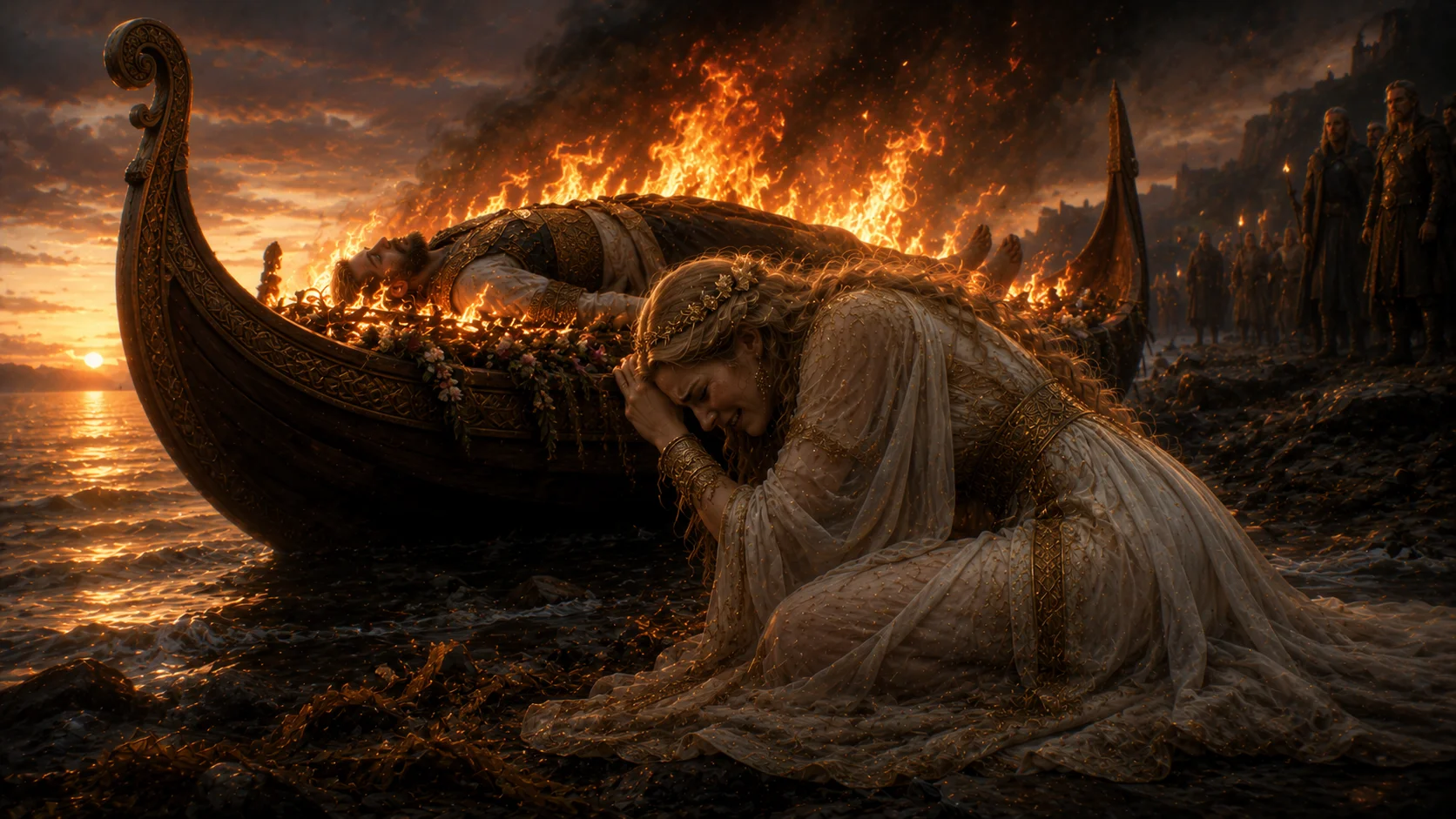
When Baldr was slain by the mistletoe through Loki's scheme, the gods bore his body to the shore to give him a great funeral upon his ship, Hringhorni. As the preparations were made and Baldr was laid upon the funeral pyre aboard his ship, Nanna was so overcome with grief at the death of her beloved husband that her heart broke within her, and she died of sorrow on the spot. It is one of the most affecting moments in Norse myth: the goddess who simply could not survive the loss of her love, dying of a grief too great to bear.
The Shared Pyre
And so Nanna was laid upon the funeral pyre beside her husband, and the two were burned together aboard the great ship and sent out in flames upon the sea — united in death as they had been in life. Nanna thus accompanied Baldr down into the realm of Hel, the land of the dead, where the two remained together. When the messenger Hermod rode down to Hel to beg for Baldr's return, he found Nanna there at her husband's side; and she sent gifts back up to the living — a linen robe for the goddess Frigg and a ring for Fulla — tokens from the dead wife to the world above, gracious even in the land of death.
The Return After the End
Like her husband, Nanna's story holds the promise of renewal. For it was foretold that after Ragnarök, when the old world has passed and Baldr returns from the dead to dwell in the new and cleansed world, Nanna will return with him — the loving wife restored to her husband, the two of them reunited not only in death but in the bright world reborn. Nanna endures as the Norse goddess of devoted love and faithful grief, the wife who died of a broken heart and followed her husband into death and beyond, embodying the deepest truth her people knew about love: that it does not end at the grave.
She died of grief at her husband's funeral and was burned upon his pyre to follow him into the land of the dead — and is promised, after the world ends, to return at his side into the world reborn.
A Name Nobody Fully Explains
Even her name keeps a secret. The Prose Edda calls her Nanna Nepsdóttir — daughter of Nép — and then says nothing further about him. No myth survives in which he acts or speaks. A verse name-list appended to the Edda does slot a Nepr among the sons of Odin, which would make Nanna a niece of the husband she married, but the list is a bare catalogue of names and nothing elsewhere develops it. He exists as a single word fastened to his daughter's name, a father reduced to a patronymic. It is a common shape in Norse genealogy: a whole story implied by a name tag, and then silence where the story should be.
The name Nanna itself has never been settled. One proposal ties it to the Old Norse verb nenna, "to be inclined to, to be resolved on," kin to a Germanic root for daring — a fitting source for a goddess whose one recorded act is a refusal to be parted from her husband, living or dead. Another traces it to a much older layer of language: a soft, repeated syllable for a beloved woman or mother-figure that turns up, independently, in tongues with no common ancestor — the kind of sound infants produce before grammar, which cultures across the world then keep as a term of tenderness. If that is where her name comes from, then Nanna was never really a name at all. It was an endearment that hardened, over centuries, into a goddess.
Forseti, the Peacemaker Born of Grief
The marriage that ended on a funeral pyre had already produced a son, and he became, of all the Æsir, the one least like his parents' story. Forseti sits in Glitnir, a hall held up on pillars of gold and roofed in silver, and there he judges. Snorri writes that whoever brings him a difficult dispute leaves it settled, and calls Glitnir the best court among gods and men both. It is a strikingly narrow portfolio for a god — not power over storms or war or death, but the harder gift of making two angry people agree.
It is difficult not to read that inheritance against where he came from. His father was killed by a plot inside his own family's household; his mother's heart failed at the graveside. Out of a story with no villain who could be reasoned with and no ending that could be prevented, the myth produces a god whose entire function is prevention — the settling of quarrels before they become tragedies. Whether the Norse themselves drew that connection is impossible to know. But Forseti's court, sitting at the far end of his parents' grief, is one of the quieter ironies in the mythology.
A Different Nanna: The Mortal Princess of Saxo's History
Snorri Sturluson is not the only medieval writer who told Nanna's story, and the other version barely resembles his. In the Gesta Danorum, the sprawling history of the Danes written by Saxo Grammaticus around the turn of the thirteenth century, the cast is brought down to human scale: Höðr becomes Hotherus, a mortal prince, Baldr becomes Balderus, a demigod son of Othinus, and Nanna becomes a mortal princess — the daughter of King Gevar of Norway, raised alongside her foster-brother Hotherus and in love with him since childhood. When Balderus glimpses her bathing, he is seized with a longing that will not leave him, and what had been a private courtship becomes a war between two claimants to the same woman.
Nanna marries Hotherus. Balderus does not accept it, and the story that follows is battles, sieges, and a struggle for supremacy fought with human armies rather than mistletoe and mischief. In Saxo's telling Baldr does not die of a dart thrown in innocent sport at a family gathering — he is wounded in open war and dies of it days afterwards, the demigod's charmed body finally failing him. There is no grief-death for Nanna here, no shared pyre. Saxo's Nanna is a woman fought over, not a widow who follows her husband into the flames. That two entirely different traditions could grow around the same three names is a reminder that "Norse mythology" was never one fixed text — it was competing stories, told in different centuries for different purposes, that happened to share a cast.
From Iceland to the Danish Stage
Nanna's grief did not stay buried in medieval manuscripts. When Norse mythology was rediscovered as literary material in the eighteenth and nineteenth centuries, her death at the pyre proved to be exactly the kind of scene later writers wanted: intimate, human-scaled, and unbearably sad in a mythology otherwise full of monsters and battles. The Danish poet Adam Oehlenschläger, more responsible than any other single writer for turning the old gods into national literature during Denmark's Golden Age, put the story on the stage as tragedy in Baldur hin Gode. In England, Matthew Arnold gave it its most complete Victorian retelling in his 1855 narrative poem Balder Dead, which follows Snorri through Hermod's ride into Hel and the burning of the ship — and which finds Nanna already there among the dead, at her husband's side, waiting out the world with him. Two very different literary cultures, half a century apart, reached for the same scene: not the death of a god, but the death of his wife beside him.
The Logic of a Love That Cannot Be Widowed
It is worth asking why grief, of all things, was the death chosen for her. Norse myth is not short of violent ends, yet Nanna is given a death with no external cause — no blade, no sickness, no monster, nothing that can be fought or outrun. That is a very specific claim for a myth to make: that a bond can be strong enough to end a life on its own, without anyone or anything doing the killing.
The idea was not confined to poetry. The tenth-century Arab traveller Ibn Fadlan, describing a ship funeral he witnessed among the Rus on the Volga, recorded a slave woman who volunteered to accompany her dead master, and who was then killed and burned with him aboard his ship so that she might go with him into whatever came next. It is a different people, a different century, and a far darker kind of bond — a captive's offer is not a wife's grief — but it shows that the wish underneath Nanna's story, of refusing to be separated from the dead by the mere fact of being alive, was not only a poet's invention. Nanna gave that wish its most tender shape: not a rite performed, but a heart that simply would not go on beating alone.
Sources & traditions
- EncyclopediaWikipedia — Nanna (Norse deity)
- TraditionNorse texts, inscriptions and later retellings (Scandinavia)
Myths change from area to area and from time to time. This chronicle follows the most widely told versions; tellings in other villages, regions and eras may differ.