Tyr was the Norse god of war, justice, law and heroic glory — the bravest of the Aesir, a god so courageous and so devoted to the keeping of oaths that he willingly sacrificed his own right hand to bind the monstrous wolf Fenrir and save the gods. Older even than Odin in origin, he is the one-handed god of honour, the deity who embodied the sacred bond of the sworn word.
The God of War and Law
Tyr (Old Norse Týr; the same god the early Germans called Tiwaz, who gives his name to Tuesday) was a god of war, but more deeply a god of justice, law and the formal order of things — the divine guarantor of treaties, oaths and right conduct. In the most ancient layer of Germanic religion he may once have been the chief sky-god, a role later eclipsed by Odin; by the Viking age he was honoured as the most valiant and honourable of the gods, the one invoked for victory in battle and for fairness in the assembly. He was a god of single combat and of the courage to do what must be done.
The Binding of Fenrir
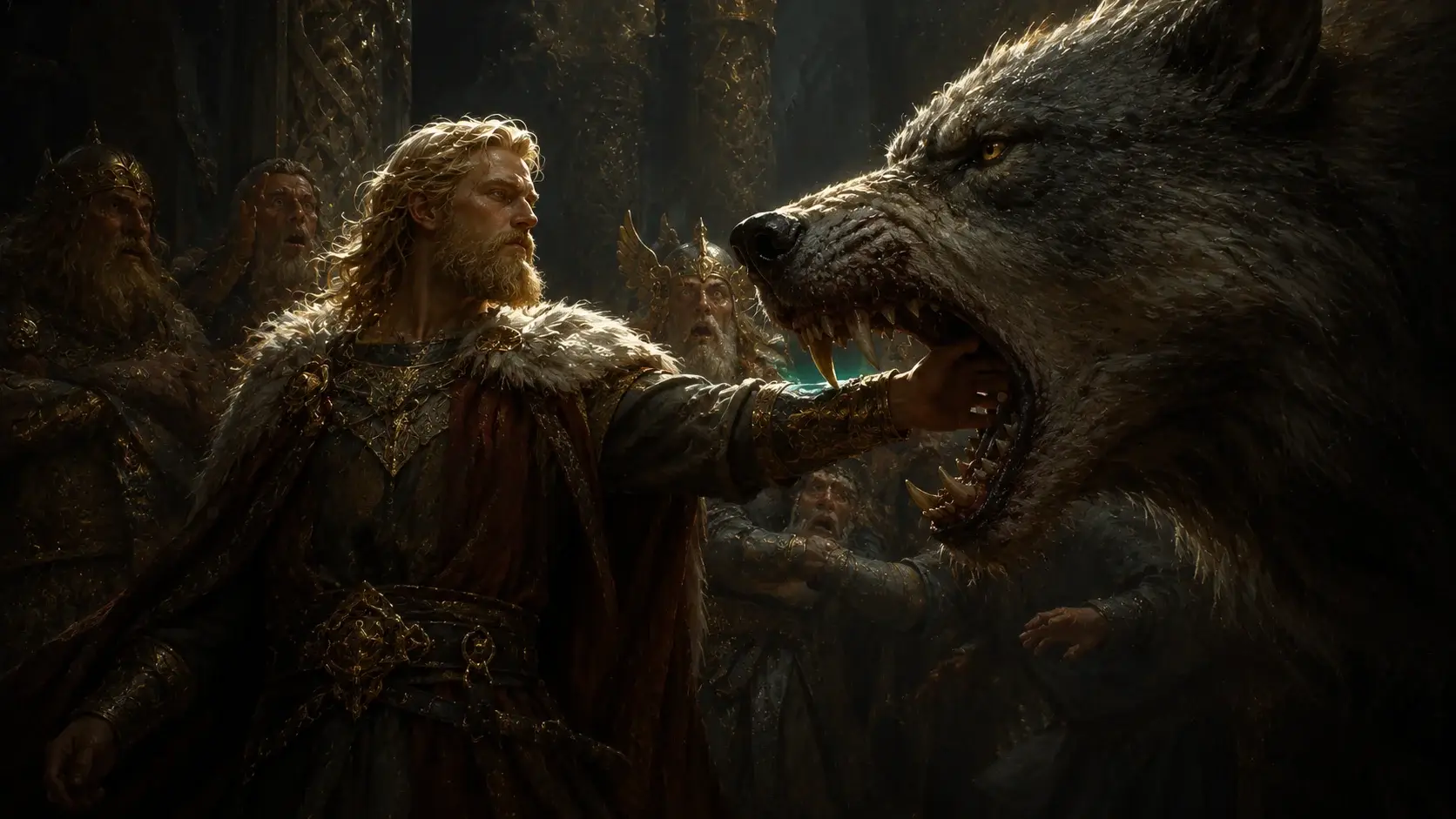
Tyr's defining deed was an act of supreme sacrifice. The gods had raised the wolf Fenrir, the monstrous child of Loki, in their midst, but as he grew to terrifying size and they learned he was fated to destroy them, they resolved to bind him. Twice they tried with mighty chains, and twice the wolf broke free. At last the dwarves forged a magical fetter, Gleipnir — soft as silk but unbreakable. But Fenrir, suspecting a trick, refused to be bound by it unless one of the gods would place a hand in his jaws as a pledge of good faith. The gods hesitated, all of them — for they meant to betray the wolf, and whoever gave the pledge would surely lose the hand. Only Tyr stepped forward and laid his right hand between the great wolf's teeth.
The Price of the Oath
The gods bound Fenrir with Gleipnir, and the wolf strained and could not break free — and realising the betrayal, he bit down and tore off Tyr's hand at the wrist. The wolf was bound, the gods were saved — but Tyr had paid the price, knowingly, with his own flesh. The deed captures everything Tyr stood for: the courage to make a sacrifice no one else would make, and the terrible paradox of his nature as the god of oaths who broke an oath (the pledge to the wolf) for the greater good, and accepted the loss of his hand as the cost. Ever after he was the one-handed god, his maiming the badge of his supreme courage and honour.
The Doom of the Hound
At Ragnarök, Tyr is fated to fight and fall against Garm, the monstrous hound that guards the gates of Hel — the two destroying each other, the god of war meeting his end against a great hound just as Odin meets his against the wolf. Tyr endures as the very embodiment of courage, justice and self-sacrifice — the god who gave his hand for the safety of all, and whose name marks Tuesday still. He stands for the highest Norse virtues: bravery in the face of certain loss, and devotion to honour above the safety of the self.
Every other god drew back from the wolf's jaws — only Tyr laid his hand between the teeth, knowing he would lose it, because the binding of the beast was worth the price.
The Sky-Father Who Lost His Sky
Tyr's name is not really a name at all. In Old Norse, týr is also a common noun meaning simply "god" — its plural, tívar, is one of the ordinary poetic words for the gods as a body. Odin collects it as a suffix in title after title: Sigtýr, god of victory; Hangatýr, god of the hanged; Farmatýr, god of cargoes. A poet who wrote Hroptatýr meant Odin — but the word he reached for to say "god" was the name of a different god entirely.
That is a linguistic fossil, and it points somewhere very old. Tyr descends from Proto-Germanic *Tīwaz, and behind that lies the Proto-Indo-European root for a bright celestial being — the root that surfaces as Latin deus and Sanskrit deva, and that also produced the names Zeus, Jupiter (Latin Diespiter, "sky-father") and the Vedic Dyaus Pitar. Tyr is not descended from Zeus. He is Zeus's cousin, struck from the same ancient word and carried north instead of south.
What became of him afterwards is the interesting part, and the honest answer is that nobody knows. There is no myth of a succession, no Norse scene of one god unseating another. Whether the sky-god was edged aside by a newer, stranger, more ambiguous deity of poetry and the gallows, or whether the shift happened so early that no Norseman ever remembered otherwise, cannot be recovered. All that survives is the shape of the evidence: a god reduced to a single searing anecdote, and a vocabulary that still calls every god by his name. The language remembers what the stories forgot.
Mars of the Assembly
The oldest direct evidence for Tyr's worship does not come from Iceland. It comes from a Roman fort on Hadrian's Wall.
At Housesteads in Northumberland, third-century Germanic troops in Roman service — Frisians who described themselves on the stone as men of Twenthe — set up a dedication to Mars Thingsus. Not Mars the battlefield butcher: Mars of the Thing, the assembly. The same stone names two goddesses called the Alaisiagae, Beda and Fimmilena, whose names have long been compared with terms from later Frisian legal procedure. Sit with that for a moment: homesick soldiers a thousand miles from home, carving in Latin on the far edge of an empire, name their war-god after a courtroom.
Roman writers had already made the same identification. When Tacitus described Germanic religion he used Roman names for what he saw, and the god he called Mars is generally understood to be Tiwaz. That equation is why Latin dies Martis became Old English Tīwesdæg and Old Norse týsdagr — and so Tuesday, Danish tirsdag, and in Alemannic dialects Zischtig, from the southern form Ziu. Dutch dinsdag and German Dienstag are usually traced instead to the Thing-epithet itself: the assembly god's day.
This is the key to Tyr that a modern reader almost always misses. He is not the god of slaughter — that is closer to Odin, who chooses the slain and delights in betrayal. Tyr is the god of the procedure: the formal duel, the sworn treaty, the legal assembly where free men settle who owes what to whom. In a society with no police force and no standing court, the oath was the state. Eyrbyggja saga and Landnámabók both describe the heavy ring that lay on a temple altar, reddened in the blood of sacrifice, on which men swore.
And Snorri is specific about which hand Tyr laid between the wolf's teeth. The right one.
The Rune That Bears His Name
Tyr is the rare god who is also a letter. The rune ᛏ — an upward arrow, a shaft with two slanting arms — is named *tīwaz after him. In the older twenty-four-rune row he has company, since *ingwaz is named for the god Ing; but in the sixteen-rune younger futhark used across the Viking Age, týr is the only rune name left that belongs to a god at all.
The Eddic poem Sigrdrífumál gives the instruction plainly: if you want victory, cut victory-runes on the hilt of your sword and on two further parts of the weapon whose Old Norse names — véttrim, valböst — can no longer be translated with confidence, and name Týr twice. It is one of the very few pieces of practical Norse religion that survives as an instruction rather than a story: a thing a warrior actually did to a real object with a real knife. Repeated t-runes do turn up in surviving inscriptions.
The rune poems keep him too. The Old Icelandic poem calls him the one-handed god and, with grim economy, "the leavings of the wolf" — what the beast did not swallow. The Old Norwegian poem gives him the same single hand. The Old English rune poem is stranger and lovelier: its Tīr is a sign that keeps faith well with princes, ever on its course above the mists of night, and never fails. Whether that means the god, a guiding star, or both at once has been argued over for a century. Either way the virtue named is the same one: constancy. The thing that does not fail.
Whose Son Was He?
Snorri Sturluson, compiling his handbook of poetry in thirteenth-century Iceland, lists Tyr among the sons of Odin. The Eddic poem Hymiskviða flatly contradicts him: there Tyr calls the giant Hymir his father, and brings Thor home to a hall where his grandmother is a monstrous thing of nine hundred heads, while his mother moves among them bright-browed and gold-adorned, carrying ale to her son.
The contradiction is probably not a blunder. It is what a religion looks like after a thousand years across a dozen regions with no scripture and no priesthood to enforce consistency. Snorri was tidying; the poem preserves an older and wilder pedigree in which the god of law is half-giant, born on the wrong side of the boundary he exists to police.
Hymiskviða is also the only surviving narrative in which Tyr does anything other than lose a hand — he travels with Thor to fetch a cauldron a mile deep, so the gods can brew their ale. It ends with a small, telling humiliation. When the cauldron has to be carried off, Tyr takes hold of it twice and cannot shift it. Thor lifts it and walks out with it on his head. The god of the sworn word is not the god of raw strength, and the poem does not let him pretend otherwise.
What Loki Said
In Lokasenna, Loki insults every god in the hall in turn, and each insult is aimed at a specific nerve. When Tyr speaks up in Freyr's defence, Loki turns on him with a line far crueller than it first looks: you never could carry things fairly between two people. The god of arbitration, accused of being unable to arbitrate.
Then he twists it. Tyr's wife bore a son by Loki, and Tyr never received so much as a penny in compensation. In a legal culture where every injury carried a tariff, that is the deepest cut available — the guarantor of settlements, personally unsettled and personally uncompensated. Tyr's answer is not a denial. He says only that he lacks a hand and Loki lacks the wolf, and that the wolf must wait in bonds until Ragnarök.
It fits an odd remark Snorri makes elsewhere: that Tyr, for all his valour, is not called a reconciler of men. This is a god who upholds the law without smoothing anything over. He is the courage the law needs, not the mercy.
Where He Was Actually Worshipped
Honest answer: far less is known than anyone would like. Iceland preserves almost nothing of him, and Norway and Sweden little. Denmark is the exception. Tissø on Zealand — a lake beside one of the richest excavated magnate complexes of the Viking Age, where weapons were deposited in the water — is generally read as Tý's lake, and several Danish place-names built on Tis- point the same way. There is no surviving temple, no festival calendar, no priesthood anyone can name. What survives is a scatter of place-names, a Roman-era dedication on a British frontier, a rune cut into sword hilts, and a weekday every one of us still says out loud.
The same thinness haunts his iconography. No attribute marks him out in art the way Thor's hammer or Odin's ravens do — except absence. A number of Migration-period gold bracteates from Scandinavia show a figure placing a hand into the jaws of a beast, and these have long been read as Tyr and Fenrir. If the reading is right, it is the oldest picture of the story in existence, made centuries before anyone wrote it down. Otherwise the way to recognise Tyr is the way his own poets did: count the hands.
The Long Afterlife
The rune has had a darker twentieth century than the god. The t-rune was taken up as an emblem by leadership schools of the SA and SS in Nazi Germany, and it still circulates in extremist iconography today — a piece of the alphabet turned into a badge by people with no interest in what it originally meant. Worth knowing, if only so that the symbol is read accurately when it appears.
The gentler afterlives are everywhere. The Faroe Islands produced a metal band named Týr that built a career on Norse material; God of War: Ragnarök made him a pacifist prisoner, inverting the war-god into someone who refuses to fight; Neil Gaiman and Rick Riordan both keep him; Marvel has an Asgardian Tyr. And every Tuesday morning, several hundred million people say the name of a forgotten Indo-European sky-father before their first cup of coffee.
Why the One-Handed God Endures
Because his myth is about a problem no society has ever solved.
The moral arithmetic of the binding is worth stating flatly. The wolf could not be bound without deceiving him, and could not be deceived without a hostage. So the god of oaths is the one who gives his word falsely, and pays for the falsehood with the very hand he offered as its guarantee. He does not get to be innocent. He gets to be effective, and maimed, and the myth offers him no comfort at all about the trade.
That is the adult version of courage, and it is why Tyr endures while grander gods flatten into cartoons. Thor is strength and Odin is cunning, but Tyr is the recognition that order is not free — that someone has to reach into the jaws knowing, and that the reaching costs a hand. Every treaty kept at a loss, every promise held to at personal expense, is a small repetition of that gesture. The Norse understood that the wolf can be bound. They simply never pretended it could be bound for nothing.
Sources & traditions
- EncyclopediaWikipedia — Týr
- TraditionNorse texts, inscriptions and later retellings (Scandinavia)
Myths change from area to area and from time to time. This chronicle follows the most widely told versions; tellings in other villages, regions and eras may differ.