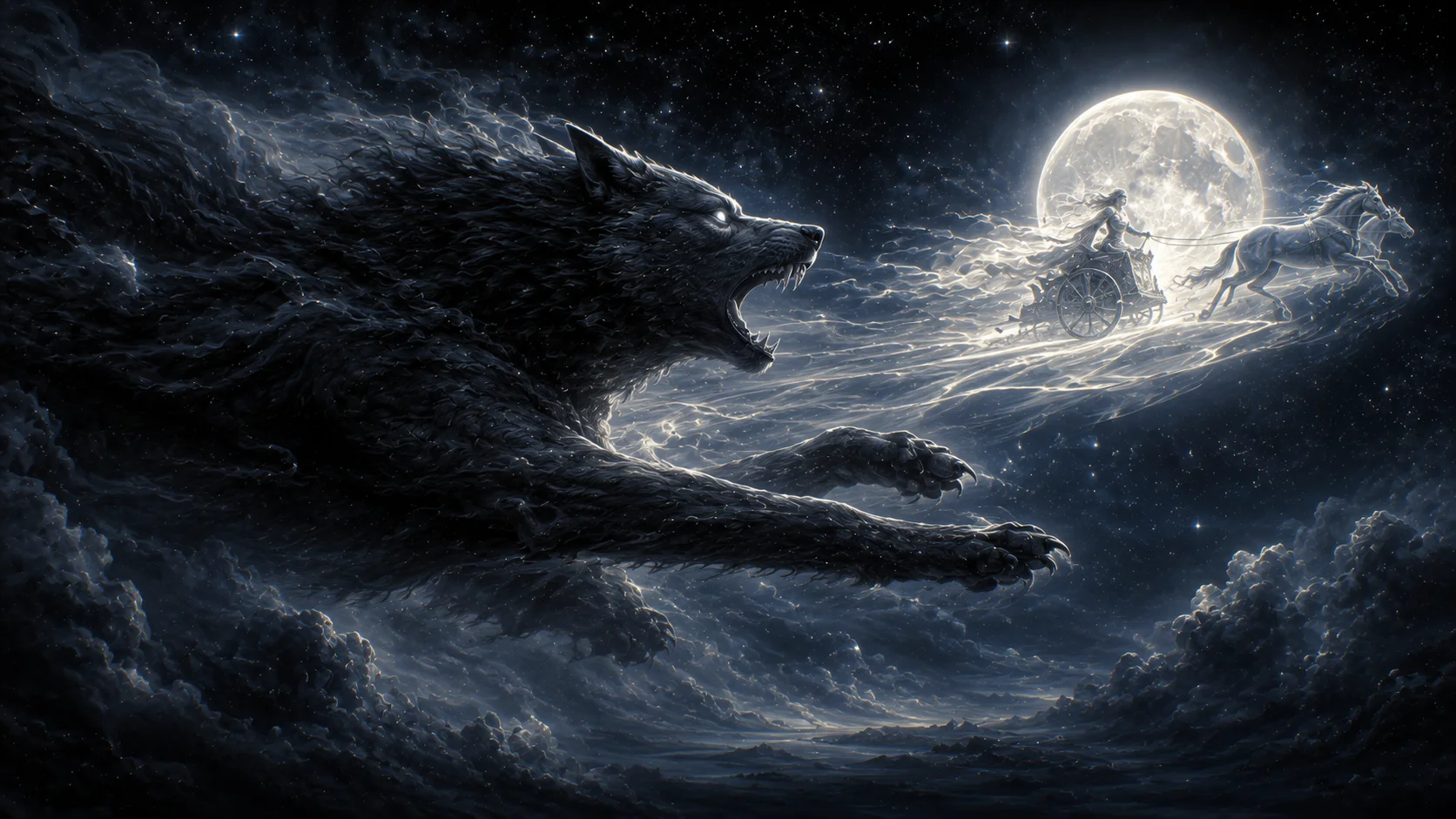
Hati was the great wolf that chases the moon across the night sky — the counterpart of his brother Sköll who hunts the sun, pursuing the moon-god Mani and fated, at Ragnarök, to catch and devour him. He is the hunger at the heels of the moon, the darkness that hunts the night-light to its doom.
The Wolf at the Moon's Heels
Hati (Old Norse Hati Hróðvitnisson, “he who hates,” son of Hróðvitnir) was a monstrous wolf who pursues the moon across the night sky. As his brother Sköll chases the sun-goddess Sol by day, so Hati races after the moon-god Mani by night, hungering to catch and swallow the moon. His pursuit drives the moon onward across the dark, the night-light fleeing the jaws at its back just as the sun flees by day. The two wolves were said to be of monstrous brood, born in the Iron Wood to a giantess, bred to hunt the lights of heaven.
The Hunt Across the Night
The image of Hati forever chasing the moon is the Norse explanation for the moon's motion through the night sky and for the terror of a lunar eclipse. When the moon darkened and seemed to be swallowed, the Norse saw the moment when Hati had drawn near and almost seized his prey — and people would raise a great noise to frighten the wolf and drive him back from the moon. Night after night the chase goes on, Hati at the moon's heels, the pale light fleeing across the dark, never able to rest for the hunger that pursues it.
The Devouring at Ragnarok
At Ragnarök, Hati's chase reaches its terrible end. As the world rushes to its doom, Hati at last catches the moon and devours it, even as his brother Sköll swallows the sun. The two great lights of heaven are extinguished together, swallowed by the wolves that hunted them, and the sky goes dark — one of the great signs that the end has come and the final battle is at hand. The stars, too, vanish from the sky. With sun and moon both devoured, the world is plunged into a darkness that heralds the doom of the gods.
The Darkness That Hunts the Moon
Hati endures as the wolf that chases the moon — the night-time counterpart of Sköll, the hunger at the heels of the moon, the pursuer whose final triumph at Ragnarök extinguishes the night-light. Together, the two wolves embody the Norse vision of the heavens as a place of eternal flight and pursuit, the sun and moon forever fleeing the jaws of the wolves, the precious lights of day and night both hunted by a devouring darkness — and both, at the end of the world, swallowed at last.
As Sköll hunts the sun by day, Hati hunts the moon by night — and at the end of the world the two wolves swallow the lights of heaven together, and the sky goes dark.
Named in the Poetic Edda
Hati is not Snorri Sturluson's invention. He is named in Grímnismál, one of the mythological poems preserved in the thirteenth-century Codex Regius and generally reckoned older than Snorri's Prose Edda by two centuries or more. A single stanza sets both wolves of the sky running: Sköll after the sun, and a second wolf named Hati, Hróðvitnis sonr — “son of Hróðvitnir” — loosed after what the poet calls only the bright bride of heaven. The poem does not pause to explain who Hróðvitnir is, or to unpack the kenning; Snorri, reading it later, took the quarry for the moon, and every retelling since has followed him. Hati is simply there already, a fixture of the night sky the audience is assumed to recognise without introduction.
Something older and vaguer stands behind him in Völuspá, the visionary poem that opens the Poetic Edda. There an aged giantess sits east in the iron forest of Járnviðr and breeds the kindred of Fenrir; and of that whole brood, the poem says, one in particular becomes the snatcher of the moon in a troll's shape. He is given no name at all. It is the same dread with nothing yet attached to it — the appetite first, the wolf's name second.
Whose Son Is He?
The patronymic is the loose thread readers keep pulling at. Hróðvitnir means something like “famous wolf,” and Old Norse verse uses it elsewhere as a byname for Fenrir himself: in Lokasenna, Týr throws it at Loki as a taunt — I lost a hand, you lost Hróðvitnir — meaning the wolf that bit the hand off was Loki's own son, and is now bound. Read that way, Hati is not merely kin to the wolf fated to kill Odin; he is Fenrir's son, one branch of a single bloodline built to end the world in stages: the father breaking his chains, the sons swallowing the lights of heaven, all on the same morning.
Snorri keeps the patronymic — his Gylfaginning calls him Hati Hróðvitnisson outright — and then, a few lines later, sources the sky-wolves somewhere else entirely: an old giantess dwelling east of Midgard in the Iron Wood, among troll-women Snorri names the Járnviðjur, who bears many giant sons and all of them in wolf shape. The two accounts sit side by side on the same page and were never reconciled. That is itself revealing. Medieval Icelanders seem to have cared far less about Hati's exact family tree than about the role he filled — a wolf, in the wolf-shaped corner of the world, sent after the moon.
Mánagarmr, the Moon-Hound
Read Gylfaginning a little further and a second wolf appears that the text never quite squares with Hati. He is Mánagarmr, “Moon-Hound,” whom Snorri calls the mightiest of the entire wolf-kindred: he fills himself with the life of every man who dies, he swallows the moon, and he spatters the sky and all the air with blood. On its face this is the same event Hati is already fated to cause, told a second time under another name with a grislier appetite attached. Whether Mánagarmr is Hati remembered twice or a separate hunger aimed at the same target has never been settled; most modern readers treat them as one wolf, but no medieval text says so. The doubling reveals less about careless record-keeping than about how badly the imagination wanted the moon's killer named — twice, if once was not enough.
Kin Among the Doom-Beasts
Hati does not hunt alone in the mythology's last chapter. Bound before the cave mouth of Gnipahellir, on the road down to Hel, waits Garmr, whose baying is the drumbeat of Völuspá's refrain and one of the signs that the end has begun: the hound howls, the fetter breaks, the ravener runs free. At Ragnarök, Garmr and the god Týr kill one another. No surviving text calls Garmr and Hati brothers, and some scholars have wondered whether Garmr and Fenrir were once a single figure that tradition later split in two. But the pattern is hard to miss: Norse myth posts a wolf at every gate and every horizon — Fenrir at Odin's throat, Sköll at the sun, Hati at the moon, Garmr at the threshold of the dead. The end of the world arrives on four legs, with teeth.
An Eclipse the World Over
The instinct to explain a darkening sky as a beast biting into it was never uniquely Norse. In Hindu tradition the demon Svarbhānu stole a mouthful of the drink of immortality and was beheaded for the theft; his severed head, Rāhu, still chases the sun and the moon across the heavens and still catches them — and they emerge moments later through his open neck, which is why no eclipse lasts. In Chinese folk belief a celestial dog, the Tiangou, was blamed for biting into the sun or moon, and the remedy was to beat drums and gongs until the beast let go. Elsewhere the culprit is a dragon, or a frog, or a great toad. The details shift with the landscape; the shape of the story does not. Something with an appetite is loose in the sky, and only human noise will drive it off — which is precisely what the Norse were said to do for a moon caught in Hati's jaws. He is the northern answer to a question nearly every sky-watching culture on earth has asked.
A Wolf Rendered in Paint
Hati has left remarkably little trace in surviving Norse art. No rune stone or church carving has been securely identified as him. Fenrir, by contrast, is worked into stone again and again — a wolf at the leg of a spear-carrying figure on a cross-slab from the Isle of Man, wolves and bound monsters on carved crosses in northern England — while the wolves of the sky went unrecorded. Hati's visibility today is very largely a modern invention. The English illustrator John Charles Dollman painted the pair in full pursuit of sun and moon in 1909, for H. A. Guerber's Myths of the Norsemen: two wolves stretched flat out across the cloud, in a chase with no beginning and no rest. That one picture has been reprinted in general-audience retellings ever since, and it has done more to fix Hati's appearance in the popular imagination than any medieval source ever attempted — which is a fitting fate for a wolf the old poets never bothered to describe. They only told us he was coming.
Sources & traditions
- EncyclopediaWikipedia — Hati Hróðvitnisson
- TraditionNorse texts, inscriptions and later retellings (Scandinavia)
Myths change from area to area and from time to time. This chronicle follows the most widely told versions; tellings in other villages, regions and eras may differ.