Sol was the Norse goddess of the sun — the radiant maiden who drove the sun-chariot across the sky each day, pursued forever by a ravening wolf that is fated, at Ragnarök, to catch and devour her. She is the personified sun of the north, beautiful and doomed, racing across the heavens in eternal flight from the jaws that hunger to swallow the light.
The Sun-Maiden
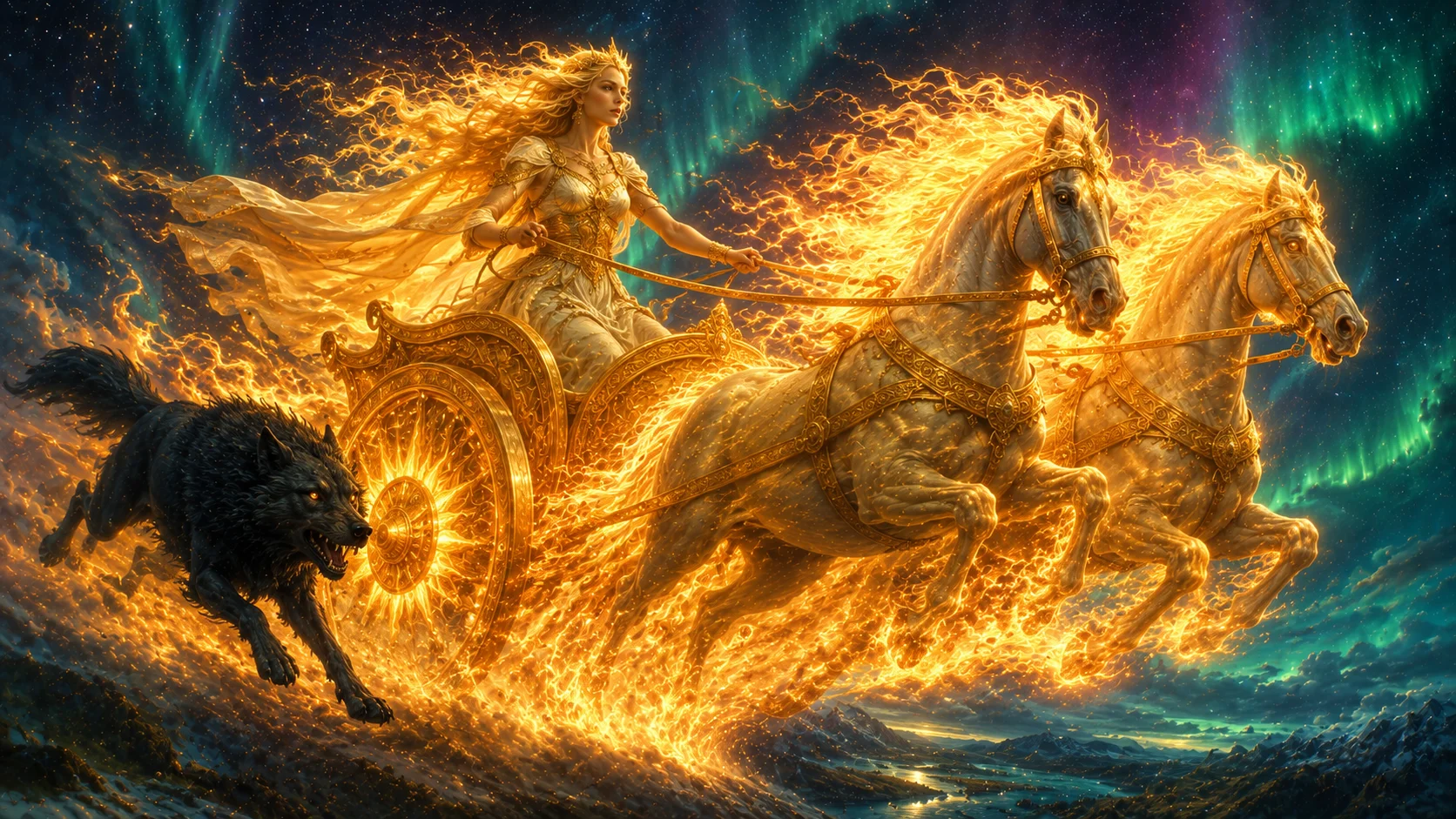
Sol (Old Norse Sól, “sun”; also called Sunna) was the goddess who personified and drove the sun. She and her brother Mani (the moon) were the children of a man named Mundilfari, who named them so proudly for the sun and moon that the gods, offended at his presumption, took the two and set them in the heavens to guide the chariots of the sun and moon across the sky. So Sol became the driver of the sun-chariot, drawn by two horses, Árvakr (“early-waker”) and Alsviðr (“all-swift”), beneath whose shoulders the gods set bellows or iron to keep them cool from the sun's heat.
The Wolf at Her Heels
Sol does not cross the sky at leisure: she flees. Behind the sun-chariot races a great wolf named Sköll, who pursues Sol endlessly, hungering to catch and swallow her — and it is this eternal chase that drives the sun so swiftly across the heavens, for Sol dares never slow. (Her brother Mani is likewise chased by the wolf Hati.) The Norse explained eclipses as the moments when the wolf drew near and seemed about to seize the light. The sun's daily race, in this telling, is a flight for its very life.
The Devouring at Ragnarok
The chase has a foreordained end. At Ragnarök, the doom of the gods and the world, the wolf Sköll will at last catch Sol and devour her, and the sun will be swallowed and the world plunged into darkness — one of the terrible signs that the end has come. Yet even here the Norse vision holds a thread of renewal: before she is taken, Sol will give birth to a daughter as bright and beautiful as herself, and after the old world has burned and a new one risen, this daughter will take up her mother's course and drive a new sun across the sky of the cleansed and reborn world.
The Light That Flees and Returns
Sol endures as the Norse personification of the sun — the radiant maiden in eternal flight, the light pursued by the wolf, doomed to be devoured yet promised renewal in her shining daughter. She embodies a profoundly northern vision of the sun: not a serene and unchallenged ruler of the sky, but a beautiful fugitive racing the darkness, precious precisely because the wolf is always at her heels — and because, even after the wolf swallows her at the end of all things, the light is promised to rise again.
The sun races across the sky not in triumph but in flight, a wolf forever at her heels — and though he will swallow her at the end of the world, her bright daughter will rise to drive the sun of the world reborn.
Roots Older Than the Sagas
Everything in the account above — Mundilfari's presumption, the chariot, the wolf at her heels — comes down to us from manuscripts written in Christian Iceland in the thirteenth century: the Poetic Edda and Snorri Sturluson's Prose Edda. But Sol herself is older than the vellum she survives on. Some three centuries before those books existed, a cleric writing in Old High German copied two short healing-charms onto a blank page of a liturgical book — verses meant to be spoken over an injury rather than read as literature. The manuscript later came to rest in the library at Merseburg, in what is now Germany, and took its name from the town, though the writing itself was most likely done at the abbey of Fulda. The second charm tells how Phol and Wodan rode to the woods, where the foot of Baldr's foal was wrenched; and there, in the line that follows, stands Sunna, named beside Sinthgunt among the goddesses at the healing. That is Sol under her continental Germanic name, present in a practical remedy centuries before any Icelander wrote a word about her chariot — evidence that the sun-goddess was not a literary invention of the saga age but an inherited figure, carried in belief long before she was carried in ink.
The Old High German is teasingly ambiguous about what she actually does there. Thu biguol en Sinthgunt, Sunna era suister can be read as “then Sinthgunt sang charms over it, and Sunna her sister” — two goddesses working the cure — or as “then Sinthgunt, Sunna's sister, sang charms over it”, in which case Sunna is named only to identify somebody else. A single line, and a thousand years of scholarship has not settled which sister is holding the horse's leg.
Push back further and the sun-chariot itself turns up in bronze. In 1902 a small gilded model was lifted out of a peat bog on the Trundholm moor, in Odsherred on the Danish island of Zealand: a horse hauling a wheeled disc, one face bright with gold leaf and the other left plain, as though built to be drawn in a circle from day into night and back again. It dates to roughly 1400 BCE — some twenty-six centuries before the Eddas were written, and more than two thousand years before the first surviving word about Sol. Nothing explains it in writing; Bronze Age Scandinavia left none. But the shape of the idea, a horse-drawn sun crossing the sky on wheels, is unmistakably the one Snorri was still setting down in prose two and a half millennia later.
Glenr, the Husband Nobody Explains
Sol's family, as the earlier telling has it, runs almost entirely up and down — a father, a brother, eventually a daughter. Snorri adds one relation sideways, and does it in a single clause: in Gylfaginning he mentions, almost in passing, that Sol was married to a man named Glenr, and then never returns to him. The marriage was evidently common enough knowledge to be useful, because Skáldskaparmál lists kona Glens, “Glenr's wife”, among the approved ways for a court poet to say the sun.
And that is all of him. No myth attaches to Glenr, no parentage, no deeds, no reason given for the match — he survives as a husband and nothing else, a name kept in circulation for no purpose but to give the sun a household. It is a small, almost administrative detail, and yet it says something about how thoroughly the Norse domesticated their sky: even the fleeing sun was tidied into a marriage.
Svalinn, the Shield Before Her Face
Grímnismál, the great catalogue-poem of the Poetic Edda, adds a detail the chariot alone leaves out. Sol does not cross the sky protected only by cooled horses; a shield rides ahead of her too. Its name is Svalinn, “the cool one”, and the poem states plainly that it stands before the sun — and that if it ever fell away, mountain and sea alike would burn.
Sit with that image and it reframes the whole myth. The sun is not a warmth the world simply enjoys, but a furnace held off by a single screen, one failure away from setting the earth alight. The bellows beneath Sol's horses keep her team from scorching; Svalinn is what keeps everything else from scorching too. Norse cosmology did not imagine sunlight as freely given. It imagined it as actively held back.
Álfröðull, the Elf-Beam
The plain word sól was not the only name the poems had for her. In Vafþrúðnismál and Skírnismál she appears as Álfröðull — rendered variously as “elf-beam”, “elf-disc” or “elf-glory”, from álfr, elf, and röðull, a word for the sun's disc or radiance. It is under this name, not her plainer one, that Vafþrúðnismál foretells the daughter she will bear before the wolf takes her.
Why the elves should be in the sun's name at all is genuinely disputed. The deflating explanation is metrical: Old Norse verse is built on alliteration, and a poet needing a vowel-initial word for the sun had few better options than one beginning with álfr. The more interesting proposal, argued by the scholar Alaric Hall, is that elves and sunlight were simply congruent in the Norse imagination — and Snorri does put the light-elves in a hall in the heavens and call them fairer than the sun to look upon. Either way, the effect on a modern reader is the same: Old Norse poetic diction can feel like a locked door, because to know who Álfröðull is you had to already know that elves and light belonged together.
A Goddess Where the Neighbours Have Gods
Set Sol beside the sun-deities of the cultures around her and one fact stands out at once: she is a she. Greek Helios, Vedic Surya, the Roman Sol — all male, all charioteers, and all bearing names that descend, like the English word “sun” and like Sol's own, from a single ancient Indo-European root. Scandinavia breaks the pattern, and does not break it alone. Across the Baltic, the Lithuanian and Latvian sun-goddess Saulė likewise drives a chariot with copper wheels across the sky, and her lunar counterpart, Mėnuo, is male and is reckoned her husband — the same reversal, among a neighbouring branch of the same language family, that the Norse made of Sol and Máni.
Why the north should have inverted it is nowhere recorded, and any answer is a guess. One at least worth weighing sits in the latitude. Where the sun is a dependable daily fact, it can be imagined as a monarch beyond challenge — the Roman cult title Sol Invictus, “the unconquered sun”, says exactly that. In Scandinavia the daylight visibly drains away each autumn and in the far north goes out altogether, and a sun that can be lost is a harder thing to cast as an emperor. The wolf, from that angle, is not only a monster. It is a description of a northern winter.
Sol in Living Heathenry
Sol did not stay confined to manuscripts. Modern Heathenry — the revived worship of the old Norse gods, practised today in Iceland, across Scandinavia and well beyond — draws its gods from these same Eddic sources. Ásatrúarfélagið, the Icelandic Ásatrú fellowship, was founded in 1972, on the first day of summer by the old reckoning, and recognised by the Icelandic state as a religious organisation in May of the following year. Its year is still marked out by the sun: of its four principal blóts, one falls at the winter solstice and one at the summer solstice, with the others at the old Icelandic thresholds of summer and winter.
It is a quiet continuity worth noticing. The manuscripts that preserve Sol were written by Christians recording a religion they no longer practised, and for seven centuries she was a figure of literature. Now there are again people who divide their year by the sun's turning and take these texts as something more than literature — and the goddess once imagined racing for her life across the sky is, in their reckoning, still expected each morning to make the crossing.
Sources & traditions
- EncyclopediaWikipedia — Sól (Germanic mythology)
- TraditionNorse texts, inscriptions and later retellings (Scandinavia)
Myths change from area to area and from time to time. This chronicle follows the most widely told versions; tellings in other villages, regions and eras may differ.