Nott was the Norse personification of the night — the dark goddess of giant descent who rode across the sky bringing darkness, the mother of the day and the ancestress of the night itself. Older than the bright gods, she is the deep darkness from which the day is born, riding her dark horse across the heavens in eternal procession.
The Dark Goddess
Nott (Old Norse Nótt, “night”) was the personification of the night, a goddess of the giant-kind (jötnar), dark-haired and dark-complexioned as befitted her nature, and counted among the oldest of beings. She was the daughter of a giant named Nörvi (or Narfi), and through her marriages she became the mother of several beings, including, by the shining Delling, the bright god Dagr (Day) — so that Night was, fittingly, the mother of Day, the darkness giving birth to the light. By another union she was mother of Jord (Earth), and thus grandmother of Thor.
Hrimfaxi, the Frost-Mane
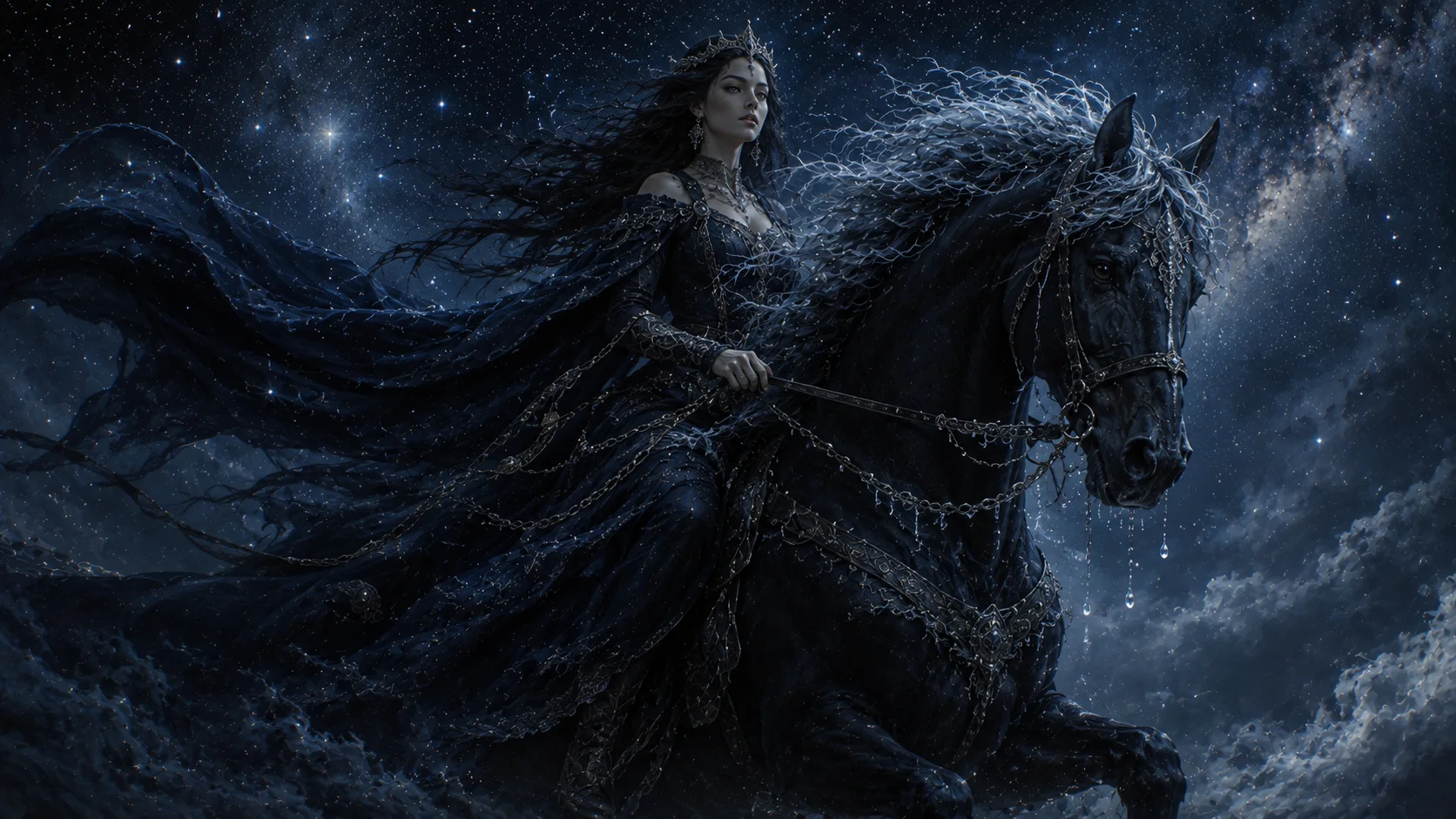
Like her son Dagr, Nott was given a horse and chariot by the gods with which to ride around the earth, bringing night in her wake. Her horse was named Hrímfaxi (“frost-mane” or “rime-mane”), and it was said that each morning, as Hrímfaxi finished his nightly course, the foam and froth from his bit fell upon the earth as the morning dew. So the Norse explained the dew of dawn as the spume from the night-horse's bridle, scattered across the land as night gave way to day — a counterpart to the shining mane of her son's day-horse Skinfaxi.
The Mother of the Cycle
Nott rode first, and her son Dagr followed: mother and son together drove their horses around the same circular path across the sky, one after the other, weaving the endless alternation of darkness and light. Nott's precedence — night riding out before day — reflected an old northern sense that darkness comes first and the light is born from it, just as Night was the mother and Day her child. In the reckoning of time, too, the Norse counted by nights rather than days (a custom that survives in our “fortnight”), giving Nott a quiet primacy over her shining son.
The Darkness From Which Day Is Born
Nott endures as the Norse personification of the night — the dark giantess on her frost-maned horse, mother of the day and of the earth, the deep darkness that comes before and gives birth to the light. She embodies the northern reverence for the long, dark nights and the profound idea woven through Norse myth: that darkness is not merely the absence of light but its mother, the ancient deep from which day, earth and even the thunder-god's line all descend.
Night rides out before the day on a frost-maned horse whose dripping bit scatters the morning dew — for to the Norse, the darkness came first, and from Night herself the bright Day was born.
Where the Night Comes From
Nearly everything we know about Nótt survives because a god walked into a giant's hall and asked questions to which he already knew the answers. In the Eddic poem Vafthrúðnismál, Óðinn stakes his head on a contest of lore with the ancient giant Vafthrúðnir, and among the riddles he puts is this: whence came the day that passes over mankind, and the night with its waning moons? The giant does not answer with mechanics. He answers with parentage — Dellingr is the father of Day, and Night was born of Nörvi — because to a Norse audience a genealogy was an explanation. To say who fathered a thing was to say what it is.
That single stanza is the oldest bedrock. Around it, three further passages build the figure. Vafthrúðnismál elsewhere names Hrímfaxi and the drops from his bit that become the dew of the dales, so the frost-maned horse is genuine old verse and not a later ornament. Alvíssmál preserves the names by which night is known in each of the worlds. And in the thirteenth century the Icelander Snorri Sturluson, writing his Prose Edda as a handbook for poets who no longer knew their own mythology, gathered the scattered verse into the orderly account most retellings still follow: the giant father in Jötunheimar, the dark daughter, the three marriages, and the Allfather setting mother and son in the sky with a horse and chariot each.
It is worth noticing what Snorri added and what he only tidied. The riders, the horses, the dew — those are attested in verse older than him. The neat cosmological machinery, the sense of a sky mechanism running on a schedule, is largely his gift for system. Nótt in the poems is less a functionary and more a presence.
Three Husbands and the Blood of the World
Nótt married three times, and each marriage produced a piece of the world.
Her father Nörvi — also given as Narfi, a name that belongs elsewhere in the myths to a son of Loki, one of the many echoes in Norse naming that the sources never explain — was a giant dwelling in Jötunheimar. Her first husband was Naglfari, and their son was Auðr, whose name means wealth or riches and about whom absolutely nothing else survives: a child of Night named for abundance, and then silence. Norse myth is full of these stubs, figures who exist only as a name in a list, and they are a useful corrective to the modern assumption that a mythology is a finished, coherent story. What we have is the wreckage of something much larger.
Her second husband was Annarr (or Ánarr), and their daughter was Jörð — the Earth. Her third was Dellingr, and he alone was reckoned of the kin of the Æsir; their son was Dagr, the Day. Read in order, the three marriages climb: an obscure giant, a shadowy figure, and at last one of the shining gods. Darkness marries towards the light and finally bears it.
The consequence runs deeper than a family tree. Because Jörð is Nótt's daughter, and because Óðinn begot Thor upon Jörð, the thunder-god who spends his career killing giants carries giant blood from his mother's side — and, through Óðinn's own mother Bestla, from his father's side as well. The Norse cosmos does not divide cleanly into gods and monsters. The enemy is also the ancestor, and the line runs back through Night.
The Many Names of Night
One Eddic poem does something few other mythologies bother to record: it asks what each race of beings calls the world. In Alvíssmál, Thor detains the all-wise dwarf Alvíss with an interrogation about vocabulary — what is the earth called among gods, the sea among elves, the fire among giants — and when he comes to night the answer is a small poem in itself.
- Men call it simply nótt, night.
- The gods call it njól, darkness, and the mighty powers call it gríma — the mask, the hood, the thing that covers a face.
- The giants call it óljós, the unlight: night defined by what has been taken away.
- The elves call it svefngaman, sleep-joy.
- The dwarfs call it draumnjörun, dream-Njörun — naming her after a goddess, Njörun, of whom nothing survives but the name.
Six words, and each one is a whole attitude. To the giants night is deprivation; to the elves it is pleasure; to the sacred powers it is concealment; to the dwarfs, who live underground and are the only beings in the list for whom darkness is home, night is not an event at all but a person who brings dreams.
And the poem's ending is the sharpest commentary on Nótt in all of Norse literature. Thor has not been curious. He has been stalling. He keeps the dwarf answering until the sun clears the horizon, and Alvíss — who not long before has explained what the elves and the dwarfs call the darkness — is caught above ground by the risen day. The poem ends there, on the dwarf and the daylight. The whole catalogue of night's beautiful names is spoken by a creature the morning is about to reach.
Hail Night, and Night's Kin
There is no evidence that anyone built Nótt a temple. No place-name in Scandinavia is convincingly hers, no sacrifice is recorded to her, no priesthood, no festival. By the ordinary measures of Norse religion she was not worshipped at all.
And yet she is greeted. In Sigrdrífumál, when the sleeping valkyrie is woken and speaks her first words, she does not address Sigurðr. She hails the day, and the sons of day, and then night and night's kinswoman, and asks them to look upon her with unangry eyes; only afterwards does she greet the Æsir, the Ásynjur and the bountiful earth. It is a formal salutation to the powers of the sky, and Night stands in it as an equal to Day. This is what devotion to Nótt looks like in the surviving record: not offerings, but acknowledgement — the recognition that the dark half of the turning is a person and should be spoken to.
That precedence shows up in how the Germanic peoples measured time as well. Tacitus, writing about them at the end of the first century, noted that they counted not by days but by nights, so that the night appeared to lead and the day to follow. The Norse day likewise began in the evening, which is why the great feasts fall on the eve; and the full turning of the sky was reckoned as two dægr, a dark half and a light one. When Nótt rides out ahead of her son she is not being given a courtesy. She is going first because in the northern reckoning, night is where the day starts.
Sisters in Other Skies
The word itself is one of the oldest things a European can say. Old Norse nótt, Old English niht, Latin nox, Greek nyx, Sanskrit nakt-, Lithuanian naktis — the term for night came through thousands of years of linguistic churn almost unaltered, which tells you something about how often it needed saying.
The goddess travelled with it. In Hesiod's Theogony the Greek Nyx is born near the very beginning, before the Olympians exist, and with Erebos she bears Aether and Hemera — Day. Greek Night, like Norse Night, is older than the bright gods and is the mother of the light. Hesiod has her and her daughter pass one another at a bronze threshold, one always going out as the other comes in, never both inside the house at once: the same picture as two riders on one circular road, meeting but never overlapping. And in the Iliad, Sleep explains that Zeus once held back from a punishment because he shrank from doing anything displeasing to swift Night — a rare admission that the sky-father was wary of something.
Further east, the tenth book of the Rig Veda preserves a hymn to Rātrī, the Night, whom the poets call the sister of the dawn-goddess Uṣas. She comes looking out with many eyes — usually taken to be the stars — and fills the wide places, and the singers ask her to pass by them harmlessly, to keep the wolf and the thief away, and to let them sleep until morning. It is warmer than the Norse material and far more personal, a prayer rather than a genealogy, but the shape is recognisable: night as a female power to be addressed, related to the dawn, arriving rather than merely happening.
Whether that is a shared inheritance from a common ancestor language or simply the same idea arrived at three times by people watching the same sky, the agreement is striking. In all three traditions night is a woman, she is older than the bright powers, and she is spoken to rather than merely endured.
How to Recognise Her
No Viking Age carving, no picture-stone, no amulet has ever been securely identified as Nótt. She has no attribute the way Thor has his hammer or Óðinn his ravens; there is no agreed way to spot her in early art, because as far as anyone can demonstrate, early art did not depict her.
The image everyone now carries is a nineteenth-century one. When Scandinavian Romanticism went looking for its own antiquity, the Norwegian painter Peter Nicolai Arbo gave Nótt the form she has kept: a dark-haired woman on a dark horse, mane and cloak streaming, riding through a sky already going black behind her. The matched pair we now take for granted — two riders, one dark and one radiant, following each other around the rim of the world — is a composition assembled by nineteenth-century artists out of a few lines of medieval verse, not an image inherited from the Viking Age. If you want to know her in a picture, look for the horse's bit: an artist who has read the sources will show it foaming.
Living tradition has taken her up again. Modern Heathen and Ásatrú practice draws its ritual language largely from the Eddas, and the valkyrie's greeting to Day and Night is among the passages it uses. In the Icelandic winter, where the language has changed little enough that nótt is still simply the word for night, hailing her is less an antiquarian gesture than an accurate description of the hours involved.
Why Night Rides First
Underneath the genealogy is a fact of latitude. Reykjavík sits at about 64 degrees north, just short of the Arctic Circle; at midwinter the sun is above its horizon for roughly four hours, and even those are a long blue twilight rather than a day. Further up the Norse world, above the circle in northern Norway, the sun does not clear the horizon at all for weeks together. In that world, darkness is not the interval between days. It is the ordinary condition of things, and daylight is the visitor.
A mythology built in that climate was never going to make night the gap between one day and the next. What it gave her instead was a road with no end on it: bound to her circle she goes round and comes round, the horse never tires, and the one thing no source ever grants Nótt is a night off. Her son is the one who arrives. She is the one who is always already there.
That is why the story still works on people who have never opened an Edda. In the north the dark was not the exception that needed explaining. It was the baseline, the thing there was always more of — and a people who counted out their lives in nights handed the counting to her.
Sources & traditions
- EncyclopediaWikipedia — Nótt
- TraditionNorse texts, inscriptions and later retellings (Scandinavia)
Myths change from area to area and from time to time. This chronicle follows the most widely told versions; tellings in other villages, regions and eras may differ.