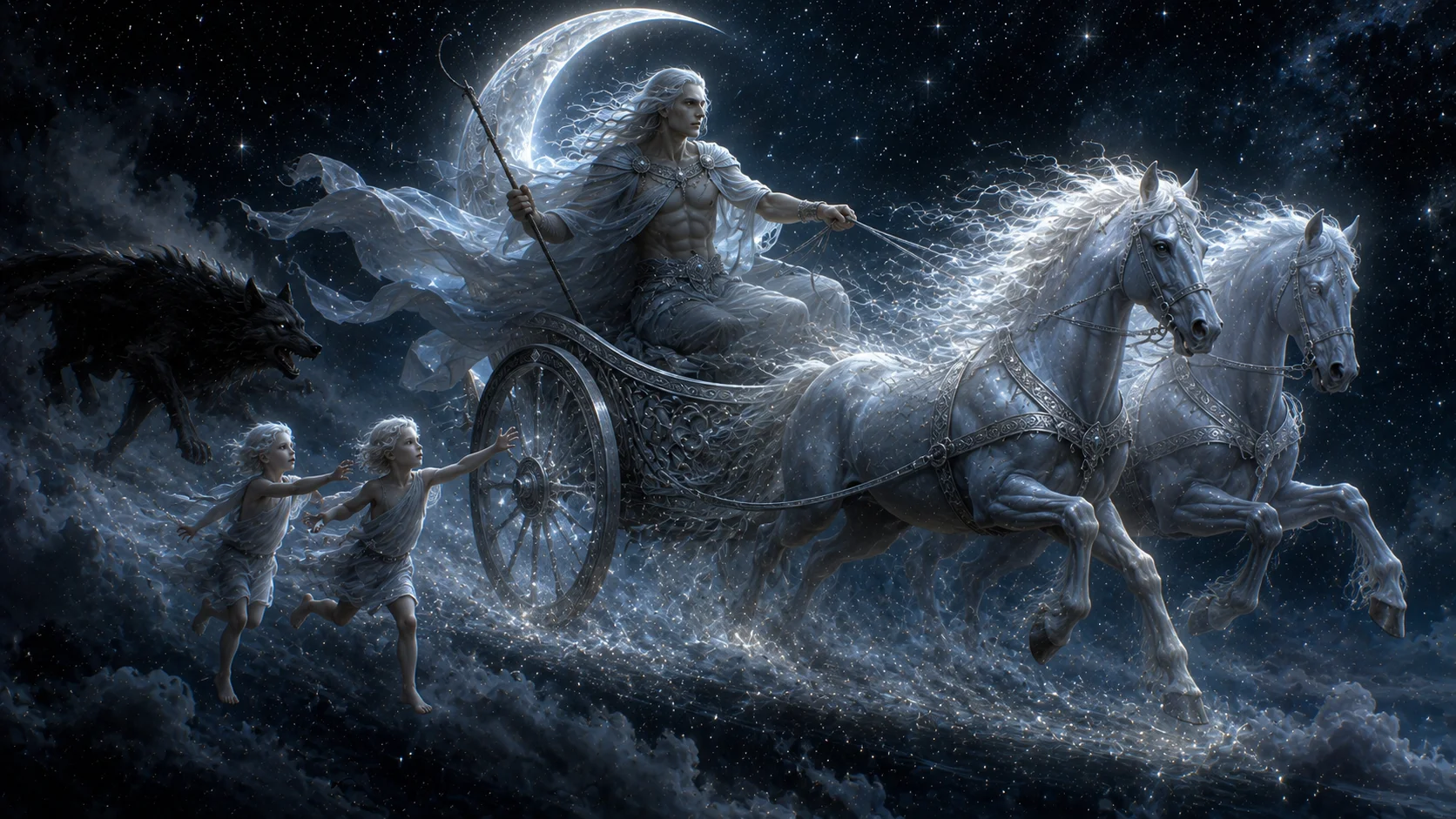
Máni is the personification of the moon in Norse mythology — brother of the sun-goddess Sól, son of Mundilfari, and the tireless driver of the moon's course across the night sky. Attested in both the Poetic and Prose Eddas, he is a quieter figure than many of the north's gods: not a deity of cult and sacrifice but a cosmic function given a name and a fate, the steady counterpart to his sister's blazing chariot, fleeing forever the jaws of a wolf that the north believed would one day close on him.
The Naming That Angered the Gods
According to Gylfaginning, Máni and Sól were the children of a man named Mundilfari, who looked at his son and daughter and, struck by their great beauty, named the boy Máni ('moon') and the girl Sól ('sun') after the two lights of the heavens. It was a father's pride, but the gods took it as presumption. Mundilfari's naming of his children after the sun and moon angered them, and their response was total: they seized the pair and set them in the sky itself, no longer free children but fixed instruments of the cosmos, harnessed to drive the courses of the sun and the moon for the rest of time. It is a myth less about Máni's own will than about how little say he had in the shape of his existence — a beauty that was punished by being made eternal and functional at once.
The Keeper of Nyi ok Nid
Once placed in the heavens, Máni's task was to guide the moon and govern its changing face — described in the old sources as ruling its nyi ok nid, its waxing and its waning. For a culture that measured time by nights rather than days, and by months rather than weeks, this was no small charge. Máni was not merely a light overhead; he was the mechanism by which the passage of time itself became visible and countable, growing from nothing to fullness and shrinking again in a cycle the north set its calendars by. Where Sól's chariot marked the turning of day into night, Máni's marked the turning of night into night, month folding into month, an unbroken rhythm running quietly at the edge of the world's attention.
Bil and Hjúki, Taken from the Earth
Gylfaginning preserves a stranger, more intimate story folded into Máni's cosmic office: that he once took two children up from the earth, a girl named Bil and a boy named Hjúki, as they carried a pail called Sæg slung on a pole called Simul between them. Máni lifted them from the world below and kept them with him in the sky, so that they follow his path even now. The saga gives no fuller account of why he chose them or what became of them beyond this taking — only the image endures, two human children hauling their pail into the heavens and never coming down. Some scholars have connected this tale to the folk image of a face or figures visible on the moon's surface, and even, at a further remove, to later folklore about children climbing a hill with a pail between them, though the precise thread connecting the medieval Icelandic text to that folklore remains debated rather than settled. What the source itself supports is more modest and, in its way, more haunting: Bil and Hjúki became fixtures of Máni's sky, permanent company for a god who otherwise crosses the dark alone.
Named by Every Race of Being
The eddic poem Alvíssmál gives Máni a different kind of prominence: it is one of the entities whose many names the dwarf Alvíss recites when pressed to prove his learning, listing what the moon is called among gods, among elves, among dwarfs, and among giants, each people speaking of the same light in its own tongue. That a single figure could carry so many names across so many kinds of beings speaks to how universally visible Máni was held to be — not a god confined to one hall or one people's worship, but a presence every race under the sky had reason to name for itself, precisely because every race under the sky could see him.
Hati Hróðvitnisson, Running Behind
Máni does not cross the sky unthreatened. He is pursued, according to Grímnismál and Gylfaginning, by a wolf named Hati Hróðvitnisson, who chases the moon much as the wolf Sköll chases Sól's sun across the same heavens. This is presented as the standing condition of the moon's flight, not a single episode: a wolf always at his heels, always hungering, the chase itself woven into the explanation for why the moon moves as restlessly and as fast as it does. The pairing with Sól and Sköll is deliberate and exact — brother and sister, each given their own tireless hunter, each fleeing across the sky for reasons bound up with the same mythic order.
The Devouring Foretold
The chase is not eternal. Norse tradition holds that at Ragnarök, the wolf Hati will finally catch Máni and devour him, just as Sköll will at last catch and devour Sól. It is one of the fixed points of the foretold end of the world: the moon does not merely set or fade but is caught and consumed, its light extinguished by the very hunger that had trailed it since the beginning of its course. The image carries a particular weight because it had always been coming — every night Máni completed his circuit pursued was, in the mythology's own logic, one night closer to the night he would not escape.
A Sister's Different Ending
The Eddas draw a careful distinction in what follows. Völuspá tells that after Ragnarök, a new sun — the daughter of Sól — will continue her mother's path across a renewed sky. This continuity, however, belongs to Sól's line and is not extended to Máni in the surviving sources; no daughter or successor is recorded to carry on his course after Hati's jaws close. The asymmetry is worth sitting with rather than smoothing over: the sun's light is given a future beyond the world's ending, while the moon's fate, as the texts leave it, ends where the wolf catches him.
A God Without a Cult
Unlike Thor or Freyr or many of the north's more actively worshipped figures, Máni appears in the sources as something closer to a cosmic office than a god with altars, priests, or offerings recorded in his name. He is grammatically and narratively treated as the moon's personification more than as a deity petitioned for favor. This does not make him a minor presence in the mythology — his sky is crossed every night, his name is known to every race in Alvíssmál, his fate is fixed in the account of the world's end — but it does mark him as a different kind of figure from the pantheon's more transactional gods: necessary to the order of things rather than approached for aid within it.
Overshadowed by His Own Sister
In modern reception, Máni tends to stand in Sól's shadow, appearing in some neopagan practice and fantasy fiction as a minor lunar deity while his sister draws the greater share of popular attention. It is a quiet irony given how carefully the myths pair the two: brother and sister, sun and moon, each pursued by a wolf, each fixed in the sky by the same act of the gods, each named from the same father's pride. Where Sól has become the more visible half of that pair in later retellings, the older sources give Máni's course, his companions, and his foretold ending no less complete a shape.
The Measure of the Northern Night
Taken whole, Máni's myth is the story of a beauty punished into permanence, a duty faithfully carried out across the growing and shrinking of every month, two stolen children riding forever at his side, and a wolf whose hunger was always going to be satisfied in the end. He is the moon of the north exactly as the north needed one: a light to count the nights by, a chariot fleeing across a sky it never chose, and a reminder, written into the very shape of the myth, that even the lights that govern time are bound by a clock of their own.
Sources & traditions
- EncyclopediaWikipedia — Máni
- TraditionNorse texts, inscriptions and later retellings (Scandinavia)
Myths change from area to area and from time to time. This chronicle follows the most widely told versions; tellings in other villages, regions and eras may differ.