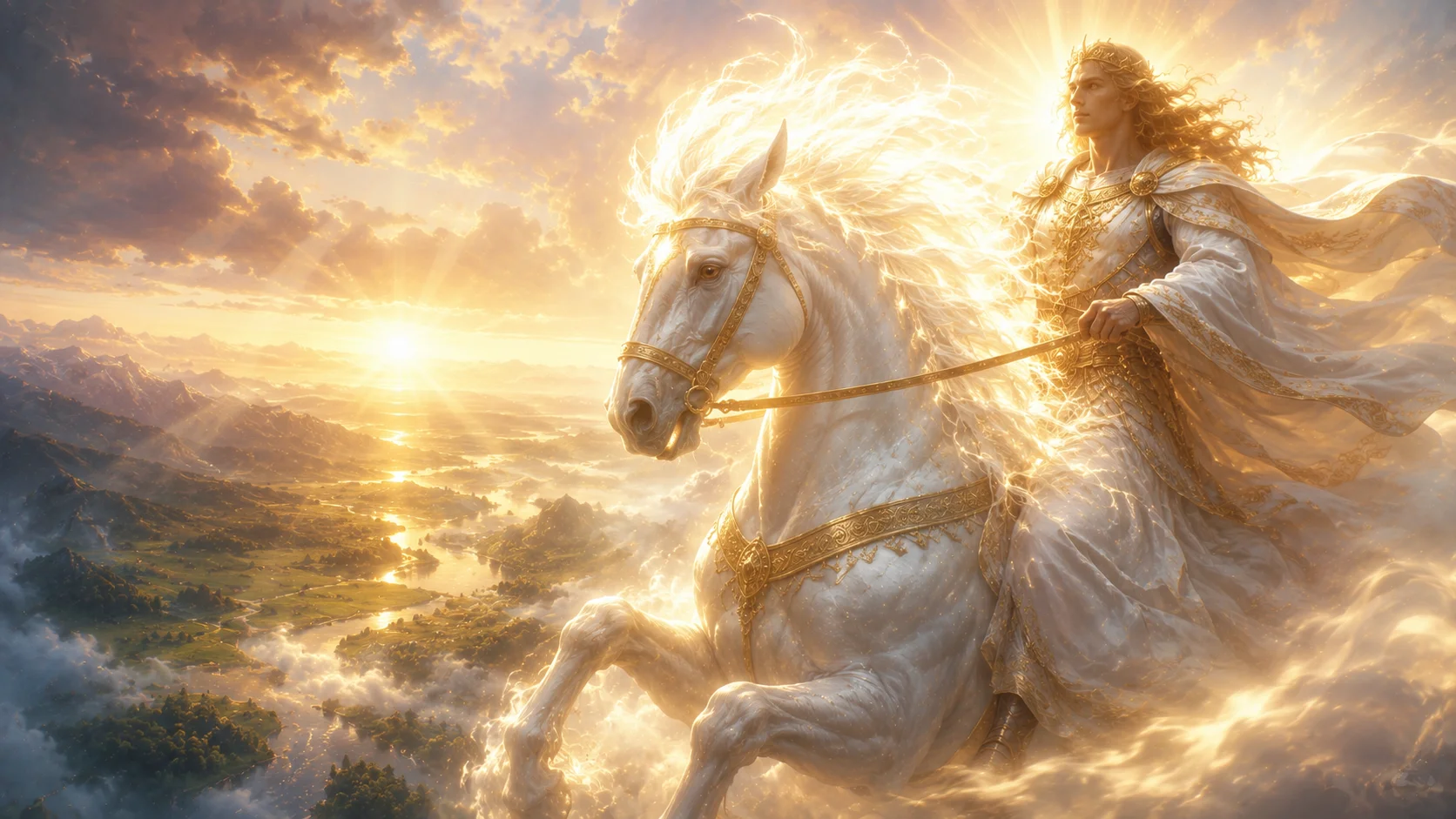
Dagr was the Norse personification of the day — the shining god who rode across the sky each morning on a gleaming horse, bringing daylight to gods and men. Son of the dark goddess Nott (Night), he is the bright half of the eternal turning of day and night, the radiant rider whose passage lights the world.
The Bright Rider
Dagr (Old Norse Dagr, “day”) was the god who personified the daylight, a being radiant and fair as befitted his nature. The Prose Edda’s Gylfaginning names him son of Nott, the goddess of night, by her husband Dellingr (“the shining one”), a figure of or closely associated with the Aesir — and from this union of night and a shining father came the bright day. Dagr himself appears in only a small handful of lines across the surviving sources, yet those lines were enough to fix him permanently in the architecture of the Norse cosmos: he is not a god with adventures, but a god who is an event, repeated without fail every day the world turns.
A Lineage Half of Giants
Dagr’s ancestry is stranger than his sunlit role suggests. Gylfaginning traces his mother Nott back through a line of jotnar — the giants of Norse cosmology — making Dagr himself, the shining bringer of day, partly descended from that same giant stock through his mother’s side. It is a detail easy to miss and worth dwelling on: the Norse did not build daylight out of purely divine material. Day is the offspring of Night, and Night is a daughter of giants, so the brightness that floods the world each morning carries, in its own genealogy, the darkness and the old, elemental forces it is forever riding out to dispel. Nothing in the sources suggests this ancestry troubled Dagr’s standing or his welcome among the Aesir; it simply reflects how thoroughly the mythology entangled the orderly world of the gods with the primal world that preceded it.
Brothers and Half-Brothers by Night
Because Nott is said to have borne children by more than one husband across her successive marriages, Dagr stands as half-brother to several other figures descended from her by different fathers. The sources are spare on the details of these siblings, and nothing beyond the bare fact of shared maternal descent is recorded about how Dagr related to them. What matters cosmologically is the structure itself: Night is a mother whose family spans unions with different fathers, and Day is one branch of that family, singled out and given his own horse, his own chariot, and his own fixed task in the turning of the world.
Odin’s Gift of Horse and Chariot
Per Gylfaginning, it was Odin himself who gave Dagr and his mother Nott each a horse and a chariot, so that the pair might ride around the earth once every twenty-four hours. This is one of the few active verbs attached to Dagr in the entire mythological record — he does not act so much as he is equipped to act, granted by the chief of the Aesir the means to perform an unending cosmic office. The gift itself is the whole of his story: a horse, a chariot, and a circuit of the earth repeated forever. Norse myth rarely bothers to narrate what does not change; Dagr’s ride belongs to that category of things so constant they need no plot, only an explanation of how they came to be.
Skinfaxi, the Shining-Mane
Dagr’s horse was named Skinfaxi (“shining-mane”), attested by name in both the Prose Edda’s Gylfaginning and the Poetic Edda’s wisdom-contest poem Vafthrudnismal, where the riddling exchange between Odin and the giant Vafthrudnir includes the naming of the horse that draws bright day over mankind. It was from the gleaming of Skinfaxi’s mane that the light of day was said to spread across the sky and the earth. As Skinfaxi galloped along Dagr’s course, his radiant mane lit the air and the land, so that the very coming of daylight was the shining of the day-horse’s mane streaming across the heavens. It is one of the loveliest images in Norse cosmology: the dawn as a bright horse’s mane catching fire with light as it runs, visible confirmation, morning after morning, that the god has begun his circuit again.
Hrimfaxi and the Order of the Ride
Dagr does not ride alone through the myth’s telling of the cosmic cycle; his mother Nott precedes him, drawing her own horse, Hrimfaxi (“frost-mane” or “rime-mane”), across the sky first, bringing the darkness and the cold dew that the frost-horse’s mane was said to scatter over the earth. Only after Nott’s circuit does Dagr follow with Skinfaxi, bringing the day in turn. The order is fixed and repeats without variation: night, then day, mother before son, dark mane before shining mane, forever. Vafthrudnismal preserves this pairing explicitly, naming both horses within the same riddling exchange.
The Wheel That Never Stops Turning
Together, Dagr and Nott make up the ceaseless alternation of day and night that ordered the lives of gods and mortals alike. Mother and son ride the same circular course one after the other, each completing the circuit in turn, around and around, so that the world passed forever from darkness into light and back again. In this the Norse gave a face and a genealogy to the most basic rhythm of existence: not an abstract mechanism but a family riding in eternal procession across the heavens, night always yielding to day and day always yielding back to night, an order stable enough that Vafthrudnismal could cite it as the kind of settled cosmic knowledge a wise being ought to know without hesitation.
A God Without a Story
What is striking about Dagr, set beside gods such as Thor or Freyr, is how little narrative attaches to him. He has no independent myths beyond his cosmological role: he does not appear as an actor in Ragnarok, plays no part in the death of Baldr, and is given no spouse, no children, and no conflicts anywhere in the surviving sources. He is not absent from the mythology so much as he is present in a different register — not as a character who does things within the story, but as a fixed condition the story assumes. Every episode in Norse myth that takes place “during the day” happens, in effect, because Dagr has already ridden out; the god is folded invisibly into the background of nearly every other tale, present everywhere and named almost nowhere.
A Name Worn by Mortals Too
The word Dagr was also simply the Old Norse word for “day,” and it saw wide use as an ordinary personal name among legendary and historical figures recorded in the sagas, entirely apart from the divine personification. Care is needed not to conflate these human bearers of the name with the god who rides Skinfaxi across the sky; the sagas’ various men named Dagr are historical or legendary persons with their own genealogies and deeds, sharing nothing with the cosmological figure but the word itself. The overlap is a reminder of how deeply the vocabulary of the mythology was woven into everyday Norse speech — the day was not only personified as a god but named, for ordinary people, with the god’s own name.
A Minor Presence in Later Retellings
Dagr has carried only a limited independent cultural presence forward from the medieval sources. Where he appears in modern fantasy adaptations, it is typically in the same register the Eddas gave him: a minor cosmological figure invoked to explain or dramatize the passage from night to day rather than a protagonist carrying his own arc. This modest afterlife suits a god whose entire recorded character is a single, repeated act of riding — there is little plot to expand and no hidden motive to excavate, only the fact of a bright horse crossing the sky once every day since the gods first set the world in motion.
The Coming of the Light
Dagr endures as the Norse personification of the day — the bright rider on the shining-maned horse, son of night and grandson of giants, bringer of the daylight that floods the world each morning. He embodies the northern wonder at the daily return of the light, especially precious in lands of long dark winters, and completes the Norse vision of time itself as something living and divine: not an abstraction, but a god and his mother riding their horses in turn across the sky, weaving day and night into the endless fabric of the world.
Each morning the bright god rides out on a horse whose shining mane sets the sky alight — for to the Norse, the coming of day was the gleaming of Skinfaxi’s mane across the heavens.
Sources & traditions
- EncyclopediaWikipedia — Dagr
- TraditionNorse texts, inscriptions and later retellings (Scandinavia)
Myths change from area to area and from time to time. This chronicle follows the most widely told versions; tellings in other villages, regions and eras may differ.