Before the mouth of a cave called Gnipahellir, something is howling. It has been howling, in one telling or another, since before the first gods fell. The sound carries across the boundary between the living world and the dead, and every time a listener hears it rise a little louder, a little closer to breaking free, they understand what it means: the fetters are failing, the wolf is nearly loose, and the end the seer foresaw is one step closer. The hound making that sound has a name — Garm — and almost nothing else. No parentage, no color beyond the blood that stains him, no story of how he came to guard that gate. He exists in the surviving texts almost entirely as a voice and a fate: the voice that marks the countdown to Ragnarök, and the fate of dying alongside the god who kills him.
The Cave at the Edge of the Dead
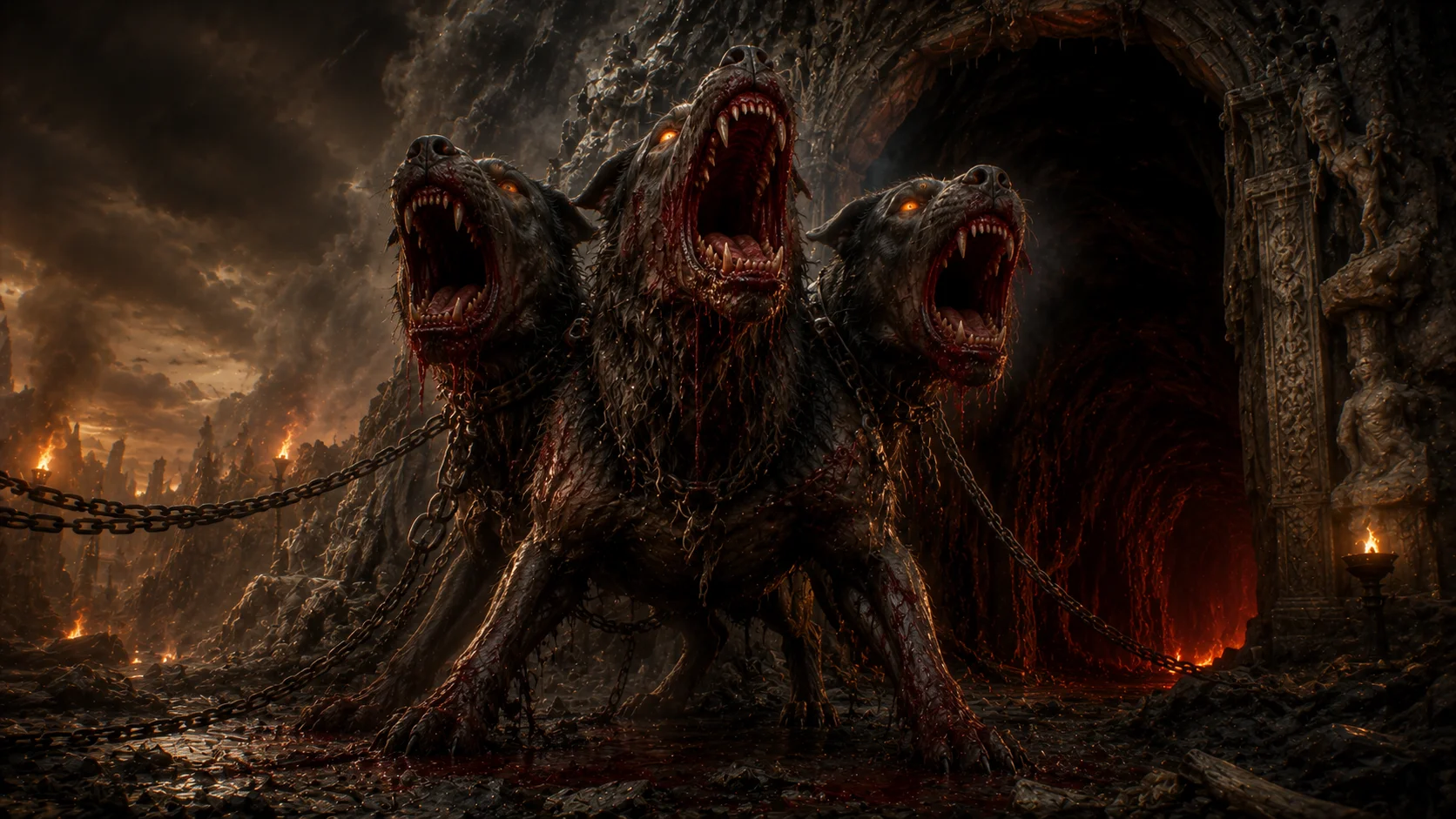
Garm — Old Norse Garmr — is a hound, and the one physical detail the sources commit to is that he is blood-stained. He guards the entrance to Hel, the realm of the dead, and he does it from a specific place: a cave named Gnipahellir, the "overhanging cave" or "cliff cave," set before Hel's gate like a threshold nothing living is meant to cross uninvited. Hel here is not damnation in the Christian sense. It is the destination for those who died of sickness and old age rather than in glory — a separate cosmological address from Valhalla, where Odin gathers the honored slain. Garm's post is specifically at the border of that quieter underworld, the one for ordinary death rather than heroic death, and his job is to keep it shut.
No source explains how he came to hold that post, who set him there, or what he looked like beyond the blood. Norse myth is often like this — an image handed down without its scaffolding — and Garm is one of the starkest examples. He is a function first and a character a distant second: the guardian, the watcher, the thing that bars the gate of the dead and, when the time comes, stops barring it.
A Refrain Built to Repeat
Garm's clearest appearance is in Völuspá, the great prophetic poem of the Poetic Edda in which a seeress recounts the history and the coming destruction of the world to Odin. Within that recounting, one line returns again and again like a drumbeat: Garm howls loudly before Gnipahellir; the fetter will break and the wolf run free. It is not delivered once and left behind. It recurs, each time landing a little differently against the events building around it, so that by the time Ragnarök actually arrives the reader has already heard its herald bark a dozen times.
Now Garm howls loudly before Gnipahellir; the fetter will break and the wolf run free.
That structure matters as much as the content. Garm's howling is not a single omen among many, noted once and moved past. It is the poem's own pulse — a line planted early and repeated on a schedule the audience comes to recognize, so that its final recurrence lands not as new information but as the moment a held breath is finally released. Whoever composed Völuspá understood that dread builds through repetition, and gave that job to a dog at a cave mouth rather than to a god.
What the Howling Means
The refrain does more than announce Garm. It ties his voice to the wolf Fenrir's fetter — the binding that holds the great wolf in check until Ragnarök looses him to kill Odin. Garm's howl and Fenrir's breaking bond are yoked together in the same line, over and over, as if the poem wants its audience to feel them as a single unraveling rather than two separate events. Across Völuspá's account of the end, bonds fail one after another: the wolf's fetter, the ties holding back monsters and giants, the order that had kept the world's worst dangers penned. Garm's howling belongs to that larger pattern — one more restraint giving way, one more warning that the thing being contained will not stay contained much longer.
There is no scene of Garm actually straining at a chain, no description of what binds him or who bound him. The poem is content to let the sound carry the meaning. A hound baying louder and louder before a cave is, on its own, enough to tell an audience steeped in this cosmology that the end is approaching — the same way a rising wind tells a sailor a storm is close before a single cloud is named.
Named Best Among Dogs
Garm surfaces a second time in the Poetic Edda, in Grímnismál, a poem largely structured as a catalogue reciting lists of the best of various things: the best of gods, the best of trees, and, among them, the best of dogs. The line naming him there is brief and almost offhand: Garm is best of dogs. It is a strange kind of honor for a creature otherwise defined by blood and doom, but it fixes something worth noticing — that in this tradition, the guardian of Hel's gate was not merely feared. He was ranked, and ranked first, in a poem otherwise busy listing the finest things the Norse cosmos had to offer. Fearsome and foremost were not, apparently, in tension.
The two Poetic Edda appearances are almost all that survives of Garm as an independent figure. He does not recur in Snorri Sturluson's Prose Edda with any elaboration beyond the general cosmology of Hel that the Gylfaginning section lays out, and no picture stone or rune carving has been identified as depicting him — unlike Fenrir, who does appear in some Viking Age stone imagery. Garm is a creature almost entirely of poetry, known through two brief eddic mentions and nothing carved, painted, or built to accompany them.
The Battle No One Wins
At Ragnarök itself, Garm's role finally moves from omen to action. He breaks free — the fetter the refrain warned about finally gives — and joins the general unraveling: giants marching, monsters loosed, the ordered world coming apart on every front at once. On the battlefield, Garm's opponent is Tyr, the one-handed god of war and justice, the god who had earlier sacrificed his own hand into Fenrir's jaws so the wolf could be bound in the first place. The two meet, and neither wins. Garm and Tyr kill each other — the guardian hound and the god who had once paid a hand for the world's safety, falling together in the same moment.
It is worth being precise about what this is not. Garm does not fight Odin — that death belongs to Fenrir, in the same battle, on a different part of the field. And Garm's realm is not Valhalla; he never guards the halls of the honored dead, only the quieter gate of Hel. His death-match is specifically with Tyr, and it echoes a pattern that runs through the whole of Ragnarök as Völuspá tells it: paired destructions, each side taking the other down. Odin falls to Fenrir. Thor falls to Jörmungandr, and kills the serpent in the same stroke. Freyr falls to Surt. And Garm and Tyr fall together, hound and god, guardian and the one who once bled to buy the world a little more time.
One Hound, or Two Names for the Same Beast?
A question that will not quite settle: is Garm his own creature, or is he Fenrir wearing a second name? The case for identification is not frivolous. Both are bound monstrous canines. Both are released at Ragnarök. Both die in single combat with a god who had a special, personal stake in containing them — Tyr for Garm, Odin for Fenrir — and the shapes of those two fights mirror each other closely enough that some scholars have wondered whether the tradition once told one story about one hound-monster and later poets or copyists split it, or preserved two regional variants, without fully reconciling them.
But the mainstream reading — and the one the surviving texts more directly support — keeps them separate. Fenrir is a wolf, explicitly fated to kill Odin. Garm is a hound, stationed at Gnipahellir before Hel's gate, explicitly fated to kill and be killed by Tyr. The poems name them as distinct figures with distinct opponents and never collapse the two into one. The identification theory survives as a live scholarly conversation, not a settled fact, and it is worth holding both things at once: the resemblance is real, and the primary sources still treat them as two.
A Name Worn Thin
The word garmr itself carries traces of what this figure might once have meant more broadly. Beyond its use as this specific hound's name, Old Norse could use garmr as an ordinary or even contemptuous word for "dog" — closer, perhaps, to how English uses "cur" or "mutt" than to a proper name. Some etymological discussion connects the root to ideas of howling, yapping, or roaring, which would make the name almost a description folded into itself: the Howler, dwelling at the cave, doing exactly what his name says until the day he stops.
That double life — proper name and generic word for "dog" occupying the same word — is a small but telling detail. It suggests a figure who may have started as more archetype than individual: not so much a specific, storied hound with a lineage and a personality, but the idea of the guard-dog itself, elevated to cosmic stakes and given a place in the poem where the world ends.
The Shape of the Silence
What is most striking about Garm, read against other Norse monsters, is how little the sources bother to tell. Fenrir gets an origin, a family, a binding scene, a prophecy naming his specific victim. Garm gets a cave, a color, a howl, and an opponent. No birth story. No parentage. No account of who chained him there or why a hound was chosen for that post rather than some other creature. The Prose Edda, which elsewhere loves to fill in the mechanics behind a mythological image, never turns its attention to Garm's backstory at all.
That silence is not necessarily a loss of material — it may simply be how this figure was always meant to function. A gatekeeper does not need a biography for the sound of his howling to do its work. The poem needed a border-warden whose voice could be dropped into a repeating refrain, tightening with each recurrence, and Garm's spareness may be exactly what let him serve that purpose so well. He is less a character the audience is meant to know than a signal the audience is meant to dread.
A Guardian Among Guardians
Garm belongs to a pattern found well beyond Scandinavia: the underworld watched over by a monstrous dog. The comparison most often drawn, in secondary scholarship rather than in the Old Norse texts themselves, is to Cerberus, the multi-headed hound who guards the entrance to the Greek underworld. Neither tradition borrows directly from the other so far as the sources show, but the convergence is easy to see — different peoples, working independently, arriving at the same instinct that the boundary of death needs a dog standing watch over it, fierce enough to keep the wrong things from crossing in either direction.
Garm's version of that instinct is specifically Norse in its stakes: his watch is not permanent. Where Cerberus's myths do not typically hinge his guard-duty to the end of the world, Garm's whole narrative function is temporary by design — he holds the gate only until Ragnarök arrives, at which point holding it stops being possible and dying in battle becomes his role instead. He is a guardian built, from his very first mention, to eventually fail at guarding.
What the Cave Still Holds
Strip away everything uncertain and what remains is compact but resonant: a blood-stained hound at a cave called Gnipahellir, keeping watch at the gate of Hel; a refrain in Völuspá that uses his howling to count down to the world's end, tying his voice to the failing of Fenrir's own bonds; a passing but genuine honor in Grímnismál, named best among dogs; and a final battle at Ragnarök in which he and Tyr — hound and one-handed god — kill each other in the same stroke. Around that core sits real uncertainty, honestly unresolved: whether he is his own being or another name for Fenrir, what his howl truly signified beyond omen, why a hound was chosen for this post at all.
Modern retellings tend to flatten Garm into a generic "hellhound," one more entry in a long list of scary underworld dogs borrowed for games and fiction with little of the specific texture the Eddas gave him. But the texture is there for anyone who goes looking: not a monster introduced with menace and elaborated at length, but a voice heard again and again before it is ever explained, growing louder each time, until the day it finally stops guarding and starts fighting — and the hound who was once simply "best of dogs" dies taking a god down with him.
Sources & traditions
- EncyclopediaWikipedia — Garmr
- TraditionNorse texts, inscriptions and later retellings (Scandinavia)
Myths change from area to area and from time to time. This chronicle follows the most widely told versions; tellings in other villages, regions and eras may differ.