Vidar was the Norse god of vengeance, silence and the deep forest — the strong, silent son of Odin who is fated to avenge his father at Ragnarök by slaying the great wolf Fenrir, and who is among the few gods destined to survive the end of the world and walk in the new age. Second in strength only to Thor, he is the quiet avenger upon whom the future itself depends.
The Silent God
Vidar (Old Norse Víðarr) was a son of Odin by the giantess Grid, and was called “the silent god” — a deity of few or no words, grave and reserved, who dwelt apart in a wild realm of deep woods and tall grass called Víði. He was reckoned the strongest of the gods after Thor, a being of immense power held in quiet reserve. His silence was not weakness but a kind of gathering: he was the god who waited, holding his strength for the one terrible deed for which he was destined.
The Shoe of Vidar
One of the strangest details in all of Norse myth concerns Vidar's footwear. It was said that throughout all the ages, in every land, people who trimmed leather to make shoes would cut away the scraps at the toe and heel and cast them aside — and that all these discarded leather scraps, gathered from all the world and all of time, went to build a single mighty shoe for Vidar. This shoe was being assembled for one purpose alone: the day when Vidar would need it to face the wolf at the end of the world. The Norse even advised that one who wished to aid the gods should cut these scraps carefully, to add to Vidar's shoe.
The Vengeance Against Fenrir
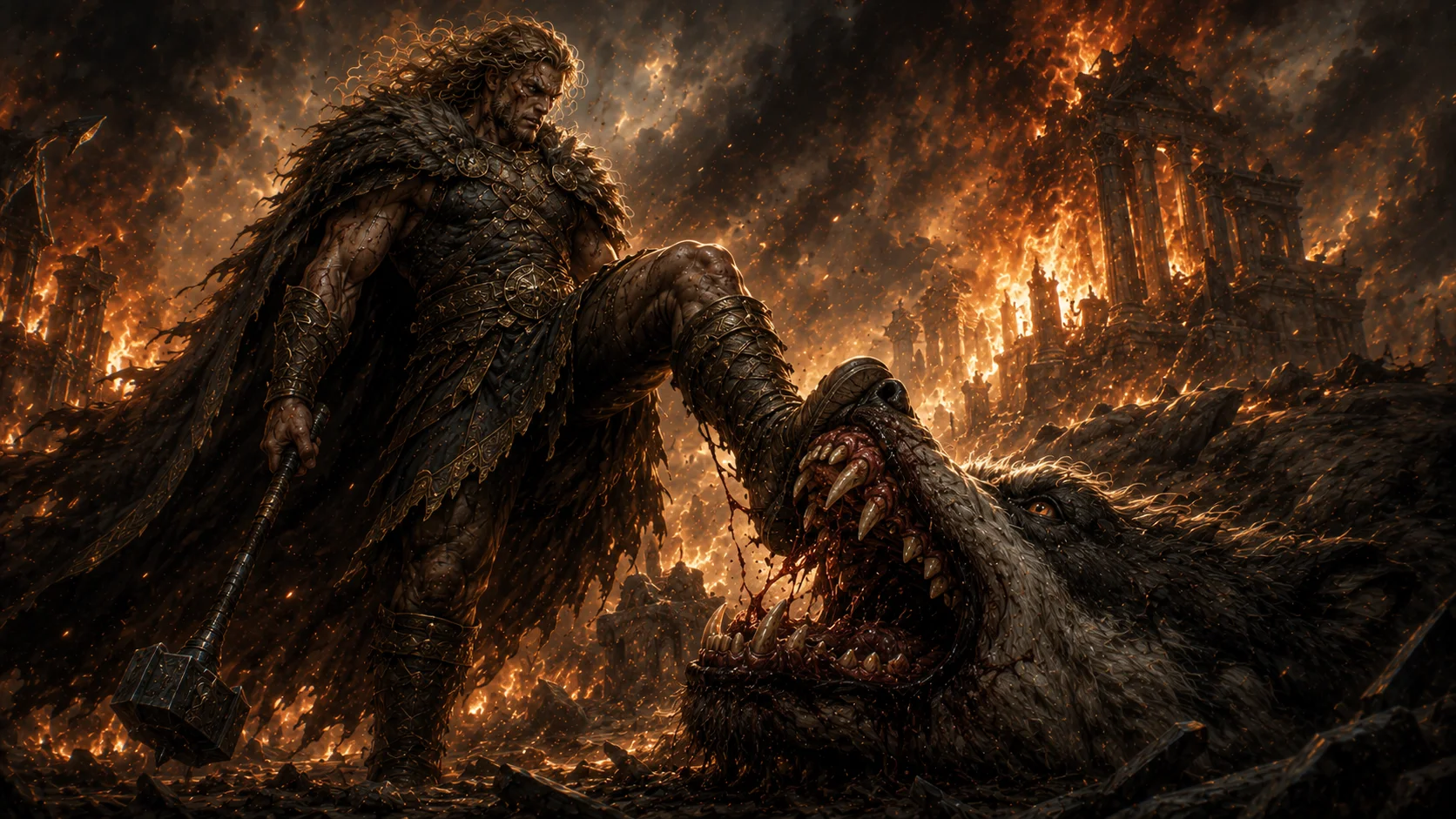
At Ragnarök, the great wolf Fenrir breaks free and devours Odin himself, swallowing the All-Father whole. And then Vidar steps forward to avenge his father. With his great shoe — the one built of all the leather-scraps of all the ages — he plants his foot upon the wolf's lower jaw, that mighty boot protecting him from the beast's teeth; with one hand he seizes the wolf's upper jaw, and he tears Fenrir's mouth apart, rending the monster and killing it, avenging Odin and destroying the beast that was the gods' ancient dread. It is the silent god's single great act, the deed for which all his strength was held in reserve.
The God of the World to Come
Vidar is one of the handful of gods fated to survive Ragnarök — to walk out of the fire and flood of the world's ending into the new, green, cleansed world that rises after, there to dwell with the other survivors and the returned Baldr. He endures as the god of vengeance and renewal, the quiet strength that outlasts the catastrophe, the avenger who slays the wolf and then steps into the future. He embodies the deep Norse hope hidden within their vision of doom: that even the end of the world is not the absolute end, and that some things — strength, justice, the patient god who waited — pass through the fire and live on.
The silent god said nothing through all the ages, gathering his strength and his shoe of leather-scraps — until the day the wolf ate Odin, and Vidar tore the beast apart and walked on into the world reborn.
The Poems That Named Him
Vidar is not a late invention grafted onto the Ragnarök story to give it a tidier ending — he appears by name in the oldest poetry Norse cosmology survives in. The Vafþrúðnismál, a wisdom-contest poem of the Poetic Edda, already assumes its audience knows who will kill the wolf and who will be left standing afterwards; it does not introduce Vidar so much as confirm him. The Grímnismál goes further and gives him an address: in its catalogue of the gods' dwellings, one stanza sets Vidar's land thick with brushwood and high grass, and names it as the ground from which the bold son will spring from horseback to avenge his father. A horse, a rider, and a wood nobody else lives in — that is the whole of him in the older verse, and that verse is generally reckoned older than the fuller prose account Snorri Sturluson assembled in the Gylfaginning around 1220, which is where most retellings take their detail from.
The One Order Odin Gives Him
Vidar's appearance in Lokasenna is easy to miss, and says more about him than almost anything else does. He is named in the poem's prose introduction among the gods seated in Ægir's hall, where Loki works his way around the table accusing each god in turn of cowardice, adultery and worse. Every other named god answers him back — Odin, Frigg, Freyja, Njord, Tyr, Skadi, Sif, and finally Thor, who arrives late and ends the flyting with a threat of his hammer. Vidar never speaks a line. He does exactly one thing: early in the quarrel Odin tells him to rise and let the wolf's father sit at the feast, and a single line of prose records that Vidar stood up and poured Loki his drink. The god fated to tear the wolf apart is told, in front of everyone, to serve the wolf's father a cup — and does it, without a word. It is the only place in the surviving corpus where his silence is not described but simply staged.
A Name Nobody Has Settled
Old Norse Víðarr has never been given an agreed meaning, and the disagreement is itself worth knowing about. The commonest reading takes the first element as víðr, “wide, far-reaching,” and the second as the -arr shared by a whole class of Norse names and traced back to a word for a fighting host — producing something along the lines of “the wide-ruling one.” A rival reading starts instead from viðr, “wood, forest,” which would make him simply the forest god and sits neatly beside the overgrown realm the Grímnismál assigns him. Nothing in the sources decides between them, and the two candidates describe the same god from different angles: sheer extent, or wilderness. What neither of them is, notably, is a warrior's name. Nobody called him the slayer of anything, though slaying is the single thing he is remembered for.
Two Sons, Two Kinds of Vengeance
Norse tradition answers the killing of a god with vengeance twice, and the two acts are worth setting side by side. When Baldr is killed, Odin fathers Vali on Rind, and the verse is precise about the speed of it: Vali kills when he is one night old, and will neither wash his hands nor comb his hair until he has carried Baldr's slayer to the pyre. Vidar is that story's mirror image in every respect that matters. Where Vali is begotten fast and acts fast, while the world is still whole, Vidar already exists and simply waits — through ages, through the entire span of the world, saying nothing, until the morning when saying nothing is no longer possible. Between the two of them the mythology keeps both versions on record: vengeance as reflex, and vengeance as a lifetime of holding still.
What Is Left, After
The Vafþrúðnismál and the Gylfaginning both name the gods who walk out of Ragnarök, and the list rewards reading as a list. Vidar and Vali survive from the elder generation. Modi and Magni, Thor's sons, arrive carrying Mjöllnir, their father having killed the World Serpent and then fallen dead of its venom. Baldr and Hod return from the dead to join them on Idavoll, the plain where the gods raised their first halls. It is a spare census, and almost none of the figures whose stories dominate the mythology are on it — no Odin, no Thor, no Loki, no Freyja. What survives is largely the second rank: the silent one, the one-night-old avenger, and two sons inheriting a hammer they did not win. The new world is not handed to the gods who did the most in the old one. It goes to the ones who were held in reserve.
A Foot in the Wolf's Jaw, Carved in Stone
Vidar's single scene may have left a mark outside the manuscripts, though stone is harder to read than verse. The tenth-century cross at Gosforth in Cumbria — a Christian monument raised where Norse settlers were taking on a new religion without discarding the imagery of the old one — carries panels long identified with Norse myth, including a bound figure attended by a woman, read as Loki and Sigyn. Another panel, in which a man forces open the jaws of a beast, is commonly proposed as Vidar and Fenrir, and it is the nearest thing we have to a picture of the deed. But an identification is a reading, not a caption. The Manx slab known as Thorwald's Cross shows the same basic image — a foot driven into a wolf's mouth — and there the figure carries a spear with a bird at his shoulder, so it is normally taken for Odin being devoured rather than Vidar avenging him. Father and son meet the same wolf, and in carving the difference between them can come down to whether the mason gave the man a spear.
A Name That Outlived the Religion
Most of the minor Norse gods survive only in scholarship. Vidar is an exception: Vidar is an ordinary given name in Norway and Sweden today, worn by living men with no particular interest in Ragnarök. Nothing about the god required that outcome. Odin and Thor left weekday names and place names by the hundred, monuments of a sort. The silent one left something smaller and stranger — not a monument but a name people still choose, belonging to a god whose entire story is doing nothing at all until the one moment when everything depends on him.
Sources & traditions
- EncyclopediaWikipedia — Víðarr
- TraditionNorse texts, inscriptions and later retellings (Scandinavia)
Myths change from area to area and from time to time. This chronicle follows the most widely told versions; tellings in other villages, regions and eras may differ.