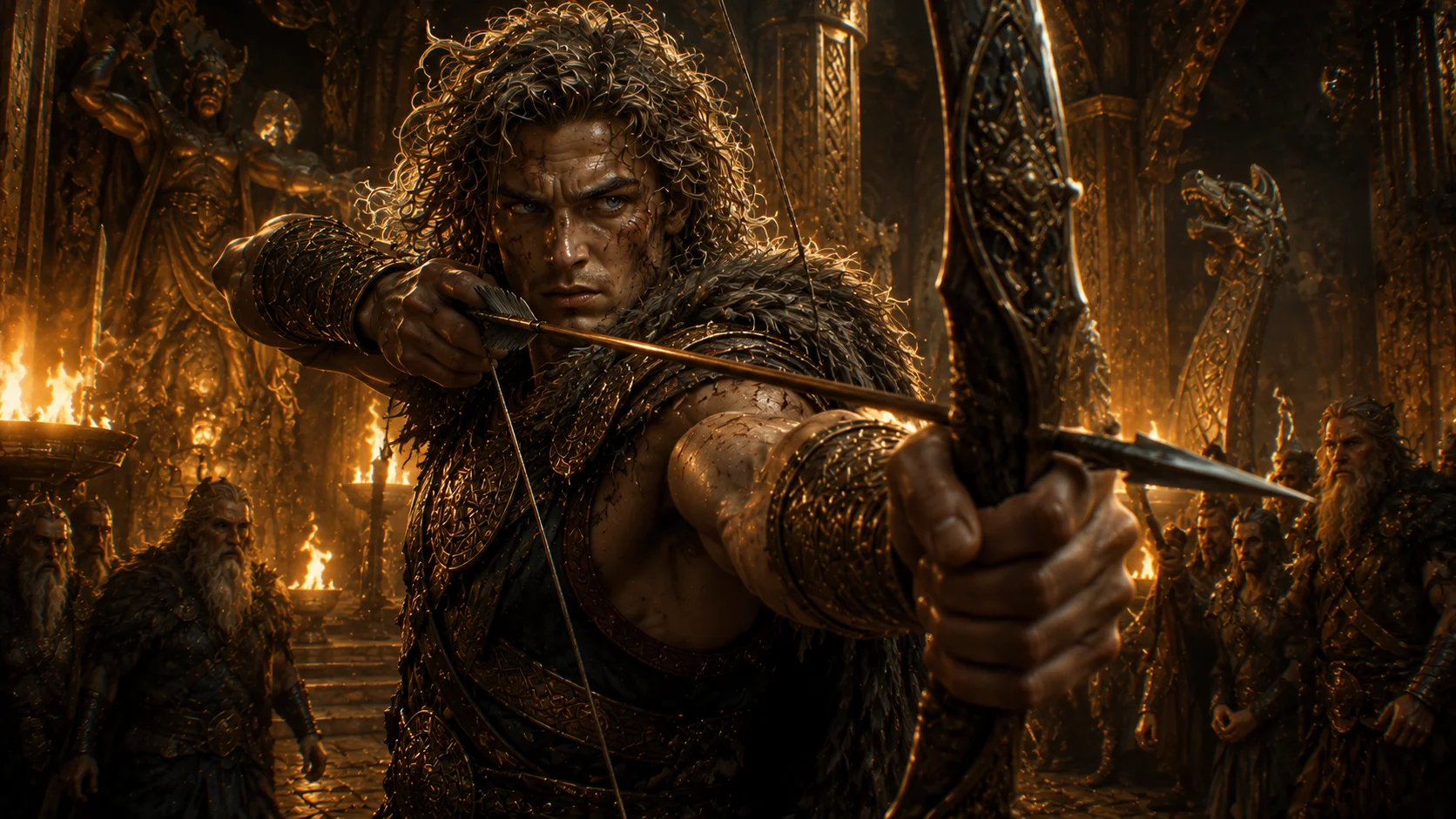
Váli was the Norse god of vengeance — a son of Odin begotten for a single, narrow purpose, who came into his strength within a day and avenged the death of Baldr before that same day had passed. Born of the All-Father's grief and a prophecy that named no other hand fit for the deed, the avenger-child who matured in a morning is counted, too, among the gods who walk on past the ruin of the world.
A Name Prophecy Demanded
Váli's existence begins not with a birth but with a foretelling. After Baldr, the shining and best-loved of the gods, was struck down, the gods needed vengeance — yet the sources are clear that none of the standing gods were fated or permitted to carry it out themselves. Odin, seeking answers, rode to consult a völva, a seeress summoned from the dead in the poem Baldrs draumar. What she told him was exact and unyielding: only a son born of Odin himself and the giantess Rindr could avenge Baldr. No substitute would serve. The vengeance had, in effect, already been assigned to a child who did not yet exist.
Rindr, Daughter of Frost and Distance
Rindr is named in the sources as a jötunn, a giantess, though what exactly she represents beyond that is left unresolved by the Eddic texts themselves — some later readings associate her with the hard, frozen earth, but this is interpretation rather than settled fact. What the myth insists upon is narrower and stranger: that she alone, of all beings, was the vessel through which the prophecy could be fulfilled. Her union with Odin is not romance in any ordinary sense. It is the mechanism by which an avenger is manufactured, deliberately, to answer a debt the other gods could not pay.
The Wooing, As Later Poets Told It
Snorri Sturluson's Eddic prose gives only the bones of how Odin came to father Váli upon Rindr. It is the Latin historian Saxo Grammaticus, writing his Gesta Danorum centuries later, who fills the gap with an extended and euhemerized account — Odin, styled there as the mortal-seeming Othinus, pursuing Rinda through disguise and magical persuasion until she yields. This should be understood as a distinct literary elaboration layered onto the myth rather than core Eddic material; it fleshes out a story the older poems only assume the audience already knows, but it is not itself the source of the prophecy or the vengeance. The two strands — terse Eddic necessity and Saxo's ornamented courtship — sit side by side rather than as a single unbroken account.
Born Without Ceremony
When Váli came into the world, he did not linger as an infant. The poem Völuspá states the fact starkly: he was born, and grew, and killed — all within his first night of life. He did not wash his hands. He did not comb his hair. Both details, small as they sound, are pointed: they mark a total suspension of the ordinary rites a person performs before undertaking anything solemn. There was no time for grooming, no pause for ritual cleanliness, because the deed the prophecy demanded of him could not wait even that long. He was not raised toward vengeance. He was made for it, and he moved toward it the instant he existed.
Blood Owed for Blood
The one who had loosed the fatal blow against Baldr was the blind god Höðr, whose hand — guided, though Váli's own myth does not dwell on who guided it — had thrown the mistletoe shaft that killed his brother. The Norse world ran on a logic of blood-debt: a killing demanded an answering killing, and until that debt was paid the matter could not be considered closed. Váli's entire attested purpose, across both Gylfaginning and Völuspá, is this single act: he sought out Höðr and slew him. Nothing else is recorded of why or how beyond that the deed was done, and done with the speed the prophecy required. It is, in the full record of his myth, the only thing he is ever shown to do.
A Debt Discharged, Nothing More Asked
What is notable about Váli, set against the other gods of the pantheon, is how little else is attached to his name. He has no hall, no wife, no further quarrels, no second myth. He is not counted among the gods who feast, scheme, or wander the nine worlds on other errands. The sources give him one entrance, one action, and then silence — as though, the debt paid, his story had nowhere left to go. This spareness is itself a kind of statement: he was not a god who accumulated a life. He was an answer to a single question, and once the question was answered, the myth had no further use for him.
One Name, Two Sons, No Relation
A separate figure bearing the same name appears elsewhere in the corpus, and the two must not be folded into one. In the account of Loki's binding, after Loki's crimes against the gods had run their course, the gods transformed one of Loki's own sons into a wolf; that wolf-son tore apart his brother Narfi, and it was with the entrails of the slain brother that Loki himself was bound to the rocks. In some tellings, the transformed son is also named Váli. This is a different figure entirely from Odin and Rindr's son — a doomed child of Loki's household, caught up in his father's punishment, sharing nothing with the avenger of Baldr but a name. The confusion is old and persistent enough that it recurs even in modern popular retellings of the Baldr cycle, but the sources themselves keep the two apart: one Váli exists to deliver justice for Baldr's death, the other is destroyed as part of Loki's own reckoning. This entry concerns only the first.
Kin to the God Who Waits With a Blade
Váli is not the only son of Odin marked out for a role in the world's final hours. His kinship with Víðarr, another son of Odin reserved for a decisive act at Ragnarök, places him within a pattern the mythology draws more than once — sons begotten or preserved by Odin specifically because a moment would come when an ordinary god could not act, and only an outsider's child would do. Váli's moment was Baldr's death. Víðarr's is still to come, at the world's ending itself.
Among Those Who Cross Into the New World
When Ragnarök finally breaks — when the sky splits and the old gods fall to the wolf and the serpent and the fire-giant — the sources name a small handful who are not consumed by it. Váli is among them, listed alongside Víðarr as gods who endure the burning of the nine worlds and walk on into whatever rises after. It is a strange kind of continuity for a figure otherwise defined by a single night's violence: the avenger who existed to close one debt is also, by the same texts, one of the seeds carried forward into the world that comes next. No further deed is recorded for him there either — only his survival, stated as plainly as his birth and his killing were.
A Duty, Not a Character
Read against the wider shape of the mythology, Váli is less a personality than an instrument the prophecy required and the gods could not refuse. He is granted no development because the story never asks anything of him beyond the single obligation he was created to fulfill. In that sense he is one of the purest expressions in the Norse corpus of the blood-feud's absolute claim: a debt so binding that a new god had to be conceived, grown to strength in a day, and sent out unwashed and uncombed to settle it, because none of the debt's rightful claimants was permitted to settle it themselves.
What the Record Withholds
No kennings for Váli survive beyond descriptions of him as Baldr's avenger or as Rindr's son — he was never woven into skaldic verse the way more storied gods were, and no poet left him a nickname of his own invention to be traced through later tradition. There is no account of a wife, no attributed hall among the gods' dwellings, no further conflict recorded either before or after Ragnarök. The silence is not an absence of evidence so much as the shape the myth gave him deliberately: everything about Váli begins and ends with the debt he was made to pay.
Begotten by prophecy to avenge a murdered brother-god, he grew from newborn to avenger within a single unwashed, uncombed night, struck down Höðr before dawn could break the debt open any further — and of all the grief that followed Baldr's death, his is one of the few threads the myths carry unbroken into the world reborn.
Sources & traditions
- EncyclopediaWikipedia — Váli
- TraditionNorse texts, inscriptions and later retellings (Scandinavia)
Myths change from area to area and from time to time. This chronicle follows the most widely told versions; tellings in other villages, regions and eras may differ.