Grid was a benevolent giantess of Norse myth — the mother, by Odin, of the silent avenger-god Vidar, and the friend who armed Thor with three life-saving gifts when the thunder-god went weaponless into the deadly hall of the giant Geirrod. She is a rare and welcome figure: a giant who was a true friend and helper to the gods.
The Friendly Giantess
Grid (Old Norse Gríðr) was a jötunn — a giantess — yet, unlike most of her kind, she was a friend and ally of the gods rather than an enemy. By Odin, she became the mother of Vidar, the silent god who is fated to avenge his father by slaying the wolf Fenrir at Ragnarök and to survive into the world reborn. As Vidar's mother, Grid stands among the giant-women who bore children to the gods, mingling the two kindreds — and she was clearly counted a friend of Asgard, dwelling in her own hall and ready to aid the gods at need.
Last updated .
The Arming of Thor
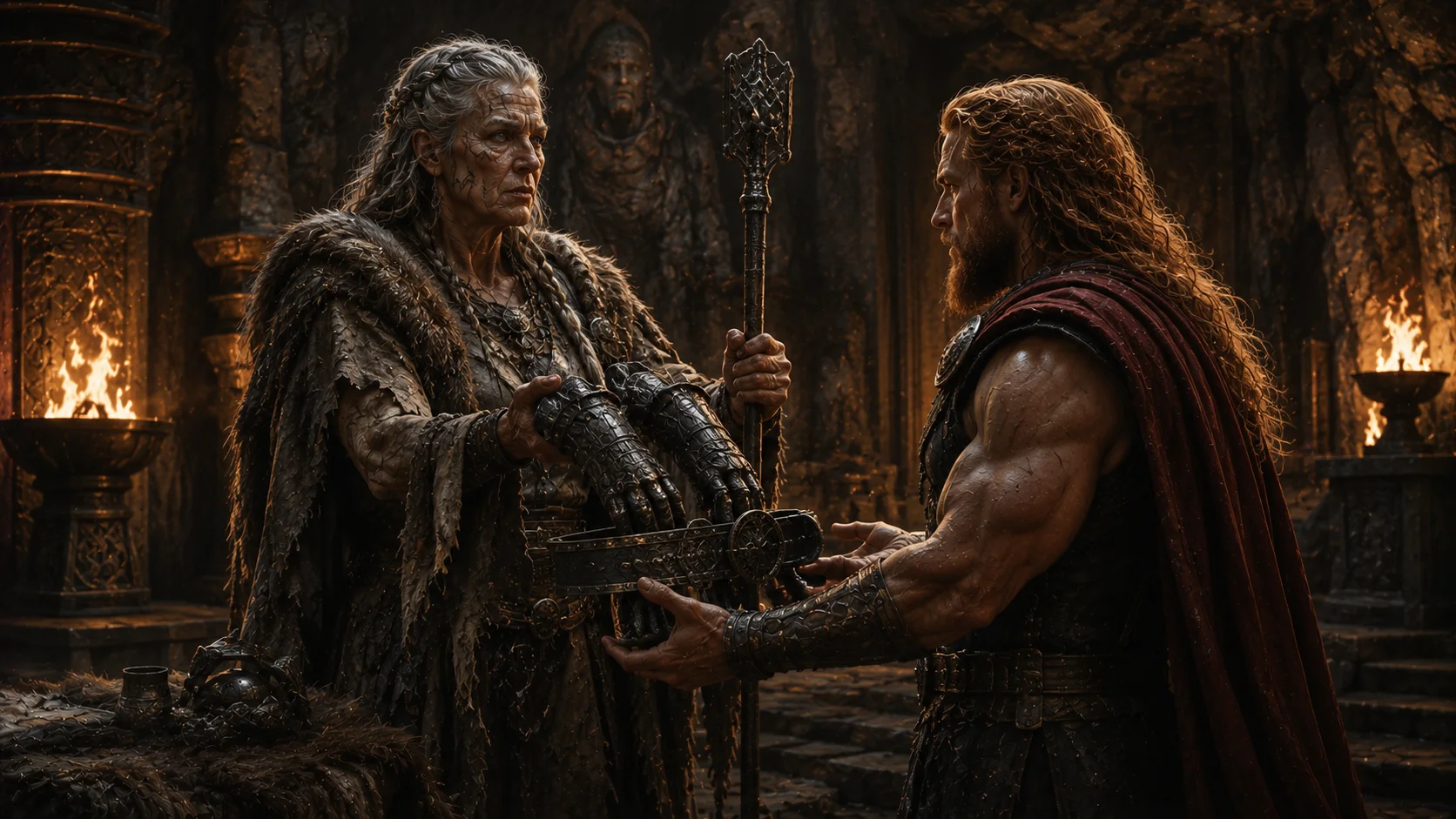
Grid's great deed was the saving of Thor. When the treacherous giant Geirrod schemed to kill the thunder-god by luring him to his hall without his hammer Mjölnir, his belt of strength, or his iron gloves, Thor set out into terrible danger stripped of all that made him invincible. On the way, he stopped at the hall of Grid — and the friendly giantess, knowing Geirrod's murderous intent, warned Thor of the trap that awaited him and lent him three precious gifts of her own to take the place of his missing gear: her magical staff (the Gríðarvölr, “Grid's staff”), her own belt of strength, and her own iron gloves.
The Gifts That Saved a God
Each of Grid's three gifts proved essential to Thor's survival. When a flooding river (raised by Geirrod's daughter) threatened to sweep him away, Thor braced himself and hauled himself out using Grid's staff. When the giant's hall held a seat that shot up to crush him against the roof, Thor jammed Grid's staff against the rafters and pushed back, crushing the daughters hiding beneath. And when Geirrod hurled a glowing lump of red-hot iron to kill him, Thor caught it in Grid's iron gloves and hurled it back through the giant, killing him. Without the giantess's gifts, the unarmed thunder-god would surely have died in Geirrod's hall. Grid's timely warning and her three borrowed treasures were what carried Thor through.
The Giant Who Helped the Gods
Grid endures as one of the most sympathetic of the Norse giants — the friendly giantess who bore Odin the avenger Vidar and who saved Thor's life with her warning and her gifts. She embodies the truth, woven throughout Norse myth, that the line between gods and giants was never simple: that the jötnar were not merely enemies but also kin, lovers, mothers and friends of the gods, and that even among the giants there were those who stood with Asgard. Grid is the giant who, twice over — as the mother of an avenger and the arming friend of Thor — was a benefactor of the gods.
When the thunder-god went weaponless into a giant's death-trap, it was a giantess who warned him and lent him staff, belt and iron gloves — and so a giant saved the slayer of giants.
The Bargain That Sent Thor Unarmed
Thor did not blunder into Geirrod's trap by accident. He was walked into it by Loki, who had bought his own life with Thor's. Wearing a falcon-cloak borrowed from Frigg, Loki had flown to Geirrod's hall for no better reason than amusement, looked in at a window, and been caught; the giant shut him in a chest and starved him there for three months, and let him out only when he swore an oath to bring Thor to that same hall carrying neither his hammer nor his belt of might. That oath is the whole plot. Everything that nearly kills Thor in this story happens because the companion walking beside him has already sold him.
Grid's warning mattered because Geirrod's hall was built to kill a guest twice over before he ever reached the high seat. The first attempt came at the river Vimur, which rose under the travellers as they waded — and not by chance: Geirrod's daughter Gjálp stood astride the water upstream, swelling the current with her own body. Bracing Grid's staff against the riverbed, with Loki clinging to the borrowed belt of might behind him, Thor is said to have flung a stone at her with the remark that a river must be dammed at its source, then hauled himself onto the far bank by a rowan growing out of the rock. Norse tradition kept the plant's name afterwards — the rowan was remembered as Thor's salvation — and a rowan set by the door to turn away harm outlasted, in Scandinavian folk practice, the story that first explained it.
The second attempt is the one the story is famous for, and its victims are worth naming. When the seat beneath Thor shot up toward the rafters, it was Gjálp — the same daughter who had flooded the river — and her sister Greip crouched underneath, heaving it upward, whose backs broke when Thor pushed back. Loki's oath bought him nothing in the end. The debt he had sworn away was paid off instead by a giantess who had no part in his bargain at all, and by two giant sisters who did.
The God Grid Gave the World
Grid's son carries a strange title: inn þögli áss, the silent god. The epithet is not decoration. No surviving poem gives Vidar a line to speak — when Odin tells him to stand and pour a cup for Loki, he stands and pours and says nothing — and yet the same tradition rates him nearly as strong as Thor and holds that the gods lean on him in every hard task. His is the kind of strength that does not announce itself, which is exactly why the tradition keeps him in reserve.
It is spent all at once, at the end of the world. When Fenrir swallows Odin whole at Ragnarök, Vidar steps up to the wolf wearing one great shoe, plants that foot on the lower jaw, takes the upper jaw in his hand and tears the beast open. The shoe is the detail worth keeping. It is not forged but assembled, out of every strip of leather a shoemaker trims from the toe and heel of a boot and throws away — and anyone who wished to be of use to the gods was told to discard those scraps, which quietly turns a cobbler's rubbish into war material for the killing of the wolf. Vidar's own land, Víði, is described as wild country grown thick with brushwood and tall grass: empty, untended, waiting. A wilderness held in reserve, like the god who owns it.
A Sisterhood of Giant-Brides
Grid was not the only jötunn woman whose body carried a line between two hostile kindreds. Skadi came to Asgard demanding blood-price for her father and left married to Njord — and by one later account married Odin afterwards, a union the Norwegian jarls of Hladir claimed as the root of their house through a son named Sæmingr. Gerd was won for Freyr under threat of curses rather than by courtship, and bore Fjölnir, reckoned an ancestor of the Swedish kings. Angrboda bore Loki the three children who end the world — Fenrir, Jörmungandr and Hel — the dark mirror of everything Grid stands for. Even Thor's own mother Jörð, the earth itself, was counted among the giant kindred. Set against that company, Grid's oddity sharpens. There is no bride-price in her story, no feud, no marriage recorded, no royal line traced back to her. She helped, and the telling simply moves on.
The Borrowed Self
Look closely at what Grid actually lent and the loan stops looking like charity and starts looking like a mirror. Thor's own equipment was three things, not one: Mjölnir; Megingjörð, the belt that doubled his strength; and Járngreipr, the iron gloves he needed in order to grip the hammer's famously short haft. Grid's hall held a belt of strength and iron gloves of her own, plus the staff Gríðarvölr to stand in for the hammer that neither of them had. She was not improvising with whatever lay to hand. She owned, outright and in her own right, a working equivalent of a thunder-god's gear. The myth never explains how a giantess came by such things, and it does not need to: the detail says, without ever stating it, that Grid was formidable long before Thor knocked at her door, and that the power Asgard prized as uniquely its own had a quiet twin sitting in Jotunheim the whole time.
Why the Silent Ally Still Matters
Every telling of the Geirrod story turns on one unsettling premise: that Thor, strongest of the gods, is only as strong as what he happens to be carrying. Strip away the hammer, the belt and the gloves and he is a very large man walking into an ambush. That is the fear the story is actually about — not giants, but the moment before a trial when your usual armour is gone and you are dependent on a stranger's goodwill instead. Grid answers that fear precisely because she is owed nothing and gains nothing. She warns Thor because he is walking into a trap and she happens to be in a position to stop it. Storytellers keep returning to that figure — the unlooked-for host who arms the traveller at the last safe threshold before the danger begins — because the anxiety it settles never really goes away. Grid is Norse myth's clearest answer to what happens when, for once, the stranger turns out to be kind.
The gear was only ever lent — staff, belt and gloves, and a warning she was under no obligation to give. The son was not a loan: on the day the wolf swallows Odin, it will be her silent, waiting boy who tears the world back open.