Geirröd was a jötunn king, lord of a hall in the giant-realms, remembered above all for one tale: how he trapped the trickster Loki into betraying Thor, how he armed his own household against the thunder-god, and how his own weapon was turned back through his body to kill him. The account survives in Snorri Sturluson's Skáldskaparmál and is echoed independently in the skaldic poem Þórsdrápa by Eilífr Guðrúnarson — giving Geirröd's story sturdier ground beneath it than many giant-tales, which often rest on Snorri's prose alone.
A Falcon Caught in the Giant's Yard
The tale does not begin with Thor at all, but with Loki flying in Frigg's borrowed falcon-shape, ranging over the giant-lands as he was given to doing. Geirröd caught sight of the bird and had it seized. Brought before the jötunn king and held prisoner, Loki found himself starved and cornered. Loki bought his freedom the only way offered to him: an oath. He would deliver Thor into Geirröd's hall, and he would do it in the one condition that made the god vulnerable — without Mjölnir, and without his belt of might, Megingjörð. A trickster forced to trick the trickster's usual mark; Loki kept the oath, and Thor set out for Geirröd's realm unarmed of the two things that made him invincible.
Last updated .
The Household Waiting
Geirröd was not alone in his hall. He had two daughters, Gjálp and Greip, jötnar in their own right and, as the tale makes plain, active agents in their father's design rather than bystanders to it. Where some giants in Norse tradition stand apart from the gods' quarrels, neutral or even allied, Geirröd's household is drawn as uniformly hostile — a king and two daughters, each with a part to play in killing Thor. It is this shape, a hostile giant king whose family closes ranks against a visiting god, that marks Geirröd's story as its own distinct type within the wider giant-lore. The tale gives Geirröd no epithet beyond jötunn and giant king; the tradition names him for what he was and elaborates him no further than the role the story assigns him.
Gríðr's Warning
On the road to Geirröd's hall, Thor came to the dwelling of a giantess named Gríðr — mother, notably, of Óðinn's son Víðarr, and no ally of Geirröd's. Where the king's household worked to destroy Thor, Gríðr worked to save him. She warned him plainly of the treachery waiting ahead and, since he travelled without hammer or belt, lent him what she had: her own belt of strength, a pair of iron gloves, and a staff that would come to be called Gríðarvölr. Three gifts, each one earning its place before the tale is done — the belt to restore some of his lost might, the gloves to let him catch what no bare hand could hold, the staff to brace against what no ordinary strength could push back. Gríðr's role is the tale's one clean counterweight: a giantess who owed the god nothing, set against a giant king and two giant daughters who wanted him dead.
The River That Rose Against Him
The way to Geirröd's hall crossed the river Vimur, and the river turned against him. Thor found the water climbing around him as he waded it, rising with a violence that had a cause rather than a source in weather: upstream, Geirröd's daughter Gjálp stood astride the river, swelling it with her own body. Thor answered the flood, not the giantess directly at first — he took up a stone and threw it at her, and the river's rise broke. Bracing on Gríðr's staff, he hauled himself the rest of the way across. The crossing itself was the first proof that the borrowed gifts were not mere courtesy; without the staff to lean on, the river alone might have finished him before he ever reached the hall.
A Chair Meant to Crush Him
Received into Geirröd's hall, Thor was shown to a single seat — hospitality with a trap folded into it. No sooner had he sat than the chair shot upward, driving toward the roof-beams with Thor still on it, the clear intent being to pin and break him against the rafters. Beneath the seat, unseen, were Gjálp and Greip, straining to force it up. Thor drove Gríðr's staff against the roof and shoved back with everything the borrowed belt of strength could give him, forcing the chair back down hard — and breaking the backs of both daughters where they crouched beneath it. The trap meant for Thor closed on the two who had set it.
Fire Taken Up in Iron Gloves
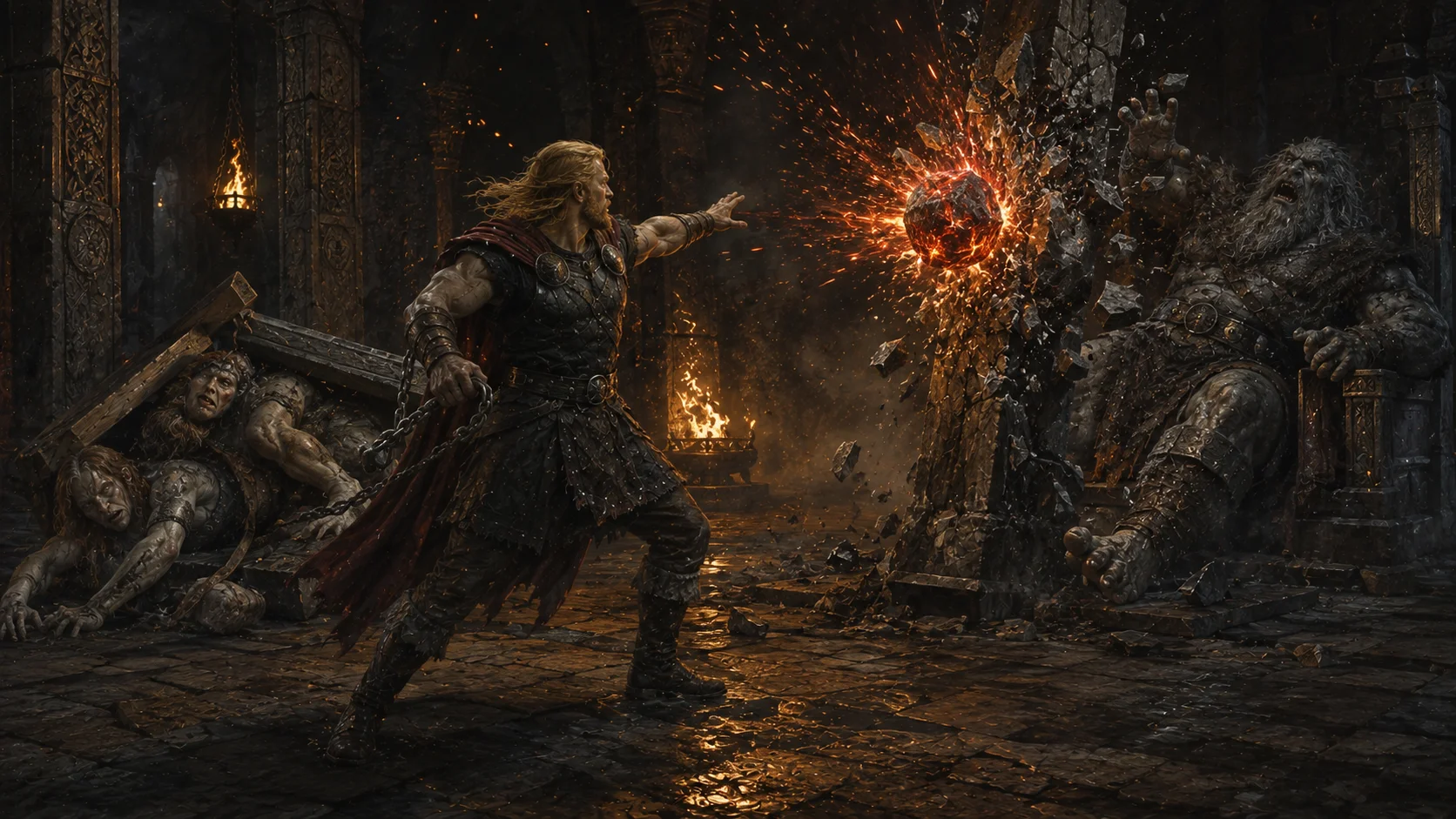
Geirröd's own move came last, and it came without warning. From the hall's fire he took up a molten mass of iron with a pair of tongs and flung it straight at Thor to finish what the river and the chair had failed to do. Thor caught it — the iron gloves Gríðr had lent him were the one thing standing between that catch and a maimed or dead god. Geirröd, seeing his throw caught rather than landed, bolted for cover behind an iron pillar in the hall. It did not save him. Thor hurled the glowing mass back with such force that it tore straight through the pillar, straight through Geirröd hiding behind it, straight through the wall of the hall beyond, and buried itself in the ground outside. The king died by the very fire he had meant to kill with, a trap turned end for end and driven back through its own maker.
What the Borrowed Gear Bought
Set the episode side by side and its shape is plain: Thor arrived stripped of the two things that ordinarily made him unstoppable, and every single stage of his survival — the river, the chair, the iron — traces back to what Gríðr had put into his hands beforehand. The staff braced him against the flood and against the roof; the belt gave him back enough strength to force the chair down; the gloves let him close bare fingers on molten metal without them ending the fight then and there. Geirröd's whole design depended on Thor having none of that, and one giantess's warning and three loans undid it completely. Nothing in the account suggests Geirröd anticipated a rival giantess arming his prey; the plan assumed an unarmed god from start to finish, and it was built on that assumption alone.
Three Ambushes, One Design
It is worth setting the three attempts against each other, because together they show a household working a single plan in stages rather than three unrelated hazards. The river was meant to drown Thor before he ever reached the hall, using Gjálp's own body against him. The chair was meant to crush him the moment he sat, using Gjálp and Greip together beneath the seat. The iron was Geirröd's own contribution, held back until Thor stood in front of him with nowhere left to retreat. Each stage escalated past the one before it — flood, then crushing weight, then fire — and each was defeated by a different piece of Gríðr's gear. The tale does not present these as separate near-misses; it presents them as one household's coordinated attempt, failing link by link.
A Bane Remembered in Verse
That the tale reaches us doubly — through Snorri's prose retelling and independently through Eilífr Guðrúnarson's Þórsdrápa — sets it apart from giant-episodes that survive on a single late thread. Skaldic tradition drew on the story for its kennings, with formulations invoking Thor as Geirröd's-bane surfacing in that verse-craft, a sign that the episode was known and referenced well before Snorri set it down in the form now read. That an independent skaldic poem preserves the same core events — the river, the household, the fatal iron — is part of why this episode is treated as more firmly attested than many single-source giant-tales.
Not to Be Mistaken for the Other Geirröðr
A separate figure bearing the same name appears elsewhere in Norse legendary material — a human king in Saxo Grammaticus and in the Old Norse saga tradition, notably Þorsteins saga Víkingssonar. Scholarship treats this as either a distinct figure who happens to share the name, or a later conflation with the jötunn king of Thor's journey; either way, the two are kept apart here. The Geirröd of the falcon, the daughters, the river, the chair, and the red-hot iron is the jötunn of Skáldskaparmál and Þórsdrápa alone, and nothing about the human king of the sagas belongs folded into his account.
The Shape of the Cautionary Tale
Strip away the specifics and Geirröd's story still holds its shape: a king who thought he had disarmed his enemy completely, a household mustered to finish the job in three separate ambushes, and a single overlooked kindness — one giantess's warning to a god she owed nothing to — unmaking every part of the plan. Geirröd is not remembered as a schemer undone by carelessness; his trap at the river worked as designed, his chair worked as designed, his iron throw worked as designed. What failed him was that Thor no longer walked into any of the three unaided. The tale's force sits exactly there, in the gap between a plan built for an unarmed god and the god who arrived quietly re-armed.
He lured the thunder-god to his hall stripped of hammer and belt, and hurled red-hot iron to kill him — only for Thor, in borrowed iron gloves, to catch it and hurl it back through the giant himself.