Hrungnir was the strongest of the Norse giants — a mighty jötunn with a heart, head and shield of stone, who dared to race against Odin, drank himself into a boasting rage in Asgard, and met his end in a famous duel with Thor, in one of the great single combats of Norse myth. His battle with the thunder-god is a tale of stone against hammer, of boasting giant against the gods' mightiest champion, and it is one of the best-attested giant myths in the entire corpus — set down in prose by Snorri Sturluson in the Skáldskaparmál and corroborated independently by the earlier skaldic poem Haustlöng, composed by Þjóðólfr of Hvinir.
The Strongest of Giants
Hrungnir (Old Norse Hrungnir) was reckoned the mightiest and strongest of all the jötnar, a giant of stone through and through — for it was said that his head and his heart were both made of hard stone, and he bore a great stone shield and wielded a massive whetstone as his weapon. His heart, Snorri specifies, was of hard stone with three sharp points. He rode a powerful horse named Gullfaxi — "golden-mane" — swift and strong, of which he was immensely proud, and it was that pride that set the whole tale in motion.
Last updated .
A Challenge on the Road to Asgard
The story begins not with malice but with boasting between riders. Odin, mounted on his eight-legged horse Sleipnir, rode into Jötunheimar and made much of the animal's speed. Hrungnir, astride Gullfaxi, would not let the claim stand unanswered — he challenged it, and gave chase. The pursuit carried him at full gallop the entire distance from the giants' country to the gates of Asgard itself, Hrungnir so intent on catching Odin and proving his horse the equal or better of Sleipnir that he scarcely noticed how far he had ridden, or into whose halls the chase had carried him.
Hospitality Offered, and Abused
Whatever quarrel had brought him there, the Æsir received Hrungnir as a guest is owed to be received. Drink was set before him, and Hrungnir drank it — deeply, and then more deeply still, until the giant who had arrived as a rival horseman had become a very drunk one. Wine loosened a tongue that pride had already primed, and Hrungnir began to boast of what he would do to the hall he sat in: he would tear up Valhalla and carry it back to Jötunheimar, sink Asgard beneath the earth, kill every one of the gods but two, and drink all their ale himself while he did it. Freyja and Sif he named as the exceptions — not sparing them out of mercy, but declaring he would take them for his own. It was a boast no host could let stand, and the Æsir, who had offered him welcome, now sent for Thor.
An Unarmed Guest and a Point of Honour
Thor did not come gently. He arrived ready to strike Hrungnir down where he sat, the threat against Sif alone reason enough for the hammer to fall. But Hrungnir had a defence that even Thor's fury could not simply override: he stood in Asgard unarmed, a guest under the gods' own roof, and to kill a weaponless man was níðingsverk — a shameful act, an act without honour, the one kind of killing that could stain even the slayer of giants. Rather than strike, the two came to terms: a formal duel, a hólmganga, to be fought properly and on even ground, at a place named Grjótúnagarðar on the border of the giants' country. Thor accepted, bound now by the same rules of honour that had just saved Hrungnir's life.
A Giant of Clay to Stand Beside Him
Word of the coming duel spread through Jötunheimar, and the giants, anxious for their champion, did what they could to tip the contest in his favour. They built him a second combatant out of raw clay — an enormous figure named Mökkurkálfi, nine leagues tall and three broad, raised to stand at Hrungnir's side and overawe the thunder-god before a blow was struck. But a heart had to be found for so vast a creature, and the only one large enough that could be got was taken from a mare. It proved a poor substitute for courage: when the moment came and Mökkurkálfi first laid eyes on Thor advancing to the field, the clay giant's borrowed heart betrayed him completely, and he lost control of his bladder in terror before the duel had even begun.
Trickery on the Field
Thor did not arrive at Grjótúnagarðar alone. His servant and companion Þjálfi ran ahead of him to where Hrungnir stood waiting, stone shield in hand as instruction for the duel required, and told the giant a lie calculated precisely to undo him: that Thor did not mean to meet him face to face at all, but planned to attack from beneath, tunnelling up through the very ground on which Hrungnir stood. It was enough. Hrungnir, unwilling to be caught with his shield useless beneath his own feet should the attack truly come from below, did the one thing that would cost him everything — he laid his shield down and stood on top of it, leaving his front bare and trusting the ground itself for protection that Þjálfi had invented purely to strip it from him.
Whetstone Against Hammer
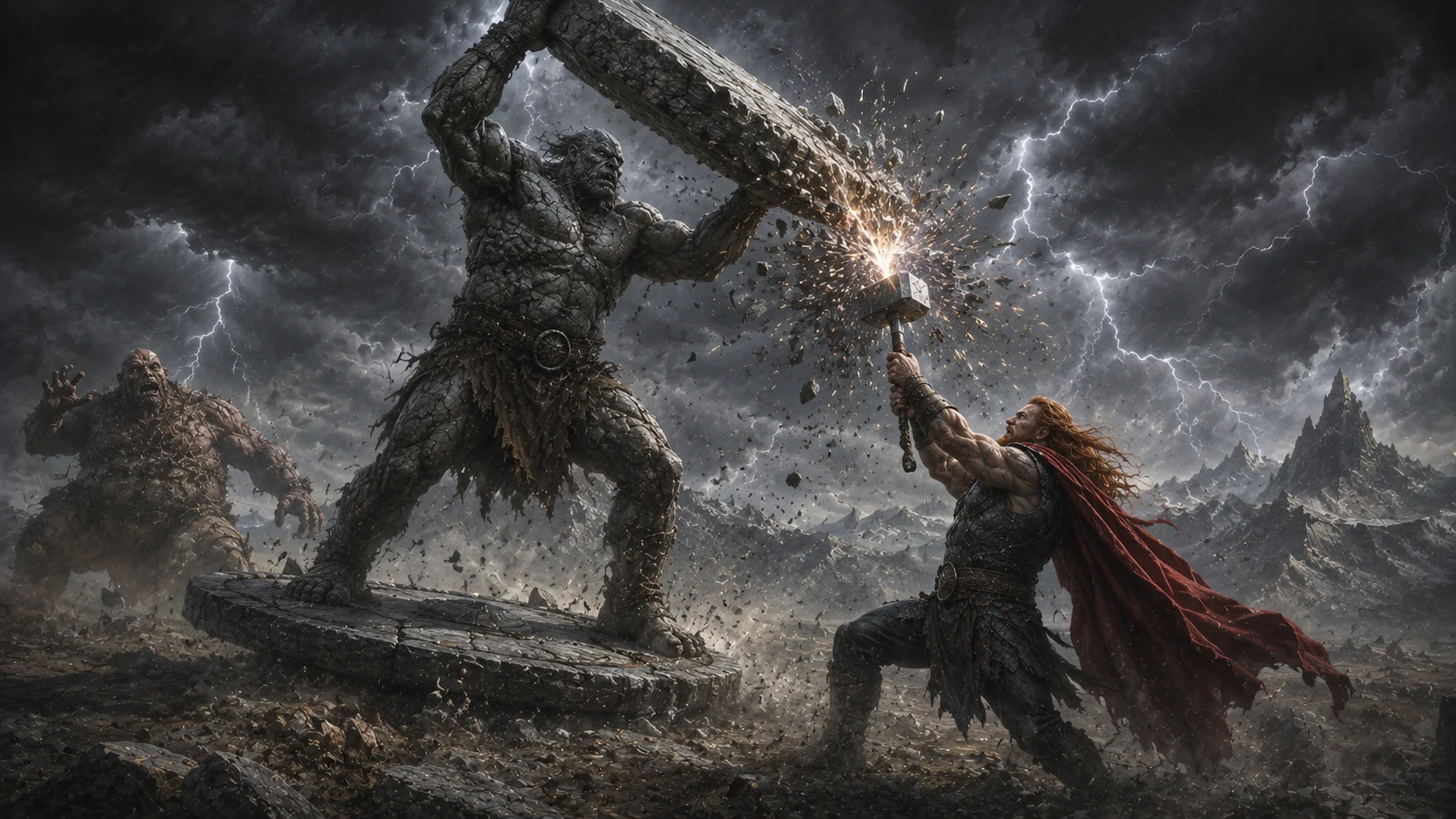
Then Thor came on in earnest, and the duel that Haustlöng and Snorri both preserve began. Hrungnir, seeing the thunder-god approaching from the front after all, hurled his great whetstone at him with all the strength that had made him the mightiest of giants. In the same instant Thor let Mjölnir fly. The two weapons met in the air between them — stone against hammer, giant's throw against god's — and it was the whetstone that broke. It shattered into pieces, and while most of it fell away, one fragment flew on and buried itself in Thor's skull, where it would remain for the rest of his life. Mjölnir did not break. The hammer flew through the ruin of the whetstone and struck Hrungnir's stone head, and the giant renowned as the strongest of his kind was killed in the single blow.
Pinned Beneath the Fallen Giant
Hrungnir did not fall clear. He pitched forward as he died, and one of his great stone legs came down across Thor's neck, pinning the victorious god to the ground beneath the very opponent he had just killed. It was no small weight — stone through and through, as Hrungnir had been in life — and for all their strength, none of the assembled Æsir could shift the leg enough to free him. Thor, who moments before had struck down the mightiest of the jötnar, lay trapped under the giant's corpse while the gods around him tried and failed, one after another, to move it.
The Infant Who Lifted a Giant
It was not a god's strength that freed him in the end, but a child's. Magni, Thor's son by the giantess Járnsaxa, was only three nights old — and he walked to his father's side, took hold of Hrungnir's stone leg, and lifted it away with an ease that none of the full-grown Æsir had managed. For that feat, done before he was old enough to be counted grown by any measure but his own strength, Thor rewarded him with Gullfaxi, the golden-maned horse that had carried Hrungnir on the chase which began the entire affair — passed now from the giant who had raced Odin to the infant who had freed the giant's killer.
The Charm Left Unfinished
The whetstone shard lodged in Thor's head was not beyond remedy, or so it seemed at first. A völva — a seeress — named Gróa was brought to chant the spells that could draw the fragment out, and as she worked, the charm was taking hold. But Thor, grateful to her and eager to repay the favour, chose that moment to tell her something he thought would please her: that he had found a way through Jötunheimar by which her husband Aurvandill might yet be brought home. The news delighted Gróa so much that she lost the thread of her own working in the telling and hearing of it, and the charm was never completed. The whetstone fragment stayed exactly where it had lodged, fixed in Thor's skull for good — and it is offered, in the telling, as the reason no one should ever throw a whetstone carelessly across a floor, lest they repeat in miniature the wound that even a god could not fully heal.
A Tale Twice Told, and Well Attested
Few single episodes among the giants rest on ground as firm as this one. Snorri's prose account in the Skáldskaparmál stands independently corroborated by Haustlöng, an earlier skaldic poem that renders the same duel in verse — prose and poetry agreeing on a story that, in much of the giant-lore, survives in only one telling or the other. Between the two, nearly every turn of the episode is preserved: the race that began it, the boast that provoked it, the point of honour that delayed it, the trickery that decided it, and the lasting mark it left on the victor himself.
What the Duel Left Behind
Hrungnir is remembered by explicit epithet as the strongest of the giants, and the fully realized duel that ends his story — down to its lasting cost to Thor — sets him apart even among the more narratively significant jötnar of the corpus. He is not merely a giant that Thor killed; he is the one whose death cost the thunder-god a permanent wound, carried in his own skull for the rest of his days as the enduring mark of the strongest opponent he ever put down in single combat.
The strongest of all giants, with a heart and head of stone, hurled his whetstone at the thunder-god — and though a shard lodged forever in Thor's skull, Mjölnir shattered the stone head and laid the boaster low.