Hymir was a Norse sea-giant — the owner of an enormous brewing-cauldron the gods needed, and the unwilling companion of Thor on the most famous fishing trip in all of myth, when the thunder-god hooked the world-serpent Jörmungandr itself. His tale combines the quest for a giant cauldron with the cosmic struggle between Thor and the great serpent.
The Giant of the Cauldron
Hymir (Old Norse Hymir) was a giant who dwelt by the sea at the edge of the world, the possessor of a vast brewing-cauldron a mile deep — the only vessel large enough to brew ale for all the gods at once. When the sea-god Aegir agreed to host a feast for the Aesir but lacked a cauldron great enough, it fell to Thor and the god Tyr (who was said to be Hymir's kinsman) to journey to Hymir's hall and obtain the giant cauldron. Hymir was a fearsome host, cold and grudging, his beard frozen with ice, and his hall a dangerous place for visiting gods.
Last updated .
The Fishing for the World-Serpent
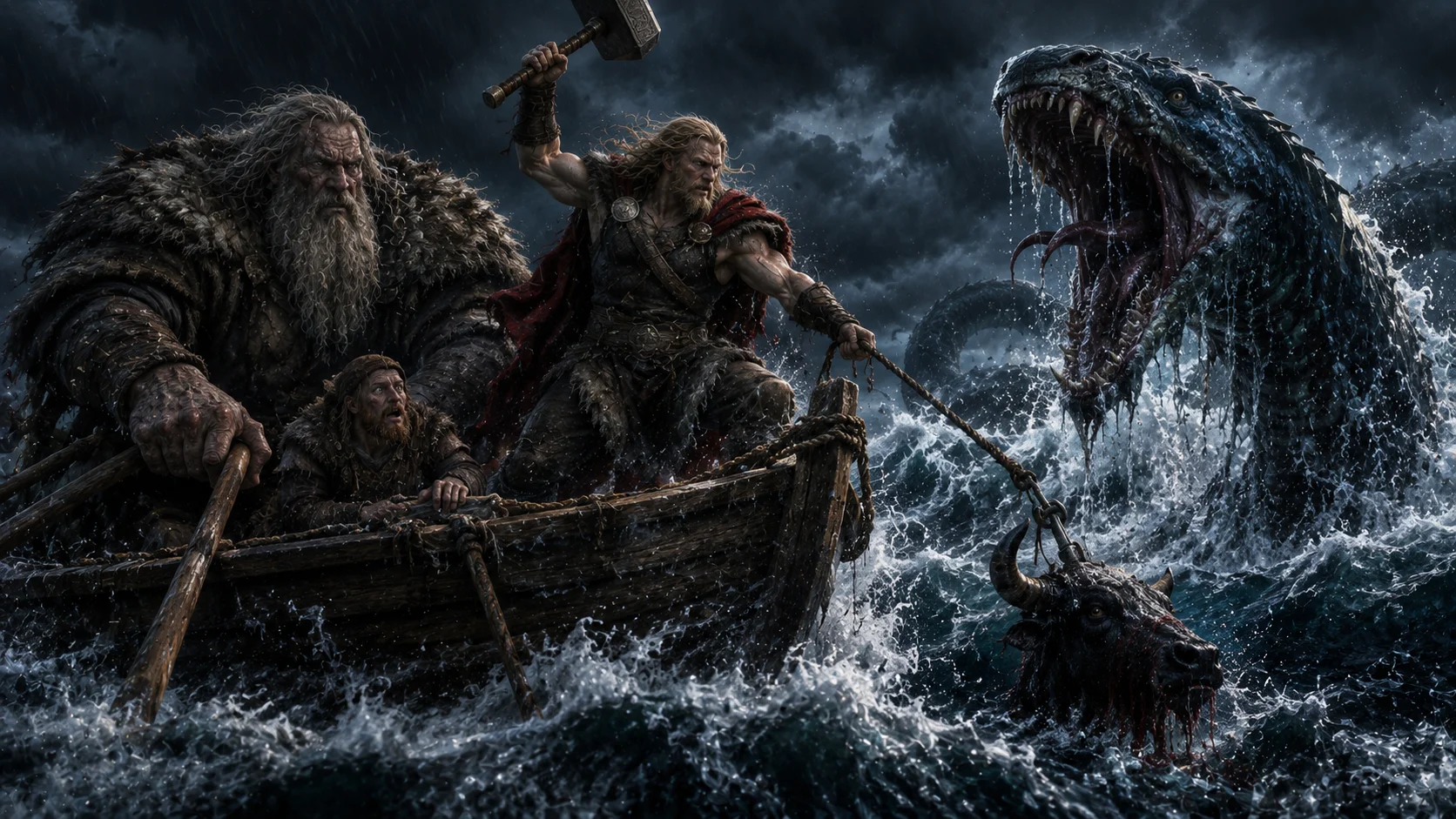
The visit produced the most famous fishing trip in Norse myth. Thor, ever hungry and ever bold, went out to sea in Hymir's boat to fish, taking as bait the head of one of Hymir's own oxen. Thor rowed far out, past the grounds where Hymir usually fished, despite the giant's growing fear — and there he cast his line, baited with the ox-head, into the deep. And the bait was taken by none other than Jörmungandr, the world-serpent that encircles the earth. Thor hauled with all his divine might, bracing his feet so hard they went through the bottom of the boat, and drew the monstrous serpent up until its venomous head broke the surface and giant and god beheld the great enemy face to face. Thor raised his hammer to strike the killing blow — but the terrified Hymir, fearing the serpent and the chaos, cut Thor's fishing line, and Jörmungandr sank back into the depths, their fated final battle postponed to Ragnarök. Thor, enraged, struck Hymir overboard.
The Winning of the Cauldron
Back at the hall, Hymir set Thor tests of strength — including the smashing of a seemingly unbreakable cup, which Thor at last shattered by hurling it against Hymir's own stone-hard head. Having proven himself, Thor took up the great cauldron (setting it over his head like a vast hood) and departed with Tyr. When Hymir and a host of giants pursued them, Thor turned and slew them with Mjölnir. The cauldron was brought to Aegir, and the gods had their ale at last.
The Host of the Great Fishing
Hymir endures as the sea-giant of the great cauldron and the unwilling witness to Thor's legendary fishing for the world-serpent — the giant whose fear cut the line and denied Thor his prey, postponing the cosmic battle to the end of the world. He embodies the recurring Norse theme of Thor's journeys among the giants, the mix of danger, strength-contest and cosmic struggle, and he is forever bound to the unforgettable image of the thunder-god hauling the world-serpent up from the deep on a fishing line.
On the most famous fishing trip ever told, Thor hooked the world-serpent itself on an ox-head — and only the giant Hymir's terror, cutting the line, saved the great battle for the end of the world.
Older Than the Eddas
Long before Snorri Sturluson wrote a word of the Prose Edda, a poet named Bragi Boddason was already describing Thor's fishing trip — not as a story he had heard, but as a picture he was looking at. Bragi's Ragnarsdrápa, composed in the ninth century and among the oldest skaldic verse to survive at all, praises a shield given to the poet by describing the scenes painted on it, and one of those scenes is Thor hauling the world-serpent up out of the sea. That makes the fishing trip one of the oldest attested episodes in Norse myth — older than Hymiskviða, the Poetic Edda poem that tells the tale in full, and older than Snorri's prose retelling in Gylfaginning. There is a pleasing circularity in how it reached us at all: Bragi's stanzas survive only because Snorri quoted them, some four centuries later, while explaining how a poet ought to speak of the serpent.
The Household at Heaven's End
Hymiskviða does not send Thor to a stranger's hall. It sends him to family. The poem has Týr name Hymir as his own father and place the hall east of the river Élivágar, at himins enda — at heaven's end. The parentage sits oddly beside Snorri, who in Skáldskaparmál counts Týr among the sons of Odin; whatever the contradiction meant to the poem's first audience, it makes the errand stranger and more intimate. The two gods are knocking at a door that belongs, in some sense, to one of their own.
What waits inside is not comfortable. Týr's grandmother is a giantess with nine hundred heads, loathsome to her own grandson. His mother is a wholly different figure — gold-adorned, white-browed, and kind enough to carry ale to her son and to hide both visitors beneath the kettles hanging from a beam at the end of the hall, because Hymir comes home from hunting in a foul temper. It is a wise precaution, and it very nearly costs them. Hymir's gaze alone is dangerous: when he glances at the beam where the guests are hidden, the pillar bursts and the beam snaps in two, and eight cauldrons come down off it. Only one survives the fall whole, hard-forged enough to take the impact. He is a host who wrecks his own kitchen simply by looking at it.
At table, Thor's appetite finishes off the evening. Three oxen are cooked and Thor eats two of them by himself, whereupon the giant announces, unnerved, that the household will have to go fishing in the morning if anyone intends to eat again. It is Thor, not Hymir, who then walks out and tears the head from the giant's finest ox — a beast the poem troubles to name, Himinhrjótr, usually rendered "heaven-bellower."
Two Poets, Two Endings
The sources do not fully agree on how the climax plays out, and Snorri is the more interesting witness precisely because he does not pretend otherwise. In Gylfaginning the giant goes pale at the sight of the serpent's head and the venom washing into the boat, and cuts the line; Thor hurls his hammer after the sinking creature; and Snorri then records, and rejects, a rival ending — some men say the hammer struck the serpent's head off, he writes, but he holds it truer to say that Jörmungandr lives still. The version everyone remembers is therefore a version Snorri chose, with the alternative preserved a sentence away.
Hymiskviða's own account is more compressed and more violent, and translators have argued for a very long time over exactly what its closing lines describe: whether the hammer lands, whether the serpent merely sinks, even whether it is Hymir who cuts the line at all. The older poem preserves an encounter that resists being written down plainly. Snorri, working in the thirteenth century, gave it a clean shape — the miss rather than the strike — and the clean shape is the one that survived.
Two Faces of the Sea
Norse myth keeps its ocean divided between two very different giants. Aegir is the sea as feast-hall: hospitable, wealthy, the host whose gathering the Aesir actually want to attend, and whose name stands for the sea itself throughout skaldic verse. Hymir is the sea as frontier — rime-bearded, grudging, dwelling out at heaven's end where the fishing grounds turn dangerous and the water hides the world-serpent. It is fitting that a myth needing a vessel large enough for a god's feast has to leave Aegir's hospitality behind and go looking in Hymir's cold hall to find one. Between them the two giants hold the ocean's welcome and the ocean's threat, and the story only works because they are not one figure wearing two names.
Carved in Stone
Bragi was not the last artist to reach for this scene. Long after painted shields had rotted away, Viking Age carvers kept returning to the same image: a figure in a boat, one leg braced hard against or straight through the hull, hauling on a line that vanishes into the water below. The clearest surviving example is the eleventh-century Altuna runestone in Uppland, Sweden, where Thor's foot punches through the bottom of the boat exactly as the poems describe and an ox-head hangs at the end of the line — and where, tellingly, he fishes alone. The carver kept the serpent and dropped the giant. A carved stone at Hørdum in Thy, Denmark, and the so-called Fishing Stone at Gosforth in Cumbria, England, both keep the second man in the boat, and the English example shows how far the scene travelled in the baggage of Norse settlers. Few episodes in Norse myth are attested this often in stone, and none of these carvings needs a caption: a man in a small boat with his foot somewhere it should not be is enough.
Why the Line Had to Be Cut
Whatever the older poem meant, the tradition that prevailed needed Hymir to lose his nerve, because the alternative is a story the Norse cosmos cannot absorb. Ragnarök turns on Thor and Jörmungandr destroying one another at the end of the world — the god kills the serpent, walks nine paces, and falls dead of its venom. If the serpent dies on a fishing line partway through an errand to borrow a cauldron, that ending has nowhere left to go. Hymir's fear is not a blemish on the tale; it is the hinge the whole future hangs from. Seen that way, the giant who cuts the line is not simply a frightened old host spoiling his guest's catch. He is the reason there is still a world left to end — and it is a very Norse sort of consolation that the thing holding fate together should turn out to be a coward's flinch.