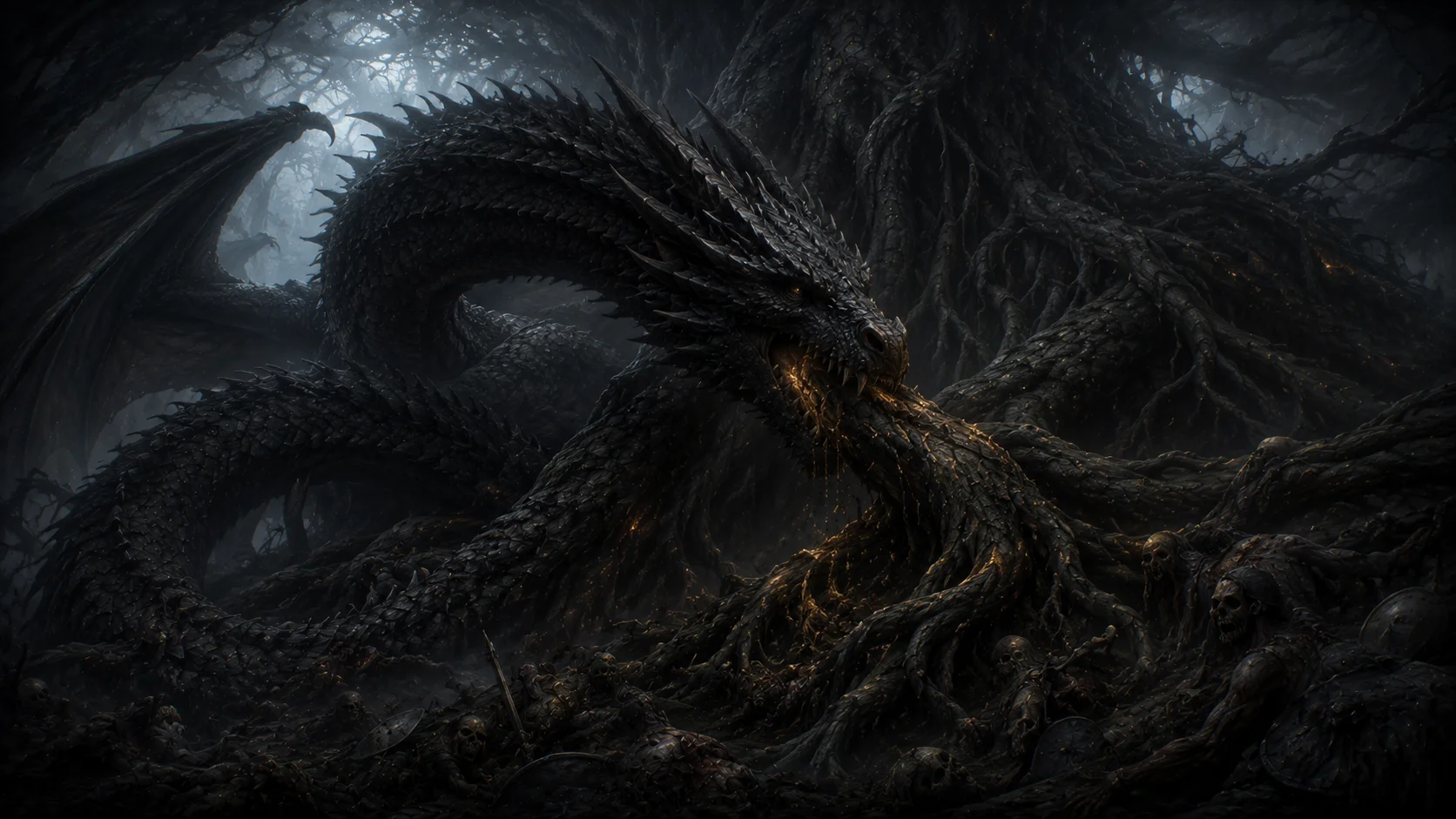
Nidhogg was the great dragon-serpent that gnaws at the roots of the world-tree Yggdrasil — the malevolent corpse-eating beast of the Norse underworld who chews ceaselessly at the foundations of the cosmos and feasts upon the bodies of the dishonoured dead. He is the constant gnawing decay at the root of the world, the corruption that works always to bring the great tree, and all it holds, down.
The Gnawer of the Roots
Nidhogg (Old Norse Níðhöggr, “malice-striker” or “he who strikes with hatred”) was a monstrous dragon or serpent that dwelt at the lowest depths of the cosmos, in the spring Hvergelmir in the cold realm of Niflheim, beneath one of the three great roots of the world-tree Yggdrasil. There, Nidhogg gnaws unceasingly at the root of the tree that holds up all the worlds — chewing, always chewing, working to undermine the very structure of the cosmos. He is the principle of decay and corruption at the foundation of everything, the destruction that gnaws away at the root of the world even as the tree strives to live.
The Feud Up the Tree
Nidhogg was locked in an eternal exchange of insults with the eagle that sits in the topmost branches of Yggdrasil. Between them, running up and down the great trunk, scurried the squirrel Ratatoskr, who carried slanderous messages back and forth — bearing the eagle's insults down to Nidhogg and Nidhogg's threats up to the eagle, stirring the feud between the dragon at the root and the bird at the crown. This strange detail gives the cosmic tree a living, quarrelsome inner life: the malice-striker below, the eagle above, and the gossiping squirrel forever carrying spite between them.
The Devourer of the Dead
Beyond gnawing the tree, Nidhogg had another grim office: he fed upon the bodies of the dead. In the Norse vision of the afterlife, the dishonoured dead — oath-breakers, murderers and the wicked — came to a grim shore in the underworld, and there Nidhogg sucked the blood from their corpses and tore at their bodies, a fate of horror reserved for those who had lived without honour. He was thus a beast of punishment as well as decay, the dragon who consumed the worst of the dead in the cold depths below the world.
The Survivor of the End
Nidhogg has a strange and ominous role at the very end of the Norse story. In the great prophecy of Ragnarök and the world's renewal, after the old world has burned and drowned and a new green world has risen, the seeress's vision ends with a final, unsettling image: Nidhogg flying up from below, bearing corpses in his wings, over the new world. The meaning is debated — perhaps a last shadow of the old darkness lingering even into the reborn world, perhaps the inescapable persistence of death and decay. Nidhogg endures as the Norse dragon of corruption and the gnawing of the world — the malice-striker at the root of all things, the devourer of the wicked dead, the decay that works forever against the life of the cosmos, and the dark shape that survives even the ending of the world.
At the root of the world-tree, in the cold depths, a dragon gnaws forever at the foundation of all things and feasts on the dishonoured dead — the decay that even the world's rebirth cannot quite be rid of.
The Name Is an Accusation
Most monsters are named for what they look like. This one is named for a crime. The first element of Níðhöggr is níð, and in the Norse world that word carried a weight almost impossible to translate: not simply insult, but the specific, ruinous slander that stripped a man of his standing among other men — the accusation of cowardice, of oath-breaking, of being unmanly. A man branded with it became a níðingr, socially dead while still breathing. The second element is höggva, to hew or strike with an edged weapon. The dragon's name is therefore something like the one who strikes with dishonour — a butcher's verb welded to a courtroom noun.
This was not abstract. The medieval law codes of Iceland and Norway treated níð as an actionable offence, and composing a slanderous verse or raising a carved wooden effigy could cost a man full outlawry. The most famous instance is Egil Skallagrímsson's. He set a horse's head on a hazel pole with the face turned inland, carved runes on it, and cursed the land-spirits themselves to wander lost until they had driven King Eiríkr Blood-axe and Queen Gunnhildr out of Norway. That was a níðstöng, a scorn-pole, and it was understood to work. So when the poets put the syllable níð at the bottom of the world and gave it teeth, they were not merely naming a big snake. They were saying that the thing eating the foundations of creation is the same force that eats a man's name.
There is a second word lurking here. Old Norse also has nið — the dark of the moon, the nights when there is no light at all, preserved in niðamyrkr, pitch blackness. The dragon flies up at the end of the world from a range called Niðafjöll, usually read as the dark mountains. The two words are distinct — the vowel in the dragon's name is the long one — so this is not etymology but echo, and echo is a thing Norse verse enjoys rather than resolves.
How Little We Actually Have
It is worth being honest about the source base, because Nidhogg looms far larger in the modern imagination than he does on the page. Everything securely known about him comes from a handful of stanzas in two Eddic poems — Völuspá, the seeress's prophecy, and Grímnismál's catalogue of the world-tree — plus Snorri Sturluson's prose retelling in the Gylfaginning, written around 1220, which mostly paraphrases and quotes those same verses. The poems themselves survive chiefly in a single Icelandic codex written in the 1270s, with a second, differing version of Völuspá preserved in the early fourteenth-century Hauksbók. A versified name-list attached to the Prose Edda in some manuscripts files him simply among the serpents, one entry in a long roll of worms.
He has, so far as anyone can securely say, no surviving image. Scandinavia is thick with carved and cast serpents — the writhing, interlacing beasts of the Urnes style, the biting worms on rune-stones, the ship-prow dragons — and none of them can be identified as this particular dragon rather than any other. What survives of Nidhogg is entirely verbal. That is part of why he has proved so easy for later ages to fill in.
The Tree Is Eaten From Every Side
Nidhogg is usually pictured alone at the root, which badly understates the situation. Grímnismál works methodically down Yggdrasil listing everything that is currently damaging it, and the list is long. Four harts — Dáinn, Dvalinn, Duneyrr and Duraþrór — crane their necks and crop the fresh shoots. The trunk rots at the sides. And beneath the roots lies not one serpent but a nest of them: Góinn and Móinn, sons of Grafvitnir (“grave-wolf”), together with Grábakr (“grey-back”), Grafvölluðr, Ófnir and Sváfnir, who the poem says will forever wear away the tree's branches. It then delivers one of the bleakest lines in Norse literature: the ash of Yggdrasil suffers hardship greater than men know.
Snorri goes further and says that in the spring Hvergelmir — the roaring cauldron from which every river in the cosmos is said to flow — there are so many serpents with Nidhogg that no tongue can number them. Two of the worm-names in that list, Ófnir and Sváfnir, also appear elsewhere in the very same poem as names of Óðinn, which is either scribal accident or one of those quiet Norse jokes about who is really coiled where.
The point of the catalogue is structural, not decorative. Yggdrasil is not a stable pillar. It is a living thing under continuous attack from above, from the side and from below, and it holds up the worlds anyway.
Which Root, and Where
Ask exactly where Nidhogg lies and the sources stop agreeing. Grímnismál gives the tree three roots — one reaching down to Hel, one to the frost-giants, one over the world of men. Snorri gives three as well, but redraws the map: one root among the Æsir, one among the frost-giants where Mimir's well lies, and one over Niflheim, the freezing mist-world, with Hvergelmir beneath it and Nidhogg gnawing that root from below.
These are not the same cosmology, and no amount of tidying makes them one. Norse myth was never a single system administered from a centre; it was a set of overlapping regional and poetic traditions, written down late and largely by Christians. The disagreement about where the dragon lies is a useful reminder that the Norse afterworld was not a diagram. Hel, Niflheim and Náströnd blur into one another in the texts because they were never meant to be plotted.
Náströnd, the Shore of Corpses
Völuspá gives the place where Nidhogg feeds a description of extraordinary architectural nastiness. On Náströnd, the corpse-shore, stands a hall far from the sun with its doors facing north. Its walls are woven of the spines of serpents, plaited like wattle. Venom drips in through the smoke-hole in the roof. Heavy streams run through the hall — Snorri, retelling it, makes them rivers of poison — and through those the dead must wade.
Who wades? The poem names three offences precisely, and the precision is the whole point: perjurers and oath-breakers, murderers, and the man who seduces another man's wife. The middle term is sharper in Old Norse than in English, because Norse law distinguished the killing you declared openly, which could be paid for, from the killing you concealed, which could not. Nothing here concerns belief, ritual observance or piety. These are the crimes that broke the Norse social contract — the sworn word, the safety of the household, the integrity of the marriage bond — and they are precisely the offences that made a man a níðingr. Nidhogg is not devouring sinners in a theological sense. He is finishing what the law started, eating the men whose names had already been eaten.
That is a genuinely different logic from the Christian hell that was arriving in Scandinavia as these poems were being fixed in writing, and the difference is easy to miss because the imagery of venom and darkness looks so familiar. The Norse underworld punished dishonour, not unbelief.
The Tree Is Also Being Healed
The gnawing is only half the mechanism, and the half everybody remembers. At another root sits the well of Urðr, and beside it the Norns. Every single day, Snorri says, they draw water from the well together with the clay that lies around it and pour it over the ash, so that its limbs shall not wither or rot. The water is so holy that everything entering the well comes out white as the film inside an eggshell.
Read the two images together and the Norse cosmos turns out to be something more interesting than a doomed tree. It is a maintained one. Decay works ceaselessly from below; care works ceaselessly from above; the tree stands because the second exactly matches the first, day after day, and not because it is invulnerable. That is a strikingly agricultural theology from a people who knew that nothing green survives without tending. The world is not built. It is kept.
Not Fáfnir, Not Jörmungandr
Three great serpents dominate Norse myth and they are constantly confused. They are not the same creature, and not even the same kind of thing. Fáfnir is a person: he murdered his father Hreiðmarr over cursed gold and let greed transform him into a dragon on the heath, until Sigurðr killed him from a pit and tasted his blood. He belongs to the heroic legends, and it is his story — not Nidhogg's — that fed the German Nibelung tradition and, later, Wagner. Jörmungandr, the Midgard Serpent, is Loki's child, flung into the ocean to encircle the inhabited world, and is bound to Þórr in a mutual death at Ragnarök.
Nidhogg is neither. He has no parentage, no origin story, no antagonist, and no death. Nobody fights him. No god is prophesied to kill him. He is not a character but a condition — the only one of the three who is less a creature than a process with a mouth.
A note on vocabulary that clarifies all three: the Old Norse word dreki is a loan from Latin draco, arriving with southern learning. The older native words are ormr and naðr, worm and adder. Norse dragons are, at root, enormous snakes.
The Last Stanza, and Its Problem
The closing image of Völuspá — the dark dragon rising over the reborn world with the dead aboard him — is one of the most argued-over passages in medieval Northern literature, and two details of the wording decide what the whole poem means.
The first is small and strange. He carries the corpses in his feathers. The word really is feathers, applied to a snake, and English translations quietly smooth it to wings.
The second is the direction of travel, which the poem never states. Read one way, the dragon is a stain the world's rebirth failed to remove: even in the clean new earth, death is already airborne. Read the other way, he is carrying the old dead away, clearing the corpse-shore, and the poem ends with the last of the old order leaving. The seeress gives no verdict — she says only that now she must sink. Nor do the manuscripts agree about the ending: Hauksbók carries a stanza absent from the older codex in which a mighty one comes from above to rule over all, a line often read as Christian intrusion, and it changes the colour of everything around it.
One further detail cuts against the purely bleak reading. The dark mountains the dragon flies from are also, in Snorri's account, the site of a hall of red gold where good people are said to dwell after the end. The Norse imagination did not keep its geography as morally tidy as we would like.
Why the Gnawing Dragon Will Not Die
Fewer than a dozen stanzas, no image, no story of his own — and yet Nidhogg has outlasted better-documented monsters and turned up in modern fantasy, in metal, and in games from a minimalist duelling title that took his name outright to the great wyrm at the heart of a long-running online role-playing war. The reason is that he articulates an anxiety that has, if anything, sharpened.
Most mythologies place their apocalypse in the future, safely elsewhere in time. The Norse put theirs in the present tense and underground. The end of the world is not an event scheduled for later; it is already happening, quietly, at the root, and has been happening the entire time the sun has been shining on the branches. Every structure you rely on — the household, the law, the state, the biosphere — is being chewed at its foundation by something you will never see and cannot bargain with, and the only thing standing between it and collapse is somebody going out every single morning with a bucket.
That is not a monster story. It is a description of maintenance, entropy, and the cost of keeping anything alive, told a thousand years before anyone had the vocabulary for it. The malice-striker endures because the gnawing is real.
Sources & traditions
- EncyclopediaWikipedia — Nidhogg
- TraditionNorse texts, inscriptions and later retellings (Scandinavia)
Myths change from area to area and from time to time. This chronicle follows the most widely told versions; tellings in other villages, regions and eras may differ.