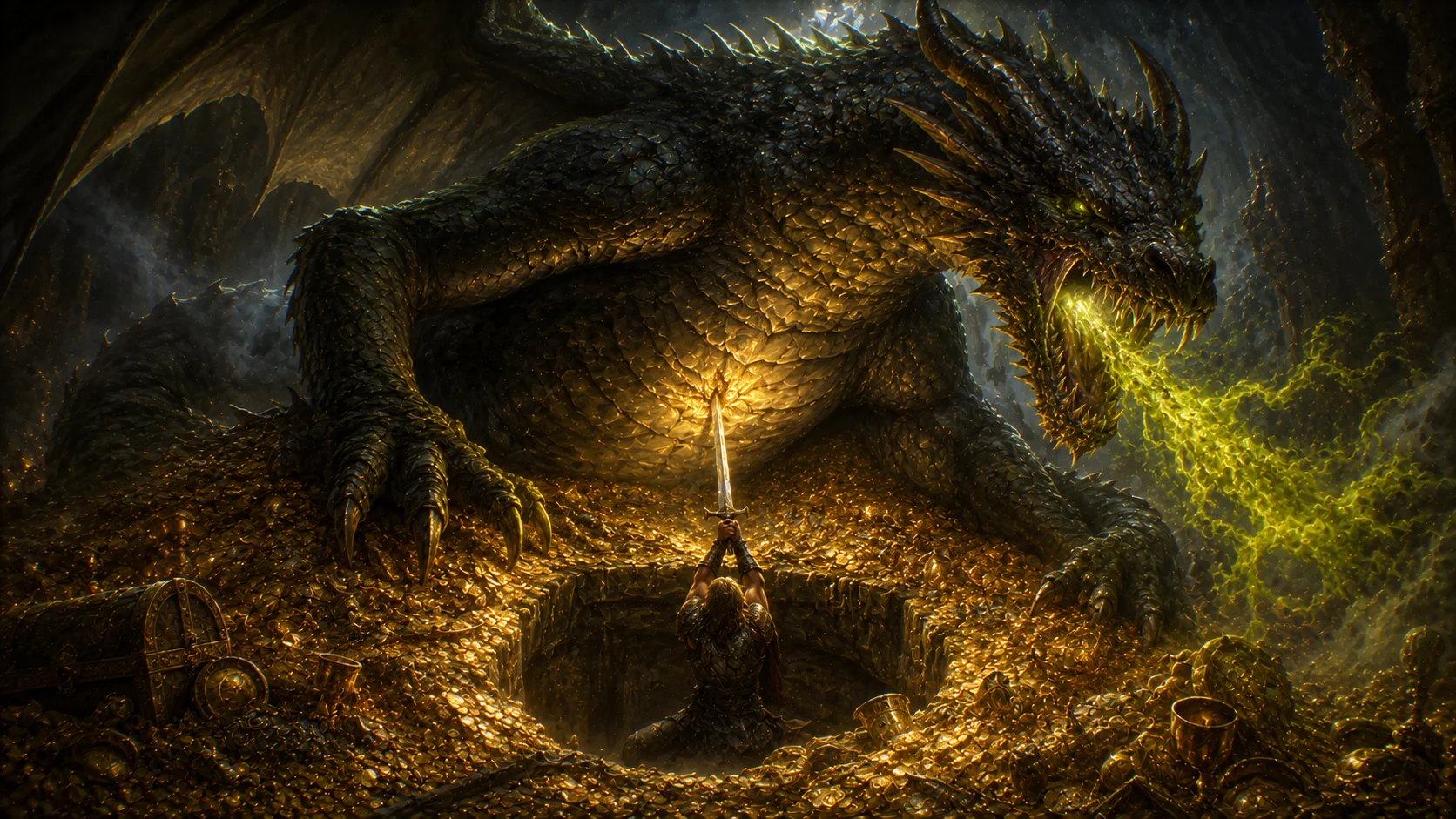
A hole in the ground, dug the night before, deep enough for a man to crouch in. Above it, a worn track down to water, the kind of path a heavy body drags itself along every day out of habit. Sigurd climbed into that pit before dawn and waited with a sword he had not made himself, for a creature that had once been somebody's son.
The Skin That Had to Be Covered in Gold
The story of Fafnir does not begin with a dragon. It begins with an otter, killed by the god Loki on a riverbank, that turned out to be a man wearing an otter's shape when he died. His name was Otr, and the family he belonged to would demand a price for him that no ordinary killing required: his skin, they said, must be filled with gold and covered entirely, every hair hidden, before the debt was paid.
Loki went and got that gold from a dwarf named Andvari, who lived under a waterfall in the shape of a pike. Loki took Andvari's whole hoard by force, and when the dwarf begged to keep back one small ring, Loki stripped that from him too. Andvari let the ring go, but not the insult — he cursed it, and through it the entire hoard, to bring death to whoever held it. That ring had a name: Andvaranaut, "Andvari's gift," a gift only in the way a trap baited with meat is a gift.
A Farmer's House With Three Sons
The dead otter's family was headed by Hreidmar, and he had two other sons besides Otr. One was Regin, a smith. The other was Fafnir — Old Norse Fáfnir — and it is worth sitting with the fact that at this point in the story he is simply a brother, standing in his father's house while cursed gold is stacked up to cover a dead sibling's skin. Nothing about him yet suggests a monster. The sources themselves are not even fully agreed on what kind of being he was before all this — man, or something closer to the dwarf-adjacent lineage his family seems tied to. What is certain is that he was a son, with a father and two brothers, in a house that had just been paid a fortune in blood money.
The Curse Riding Inside the Ring
Weregild is supposed to close a wound. This weregild opened one. Andvari's curse did not need to work through sorcery or spectacle; it needed only to sit inside the gold and wait for someone to want it badly enough. It found that someone almost immediately, and it found him inside the very household the payment was meant to make whole.
The Murder on the Heath Road
Fafnir killed his own father. He took Hreidmar's life to take the gold entire, and he shut his brother Regin out of any share of it — the smith who had lost a brother to Loki's blade now lost a father to Fafnir's greed and a fortune to his own kin in the same stroke. There is no confrontation recorded, no argument that survives; only the outcome, stark as a chronicle entry: the gold changed hands by way of a father's death, and one brother walked away with everything while the other walked away with nothing.
What Greed Built Out of a Man
What happened next is the part of the story that has outlived every other detail of it. Fafnir did not merely keep the gold. He took it out to a lonely stretch of land and turned into a dragon to lie on top of it — a monstrous, poison-breathing serpent whose entire remaining existence became the act of guarding a pile of metal from everyone, including, presumably, himself. He had a brother once, and a father, and whatever ordinary shape he was born into. He gave all of it up for the privilege of coiling alone over cursed treasure.
He murdered his father for the cursed gold and let his greed turn him into a venom-breathing dragon coiled upon the hoard — until a hero's sword found his soft belly from below.
It is difficult to find a cleaner image anywhere in myth for what greed does to a person than this one: a man so thoroughly consumed by wanting that the wanting becomes his whole body, and the body it becomes is a beast fit only for solitude and poison. The very idea of a dragon lying for years upon a hoard it can never spend, guarding gold it can never use, traces back to Fafnir stretched across his treasure on that heath — the image that later fantasy borrowed wholesale without always remembering whose story it came from.
Gnitaheath and the Helm of Terror
The place Fafnir chose was called Gnitaheath (Gnitaheiðr), and there he lay across his hoard associated with a fearsome object known as the Ægishjálmr — the "helm of terror." Between the dragon-shape itself and this helm, Fafnir made himself into something nobody sane would approach. That, after all, was the entire point: a hoard is only safe from thieves if the thing lying on it is worse than anything a thief could imagine finding there.
A Smith Who Wanted His Share
Regin did not forget what he had lost. Denied any part of the gold, he found another way to it: he took in and raised a young hero named Sigurd, and — either forging Sigurd's sword outright or reforging it from the fragments of an older blade belonging to Sigurd's father Sigmund — he gave the young man a weapon called Gram. Regin's motive was never disguised as anything nobler than it was. He wanted his brother dead and his father's gold in his own hands at last, and he wanted someone else to do the killing.
Dwarves keep turning up at the edges of this story wherever metal is being worked or gold is changing hands — Andvari cursing the hoard in the first place, and now Regin the smith shaping the very sword that would end his brother's life with it. The gold and the forge are never far apart in this family's history.
The Pit Beneath the Water-Path
Regin's counsel to Sigurd was practical rather than heroic: dig a pit along the track Fafnir used on his way down to drink, hide in it, and when the dragon's great bulk crawls directly overhead, drive the sword upward into the one part of him not armored — his underside. Sigurd did exactly that. There was no duel, no exchange of blows face to face; the killing of Fafnir was an ambush from beneath, a hero waiting in a hole in the earth for a monster who never saw him.
Words From a Dying Dragon
What makes Fafnir more than a beast to be dispatched is what happens after Sigurd's sword finds him. He does not simply die. He speaks — a long dying exchange with the man who killed him, in which Fafnir warns Sigurd that the very gold he is about to inherit carries the same curse that undid its previous owner, and foretells that Sigurd's own life will end in the shadow of this treasure too. A dragon built entirely out of greed spends his last moments not raging but warning, as if some remnant of the brother and son he once was could still recognize the trap for what it was, even from inside it.
The Heart, the Blood, and the Birds
Regin, arriving once the dragon was dead, told Sigurd to roast Fafnir's heart. While Sigurd was preparing it, he tasted the dragon's blood by accident, and the taste opened his ears to the speech of birds. What the birds said undid Regin completely: they warned Sigurd that the smith who raised him meant to kill him next and take the whole hoard for himself. Sigurd believed them. He killed Regin before Regin could act, and walked away with everything — the gold, the ring, the curse, and, if Fafnir's dying words were true, his own coming doom folded in among the coins.
A Name Nobody Can Quite Explain
Even the name Fáfnir resists easy explanation. Some scholars connect it to a root suggesting an "embracer," others tie it loosely to serpent or coiling imagery, but there is no settled, agreed-upon etymology in mainstream scholarship. It is a small honesty worth keeping in a story this old: not every thread leads somewhere certain, and the name of Norse myth's most famous dragon is one of the threads that simply trails off.
Fafner in a German Opera House
The Fafnir most people outside Norse studies have actually encountered is not quite this one. Richard Wagner's opera cycle Der Ring des Nibelungen reworks him into "Fafner," a giant rather than a farmer's son, who together with his brother Fasolt is paid the cursed gold for building the hall of Valhalla, and who later uses a magic helm to become a dragon. It is a striking transformation in its own right, and it is the version that reached the widest modern audience through opera, and later through the dragons and treasure-hoards of fantasy fiction and games that took their cue from it. But it is a nineteenth-century adaptation, built on top of the older material rather than a record of it — the giant brothers, the hall-building bargain, none of that belongs to the Eddic account of a man who murdered his father in a farmhouse and crawled out onto a heath alone.
The Gold That Outlived the Dragon
Strip away every adaptation and what remains is a story assembled almost entirely out of consequence: an otter's death that demanded gold, a curse laid on that gold by the dwarf it was stolen from, a son who let the curse work through him until it turned him into something with no kin and no rest, and a hero who took the same cursed prize from a hole in the ground and was warned, with the dragon's dying breath, that he would fare no better. Fafnir is remembered as the great dragon of Norse legend not because he was born a monster, but because nothing else in the story could have made a monster out of him except the gold itself, and his own refusal to let go of it.
Sources & traditions
- EncyclopediaWikipedia — Fáfnir
- TraditionNorse texts, inscriptions and later retellings (Scandinavia)
Myths change from area to area and from time to time. This chronicle follows the most widely told versions; tellings in other villages, regions and eras may differ.