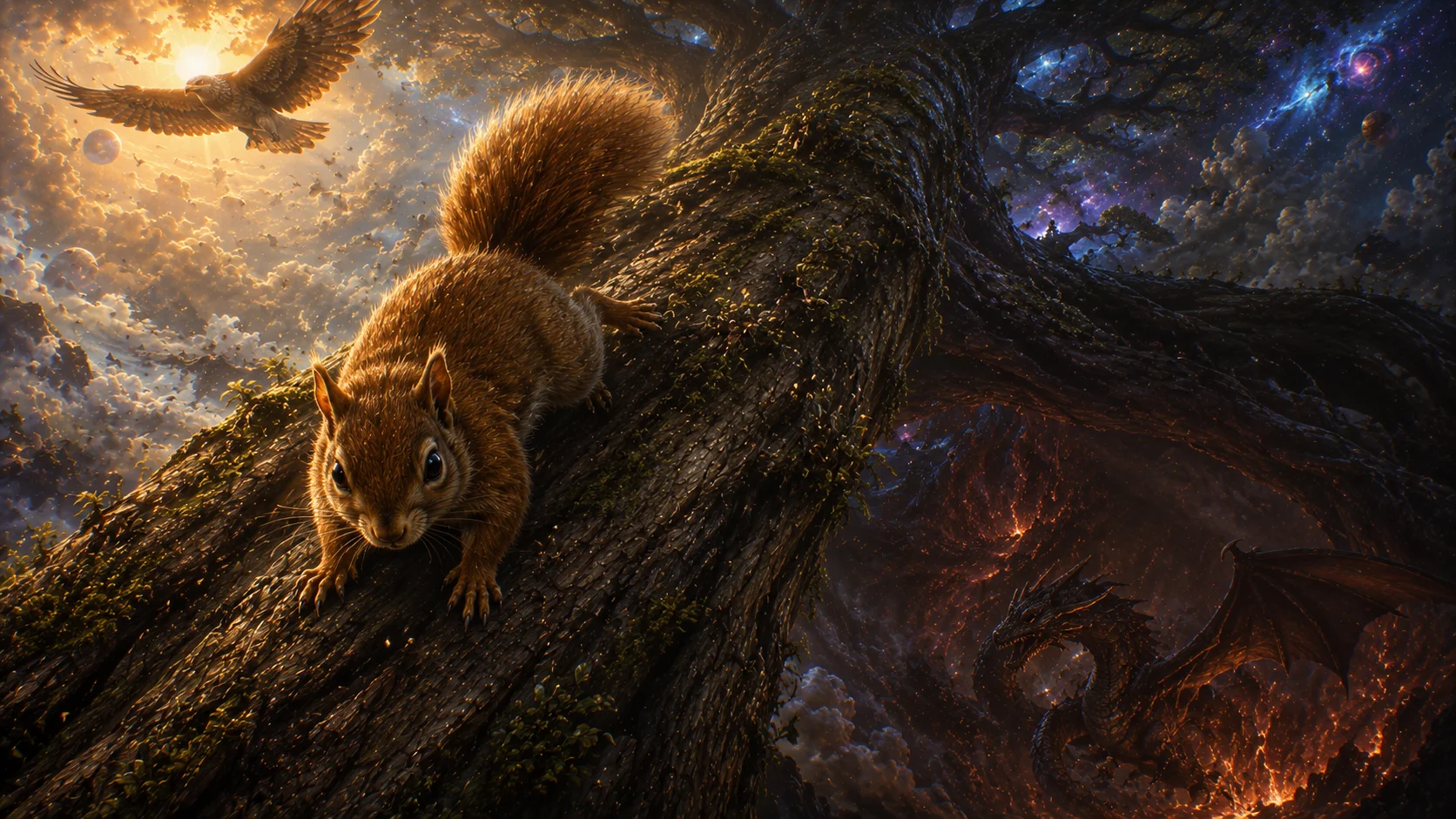
Ratatoskr was the squirrel that runs up and down the trunk of the world-tree Yggdrasil — the small, restless messenger who carries insults and slander between the eagle at the tree's crown and the dragon Nidhogg at its roots, forever stirring the feud between them. One of the most charming and curious figures in Norse myth, he is the gossip-bearer of the cosmos, the mischief that runs the length of the world-tree.
The Squirrel of the World-Tree
Ratatoskr (Old Norse Ratatoskr, perhaps “drill-tooth” or “bore-tooth,” or “climber-tusk”) was a squirrel who lived upon Yggdrasil, the great ash-tree that holds up and connects all the Nine Worlds. His task — or his mischief — was to run continually up and down the enormous trunk of the tree, the whole vast length of the cosmos, carrying messages between its top and its bottom. He was small and quick and never still, a flash of fur racing the height of the world-tree, the one creature who travelled freely between the crown and the roots.
The Bearer of Insults
The messages Ratatoskr carried were not kindly ones. At the topmost branches of Yggdrasil sat a great eagle (with a hawk perched between its eyes); at the deepest root gnawed the dragon Nidhogg. These two ancient beings — the eagle of the heights and the dragon of the depths — were locked in a bitter feud, hurling insults at one another across the impossible distance of the tree. And it was Ratatoskr who carried their spite between them: running down to bear the eagle's scornful words to Nidhogg, then running back up to carry Nidhogg's threats and curses to the eagle, keeping the quarrel alive and fanning the malice at both ends. The little squirrel was a stirrer of strife, a tale-bearer who delighted in carrying slander, ensuring the feud between the dragon and the eagle never died.
The Mischief of the Cosmos
Ratatoskr is a wonderful example of the rich, living detail of the Norse cosmic vision. The world-tree Yggdrasil was not a dead structure but a living thing, teeming with creatures — the eagle at its crown, the dragon at its root, four stags browsing its leaves, and the restless squirrel scurrying between them. Ratatoskr gives this grand cosmology a touch of liveliness and even humour: the great tree of the worlds has, running up and down it, a gossiping squirrel carrying insults between a dragon and an eagle, a small embodiment of mischief and discord woven into the very structure of the cosmos.
The Gossip of the World-Tree
Ratatoskr endures as one of the most beloved small figures of Norse myth — the squirrel messenger of Yggdrasil, the bearer of insults between the eagle and the dragon, the restless stirrer of cosmic strife. He embodies the Norse love of detail and discord, the sense that even the great tree that holds up the worlds has its own quarrels and gossip; and he remains a delightful image of mischief at the heart of the cosmos: a squirrel, forever running the length of the world, carrying spite from root to crown and back again.
Up and down the whole length of the world-tree runs a single squirrel, carrying insults between the eagle at the crown and the dragon at the root — the gossip-bearer who keeps the cosmos quarrelling.
First Set Down in the Poetic Edda
Ratatoskr's oldest appearance is a single stanza — the thirty-second — of Grímnismál, “The Lay of Grimnir,” one of the mythological poems gathered in the Poetic Edda and preserved in the thirteenth-century Icelandic manuscript known as the Codex Regius. The poem is framed as a catalogue of cosmic lore recited by a disguised Odin — calling himself Grimnir — to a king who has mistaken a god for a beggar and had him held between two fires for eight nights. Amid stanzas naming the halls of the gods and the rivers of the underworld, Grimnir pauses to name the squirrel running the ash tree. It is a throwaway detail in a much larger inventory of cosmic furniture — and it is the detail later readers have never let go of.
What the stanza actually says is narrower than the story everyone now tells. Grimnir sends the traffic one way: the squirrel bears the eagle's words down from above and repeats them to Nidhogg beneath. There is no return journey in the verse, and no word about the messages being spiteful. The malice, and the round trip, arrive with the second source.
That source is Snorri Sturluson, whose Prose Edda was composed in Iceland in the early thirteenth century and who drew directly on Grímnismál for his own account of the world-tree in the section called Gylfaginning, “The Deluding of Gylfi.” Snorri's sentence is short but it changes the shape of the thing: the íkorni, the squirrel, runs up and down the ash carrying öfundarorð — words of envy or spite — between the eagle and Nidhogg. One preposition converts a courier into an instigator. The Ratatoskr of popular imagination, the one who runs both directions and enjoys it, is a composite of a laconic poem and the prose handbook that expanded on it.
The Named Company of the World-Tree
Ratatoskr does not run an empty tree. Grimnir goes straight on, in the very next stanza, to record four harts that crop the tree's highest shoots with their necks bent back, and he gives all four names: Dáinn, Dvalinn, Duneyrr, and Duraþrór. The stanza after that insists there are more serpents beneath the ash than any fool supposes, then names six of them anyway — Góinn, Móinn, Grábakr, Grafvölluðr, Ófnir, and Sváfnir. The hawk that sits between the eagle's eyes has a name too, Veðrfölnir, though that one belongs to Snorri alone: it appears in Gylfaginning and nowhere in the Poetic Edda.
Two of the harts' names are not fresh inventions for the occasion. Dáinn and Dvalinn also stand in the great dwarf-catalogue of Völuspá, the poem that opens the Poetic Edda. Nobody in either text explains the overlap; the Eddas are rarely interested in explaining themselves. But it suggests a cosmology assembled from a shared stock of names that different poems reached into and reused, the way an oral tradition works, rather than one author inventing a world whole.
What stands out is who goes unnamed. The eagle at the crown of Yggdrasil — the very figure whose feud Ratatoskr exists to service — is never named in the surviving texts, only titled. The dragon has a name. The hawk has a name. The stags and even the anonymous mass of serpents have names. The eagle, arguably the most consequential being in the whole vertical structure of the tree, remains simply “the eagle,” an office rather than a person. Ratatoskr, the smallest and least powerful thing on the tree, was worth naming. The eagle was not.
A Monster Whose Only Weapon Is Words
Norse myth is not short of things that can kill you. Nidhogg gnaws corpses at the root; the serpent that circles Midgard will drench the sky in venom at Ragnarok; wolves are destined to swallow the sun and the moon. Set beside them, Ratatoskr is almost a joke. He has no venom, no claws worth mentioning, no army. And yet he is one of the very few beings in the mythology whose entire function is to cause a conflict rather than fight in one. Nearly every other monster in the corpus does violence directly. Ratatoskr does something rarer, and in its way crueller: he keeps two enemies who could never otherwise speak to one another, separated by the whole height of the cosmos, permanently informed of each other's contempt. He is not the war. He is the reason the war never gets the chance to end.
That is a very old, very human piece of psychology to smuggle into a cosmology: the idea that a feud does not sustain itself, that distance alone ought to let two enemies forget one another, and that it takes a third party — a carrier, an informer — to keep a grievance alive across a gap neither side could cross unaided. Take Ratatoskr off the tree and the eagle and the dragon simply stop hearing about each other. The dragon at the root has never met the eagle at the crown, and never will. Their entire war exists only because something small and quick keeps telling each of them exactly what the other one said.
A Tree with Enemies at Both Ends
Yggdrasil is not the only world-tree imagined with a predator in its branches and a serpent at its root. The much older Sumerian tale of the huluppu-tree, embedded in the poem Gilgamesh, Enkidu and the Netherworld, tells of a tree torn from the bank of the Euphrates by a storm and rescued by the goddess Inanna, who replants it in her garden at Uruk meaning one day to cut a throne and a bed from it. She never does: a serpent takes up residence at its base, the Anzu-bird raises its young in the crown, and a female demon settles in the trunk, until Gilgamesh drives all three out. The details do not match Yggdrasil's, and no line of transmission is known to connect the two traditions. What the resemblance shows instead is how naturally the imagination reaches for the same shape whenever it tries to picture a tree that holds up the world: danger above, danger below, and the trunk between them contested.
Yggdrasil's version of that shape is unusually busy. Its two ends are not locked in silent, static threat, the way guardian figures so often are elsewhere; they are actively hurling insults across a gap neither can cross on its own. Where another tradition gave its tree a monster at each end and left them to glower, the Norse imagination gave its two guardians a running argument — and then gave the argument a courier.
Ratatoskr After the Manuscripts
For a creature who occupies one stanza and one sentence, Ratatoskr has travelled remarkably far into the present. In God of War (2018) he is barely more than a cameo: a foul-mouthed summonable spirit the players nicknamed the Bitter Squirrel. The sequel, God of War Ragnarök, promotes him to a proper character — an outsized, talking, distinctly posh squirrel who tends the World Tree, and who explains that the rude little creature from the first game was only one of several spectral copies he has scattered so that he can be present in all Nine Realms at once. It is a neat modern answer to the practical problem the Eddas never raise: how does one squirrel cover a tree the size of the cosmos?
Marvel took him somewhere stranger. Ratatoskr debuted in the pages of Thor in 2004 and resurfaced a decade later as the antagonist of The Unbeatable Squirrel Girl — a giant horned Asgardian squirrel god who can change size at will and whose whispered words of discord are literal mind control rather than mere gossip. The costume is absurd; the underlying instinct is faithful. Marvel's Ratatoskr is dangerous for exactly the reason the Eddic one is memorable: what he does with the things he overhears.
What survives every retelling, reverent or ridiculous, is the instinct the Codex Regius scribe already had seven and a half centuries ago — that a cosmology this vast needs one small, disreputable creature running through it, refusing to let its two great enemies simply drift apart.
Sources & traditions
- EncyclopediaWikipedia — Ratatoskr
- TraditionNorse texts, inscriptions and later retellings (Scandinavia)
Myths change from area to area and from time to time. This chronicle follows the most widely told versions; tellings in other villages, regions and eras may differ.