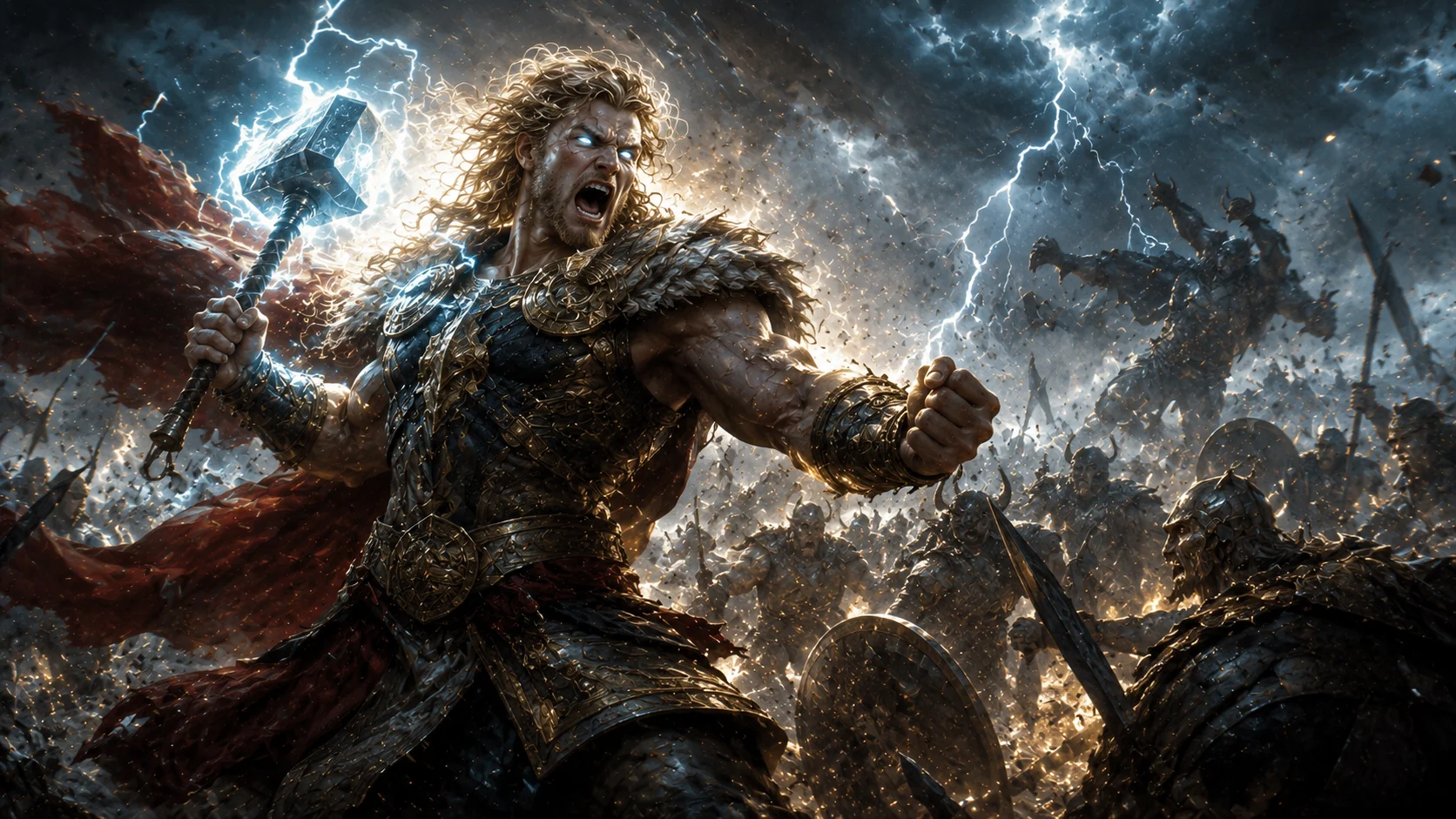
Modi was the Norse god of battle-wrath and courage — a son of Thor whose name means “the angry” or “the brave,” the personification of the furious courage of the warrior in the thick of the fight. With his brother Magni he is fated to inherit Thor's hammer and to walk into the new world after the end of all things.
The Brave and Angry One
Modi (Old Norse Móði, from móðr, meaning “wrath,” “courage,” “the fierce mood of battle”) was a son of Thor, and where his brother Magni embodied the thunder-god's physical strength, Modi embodied his battle-fury — the wild, fierce courage that seizes a warrior in combat, the rage and daring that drives a fighter forward against all odds. He was the divine personification of the warrior's mood, the berserk valour that the Norse so prized in battle, the spirit that makes a man fearless and terrible in the fray.
The Sons of Thor
Modi and Magni are nearly always named together as the two sons of Thor who carry their father's legacy forward — strength and battle-courage, the two halves of the warrior-god's power. Between them they hold what made Thor the champion of the gods: Magni the raw might to lift and to strike, Modi the fierce courage to face any foe. Together they are the inheritance of the thunder-god, the qualities that defended Asgard distilled into his two surviving sons.
The Heirs of Mjolnir
Modi's destiny, like his brother's, lies beyond Ragnarök. When the old world burns and the great gods fall — when Thor himself dies slaying the world-serpent — Modi and Magni are foretold to be among the survivors, and to inherit Thor's hammer Mjölnir, bearing it together into the new world that rises green and cleansed from the ashes of the old. The hammer of the thunder-god, the great defender against chaos, thus passes to the brothers who embody his strength and his courage, to be carried on in the age to come.
The Courage That Endures
Modi endures as the Norse personification of battle-courage and the heir, with Magni, of Thor — the fierce valour of the warrior given divine form, the spirit that survives the end of the world. He embodies the Norse warrior-ideal at its purest: not merely strength, but the fearless, furious courage to stand and fight whatever comes — and the deep hope, woven through the doom of Ragnarök, that such courage does not perish with the old gods but lives on, hammer in hand, into the world reborn.
Strength and courage were the two halves of the thunder-god's might — and when Thor falls at the world's end, his two sons take up his hammer and carry his valour into the age to come.
An Older Voice Than Snorri's
The detail that Modi will one day carry Mjolnir does not begin with Snorri Sturluson. It begins in verse, in the eddic poem Vafthrudnismal, a wisdom-contest between Odin, travelling in disguise, and the giant Vafthrudnir, who claims to know the fate of everything that exists. Odin asks which of the Aesir will hold the possessions of the gods once the fire of Surt is quenched, and the giant answers almost as an afterthought inside a longer catalogue: Vidar and Vali will live in the sanctuaries of the gods, and Modi and Magni will have Mjolnir when Thor's fighting is ended. Snorri's prose account in the Prose Edda quotes that stanza rather than replacing it — the tidier later version is a gloss on the older poem, not its source. That matters, because it means Modi's survival was not a storyteller's flourish added centuries after the fact. It was already fixed in verse, in a poem generally judged to preserve pre-Christian material, before anyone wrote a word of the prose.
A God Named But Never Shown
Search the surviving corpus and Modi is never once given a scene of his own. His brother is luckier. In the tale of Thor's duel with the giant Hrungnir, told in the Skaldskaparmal, Hrungnir falls dead with one enormous leg sprawled across Thor's neck, pinning the thunder-god to the ground, and not one of the assembled Aesir can shift it — until Magni, three years old, strides up and lifts it off. Thor rewards him with the dead giant's horse, Gullfaxi, and Odin, Snorri adds, complained that it was ill done to give so fine a horse to a giantess's son and not to Thor's own father. It is a small, human moment: a boy's casual strength, a father's pride, and a grandfather's wounded dignity, in three sentences. Modi gets nothing like it. He has no duel, no rescue, no line of dialogue anywhere in the sources — only a place in a genealogy and a clause in a prophecy. Even his mother goes unnamed: Snorri tells us plainly that Magni's mother was the giantess Jarnsaxa, but on who bore Modi the sources are silent. This is not proof that Modi mattered less. Norse myth keeps a number of figures who exist to complete a pattern rather than to star in one — Vili and Ve, Odin's own brothers, help kill the primordial giant Ymir and shape the world from his body, then all but vanish from the narrative once that work is done. Modi may belong to the same quiet category: necessary to the shape of the story, invisible within it.
The Word Was a God Before the God Had a Story
The derivation of Modi's name from móðr, “wrath” or “battle-courage,” reaches back further than Old Norse. The same root runs through the whole Germanic family — Old English mod, Old Saxon mod, Old High German muot — all descending from a reconstructed Proto-Germanic *mōdaz, a word that could mean mind, spirit, courage, pride or fury depending on dialect and context. English still carries its direct descendant: mood is the same word, worn down by a thousand years of sound change. Seen this way, Modi is less a person who happens to embody courage than a common noun that acquired a father. Norse genealogy does this often enough to look like a habit — Thor's daughter Thrud is simply the word for “strength,” and Freyja's daughter Hnoss is the ordinary word for a treasure, which Snorri says is called a hnoss after her. It makes Modi feel less like a character with an inner life of his own than like an idea that borrowed the shape of one.
A Name Used to Describe the Father
Skaldic poets put that idea to practical use. The kenning-lists preserved in the Skaldskaparmal show that Thor could be named obliquely not only through his hammer or his mother Jord but through his children: “father of Magni and Modi and Thrud” sits in the same list as “husband of Sif” and “stepfather of Ull,” a riddling way to say Thor without saying Thor. Modi's chief poetic job, in other words, may have been to help describe someone else. Nor is there anything to set beside the verse. No amulet, carving or rune-stone recovered from the Viking Age has been identified with any confidence as an image of Modi — a sharp contrast with the small hammer-pendants that carried Thor himself into everyday life across Scandinavia. As far as the surviving evidence goes, Modi had no cult, no image and no object. He lived in language and nowhere else.
The Feeling of War, Given a Name
The instinct is not unique to the North. Greek tradition gave Ares two constant companions, Deimos and Phobos — Dread and Panic — who yoke his horses in the Iliad and whom Hesiod names as the sons he fathered on Aphrodite: the emotional weather of battle given legs and a face. Roman poetry reached for the same figure in the abstract. In the first book of the Aeneid, Jupiter foretells the shutting of the gates of war with impious Furor penned inside, bound behind his back with a hundred bronze knots and roaring through a bloodied mouth. Traditions working independently arrived at the same solution to the same problem: the feeling of war is not the same thing as the god who wages it, and that feeling was vivid enough to earn a name and a lineage of its own.
Why the Hammer Needed a Living Hand
Ragnarok, as the poems tell it, is not annihilation but transformation — and Mjolnir's survival belongs to that same logic of partial continuity, because the hammer was never only a weapon. It hallowed the bride at a wedding: in Thrymskvida the giants carry it in to sanctify the marriage, which is precisely what puts it back within Thor's reach. It hallowed the dead as well, laid on Baldr's pyre before the ship was fired. And it kept the giants of chaos on their own side of the world's fence. A reborn earth with no one left to lift it would stand as exposed as the old one had been before Thor. Passing the hammer to his sons is therefore not a consolation prize handed out after a defeat; it is the mechanism by which the order Thor defended outlives the god who defended it.
Modi in the Modern Imagination
It took a twenty-first-century video game to give Modi what eight centuries of manuscript tradition never bothered to: a scene of his own. In God of War (2018), Magni and Modi appear not as a genealogical footnote but as brash, quick-tempered sons of Thor who hunt the player down, contemptuous of mortals and certain of their own invincibility. It is a fitting afterlife for a god whose entire mythological existence was a single adjective — furious — attached to a bloodline. A figure defined for a thousand years purely by his temper has finally been allowed to lose it on stage.
Sources & traditions
- EncyclopediaWikipedia — Móði and Magni
- TraditionNorse texts, inscriptions and later retellings (Scandinavia)
Myths change from area to area and from time to time. This chronicle follows the most widely told versions; tellings in other villages, regions and eras may differ.