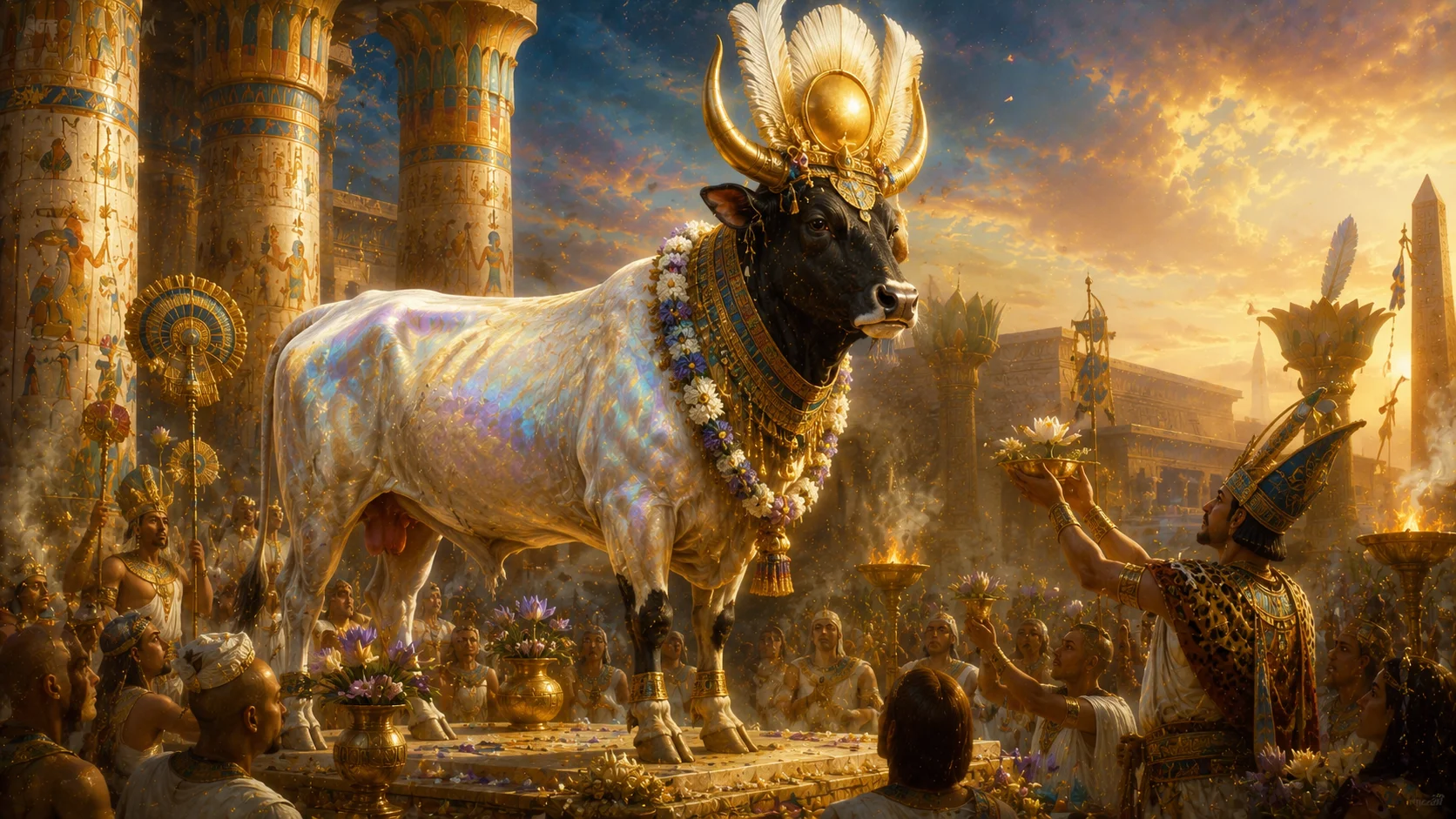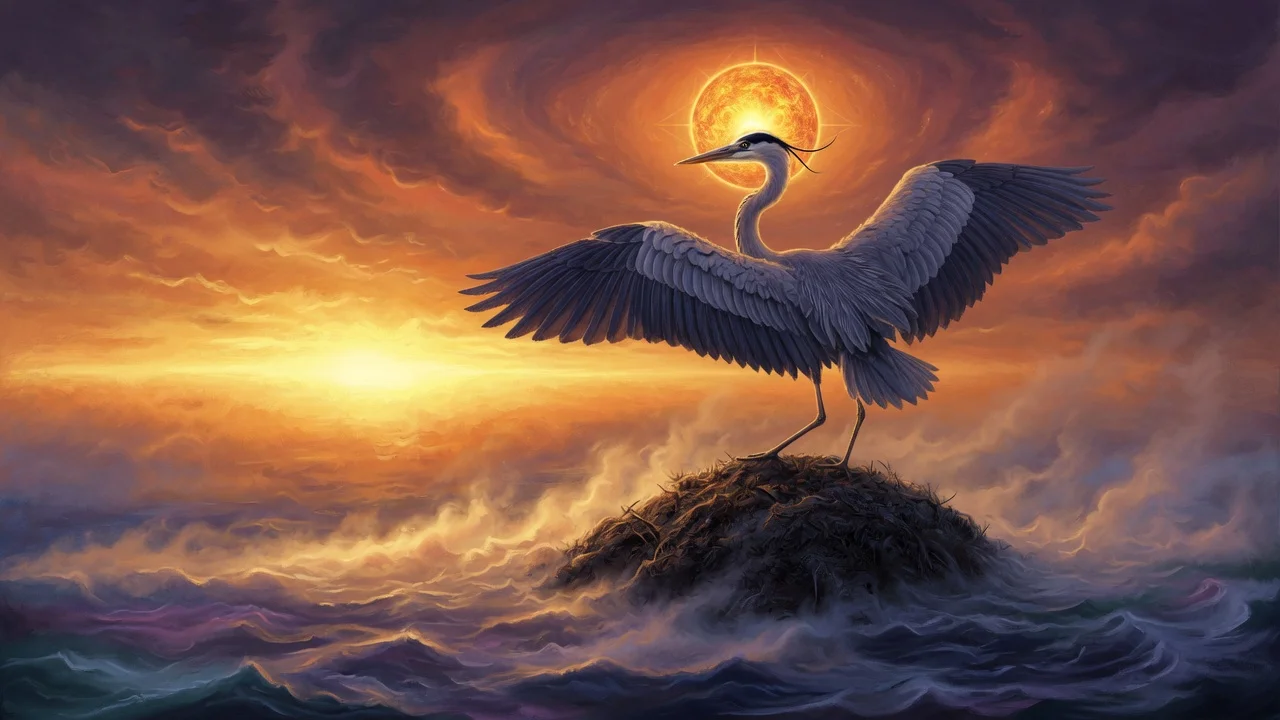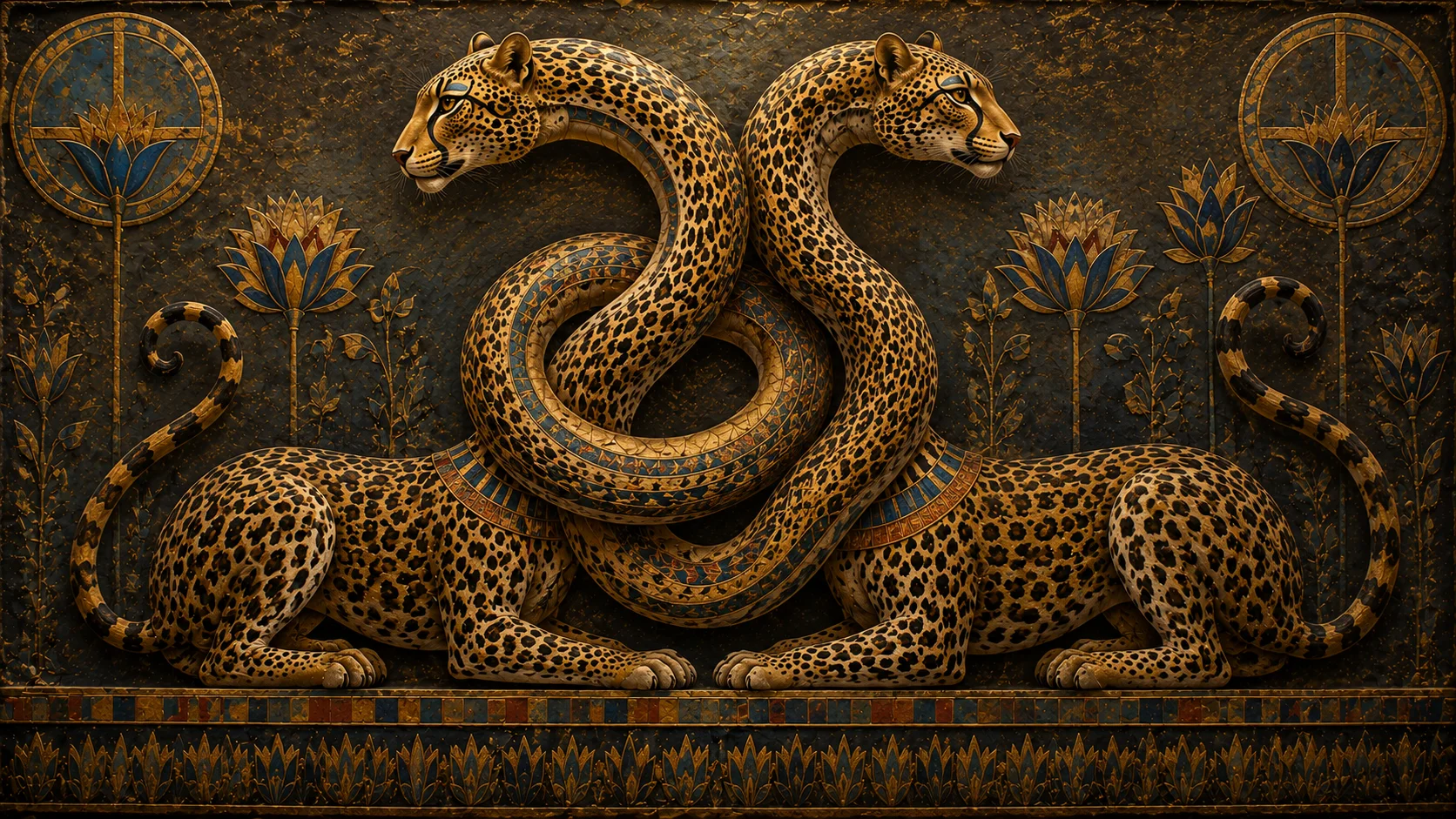
Ra was the sun-god of ancient Egypt and the king of the gods — the radiant creator who sailed his solar barque across the sky each day and through the perilous underworld each night, doing battle with the serpent of chaos so that the sun might rise again at dawn. For three thousand years he was the supreme deity of Egypt, the god whose journey was the very rhythm of life, death and rebirth that ordered the cosmos.
The Sun and the Creator
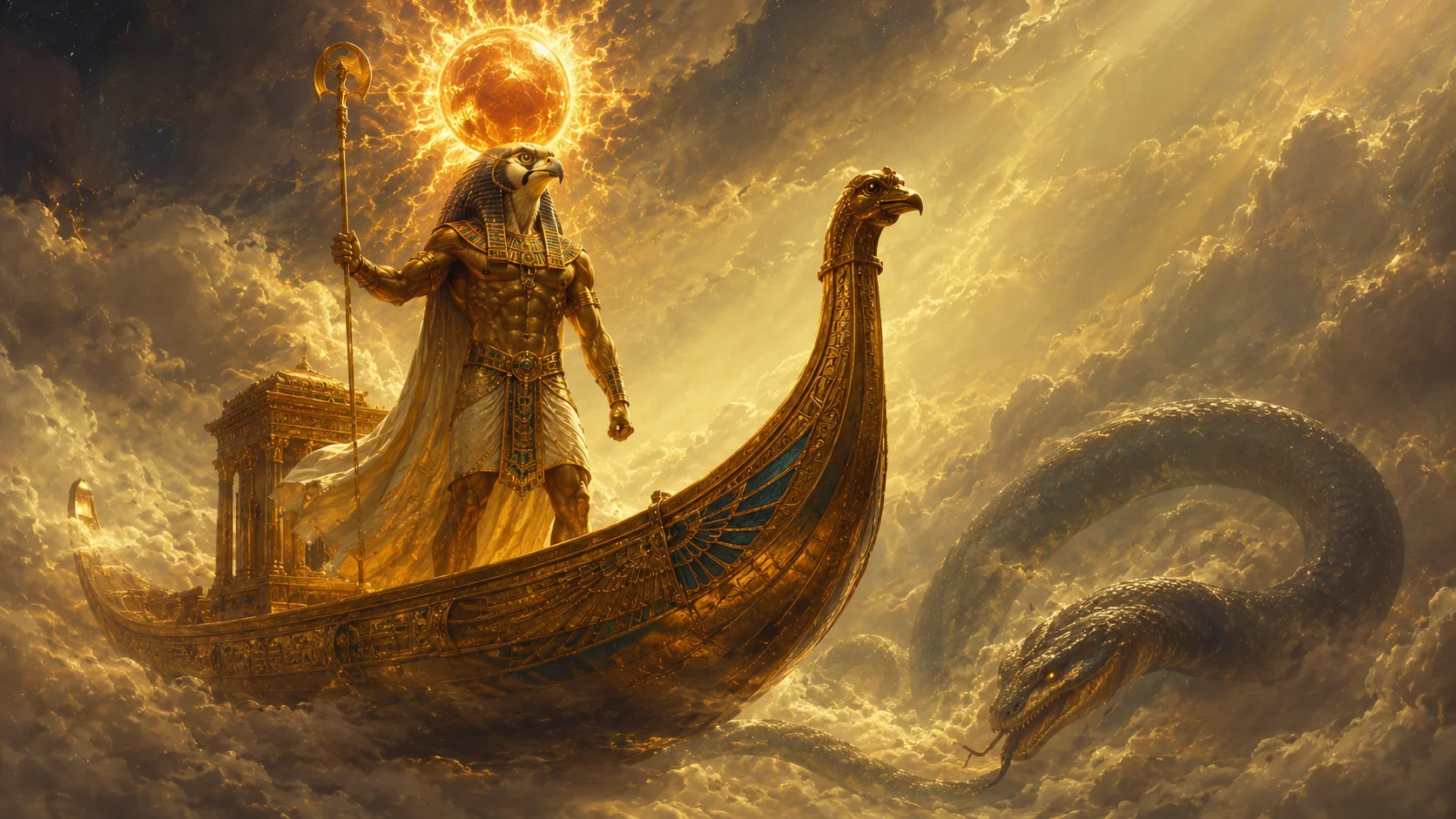
Ra (also Re) was the personification of the sun at its full noonday strength, and the chief of the Egyptian gods. In the great creation-myth of Heliopolis, the sun-god (as Atum-Ra) was the self-created first being who rose from the primordial waters of Nun upon the first mound of earth and brought forth the first gods, beginning creation. He was the source of all light, warmth and life, the king who ruled gods and men in the first ages of the world, and the divine ancestor of the pharaohs, who styled themselves “Son of Ra.” He was depicted as a man with the head of a falcon crowned with the solar disc, encircled by a sacred cobra.
The Voyage of the Solar Barque
Ra's defining act was his eternal journey across the sky. Each day he sailed from east to west in his solar barque, the Boat of Millions of Years, bringing daylight to the world — appearing at dawn as the scarab-god Khepri, blazing at noon as Ra, and setting in the evening as the ram-headed Atum in his old age. At nightfall he entered the Duat, the underworld, and sailed through its twelve dark hours — a perilous voyage through the realm of the dead, where he brought light and life to the dead as he passed, before rising renewed at dawn. The daily cycle of the sun was, to the Egyptians, this literal voyage of the god, the endless round of death at dusk and rebirth at dawn.
The Battle with Apophis
Each night, in the depths of the underworld, Ra faced his great enemy: Apophis (Apep), the colossal serpent of chaos and darkness, who lay in wait to swallow the sun and end the world. Every night the serpent attacked the solar barque, and every night Ra and his defenders (including the god Set, who stood at the prow with his spear) fought and defeated Apophis, cutting and binding the serpent so that the sun could continue its journey and rise again. This nightly battle was the cosmic struggle of order against chaos, light against darkness, played out anew every single night — and the rising of the sun each dawn was the daily victory of Ra over the forces that sought to destroy creation.
The Eye of Ra and the Aging God
Ra possessed a fearsome power in the Eye of Ra — a feminine personification of the sun's destructive heat, sent out as a goddess (often Hathor or Sekhmet) to punish the enemies of the god. In one famous myth, when mankind plotted against the aging Ra, he sent the Eye as the lioness Sekhmet to slaughter humanity, and she nearly destroyed the human race before being pacified. For Ra, in the myths, grew old — his bones turned to silver, his flesh to gold — and in his old age the cunning Isis tricked him into revealing his secret name, gaining power over him. Eventually the aged sun-god withdrew from the earth, rising into the sky on the back of the sky-goddess Nut, leaving the rule of Egypt to his successors.
The Lord of the Sun
Ra endures as the supreme god of ancient Egypt and one of the great solar deities of all mythology — the radiant creator, the king of the gods, the sailor of the sky and the underworld, the eternal foe of the chaos-serpent. He embodies the Egyptian vision of the cosmos as a daily and eternal cycle of death and rebirth, of the constant struggle to maintain order against chaos, and of the sun itself as the visible body of the greatest of the gods, sailing forever across the sky and through the dark, rising anew each dawn.
Each night he sails into the realm of the dead and fights the serpent of chaos for the life of the world — and each dawn, his victory is written across the sky as the rising sun.
The Oldest God in the Written Record
Long before Homer, before the Vedas were sung, before a single line of the Bible was set down, Egyptian priests were already carving Ra's name into stone. The kings of the Fifth Dynasty built something no dynasty before or after them attempted: dedicated sun temples at Abusir and Abu Ghurab, open-air courts centred not on a statue hidden in a dark sanctuary but on a squat stone obelisk standing in full daylight — a monumental rendering of the sacred benben, the primordial mound on which the sun-god was said to have first stood. At the close of that same dynasty, the burial chamber of King Unas at Saqqara, sealed around 2350 BCE, was inscribed with the Pyramid Texts, among the oldest religious writings on earth — and Ra is already there, fully formed, receiving the dead king aboard the solar barque. From the Fourth and Fifth Dynasties onward, “Son of Ra” was a fixed element of the formal royal titulary: a claim of divine descent that every later dynasty inherited and none dared drop.
Heliopolis, City of the Sun
The cult that produced all of this had a home: Iunu, the city the Greeks renamed Heliopolis, “Sun City,” now buried beneath the north-eastern suburbs of Cairo. Almost nothing of its temples survives above ground. The great survivor is a lone red-granite obelisk raised by Senusret I nearly four thousand years ago, still standing on the spot where it was set up, one of a pair whose twin is long gone. Yet in antiquity Iunu was one of Egypt's great centres of learning, and the doctrines its priests worked out travelled further than those of its rivals at Memphis and Hermopolis, each of which told the story of creation with its own gods at the centre. The Hebrew Bible still remembers the place by its older name: Joseph's Egyptian father-in-law is called “priest of On” (Genesis 41:45) — On being Iunu, the city of Ra. To hold that priesthood was to stand at the theological centre of the Egyptian world.
Ra's Household: the Ennead
A sun-god who claims to have made everything needs somewhere to put his relatives, and Heliopolitan theology built him an entire family tree. From the self-created Atum-Ra came the twin gods Shu (air) and Tefnut (moisture); from them, Geb (earth) and Nut (sky); and from Geb and Nut, the four siblings whose story dominates the rest of Egyptian myth — Osiris, Isis, Set and Nephthys. This lineage of nine gods, the Ennead, made Ra the great-grandfather of Osiris and the distant ancestor of every pharaoh who ever claimed Osiris's throne. It also meant that the murder of Osiris, the mourning of Isis and the kingship of Horus — the central drama of Egyptian religion — all unfold, in the traditional telling, as a family quarrel among Ra's own descendants.
One God, Several Names
Egyptian religion rarely insisted that gods stay single. Ra was worshipped at times fused with Horus as Ra-Horakhty, “Ra who is Horus of the Two Horizons,” a falcon-sun uniting kingship and daylight in one figure. When the cult of Thebes rose to national importance in the New Kingdom, its patron god Amun absorbed Ra's solar authority in turn, becoming Amun-Ra, king of the gods in a more literal sense than Ra alone had ever claimed. None of these fusions retired the older names. A single hymn could address the god as Ra, Atum, Khepri, Horakhty and Amun in successive lines without any sense of contradiction, because Egyptian theology treated them as aspects of one solar power rather than as rival deities competing for the same throne.
The Heretic Pharaoh's Solar God
Ra's centrality made him the raw material for Egypt's one serious brush with monotheism. In the fourteenth century BCE, Akhenaten raised a stripped-down form of solar worship centred on the Aten — the visible disc of the sun itself, rendered in art as a circle extending hands of light — above all other gods, shutting their temples and founding a new capital, Akhetaten, in the Aten's honour. The break was not clean at first: in the early years the Aten's formal name still opened with Ra-Horakhty, and it was later rewritten to strip out the names of the older gods altogether. What the finished doctrine kept was the disc and its life-giving rays; what it discarded was everything that made Ra a character — the falcon form, the crew of the barque, the nightly war with the chaos-serpent. The experiment collapsed within a generation of Akhenaten's death and his successors restored the old pantheon in full, but the episode shows how much theological weight the sun alone could bear once a king decided to isolate it.
Telling Ra Apart on a Temple Wall
Egyptian gods are identified less by their faces than by what they wear and what they carry, and a falcon head is shared by several of them. It is the solar disc above it, ringed by the rearing uraeus cobra, that marks the figure as solar. The cobra is not ornament: it is a goddess coiled at the god's brow, there to spit fire at anything that approaches him with bad intent. In his hands Ra usually holds the was-sceptre, the forked staff of dominion, and the ankh, the sign of life. In temple reliefs he is often shown extending the ankh toward the pharaoh's face — the gesture by which a god hands a king his next breath and his right to rule in the same motion.
Guiding the Dead Through the Amduat
Ra's nightly voyage was not only public myth; it became sacred cartography, painted onto the walls of royal tombs. From the New Kingdom onward, pharaohs had the Amduat (“That Which Is in the Underworld”) and the Book of Gates carved and painted across their burial chambers in the Valley of the Kings — hour-by-hour charts of the sun's passage through the Duat, each hour populated by the specific gates, demons and allies the god meets there. A dead king was expected to travel that same route alongside Ra, naming the right beings at the right hour, so that he might share in the god's nightly triumph over dissolution. The tomb, in effect, was built as a rehearsal space for a journey the king's soul was meant to make for real.
The God the Greeks Called Helios
Greek visitors to Egypt did what Greeks generally did with foreign gods: they looked for the nearest equivalent at home and used its name. For the sun-god of Iunu the obvious match was Helios, and the equation is fossilised in the map — Heliopolis is simply the Greek for what the Egyptian name already meant, a label that has outlived the language it replaced. The fit was never exact. Helios crossed the sky in a chariot rather than a barque, and no serpent lay waiting in the dark to swallow him. What travelled easily between the two cultures was the sun. What did not travel was the nightly fight it took to bring it back.
Why the Sun Needed a Story
Every culture that watches the sun vanish over a flat horizon has to answer the same unspoken question: what guarantees it comes back? Egypt answered with a narrative rather than a law of physics — the sun returns because a god fought for it, all night, against something that wanted it to stay dead. That is a stranger and more anxious answer than it first appears. It makes daylight contingent, a victory rather than a given, won again every single night rather than owed to the world automatically. The reward for that anxiety was a kind of intimacy other solar cults never offered quite so directly: a pharaoh, a priest, or an ordinary Egyptian reciting the right words at dusk was not merely admiring a sunset. They believed themselves to be, in some small way, standing with Ra in the prow of the boat.
Sources & traditions
- EncyclopediaWikipedia — Ra
- TraditionEgyptian texts, inscriptions and later retellings
Myths change from area to area and from time to time. This chronicle follows the most widely told versions; tellings in other villages, regions and eras may differ.