Set was the Egyptian god of storms, the desert, chaos, and foreign lands — the murderer of his brother Osiris, the fierce rival of his nephew Horus for the throne of Egypt, and yet also a mighty protector who speared the serpent of chaos each night to defend the sun-god's passage through the underworld. No figure in the Egyptian pantheon carried a more contradictory reputation across the millennia of the civilization's history: royal patron in one age, demon of destruction in another.
Born of Earth and Sky
Set was a son of Geb, god of the earth, and Nut, goddess of the sky, born into the same generation as Osiris, Isis, and Nephthys. Of the four siblings, Set alone stood apart in temperament — where Osiris embodied kingship, fertility, and the ordered rhythms of the Nile, Set embodied the opposite: the harsh red desert beyond the valley's edge, the sudden violence of storms, and the disruptive energies that Egyptian thought grouped under the name isfet, chaos, set against maat, order. In the fullness of Egyptian cosmology this pairing was deliberate: Horus, Osiris's avenging son, came to be linked with the fertile Nile Valley itself, while Set remained bound to the deserts and the foreign lands beyond Egypt's borders, so that the two gods together mapped the whole of the known world, the tamed and the untamed standing in permanent tension.
Husband of Nephthys, Shadow of a Marriage
Set was, in most tellings, the husband of his own sister Nephthys. Yet even this union was drawn into the wider family drama that would end in bloodshed: in the story preserved of the family's entanglements, Nephthys disguised herself as Isis in order to conceive a child, Anubis, with Osiris. Later tradition sometimes points to this episode — a wife's deception, a brother's unwitting betrayal — as one of the threads feeding Set's resentment, though the myths never reduce his hatred of Osiris to a single, tidy motive. It sits instead within a marriage already shadowed by the wider currents of the family's rivalries.
The Beast With No Name
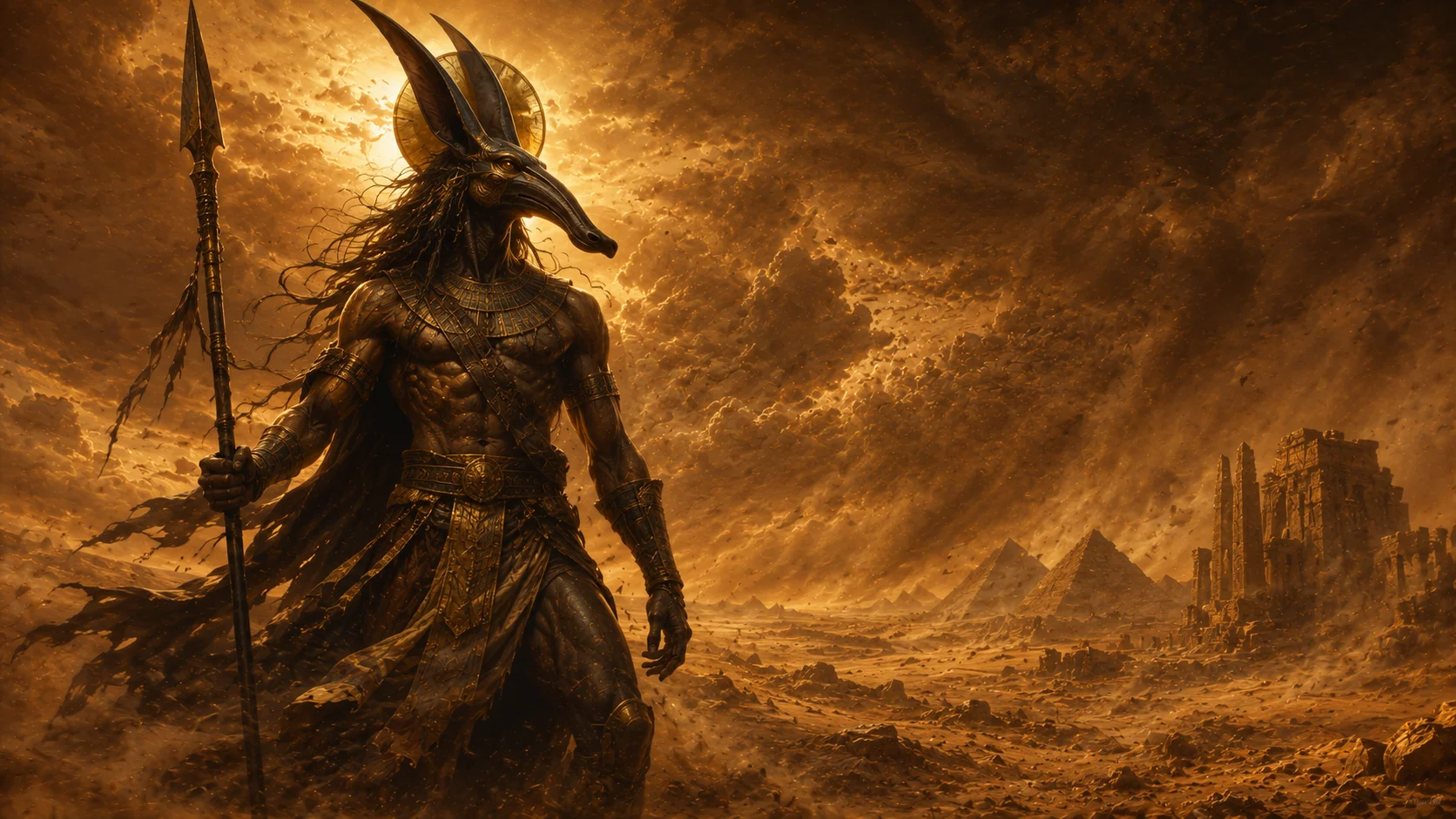
Set's image was unlike that of any other Egyptian god. He was shown as a composite creature — a curved, down-turned snout, tall square-cut ears, and a stiff, forked tail standing erect behind him — an animal that corresponds to nothing known in the natural world, its identity debated by scholars for well over a century without resolution. Artists rendered him both as this strange beast in full and as a man bearing its head, a visual language that marked him instantly, even at a glance, as something other: not simply an animal-headed god among many, but a creature invented expressly to look like nothing else, fitting for a god whose whole nature was disruption of the expected order.
The Chest on the Nile
The defining act of Set's mythology was the murder of Osiris, the central hinge of the entire Osirian cycle. In the fullest surviving account, recorded by the Greek writer Plutarch drawing on far older Egyptian tradition, Set contrived to trap his brother inside a chest built exactly to Osiris's measurements, sealing him inside and casting the chest away. When Isis recovered her husband's body and began to mourn him, Set was not finished: he seized the corpse a second time and dismembered it, scattering the pieces across the length of Egypt so that no single burial, and no single act of mourning, could make Osiris whole again. It was this act — not accident, not a duel fought in the open, but calculated betrayal and desecration — that made Set the founding villain of Egyptian myth's central story, the murderer who broke the natural succession of kingship and set the entire Osiris cycle, with all its grief and eventual justice, into motion.
The Contendings for the Throne
Osiris's death did not settle the question of Egypt's throne — it opened decades of struggle between Set and Osiris's son Horus, preserved at length in the New Kingdom papyrus known as The Contendings of Horus and Set. The tribunal of gods that was meant to judge between them instead dragged on through trial after trial, contest after contest, each side pressing its claim by cunning as much as by strength. Among the trials was a boat-building contest, each rival's vessel judged by the assembled gods — a contest of ingenuity and deception as much as craft. The struggle also turned violent and deeply personal: in the fighting between them, Set gouged out one of Horus's eyes, and Horus answered in kind, tearing out Set's testicles in retaliation — a wound as symbolically charged as the one he had suffered, striking at potency and generative power rather than at life itself.
The contest between the two also took a sexual turn, recorded in the papyrus with the same directness as its other episodes. Set, having invited Horus to stay the night at his house, attempted to sexually violate his nephew as he slept, intending the act as a humiliation that would disqualify Horus from kingship by branding him the passive partner in the assault — in Egyptian terms, a mark of submission held to make a claimant unfit to rule. Horus prevented Set's semen from entering his body, catching it instead between his hands, and reported the assault to his mother Isis. Isis, in response, disposed of Set's semen and placed Horus's own on a head of lettuce from Set's garden, which Set then unknowingly ate. When the two later brought their dispute before the divine tribunal and Set claimed to have dominated Horus, the god Thoth summoned each man's seed to answer the charge: Set's voice answered from the river marsh where Isis had cast it, while Horus's answered from within Set himself, emerging as a golden disc from Set's own skull. The trick that Set had intended as Horus's disgrace was turned back upon him in front of the assembled gods, and the episode became, in the tradition, further proof against Set's fitness to rule rather than for it.
The Tribunal's Verdict
After years of contest, insult, and injury, the assembled gods ultimately ruled in Horus's favor, awarding him the throne of Egypt as the rightful heir of Osiris. Some versions of the tradition soften this into a negotiated settlement first — a division of the land between the two claimants before the matter was finally and permanently resolved — but the outcome across the tradition converges on the same point: Horus's sole and final victory, and Set's exclusion from the kingship he had killed to obtain. The Contendings thus close the cycle that the murder in the chest had opened, order reasserting itself over the chaos that had usurped it.
Spearman at the Prow
Set's story, however, did not end in defeat and disgrace alone. In one of Egyptian religion's most striking reversals, the very qualities that made him a murderer and usurper — raw strength, ferocity, an appetite for violence — were also precisely what the cosmos needed each night. As the sun-god Ra sailed his barque through the underworld in the hours of darkness, the great chaos-serpent Apep rose to attack it, threatening to swallow the sun and unmake the world's order entirely. It was Set who stood at the prow of the barque to meet that threat, spearing Apep back into defeat night after night so that dawn could come again. Here Set was no longer chaos loosed against order — he was chaos itself deployed as order's last defense, the one force violent enough to hold back a violence still greater. He carried titles honoring this role, standing among Ra's protectors as a defender of the sun's unbroken journey.
Lord of the Red Land
Among his epithets, Set was known as "Lord of the Red Land," a direct claim to the desert wastes beyond the fertile black soil of the Nile's floodplain — the "red land" that Egyptians understood as the domain of drought, danger, and everything unregulated by the river's yearly rhythm. He was also called "the Ombite," a title drawn from Ombos, near Naqada, one of his principal cult centers and a place where his worship ran deep and largely unbroken across dynasties. A second major center of his cult rose in the Delta city of Avaris during the period of Hyksos rule, when the foreign rulers of Lower Egypt identified their own storm god with Set — a fusion that reflected his long-standing association with foreign lands and outsiders, for better and eventually for worse.
When Kings Bore His Name
It would be a mistake to read Set's entire history backward through his later villainy. In the Old and Middle Kingdoms he was a fully legitimate object of royal devotion, honored as a patron deity whose strength a king might claim as his own. The pharaoh Seti I bore a name that means, plainly, "Man of Set" — a throne name that would have been unthinkable had Set been regarded purely as an embodiment of evil. In these earlier centuries Set's chaos was understood as a necessary force within the cosmos rather than a purely destructive one: violent, yes, but no more inherently wicked than the desert itself, which was simply the reality bordering the valley on every side.
A God Recast as Enemy
That balanced reading of Set did not survive intact. Across the Third Intermediate Period and into the Late Period, his reputation darkened sharply, and the shift was tied in large part to politics as much as theology: successive waves of foreign rule — the Hyksos, later the Assyrians, later still the Persians — had favored Set's cult, and as Egyptian resentment of foreign domination hardened, so did hostility toward the god so closely linked to outsiders. Set increasingly came to be read not as a necessary counterweight to order but as the embodiment of isfet itself, chaos in its purely destructive sense, opposed root and branch to maat. The murderer of Osiris, once one troubling episode within a larger and more ambivalent portrait, hardened into Set's whole and total identity.
Erased From the Stone
That demonization left physical scars that still survive. Under the Twenty-Fifth and Twenty-Sixth Dynasties in particular, Set's image was deliberately chiseled away or defaced on a number of monuments where it had once stood unremarked — a targeted erasure, a form of damnatio memoriae inflicted on a god rather than a disgraced official, and a rare case of Egyptian religious practice actively working to remove a deity from the visual record it had itself carved centuries before. The stone itself bears witness to how completely his standing had reversed.
Destroyer and Defender in One Body
What endures across all these shifting centuries is the sheer doubleness of Set: the god who trapped his brother in a chest and scattered his body across Egypt, who fought his own nephew for a throne he had no right to and lost an intimate part of himself in the struggle, and who nonetheless stood every night at the prow of the sun's own vessel, spear raised against a chaos even greater than his own. Egyptian religion did not require him to resolve into either role alone. He was destroyer when his violence turned against maat, and protector when that same violence turned outward to meet the serpent — one nature, pointed in two directions, and Egypt's clearest surviving portrait of the idea that strength itself is neither virtuous nor wicked, only what it is aimed at.
Sources & traditions
- EncyclopediaWikipedia — Set (deity)
- TraditionEgyptian texts, inscriptions and later retellings
Myths change from area to area and from time to time. This chronicle follows the most widely told versions; tellings in other villages, regions and eras may differ.