The Bennu was the sacred bird of ancient Egypt — a magnificent heron-like bird associated with the sun, creation, rebirth and the cyclical renewal of time, who was said to have arisen at the first dawn and to be reborn from its own self in an eternal cycle. The original phoenix, the Bennu is the bird of the sun and of resurrection, the inspiration for the deathless firebird of later legend.
The Heron Who Named Itself
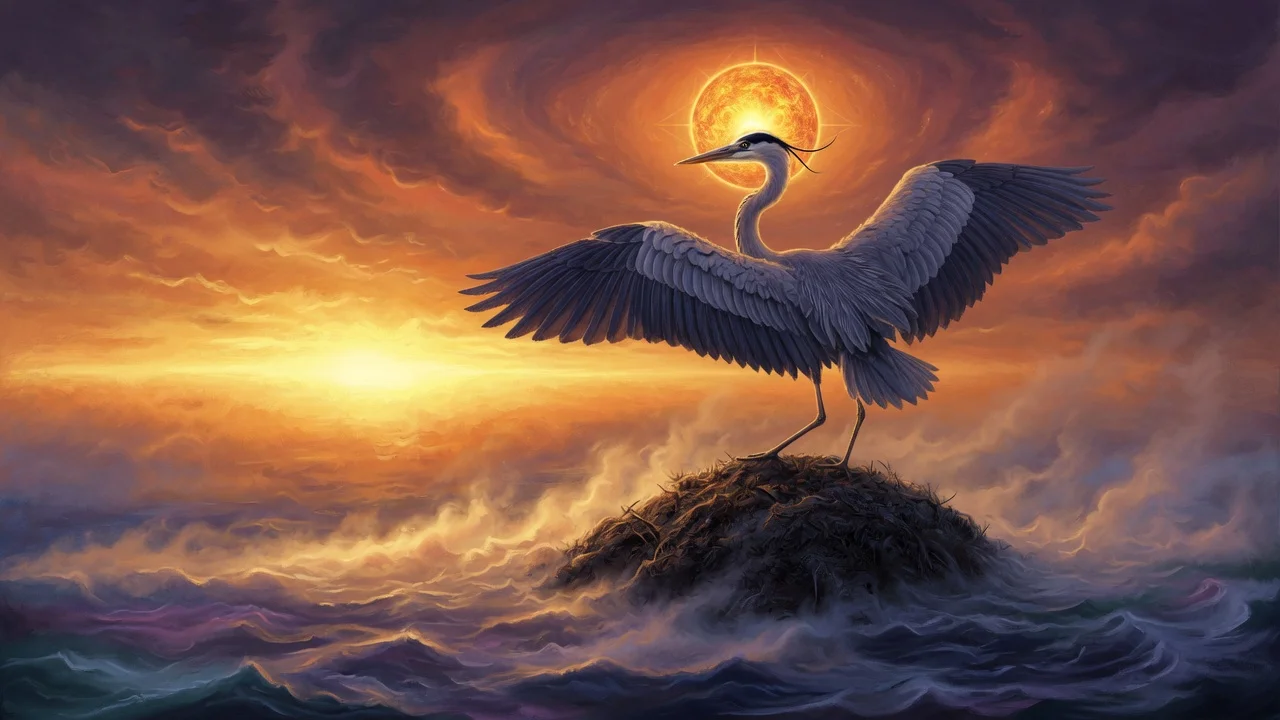
The Bennu was pictured not as some fantastical hybrid but as a bird any Egyptian could recognize on the riverbank: a grey heron (Ardea cinerea), tall and long-beaked, often shown with a crest of two long feathers rising from the back of its head. In some renderings it wears the solar disc or the Atef crown, marking its bond with kingship and the sun, and it is commonly shown standing upon the benben stone itself or perched in a persea or willow tree. There was nothing monstrous in this image. The Bennu's power lay precisely in its ordinariness of form set against the extraordinary claims made about its origin — a familiar riverine bird made the vessel of the most fundamental Egyptian idea of all: that something could bring itself into being.
Upon the Mound That Rose From Nun
Egyptian cosmology held that before creation there was only Nun, the dark, undifferentiated primeval waters, formless and without direction. From that waste, tradition said, the first solid ground appeared: the benben, a mound or raised stone breaking the surface of the flood. The Pyramid Texts — among the oldest religious writings to survive from Egypt — describe the Bennu as having come into being of itself, self-created, alighting upon or appearing at this same primeval mound. It was not made by another god's hand and did not owe its existence to any act of fashioning; it simply was, at the instant the world itself began to be. This self-origination is the single idea that everything else about the Bennu radiates outward from: a being who created itself is, by definition, immune to the ordinary rule that what begins must also end.
The Cry That Broke the Silence
Before the Bennu, Egyptian texts imply, there was no sound at all — only the mute expanse of Nun. Some accounts describe the bird's cry as the very sound that shattered that primeval silence, the first noise the cosmos ever heard, and the moment from which time itself could be said to begin. In this telling the Bennu is not merely present at creation as a witness but is one of its active agents: its voice is the starting gun of history, the point at which "before" and "after" become meaningful categories. An epithet attached to the bird reflects exactly this role — it was called a herald or announcer of Ra, the one whose utterance opens the proceedings of the world.
The Soul of Ra Made Visible
Above all other associations, the Bennu was bound to Ra, the sun god of Heliopolitan theology. Egyptian religious thought distinguished a god's outward body from his ba, the animating soul or manifest power that could take independent form, and the Bennu was understood as the ba of Ra given feathered shape. To see the Bennu, in this theological grammar, was to see something of the sun god's own living essence moving through the world apart from the great solar disc itself. Some Pyramid Text passages extend the association further, linking the bird also to Atum, the self-created creator god of Heliopolis whose identity fused with Ra's into the composite Atum-Ra. Since Atum was himself the god who arose from Nun by his own power and set creation in motion, the Bennu's self-origination and Atum-Ra's self-origination were two expressions of the same theological claim, echoing each other across the Heliopolitan system.
The Shrine at Heliopolis
The city of Iunu, known to the Greeks as Heliopolis, "city of the sun," was the great cult center of Egyptian solar theology, and it was here that the Bennu had its proper home. Egyptian tradition spoke of a specific sacred building, the Mansion of the Bennu (Hut-benben), a shrine at Heliopolis dedicated to the bird and closely tied to the benben stone that gave both the mound of creation and the shrine their shared name. This was not a diffuse, placeless myth; the Bennu belonged to a real city and a real sanctuary, where the abstractions of self-creation and solar rebirth were given a fixed cultic address. To speak of the Bennu was, for an Egyptian, to speak also of Heliopolis and of the theology that city's priesthood maintained.
A Second Ba, Wearing Osiris's Renewal
Solar theology was not the Bennu's only inheritance. Certain funerary texts draw the bird into the sphere of Osiris, the god who died and was restored to life, and there the Bennu can stand as a symbol or vessel of Osiris's own ba, carrying the promise of resurrection that Osiris embodies for the dead. This is not a contradiction of the bird's solar identity so much as a second facet of the same underlying idea: whether cast as Ra's soul or as a sign of Osiris's renewal, the Bennu consistently represents the passage through death, silence, or non-being into fresh life. Egyptian funerary religion drew freely on both the solar cycle and the Osirian cycle to describe the fate hoped for after death, and the Bennu had a foothold in each.
Becoming the Bird, Beyond the Tomb
This funerary dimension found its clearest expression in the Book of the Dead, the collection of spells meant to guide and empower the deceased through the dangers of the afterlife. Among its chapters is one devoted specifically to transformation into a Bennu, a spell that allowed the dead to take on the bird's own form and, with it, its capacity for self-renewal. To become the Bennu was to claim, on one's own behalf, the same freedom from ending that the bird had displayed at the dawn of the world. It was less a poetic flourish than a practical piece of afterlife technology: a spoken or written transformation meant to secure an outcome, rebirth, that the deceased could not otherwise guarantee.
Cycles of Flood and Season
Some interpretations connect the Bennu to the rhythms of the natural year, particularly the annual flooding of the Nile on which Egyptian agriculture depended, and to the broader task of marking or measuring time's passage. This cosmological role sits less explicitly in the primary sources than the bird's creation and rebirth symbolism does, but it fits naturally alongside them: a being tied to the very first sunrise and to recurring renewal was a fitting emblem for a land whose fortunes rose and fell with a cycle as regular and as vital as the river's own flood.
What Herodotus Heard at Heliopolis
Centuries later, the Greek historian Herodotus, writing in Book II of his Histories, recorded an account he had heard of an Egyptian bird connected with Heliopolis that regenerated from the remains of its predecessor. Egyptologists generally read this as Herodotus drawing on, or conflating his sources with, the native Egyptian Bennu — the same city, the same solar cult, the same idea of a bird renewing itself across generations. What Herodotus did not report, and what native Egyptian sources of this period do not themselves attest, is the fully self-immolating cycle familiar from later legend: the bird consumed by its own fire and rising anew from its ashes. That specific and vivid image is a Hellenistic elaboration, layered onto the older Egyptian core by Greek and Roman writers who came after Herodotus, rather than a feature of the Bennu as Egyptian religion itself described it.
From Iunu to the Wider World
Through this Greek transmission, the Bennu became the acknowledged Egyptian antecedent of the phoenix of Greco-Roman literature, and it is by that later, borrowed name that the bird is best known outside Egyptology today. Modern popular culture has almost entirely folded the two together, treating "phoenix" and "Bennu" as simple synonyms and carrying the ash-and-fire imagery back onto the Egyptian original as though it had always belonged there. It had not. The Egyptian Bennu is the older, plainer, and in some ways more radical figure: not a bird that must first be destroyed in order to live again, but one that required no destruction at all, having come into being of itself in the first place and carrying that same self-sufficiency forward through every renewal that followed.
The Bird the Priests of the Sun Kept
Set against its later reputation, the Bennu that emerges from the Pyramid Texts, the Book of the Dead, and the theology of Heliopolis is a remarkably economical figure: a heron, a stone, a cry, and a claim of self-origination, repeated across the solar cycle, the funerary hope of resurrection, and the yearly return of the flood. It did not need wings of flame or a pyre to make its case for immortality. It needed only to have been there at the very beginning, unmade by any hand but its own, and to remain available — through a spoken spell, a carved relief, a shrine at Heliopolis — to anyone who required, as the dead of Egypt did, a proof that ending was not the last word.
Sources & traditions
- EncyclopediaWikipedia — Bennu
- TraditionEgyptian texts, inscriptions and later retellings
Myths change from area to area and from time to time. This chronicle follows the most widely told versions; tellings in other villages, regions and eras may differ.