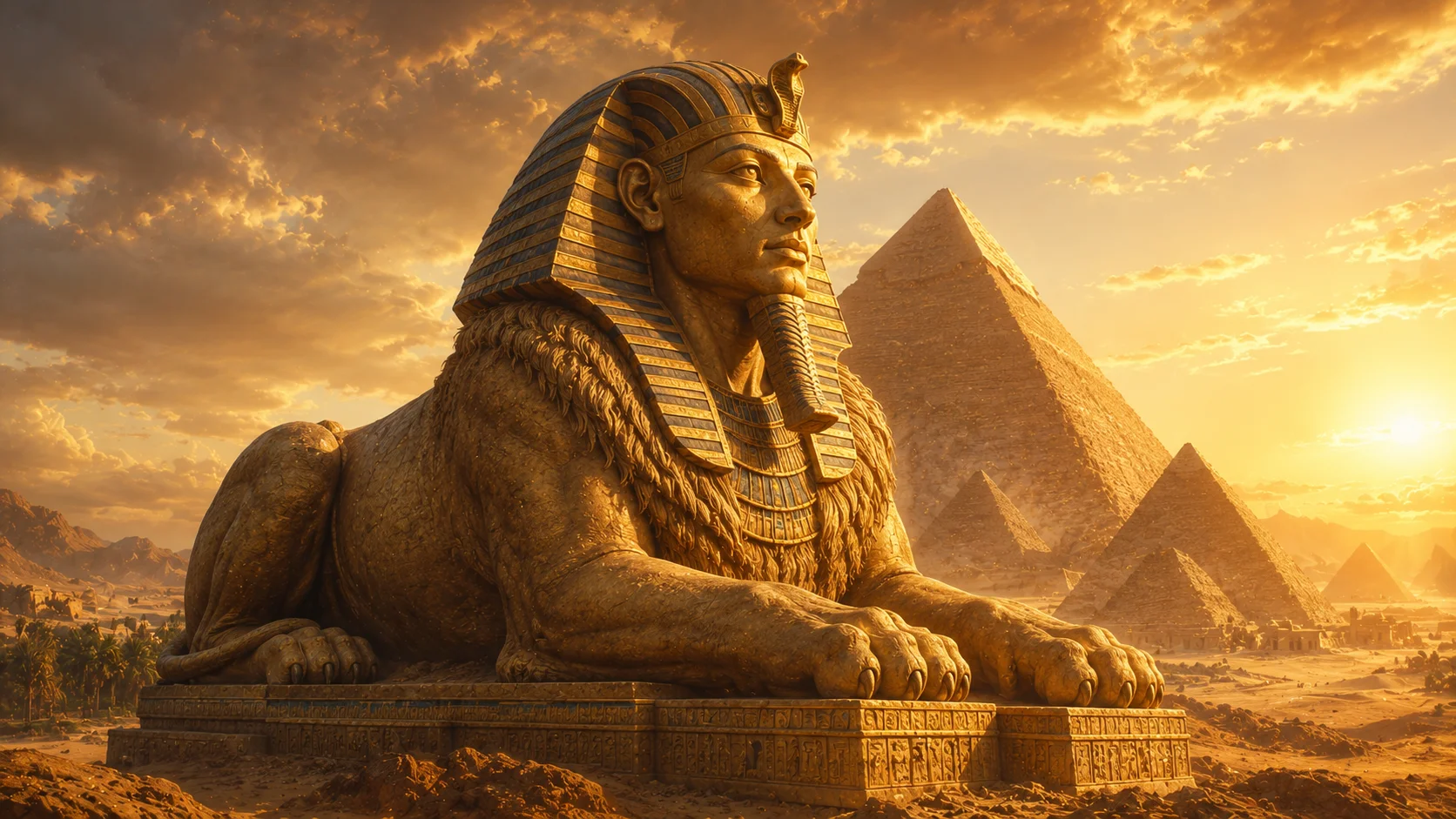
The Egyptian Sphinx is a composite image of royal power: the recumbent body of a lion joined to the head of a human, typically a pharaoh wearing the royal nemes headdress and false beard. It is not, in its native form, a monster to be feared or a riddler blocking a traveller's path — it is a guardian, a symbol of sovereignty fused with leonine strength, and it survives above all in the colossal stone form of the Great Sphinx of Giza, which has watched over the Giza plateau for roughly four and a half thousand years.
A King's Face on a Lion's Body
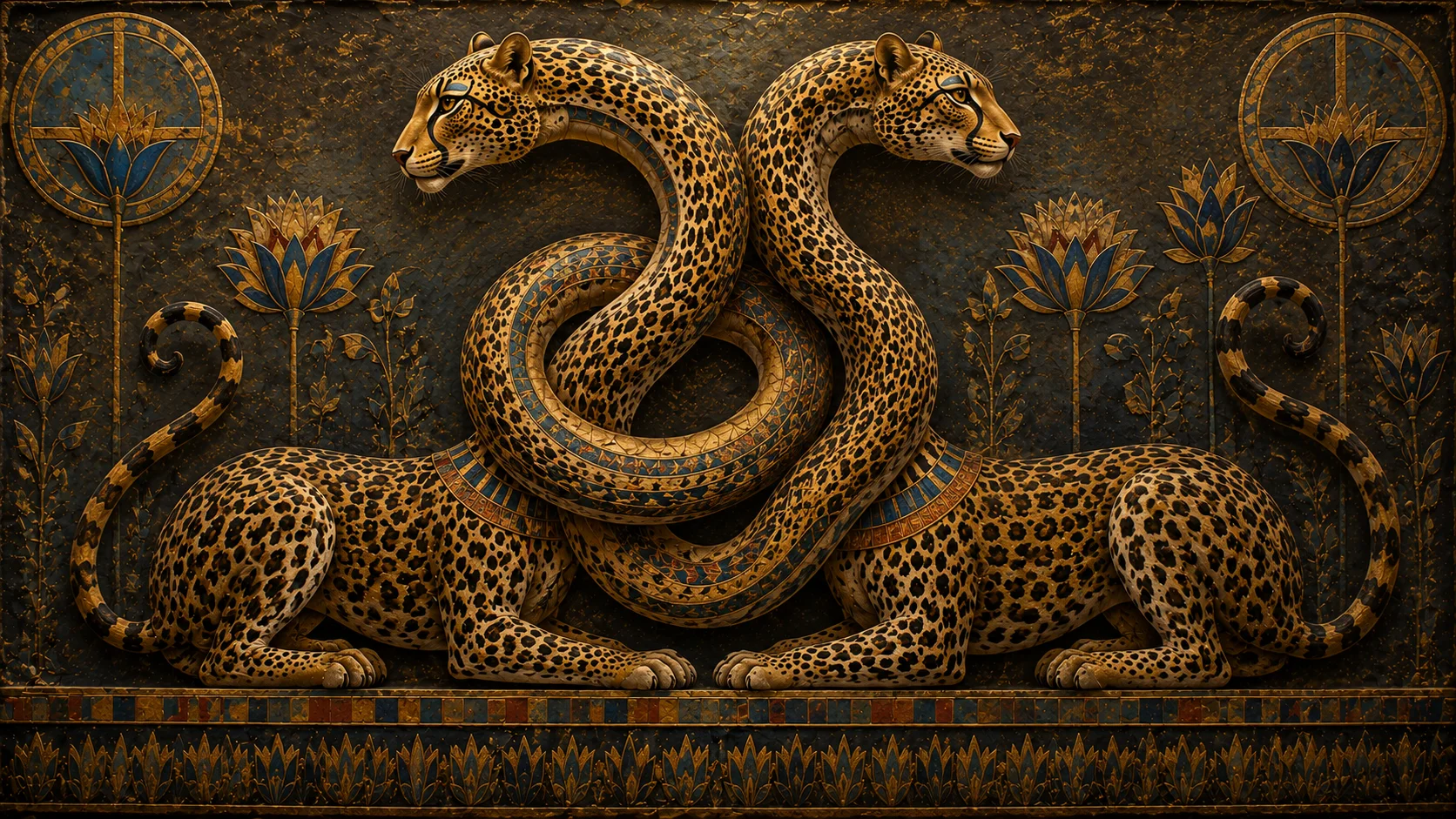
The defining feature of the Egyptian sphinx — properly the androsphinx, to distinguish it from later ram-headed and falcon-headed variants — is the union of a human head with a lion's body. The head is usually royal: a king shown wearing the nemes, the striped cloth headdress bound at the brow, often with the ceremonial false beard that marked pharaonic authority in formal imagery. The body beneath is unmistakably leonine, powerful, at rest but coiled with latent strength. This was not an arbitrary combination. The lion carried deep symbolic weight in Egyptian belief as a guardian of thresholds and boundaries, an association reflected in leonine protective deities and in twinned lion-gods conceived as guardians of the horizon itself. Placing a king's head on that body was a way of saying, in a single image, that the pharaoh possessed the lion's ferocity and the lion's role as protector, while remaining unmistakably himself.
Sovereignty Made Visible
The sphinx form functioned, first and foremost, as a statement about kingship. It was not primarily a creature of narrative or folklore in the way later traditions imagined such hybrid beings; it was an image, deployed in stone, meant to be seen and to communicate authority at a glance. A pharaoh rendered as a sphinx was shown as something more than a man: a ruler whose power had the natural force of a lion behind it, and whose right to rule carried a solar, semi-divine dimension. The form was also adaptable. While the most famous sphinxes bear unmistakably male, royal features, Egyptian art also produced sphinxes carved with the features of queens, showing that the image of composite royal-leonine authority was not rigidly restricted to kings alone, even if the grandest surviving examples read as male sovereigns.
Variant Forms Beyond the Human Head
Not every Egyptian sphinx wore a human face. Two other head-types appear in the tradition, each tied to a specific deity. The criosphinx bears the head of a ram, linked to the god Amun; long avenues of ram-headed sphinxes lined temple approaches associated with his cult, most famously the processional way connecting the temples of Karnak and Luxor, where many of the flanking sphinxes carry Amun's ram head rather than a royal human one. The hieracosphinx bears the head of a falcon, linked to the god Horus, drawing the sphinx image directly into solar and sky-god symbolism. These variants show that the sphinx was not a single fixed creature so much as a flexible template — a lion's body that could be crowned with whichever head best expressed the guardianship or divine association a particular temple or monument required.
Sentinels Along the Sacred Way
Wherever they appeared, sphinxes were guardians rather than obstacles. Temple approaches in Egypt were commonly flanked by rows of sphinxes, standing sentinel along the processional routes that led toward the sacred interior. Passing between them, a visitor moved through a corridor of watchful, composite royal-and-leonine figures before ever reaching the temple proper. This guardian function is central to understanding the Egyptian sphinx correctly: it did not test those who approached with riddles, nor did it devour the unworthy. It stood as a protector of thresholds, marking the boundary between the ordinary world and consecrated ground, much as the lion imagery it drew upon was already tied in Egyptian belief to the guarding of boundaries and the horizon.
The Colossus at Giza
All of this converges in the single most famous sphinx ever carved: the Great Sphinx of Giza, cut from the living bedrock of the plateau and standing guard near the pyramids. Egyptologists generally understand it to depict a pharaoh of the Old Kingdom's Fourth Dynasty, most commonly identified with Khafre, though the exact identification remains a live question among scholars rather than a settled fact. What is not in question is its scale and endurance: a single carved lion's body some seventy metres in length, crowned with a royal human head, that has remained in place on the Giza plateau for roughly four and a half thousand years, making it among the oldest and largest monumental sculptures to survive from the ancient world.
Horus in the Horizon
The Great Sphinx did not carry a single fixed identity across Egyptian history. In the later New Kingdom, a religious reinterpretation attached it to the solar god Horemakhet, meaning "Horus in the Horizon" or "Horus of the Horizon." This was not a replacement of its royal meaning so much as a layering of solar and Horus-related theology onto the existing monument, binding the imagery of kingship even more tightly to the daily journey of the sun and to Horus's own solar and sky associations. Under this identity the Sphinx became not merely a portrait of a long-dead king but an active embodiment of a god watching over the horizon where the sun rose each day.
The Dream Between the Paws
This solar identity is preserved in one of the few native Egyptian narratives directly attached to the Sphinx: the Dream Stela, erected between its great paws by the New Kingdom pharaoh Thutmose IV of the Eighteenth Dynasty. The stela recounts a dream in which the buried Sphinx — by then largely covered by encroaching desert sand and identified in the dream as Horemakhet — spoke to the young prince and promised him the kingship if he would clear away the sand burying its body. Whatever the historical circumstances behind the inscription, the stela stands as the clearest surviving native Egyptian testimony to the Sphinx as a speaking, divine, solar presence rather than a mute monument, and it ties the monument's physical condition — buried, then uncovered — directly into a story of kingship granted by divine favour.
A Temple Built for Solar Rite
Adjacent to the Sphinx itself stands the Sphinx Temple, built of massive limestone and granite blocks and associated with solar ritual. Its presence beside the monument reinforces the reading of the Sphinx as bound up with solar kingship ideology rather than standing as an isolated sculpture. Together, the colossal guardian and the temple at its feet formed a setting in which the ideas of kingship, protection, and the sun's daily course were made physically present on the Giza plateau, to be approached and ritually engaged with rather than simply viewed from a distance.
Not the Riddler of Greek Legend
It is worth stating plainly what the Egyptian sphinx is not, since the word "sphinx" carries very different connotations in later Western memory. The Greek sphinx — the creature of the Theban legend bound up with the story of Oedipus — is a distinct figure drawn from a separate, Near Eastern and Greek line of tradition: often female, posing a fatal riddle to travellers, and hostile to those who failed to answer. The Egyptian sphinx shares none of this. It is not typically female, does not pose riddles, and is not depicted as a predator of the unwary. It is fundamentally a royal and solar guardian image, rooted in Egyptian ideas of kingship, protection, and the lion's association with thresholds and the horizon. The resemblance between the two figures is one of later reception and conflation, not of shared origin or meaning within Egyptian belief itself.
An Image Reinterpreted by Later Ages
The Great Sphinx went on to become one of the most widely recognised symbols of ancient Egypt in the wider world, its silhouette instantly identifiable long after the theology that first shaped it had faded. In the process, Egyptian sphinx imagery was taken up and reworked across Hellenistic, Roman, and later European art, frequently merged with the entirely separate riddle-posing sphinx of Greek myth into a single blended figure in popular imagination. That merging is a development of later ages engaging with Egypt from the outside; it was never part of the belief system that produced the original monument, in which the sphinx remained, consistently, an image of royal and solar guardianship rather than menace.
The Eternal Watcher of the Plateau
Stripped of later embellishment, the Egyptian sphinx endures as it was conceived: a lion's body carrying a king's face, an image built to declare that pharaonic authority possessed the strength of the lion and, in time, the radiance of the sun god at the horizon. Rows of these figures once lined the routes into sacred precincts, their ram-headed and falcon-headed cousins standing in for Amun and Horus where a human face was not called for, while at Giza a single vast example was carved directly from the plateau's bedrock and has kept its watch, largely unmoved, since the Old Kingdom. Buried by sand, uncovered again, renamed Horemakhet by later theology, and given its own temple for solar rite at its feet, it remains what it always was beneath every later reinterpretation: a guardian carved in stone, keeping watch over the threshold between the desert and the sacred.
Sources & traditions
- EncyclopediaWikipedia — Sphinx
- TraditionEgyptian texts, inscriptions and later retellings
Myths change from area to area and from time to time. This chronicle follows the most widely told versions; tellings in other villages, regions and eras may differ.