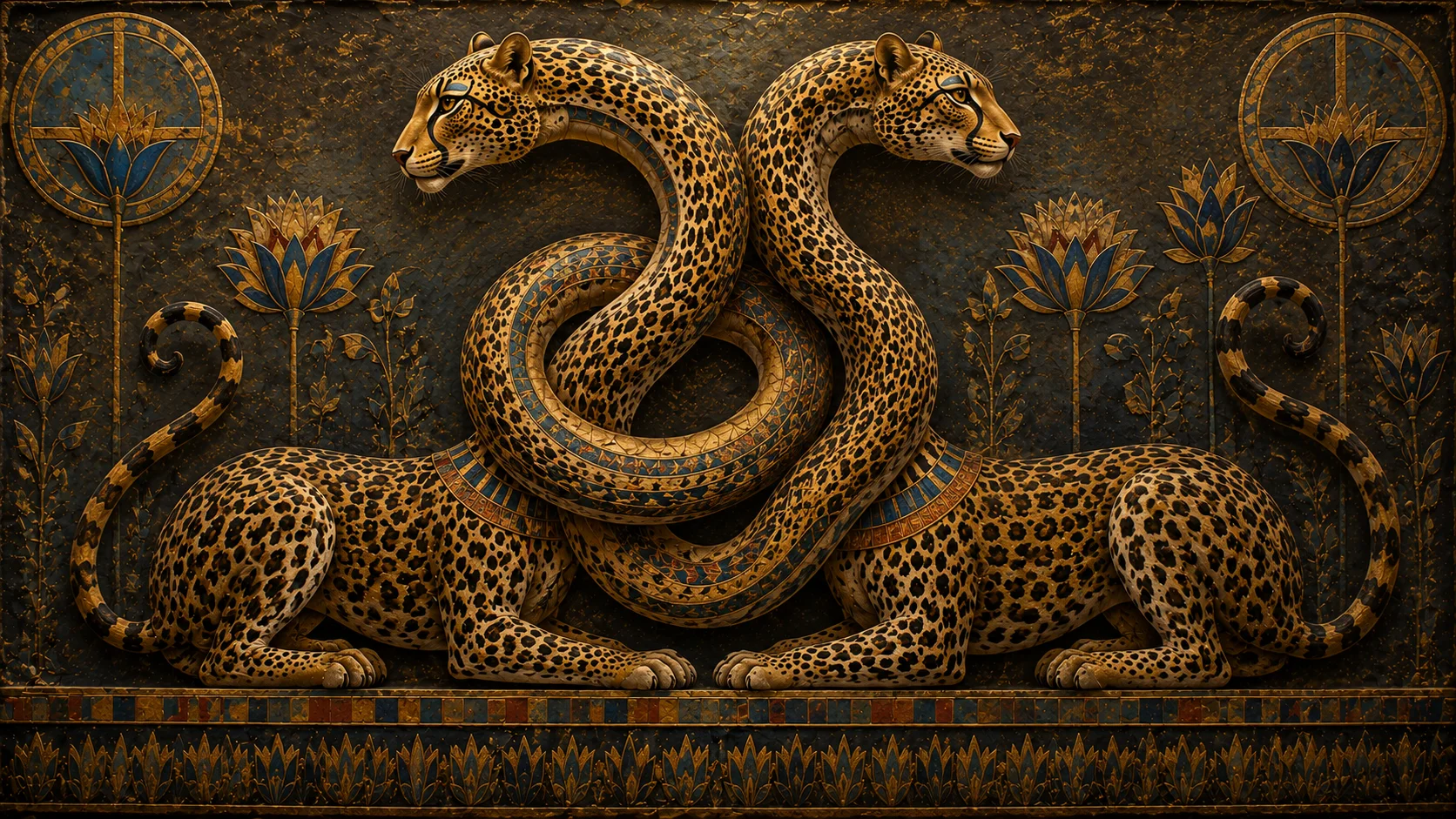
The Serpopard is the modern name for a composite creature of the earliest Egyptian art: a beast with the body of a leopard or lion and an impossibly long, sinuous, serpentine neck. It has no ancient name of its own — “serpopard” is a twentieth-century scholarly coinage, a portmanteau of “serpent” and “leopard” — and it belongs almost entirely to the Predynastic and Early Dynastic period, the formative centuries before Egypt's later religious art and literature had taken shape.
A Name Egyptologists Had to Invent
No inscription from the third or fourth millennium BC calls this creature anything at all. The word “serpopard” was coined in the twentieth century by scholars who needed a working label for a hybrid form that appears repeatedly in Predynastic and Early Dynastic imagery but is never once named in the surviving record. That absence is worth sitting with: almost every other fantastic being in Egypt's visual repertoire eventually acquires a name, an epithet, or a place in a text. The serpopard never does. It is described, in the most literal sense, by what modern eyes see in it — a leopard's body wearing a serpent's neck — rather than by anything the Egyptians themselves recorded.
Body of the Hunter, Neck of the Serpent
The creature's defining feature is the disproportion between its two halves. The body is unmistakably feline, rendered with the compact, muscular build of a leopard or lion — a predator's frame, built for the ground. Rising from that body, though, is a neck of extraordinary length, thin and sinuous, entirely out of proportion to the animal beneath it, terminating in a head that reads as feline or, depending on the carving, faintly serpentine itself. The combination gives the serpopard a silhouette unlike any other creature in Egyptian art: grounded and predatory at the base, then rising into something closer to a stalk or a vine at the top. It is this neck, more than anything else about the creature, that early viewers and modern scholars alike have found most striking — and most useful, since its flexibility is precisely what let Egyptian artists do something with it that a rigid body could never have allowed.
The Palette That Bears Its Likeness
The serpopard's single most famous appearance is on the reverse of the Narmer Palette, a ceremonial cosmetic palette dated to roughly the thirty-first century BC, at the boundary between the late Predynastic and Early Dynastic periods. There, two serpopards are shown facing one another, their elongated necks curving outward and then bending back inward until they cross and entwine, forming a circular space at the center of the composition. That central depression was not merely decorative: palettes of this kind were functional objects, used for grinding cosmetic pigments, and the serpopards' entwined necks frame the very hollow where the grinding took place. Function and image sit on top of one another here — a working tool doubling as one of the most carefully composed scenes to survive from the period.
Two Handlers, Two Leashes
The serpopards on the Narmer Palette are not shown roaming free. Each is controlled by a human handler, who holds it on a leash. Scholars reading this detail have generally taken it as reinforcing a larger theme running through the palette: the assertion of royal or human dominance over forces that are powerful, or potentially chaotic, at the exact moment the composition is making its central claim. The leashes matter because they change what kind of image this is — not simply two fantastic animals coexisting, but two fantastic animals being mastered, held in check by human hands, their entwined necks arranged into a shape rather than left to their own wild movement.
A Circle Read as Two Lands Made One
The Narmer Palette is conventionally understood to commemorate the unification of Upper and Lower Egypt, and the entwined serpopards at its center are generally interpreted within that same frame: two creatures, two necks, drawn together into a single interlocking form, taken by most Egyptologists as a visual expression of the joining of the Two Lands under one rule. It is a reading that fits naturally with everything else the palette depicts. But it is worth being precise about what kind of claim this is. The palette carries no accompanying inscription that explains the serpopard scene, and some scholars caution that its exact symbolic meaning — unification, cosmic balance, the controlling of chaotic natural force, or some combination of these — remains an interpretation built from context and comparison, not a meaning confirmed by any Egyptian text. The image is confident; its explanation, four and a half thousand years later, is necessarily more careful.
Beyond the Single Famous Object
The Narmer Palette is the serpopard's most celebrated appearance, but not its only one. The motif recurs on other ceremonial objects from the same formative window — knife handles and cylinder seals among them — suggesting that the entwined long-necked feline was not a one-off invention for a single royal commission but part of a broader iconographic repertoire that Predynastic and Early Dynastic artists drew on more than once. Seen across several objects rather than one, the serpopard looks less like a single striking image and more like a recognized visual device: a shape available to craftsmen working in this idiom, reused because it already carried meaning their audience would understand.
An Image With Kin Beyond the Nile
The serpopard motif has a notable stylistic cousin far from Egypt. Long-necked feline figures appear on Mesopotamian cylinder seals from roughly the same era, carved in a manner close enough to the Egyptian serpopard that scholars have taken the parallel seriously rather than treating it as coincidence. The similarity is generally read as evidence of contact or shared iconographic influence between early Egypt and Mesopotamia during a period of documented Uruk-related exchange — a moment when ideas, and evidently images, appear to have moved between the two river-valley cultures. The serpopard is, in this light, not only a piece of Egyptian imagination but a trace of contact between two of the world's earliest complex societies, preserved in the shape of an animal neither ever actually saw.
No Cult, No Temple, No God's Name
What the serpopard conspicuously lacks is any later religious life. It is not attested as an object of cult worship, and it carries no name in the roster of Egyptian deities. It does not appear in the temple reliefs, funerary texts, or religious literature of the dynastic centuries that follow — the kind of sustained presence that keeps gods like Montu or Nephthys visible across Egyptian history for millennia. The serpopard has none of that continuity. Whatever it meant to the artists and patrons of the Early Dynastic period, that meaning was not carried forward into the theology of later Egypt in any traceable form.
A Motif That Belongs to One Moment
Consistent with that absence, the serpopard largely vanishes from Egyptian art after the Early Dynastic period. It is not a creature with a long visual afterlife stretching across dynasties the way many other Egyptian hybrid forms are; it is, essentially, a phenomenon of the Predynastic and Early Dynastic centuries specifically, tied to the artistic and ideological concerns of that formative window and not renewed once that window closed. That narrowness is itself informative. It marks the serpopard as belonging to a particular moment in the shaping of Egyptian kingship imagery, rather than to the ongoing, evolving mythological tradition that later periods kept adding to.
Heraldry of a State Being Born
Taken together — no cult, no name, no later attestation, but a recurring and carefully composed presence at the exact moment Egypt's earliest kings were asserting unified rule — the serpopard is best understood not as an independent mythological being with a story of its own, but as a symbolic or heraldic device belonging to the ideology of early kingship. It did not need a myth to do its work. Its two intertwined bodies, leashed and controlled, arranged around the very tool used to prepare a king's cosmetics, were doing something more immediate: making an argument about unity and mastery in a single, memorable image, at the birth of the state that image served.
Rediscovered on the Museum Wall
The serpopard's presence in the modern imagination comes almost entirely through Egyptological study of the Narmer Palette and the smaller circle of Early Dynastic objects that carry the same motif. It was never a figure of continuous belief, handed down through millennia of retelling; it went quiet with the period that produced it and was found again, rather than remembered. In recent times it has also been picked up as a motif within modern fantasy media, a second life built not on any surviving Egyptian narrative but on the sheer visual strangeness of the original image — the leopard's body, the impossible reach of that entwined serpent neck, still doing, five thousand years on, exactly what it was carved to do: catch and hold the eye.
Sources & traditions
- EncyclopediaWikipedia — Serpopard
- TraditionEgyptian texts, inscriptions and later retellings
Myths change from area to area and from time to time. This chronicle follows the most widely told versions; tellings in other villages, regions and eras may differ.