Imhotep was a real historical genius of ancient Egypt who was deified after his death — the brilliant architect, chancellor, and high priest of the Third Dynasty who designed the first pyramid, and who was later worshipped as a god of medicine, wisdom and healing. One of the very few non-royal Egyptians ever to become a full god, he is the rare case of a real man elevated to divinity for his genius.
A Commoner Who Rose to the King's Right Hand
Imhotep lived in the twenty-seventh century BC, in the Third Dynasty, and served under the pharaoh Djoser. He was not born to royalty, yet he rose to occupy some of the highest offices in the kingdom — an ascent that, for a commoner in Old Kingdom Egypt, was itself extraordinary. Contemporary and later monuments record an unusually long list of titles held by one man, evidence of a career that spanned statecraft, religion, and engineering all at once. That breadth of accomplishment is the foundation of everything that was later said about him: before he became a legend, he was, by the evidence of stone inscriptions, simply the most capable man in Djoser's court.
Chancellor, Priest, and Master Builder
The titles recorded for Imhotep read like a catalogue of the state itself. He was Chancellor of the King of Lower Egypt and First after the King of Upper Egypt, placing him at the summit of royal administration in both halves of the country. He was also High Priest of Heliopolis, the great cult center of the sun god, a position of immense religious authority. Alongside these offices he is named as chief sculptor and architect — meaning the same man who managed the king's treasury and led its most important priesthood was also the one entrusted with designing the pharaoh's eternal monument. Few figures in Egyptian history combined administrative, religious, and technical authority so completely in a single career.
Stone Where There Had Only Been Mudbrick
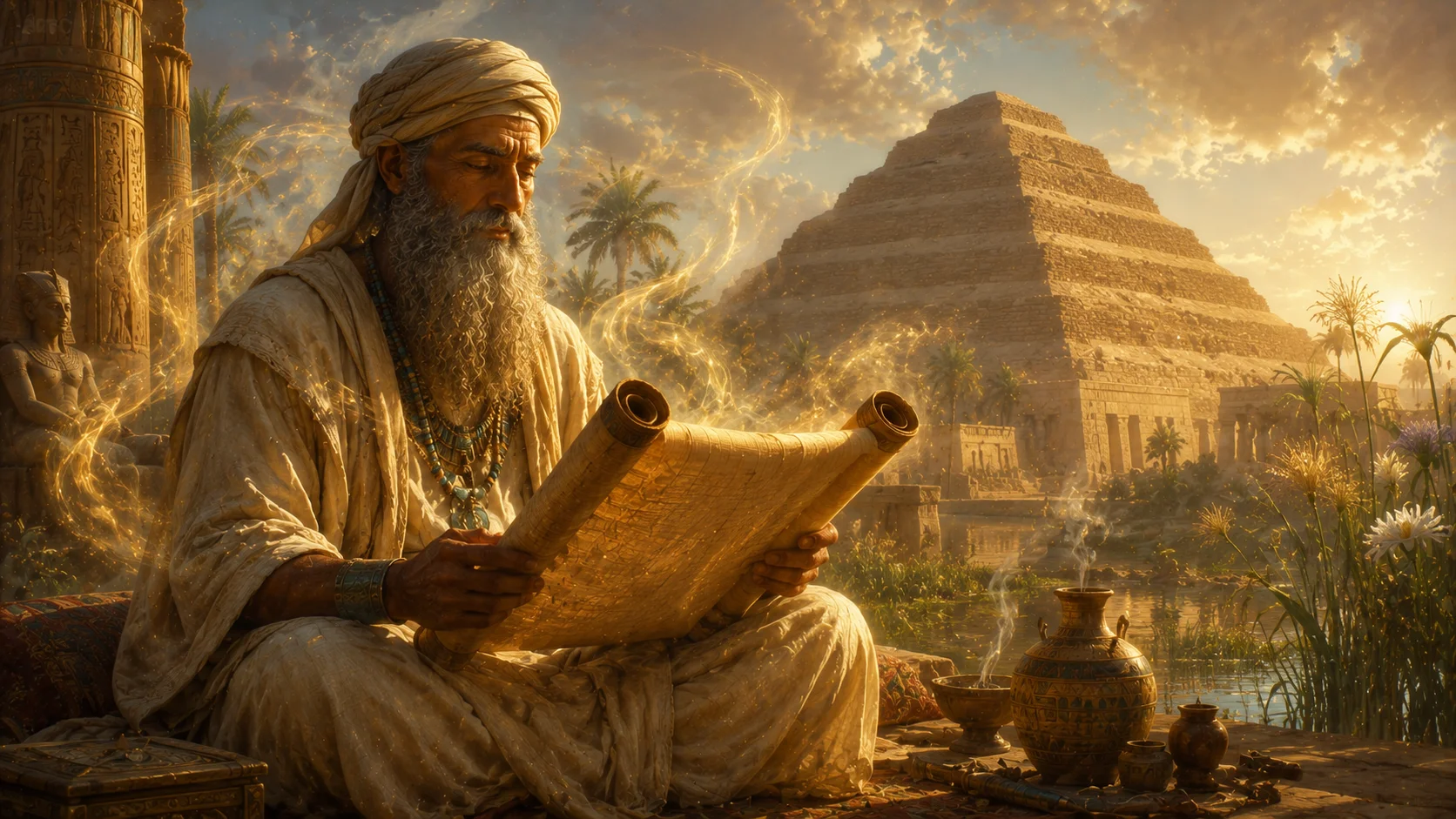
Before Imhotep, Egyptian royal tombs and monumental buildings were constructed chiefly of mudbrick. His defining achievement as an architect was to break with that tradition entirely: he is credited with designing the Step Pyramid at Saqqara, the earliest large-scale building in Egypt built from cut stone. This was not a minor technical adjustment but a wholesale reinvention of how monuments were made — a shift in material, in ambition, and in the very scale of what a single structure could be. The step pyramid stands as the direct ancestor of every later Egyptian pyramid, and its design is the reason Imhotep's name survived at all in the historical record, carved and remembered long after Djoser's reign had ended.
The Step Pyramid Rising Above Saqqara
The complex Imhotep designed at Saqqara was unlike anything that had come before it in the Nile valley. Rising in a series of stacked stone terraces, it transformed the flat mastaba tomb of earlier kings into a monument that climbed toward the sky, layer upon layer. As the first monumental structure built entirely in cut stone, it required solving problems no Egyptian builder had faced at that scale: quarrying, transporting, and precisely fitting an enormous quantity of stone blocks into a coherent, stable form. The result inaugurated the age of pyramid building that would define Egyptian royal architecture for centuries afterward, and it fixed Imhotep's name in the country's memory as the man who had done it first.
How the New Kingdom Remembered Him
Imhotep's fame did not fade with his death; it grew. By the time of the New Kingdom, more than a thousand years after he lived, he was no longer remembered simply as a builder of the past but revered as a sage and as the patron of scribes. Scribes of that later era were known to pour a libation to him before setting pen to papyrus, treating him as a source of wisdom and a guardian of their craft. This is a striking transformation in itself: a historical official who had served one king in one dynasty had, over the centuries, become a figure invoked at the start of intellectual work across the whole of Egypt.
From Revered Sage to Living God
The final stage of that transformation came in the Late Period, from roughly the sixth century BC onward, when Imhotep was formally deified. This was an honor granted to almost no one outside the royal family in the entirety of Egyptian religious history, and Imhotep is counted among the very few non-royal Egyptians ever to receive full divine status. Once elevated, he took on a specific divine role: he became a god associated with medicine and healing, and was worshipped more broadly as a god of wisdom as well. A man remembered first for stone and administration had, by the closing centuries of ancient Egyptian civilization, become an object of religious devotion in his own right.
Sanctuaries of the Sick and the Sleeping Cure
As a healing god, Imhotep received worship at temples and sanctuaries built specifically for those seeking cures. The sick traveled to these sites in hope of relief, and one practice recorded at his shrines was incubation — sleeping within the temple precinct in the hope of receiving a healing dream, a vision through which the god might reveal a remedy or grant recovery directly. This placed Imhotep's cult alongside the broader Egyptian and later Mediterranean tradition of temple-based healing, where devotion and medicine were not separate practices but part of a single religious institution.
A Divine Genealogy Written Centuries Later
Egyptian theology in the Ptolemaic period went further still, giving the deified Imhotep a divine family. In this later tradition he was described as the son of Ptah, the great creator god of Memphis, born to a mortal woman named Khreduankh; some genealogies of this era also connect him to the goddess Sekhmet. It is worth being clear about what this genealogy represents: it is a theological elaboration composed many centuries after Imhotep's lifetime, not a belief held in the Old Kingdom when he actually lived and served Djoser. The historical man and the divine son of Ptah are separated by more than two thousand years of evolving religious tradition.
Asclepius of the Nile
When Greek settlers and administrators came to know Egypt closely under the Ptolemies, they recognized in the deified Imhotep a figure equivalent to their own god of medicine, Asclepius, and identified the two. This kind of cross-cultural pairing of deities, known as interpretatio graeca, was common practice for the Greeks encountering foreign religious traditions, and it is itself a marker of Imhotep's stature: he was judged by outsiders to be the Egyptian counterpart of one of the Greek world's most important healing gods. Like the divine genealogy involving Ptah, this identification belongs to the Ptolemaic era rather than to any original Egyptian belief from Imhotep's own time.
The Seven-Year Famine and the God of the Cataract
Egyptian tradition also credits Imhotep with a role in resolving a great famine during Djoser's reign. According to the Famine Stela, an inscription set on Sehel Island that purports to record events from the Old Kingdom, a famine lasting seven years gripped the land, and it was Imhotep who advised the king, identifying the god Khnum as the deity who controlled the source of the Nile's floodwaters. Once Khnum was properly honored, the famine was said to end. This inscription, however, is itself a much later composition, and Egyptologists regard its accuracy as a record of actual Old Kingdom events with considerable doubt. It belongs to the same category as the divine genealogy and the identification with Asclepius: a later tradition built around Imhotep's memory, reflecting how thoroughly his reputation had grown rather than a contemporary account of what happened under Djoser.
Words Attributed, Not Spoken
Imhotep's reputation as a sage eventually produced texts written in his name. Writings such as the so-called Instructions of Imhotep and various wisdom-sayings circulated under his authorship, but these are pseudepigraphic compositions of the Late Period and Ptolemaic era — works attributed to him long after his death rather than texts he actually wrote. No contemporary source from the Old Kingdom, when Imhotep genuinely lived and worked, attributes to him either divine status or the authorship of any wisdom literature. The gap between the historical official and the legendary sage was filled in gradually, by later generations, over the course of many centuries.
Cult Centers from Memphis to Philae
Worship of the deified Imhotep was not confined to a single site. His cult was centered at Memphis, the ancient capital near which he had served Djoser, and at a chapel-shrine complex near Saqqara, close to the very monument that had made his name. His veneration also extended south: in the Ptolemaic temples of the Philae region he received cult worship alongside devotion connected to the goddess Isis. This geographic spread, from the heart of the Old Kingdom capital to temples built many centuries later far to the south, is itself a measure of how durable and how widely shared his cult had become by the last centuries of pharaonic civilization.
The Man Behind the Modern Mummy
Modern popular culture has, in places, recast Imhotep in an entirely different light — most notoriously in film, where his name has been attached to a villainous sorcerer or a cursed, malevolent mummy. This portrayal has no basis whatsoever in actual Egyptian religious tradition. The historical and religious Imhotep was, without exception in the surviving record, a figure of reverence: an architect of genius, a healer's patron, and one of the earliest architects and physicians known to history by name. The contrast between the fictional villain and the historical man is total, and it is the historical man — chancellor, high priest, builder of the first pyramid, and eventually a benevolent god of medicine and wisdom — who endures in the actual record of ancient Egypt.
The Man Who Became a God
Imhotep endures as one of the most remarkable figures of ancient Egypt: a real historical genius, chancellor and high priest under Djoser, architect of the first pyramid, and, centuries after his death, a fully deified god of medicine, healing, and wisdom. He embodies the Egyptian reverence for genius and great achievement, and the rare, extraordinary honor of a mortal man elevated to full divinity for his brilliance. From the Step Pyramid at Saqqara to the sanctuaries where the sick once slept in hope of a healing dream, his story traces the full distance an Egyptian could travel — from servant of the king to a god in the king's own land.
The real-life genius who designed the first pyramid and was worshipped, for two thousand years after his death, as a god of medicine and wisdom — the rare mortal man elevated to full divinity for his brilliance.
Sources & traditions
- EncyclopediaWikipedia — Imhotep
- TraditionEgyptian texts, inscriptions and later retellings
Myths change from area to area and from time to time. This chronicle follows the most widely told versions; tellings in other villages, regions and eras may differ.