Horus was the falcon-headed god of kingship, the sky and vengeance in ancient Egypt — the son of Osiris and Isis who avenged his murdered father by defeating his uncle Set and claiming the throne of Egypt, becoming the divine model of the rightful king. Every living pharaoh was regarded as the living Horus, making him one of the most fundamental gods of Egyptian kingship and the cosmos.
The Falcon of the Sky
Horus (Egyptian Heru) was one of the oldest and most important Egyptian gods, a sky-god depicted as a falcon or a falcon-headed man, whose two eyes were the sun and the moon. As a sky-god soaring above the world, his outstretched wings spanned the heavens. There were many forms of Horus across Egypt's long history, and Egyptologists are careful to separate the older, more ancient falcon-god known as Horus the Elder (Haroeris) from the figure who became far more famous in later religion — the son of Isis and Osiris. The two began as historically distinct gods and were later blended together in cult and story, but it is the younger Horus, the avenger and heir, the divine prince, whose myth came to dominate Egyptian religious imagination.
Conceived in Secret, Raised in the Reeds
After Set murdered and dismembered Osiris, Isis used her magic to reassemble and revive her husband's body long enough to conceive a son. That son was Horus, born to be the avenger and the rightful heir to the throne of Egypt. Knowing that Set would seek to destroy any child who might grow up to challenge him, Isis hid the infant Horus in the marshes of the Nile Delta, in a place called Khemmis, raising him there in secret, away from her brother's reach. It was in this hidden, watery landscape of reeds and papyrus thickets that the falcon-prince grew from a vulnerable infant into a god determined to reclaim what had been stolen from his family.
Before the Tribunal of the Gods
When Horus came of age, he presented himself before the assembled gods to assert his right to rule Egypt as the legitimate son of Osiris. This began the long dispute known from the New Kingdom text The Contendings of Horus and Set, in which a divine tribunal — headed in different versions of the story by Geb or by Ra-Horakhty — was tasked with deciding who should inherit the throne: the son of the murdered king, or the brother who had murdered him. The proceedings were neither quick nor simple, dragging on through argument, maneuvering, and repeated contests between the two claimants while the assembled gods weighed competing claims of birthright and strength.
Trials, a Boat Race, and a Wound That Would Not Heal Quietly
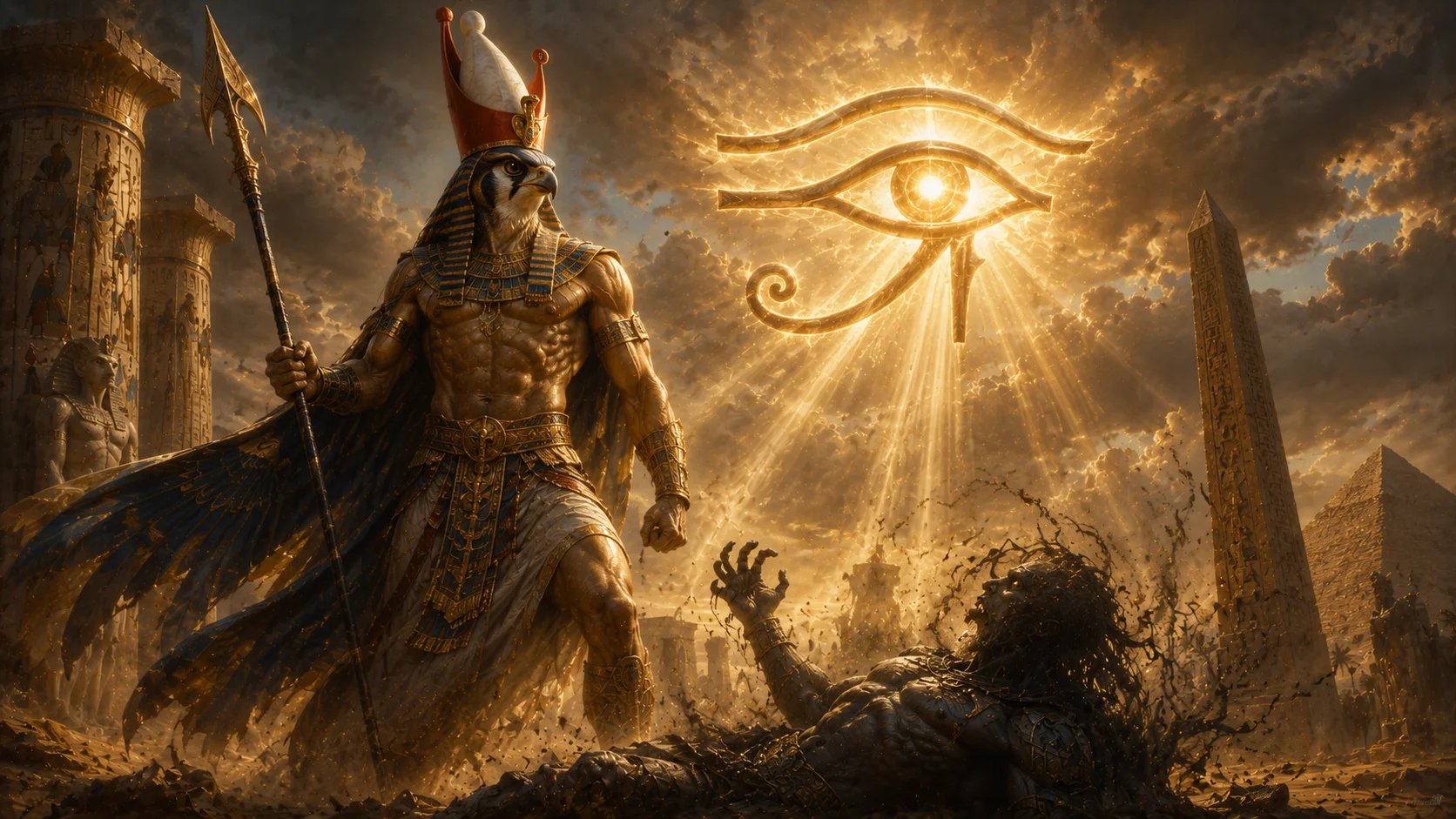
The Contendings describe an extended sequence of trials between Horus and Set, testing both cunning and physical power. Among the most memorable episodes is a boat race in which each god was required to build a vessel and race the other — a contest that, like so much of their rivalry, was decided as much by trickery as by skill. Their struggle also turned violent and bodily: in the physical fighting between them, Set tore out one of Horus's eyes, while Horus succeeded in wounding Set by tearing off his testicles. Neither god emerged from the contest unmarked, and the injuries each inflicted on the other became as central to the myth as the eventual verdict.
The Eye Torn Out, the Eye Restored
The eye that Set tore from Horus during their struggle did not remain lost. It was restored, in most tellings through the intervention of Thoth, god of wisdom and writing, and became the Eye of Horus, known in Egyptian as the wedjat. Far beyond a detail of myth, the wedjat became one of the most important protective and healing symbols in Egyptian religion, worn as an amulet and painted on coffins and temple walls to guard against harm. It also took on a remarkable second life in Egyptian mathematics: the fractional parts of the eye's outline were used as a system of numerals in medical and measurement texts, so that the god's wound, once healed, became a working tool of scribes and physicians for centuries afterward.
The Verdict of the Divine Court
After the trials, the contests, and the injuries each side had suffered, the tribunal of the gods at last rendered its judgment in Horus's favor, ruling that he was the rightful heir to his father's throne. The verdict gave Horus rule over the unified Two Lands of Egypt, and in doing so it did far more than settle a single family dispute among the gods — it established the ideological foundation of pharaonic kingship itself. From this judgment forward, the living king of Egypt was understood to be the earthly Horus, ruling by the same right that the divine tribunal had confirmed in the myth.
Horus of the Two Horizons
In one of the most significant theological developments surrounding him, Horus was syncretized with the sun god as Ra-Horakhty, meaning "Horus of the Two Horizons." This merging fused solar theology with falcon-kingship theology into a single figure, linking the daily journey of the sun across the sky with the ideology of rightful rule on earth. As Ra-Horakhty, Horus stood at the meeting point of two of the most powerful currents in Egyptian religious thought: the sun's unbroken cycle of rising and setting, and the king's claim to an unbroken, divinely sanctioned throne.
The Child Who Mastered Danger
Egyptian religion also gave Horus a much younger and more vulnerable form: Horus the Child, known in Greek reception as Harpocrates. In this guise he was shown as a nude child wearing the sidelock of youth, with a finger held to his mouth in the gesture of childhood. This form of the god was the focus of the Cippi of Horus, healing stelae that depicted the child Horus standing atop crocodiles and grasping dangerous animals such as snakes and scorpions in his small hands, mastering the very creatures that threatened ordinary people. These stelae were used as instruments of protective and healing magic, invoked especially against bites and stings, drawing on the image of the vulnerable infant of the marshes who had grown strong enough to overpower the dangers that once threatened him.
Guardians of the Viscera
Horus's protective role extended into Egyptian funerary religion through his four sons: Imsety, Hapy, Duamutef, and Qebehsenuef. These four minor deities were charged with protecting the internal organs of the deceased, each one associated with a specific canopic jar and a specific organ removed and preserved during mummification. Through them, the falcon god's guardianship reached beyond kingship and myth into the intimate, practical rituals that every Egyptian hoped would secure a safe passage into the afterlife.
Avenger, Lord of the Sky, Falcon of Behdet
Horus carried a range of epithets that reflect the many facets of his character and cult. He was hailed as Horus the Avenger of His Father, a title that recalls the central act of his myth, and as Lord of the Sky, recalling his oldest identity as a falcon soaring above the earth. As Behdety, "Horus of Edfu" or "of Behdet," he took the form of a winged sun-disk, a warrior manifestation central to the great temple reliefs at Edfu that narrate his triumph over Set. In this form he was less the wronged heir pleading before a tribunal than an active, martial power, sweeping across the sky in battle against the forces of chaos.
Nekhen, Behdet, and the Great Temple of Edfu
Horus's cult was rooted in several of Egypt's most important religious centers. Nekhen, also known as Hierakonpolis, was among his earliest and most ancient cult sites, tied to his identity as a primordial falcon god of kingship. Behdet gave him the martial epithet Behdety, while Edfu became home to his greatest surviving temple, a major source, especially from the Ptolemaic era, for the mythology of his conflict with Set. The reliefs at Edfu preserve an extended narrative version of the god's triumph, carved into stone as both religious record and royal propaganda affirming the same order that the divine tribunal had once confirmed.
The Sacred Marriage with Hathor
At Edfu, Horus's theology included his marriage to Hathor, celebrated in the Sacred Marriage festival. Each year this festival reenacted a river journey in which Hathor's cult image traveled from her own temple at Dendera to be reunited with Horus at Edfu. The festival bound the mythic marriage of the two gods to the real geography of the Nile, turning the river itself into the path of a divine reunion that worshippers could witness and participate in.
The Living King on the Throne of Egypt
Horus's victory established him as the divine pattern of kingship itself. Every living pharaoh of Egypt was regarded as the earthly embodiment of Horus, the living Horus enthroned, while each dead pharaoh became identified with Osiris, the father who now ruled in the underworld. The eternal succession of Egyptian kingship thus reenacted the myth with every transfer of power: the living king was Horus, the rightful heir; his deceased predecessor was Osiris; and the orderly passing of the throne from father to son was, in religious terms, the ongoing triumph of legitimate order, embodied in Horus, over the chaos and usurpation embodied in Set.
A Falcon Carried into Later Worlds
Horus's reach extended beyond Egypt's own borders through interpretatio graeca, the practice of matching foreign gods to Greek ones; in some contexts he was identified with Apollo. His childhood form, Harpocrates, proved especially durable, becoming a popular deity across the Greco-Roman world, including in Rome itself, where the image of the divine child with his finger to his lips traveled far from the Delta marshes where that identity began. In this way the god who was hidden as an infant to protect him from his uncle ended his mythic and religious journey recognized across the ancient Mediterranean, his falcon wings and his healing eye still carried in the memory of cultures far removed from the temples of Edfu and Nekhen where his story first took shape.
Sources & traditions
- EncyclopediaWikipedia — Horus
- TraditionEgyptian texts, inscriptions and later retellings
Myths change from area to area and from time to time. This chronicle follows the most widely told versions; tellings in other villages, regions and eras may differ.