Satet was the Egyptian goddess of the Nile flood, the southern frontier and the waters of the inundation — the guardian of Egypt's southern border at the cataracts of Elephantine, who released the life-giving flood from the river's source and purified the dead with her sacred waters. An archer-goddess of the frontier and the flood, she is the releaser of the inundation and the guardian of Egypt's southern gate.
The Goddess of the Southern Frontier
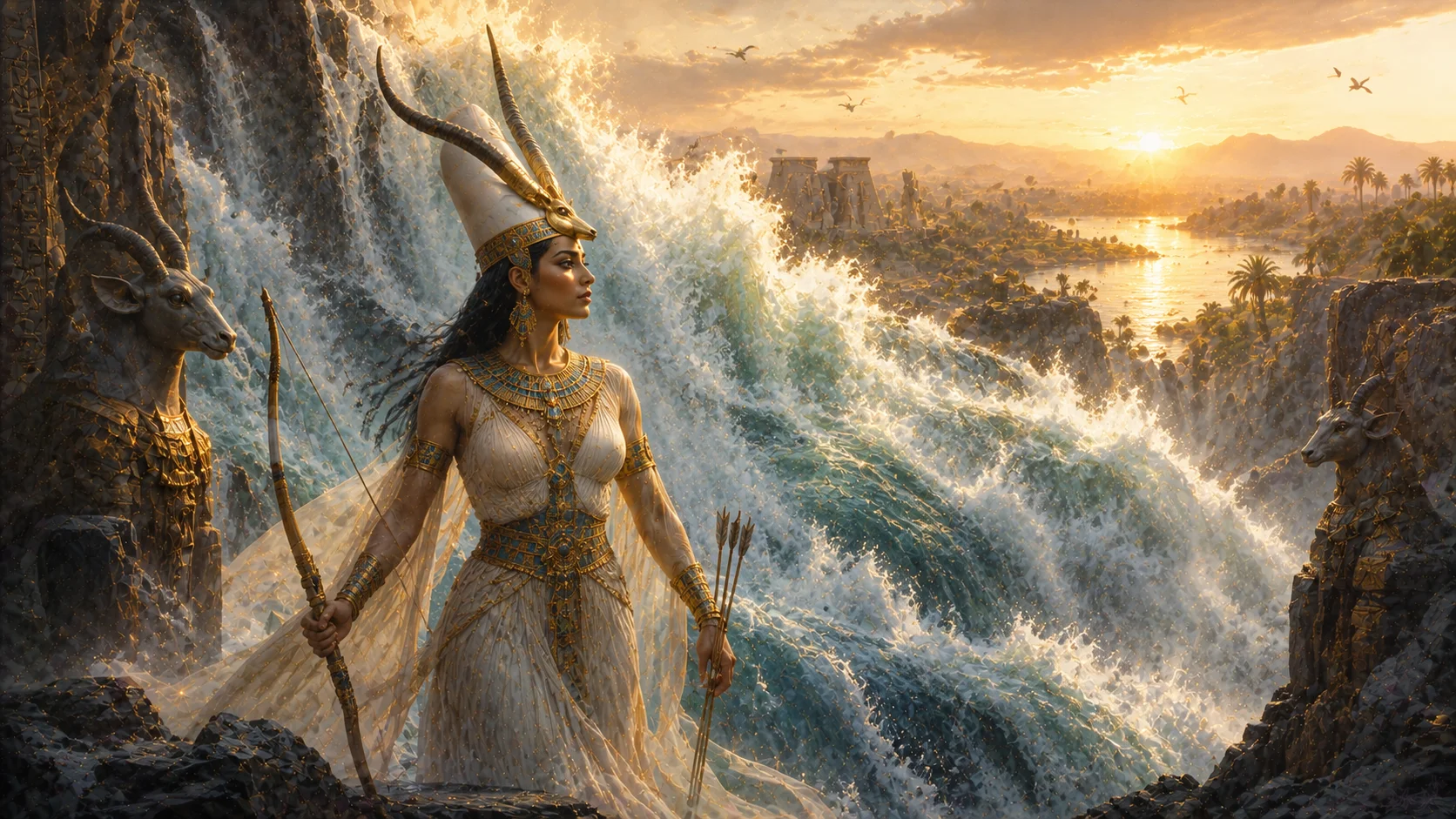
Satet (Egyptian Satet, rendered by the Greeks as Satis) was a goddess of the southern frontier of Egypt — the region of the first cataract of the Nile at Elephantine and Aswan, where Egypt met the lands of Nubia to the south. She was depicted as a woman wearing the tall White Crown of Upper Egypt flanked by antelope or gazelle horns, a headdress found nowhere else among the goddesses of the Nile and one that marked her at a glance as a deity of the far south. She often held a bow and arrows. As a goddess of the frontier, she was a guardian and an archer, defending Egypt's southern border against its enemies, her arrows ready to strike down those who threatened the land from the south. She was the protective sentinel of Egypt's southern gate.
A Name Drawn from the Bow
Her name itself carries this martial character: it is connected to the Egyptian word "to shoot", as an archer looses an arrow. This linguistic root reveals how deeply the border-guarding, weapon-bearing side of Satet was woven into her identity from the start — she was not simply a goddess who happened to carry a bow as an attribute, but one whose very name spoke of the shot arrow. That martial sense sat alongside, rather than in place of, her fertility and flood-giving role, so that a single figure held both the discipline of the frontier watch and the abundance of the rising river.
The Releaser of the Flood
Satet's most important role was connected to the Nile flood. The Egyptians believed that the annual inundation began in the south, at the cataracts of Elephantine, where the floodwaters first surged into Egypt — and Satet, the goddess of that region, was the one who released the life-giving flood, opening the way for the inundation that brought fertility to all of Egypt. As the releaser of the inundation, Satet was a giver of life and abundance, the goddess who let loose the waters that made Egypt live.
Mistress of Elephantine and Her Divine Household
With her husband Khnum, the ram-headed god who was believed to control the very source of the Nile, and their daughter Anuket, Satet formed the triad of Elephantine, the divine family who governed the flood at its source. She carried the epithet "Mistress of Elephantine", the title by which she was addressed as the presiding goddess of that island city at the edge of Egypt. Though she and Anuket both belonged to the same divine household and both were tied to the cataract waters, the two were distinguished in ritual function: Satet's role leaned toward guardianship and the release of the flood at its source, while Anuket's leaned toward nourishment, a complementary rather than overlapping partnership within the triad.
Crowned Apart from Her Daughter
Egyptian artists took care to keep Satet visually distinct from Anuket, even though the two goddesses shared a cult and a cataract. Satet wore the horned White Crown of Upper Egypt, while Anuket was shown with a feathered or reed crown. A viewer standing before a temple wall at Elephantine could tell the two goddesses apart at a glance by the crown alone — a small detail, but one that mattered enormously in a tradition where headdress carried as much meaning as name or title.
Waters from the Four Sacred Caverns
Ritual texts describe Satet purifying the king with water drawn from the four sacred caverns of the cataract, the mythic wellsprings imagined at the First Cataract from which the pure floodwater was thought to issue. This was not the ordinary river water of daily life but a specially sanctified source, reserved in the texts for the purification of kingship itself. The image of the four caverns gave concrete shape to an abstract idea: that the goddess who released the flood could also draw from its purest, most concentrated point to cleanse and renew.
The Purifier of the King in the Pyramid Texts
In the Pyramid Texts, among the oldest religious writings of Egypt, Satet is linked to the purification of the deceased king, pouring cleansing Nile water for his ascent into the afterlife. This funerary role sat naturally beside her flood-releasing one: the same goddess who let the inundation loose upon the land each year was also called upon to pour the water that readied a king's spirit for its journey beyond death. In some Old Kingdom texts she functions as a protector of the king in the afterlife in her own right, a role distinct from, yet complementary to, Anuket's nourishing part in the same funerary current.
The Purifier of the Dead
Beyond the person of the king, Satet was more broadly a goddess of purification, particularly the purification of the dead with sacred water. Her waters — the cool, life-giving waters of the cataract and the flood — were used to cleanse and purify, and she was believed to purify the deceased with libations of her sacred water, helping in their renewal and rebirth in the afterlife. As a goddess of pure, life-giving waters, she cleansed and refreshed both the living land, through the flood, and the dead, through purification, her waters a source of life and renewal in this world and the next.
Kin to the Star That Foretold the Flood
Satet was sometimes associated with Sopdet, the goddess identified with the star Sirius, whose heliacal rising — its first reappearance in the dawn sky after a period of invisibility — traditionally heralded the coming of the Nile flood. This association drew Satet into the wider Egyptian practice of reading the flood through the stars: as Sopdet's rising in the sky announced that the waters were coming, Satet at Elephantine was the one who released them at their source. The pairing linked a celestial sign in the north with a terrestrial goddess in the deep south, binding two different registers of the same seasonal event.
An Ancient Seat at Elephantine
Satet's cult center stood at Elephantine (Abu), the island city at the First Cataract, and her temple there was among the oldest attested in that region, with origins reaching back to the Early Dynastic and Old Kingdom periods. A goddess of the frontier was fittingly worshipped at the frontier itself, on an island that stood as Egypt's watchpost over the approach from Nubia. This positioning gave her cult a permanence that matched her role: as long as the cataract marked the edge of Egypt, the goddess who guarded and released it at that very spot kept her temple there.
Worship Across the Centuries
Satet's worship is attested continuously from the Old Kingdom through the Ptolemaic period, an extraordinarily long span for any Egyptian cult to endure. Temple building activity at Elephantine associated with her continued across multiple dynasties, as successive rulers added to, rebuilt, or embellished the sanctuaries of the site. Few deities held their ground at a single location for so many centuries without interruption, and Satet's endurance at Elephantine reflects how essential the guardianship of the southern frontier and the release of the flood remained to Egyptian religious life, dynasty after dynasty.
The Guardian of the Flood-Gate
Satet endures as the Egyptian goddess of the Nile flood, the southern frontier and the purifying waters — the archer-guardian of Egypt's southern border, the releaser of the life-giving inundation from the river's source, the purifier of the dead. She embodies the Egyptian reverence for the Nile flood and its source in the far south, and the role of the frontier as both a place of danger to be guarded and the gate through which the life-giving waters entered the land; and she stands, with Khnum and Anuket, as the divine guardian of the cataracts and the releaser of the flood that was the lifeblood of Egypt.
The archer-goddess of Egypt's southern gate who releases the life-giving flood from the river's source and purifies the dead with her sacred waters — the guardian of the cataracts and the inundation.
Sources & traditions
- EncyclopediaWikipedia — Satis (goddess)
- TraditionEgyptian texts, inscriptions and later retellings
Myths change from area to area and from time to time. This chronicle follows the most widely told versions; tellings in other villages, regions and eras may differ.