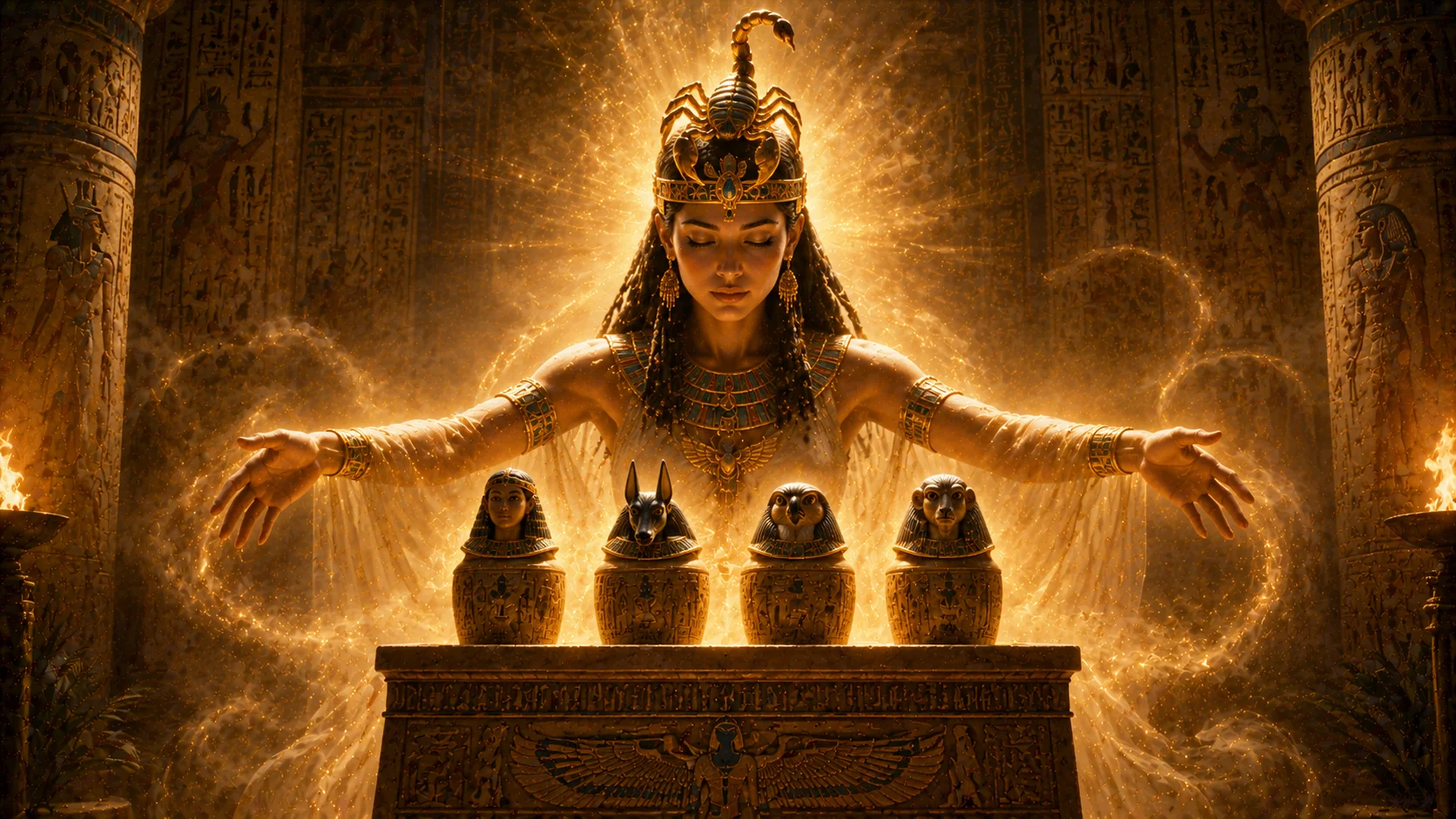
Serqet was the scorpion-goddess of ancient Egypt — the goddess of protection, healing, and the cure of venomous stings and bites, who guarded against scorpions and snakes and protected the dead, and who was one of the four great goddesses who watched over the canopic jars and the body of the deceased. The healer of the sting, she turned the deadly scorpion into a protective and curing power.
The Scorpion-Goddess
Serqet (Egyptian Serqet, also Selket, Selqet) was depicted as a woman with a scorpion upon her head (the scorpion shown with its tail raised, ready to sting), or sometimes as a scorpion itself. Her name is connected to the idea of “causing to breathe” or “she who tightens the throat” — for the scorpion's sting could constrict the breath and kill, but the same goddess could also loosen the throat and allow breath, healing the sting. She thus embodied both the danger of the scorpion's venom and the power to cure it — the deadly sting and its remedy in a single goddess.
The Healer of Stings and Bites
Serqet was, above all, the goddess of protection against and healing of venomous stings and bites — from scorpions, snakes and other poisonous creatures, which were a constant and serious danger in Egypt. Her priests were healers and magicians who specialised in treating scorpion stings and snakebites, working through her power; to be a “follower of Serqet” was to be a physician-magician skilled in curing venom. She protected against the dangerous creatures and cured those who were stung or bitten, holding the power over the venom that could kill or, if she willed, be neutralised. She was invoked for protection from these deadly creatures and for the healing of their attacks.
The Guardian of the Dead
Serqet was one of the four great protective goddesses — with Isis, Nephthys and Neith — who guarded the dead and the sacred canopic jars that held the embalmed organs of the deceased. Serqet specifically watched over the jar holding the intestines (protected by the son of Horus named Qebehsenuef), and she spread her protective arms (often shown with outstretched winged arms) over the corpse and the canopic shrine, guarding the deceased in the tomb. The four goddesses together formed a protective circle around the dead, and Serqet's fierce scorpion-power was turned to the defence of the deceased against all dangers in the afterlife. She also helped protect the young Horus in the marshes, healing him when he was stung.
The Power Over Venom
Serqet endures as the scorpion-goddess of ancient Egypt — the goddess of protection and healing, the curer of venomous stings and bites, the guardian of the dead and the canopic jars. She embodies the Egyptian way of confronting deadly dangers by making them divine and protective — turning the feared scorpion into a goddess who could cure as well as kill; and she stands among the great protective goddesses of Egypt, her scorpion-power guarding the living from venom and the dead in their tombs, the healer who held the deadly sting and its remedy alike in her hands.
The scorpion-goddess who holds both the deadly sting and its cure — the healer of venom who guards the living against scorpions and snakes and shelters the dead with her outstretched arms.
The Oldest Witnesses
By the time Egypt begins writing its religion down, Serqet is already fully formed. The Pyramid Texts — the funerary spells first carved into the burial chamber of King Unas at Saqqara in the twenty-fourth century BCE, and the oldest substantial body of religious literature to survive from anywhere on earth — set her in a protective formation around the dead king, each goddess at her own station: “Neith is behind me, and Serqet is before me.” No surviving tradition tells of her birth, and none explains how a scorpion came to be a goddess at all. She arrives in the written record already ancient and already trusted, which suggests her cult reaches back into the unrecorded centuries when the fear she answered was still raw and needed no theology to justify it.
The Seven Scorpions
Serqet is not the protagonist of the most famous scorpion story Egypt ever told, but that story is the clearest surviving window onto what her kind of magic was for. On the Metternich Stela — a healing monument found at Alexandria in 1828 and now in the Metropolitan Museum — Isis crosses the Delta marshes in flight from Set with an escort of seven scorpions, whose names the text preserves: Tefen, Befen, Mestet, Mestetef, Petet, Thetet and Matet. A wealthy woman shuts her door on the fugitive goddess. The scorpions answer the insult by pouring their venom into the sting of one of their number, Tefen, who slips under the door and strikes the woman's own son. Isis, hearing the mother wailing through the streets, gives the child the mercy his mother had refused a stranger: she takes him in her arms and names the seven scorpions one by one, and the pooled poison in him goes dead. Stelae like this one were never literature. Water was poured over the carved spells and given to the patient to drink, so the myth was swallowed as medicine, at the bedside of someone who had genuinely been stung.
The Sting That Was Left Off
Look closely at the creature Serqet wears on her head and something is usually missing. Where a living scorpion's raised tail ends in a barb, her emblem is commonly carved and painted with no sting at all — sometimes with no visible legs either, reduced almost to a written sign. Some Egyptologists read the earliest form of that emblem as a water scorpion rather than the deadly desert species, a harmless look-alike standing in for the real thing. Either way the effect is identical: the danger is present in her iconography as something withheld, a weapon deliberately not carried to its point.
The most famous image of her owes nothing to temple worship and everything to a tomb. Howard Carter's team did not clear the Treasury of Tutankhamun — the small chamber beyond the burial chamber — until the excavation's fifth season, four years after the tomb itself was found in 1922. Inside stood four gilded wooden goddesses guarding the canopic shrine. Serqet is the one with the scorpion on her head, arms flung wide, her face turned slightly to one side as though she has just looked up from her watch; Arthur Mace, who worked on the dig, called it the most impressive monument he had ever seen. That single statue has done more to fix Serqet in the modern imagination than three thousand years of worship before it.
A Goddess Without a Temple
For all her antiquity, no temple to Serqet has ever been identified anywhere in Egypt — nothing to set beside Heliopolis for Re or Abydos for Osiris. She was worshipped everywhere and housed nowhere: sharing other gods' sanctuaries, riding on amulets worn against the skin, living in spells copied onto papyrus and stone for private use. What she had in place of a cult city was a profession. The specialists who worked in her name carried the titles kherep Serqet, “controller of Serqet”, and sa Serqet, “protection of Serqet”, and their calling was strictly practical: they were the ones sent for when somebody had been bitten.
One of their working manuals survives. The Brooklyn Papyrus, a copy dated to around 450 BCE whose language points to a much older original, opens its collection of remedies by naming whose hands they belong in — “the kherep priests of Serqet” — and then does something startlingly unmagical. It works through snakes one at a time: what each looks like, what its bite does to a body, and whether the victim can be saved. Thirty-eight species were described in all, though the first thirteen entries are lost. The goddess whose emblem was drawn without its sting presided, in daily practice, over something close to a clinic.
Why the Desert Floor Became a Goddess
Egyptians did not fear scorpions the way people fear something rare. Scorpions want precisely what a house offers: the dark inside of a sandal left out overnight, a fold of stored linen, the cool underside of a sleeping mat. The hazard was domestic, it came without warning, and it was wildly out of proportion to the size of the animal delivering it. That ordinary, unheroic fact sits underneath everything else here — the emblem carved with its point removed, the spell recited over a dying child, the manual of thirty-eight snakes, the four gilded arms spread wide over a king's canopic chest. Serqet is what Egypt built on top of a creature that lived in the floor.
Sources & traditions
- EncyclopediaWikipedia — Serket
- TraditionEgyptian texts, inscriptions and later retellings
Myths change from area to area and from time to time. This chronicle follows the most widely told versions; tellings in other villages, regions and eras may differ.