Renenutet was the Egyptian cobra-goddess of the harvest, nourishment, nursing and protective fate — the goddess who watched over the granaries and the crops, nourished and named the newborn child, and protected and determined the destiny of each person. A goddess of both the harvest and the nurturing of life, she is the serpent who guards the grain and the fortune of every life.
The Serpent Who Rears the Land
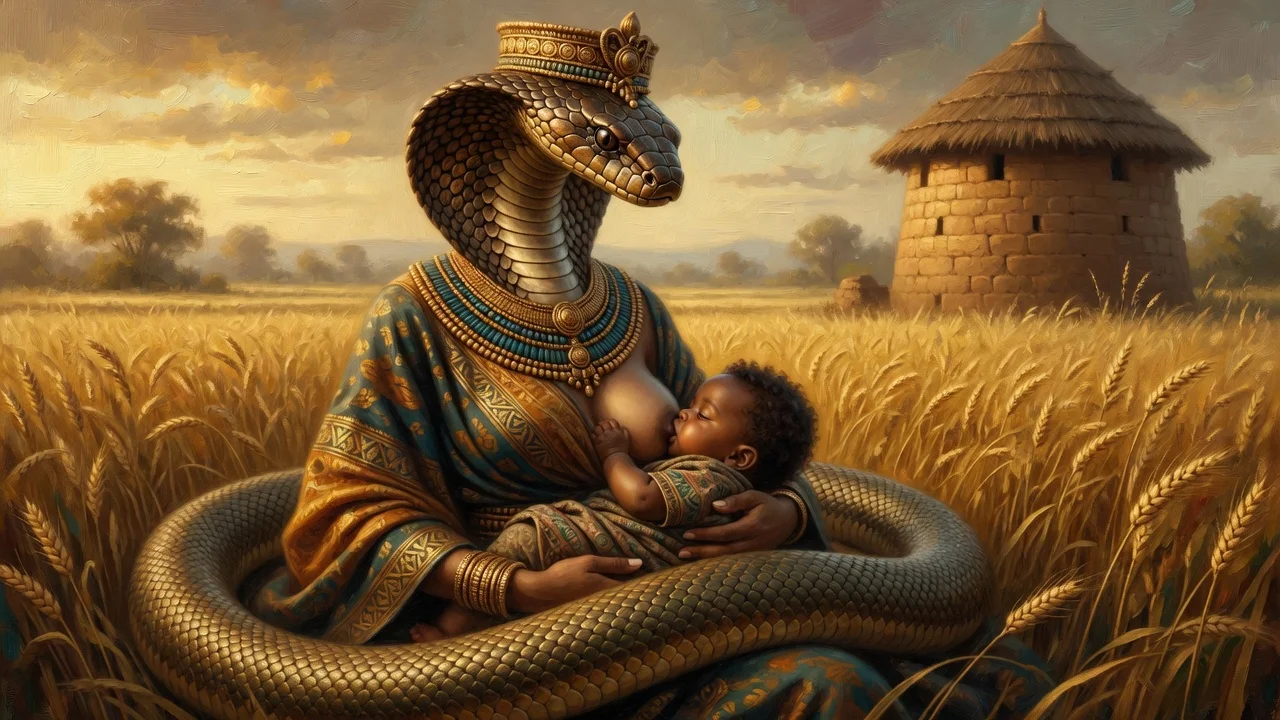
Renenutet's name is bound to the Egyptian words for nursing and rearing, and it is this double sense — rearing a child, rearing a crop — that runs through everything told of her. She could be shown as a plain cobra coiled among the grain, as a woman with a cobra's head, or as a cobra-headed woman nursing an infant at her breast, the three images sliding into one another because in her cult they were never really separate ideas. Wherever grain was threshed, stored or offered, and wherever a child was carried, named or protected, Renenutet's presence was invoked in the same nourishing capacity. Her cult is attested from the Middle Kingdom onward, giving her one of the longer continuous careers among Egypt's agricultural deities, and it persisted with particular strength into the Ptolemaic period.
Guardian of the Threshing Floor
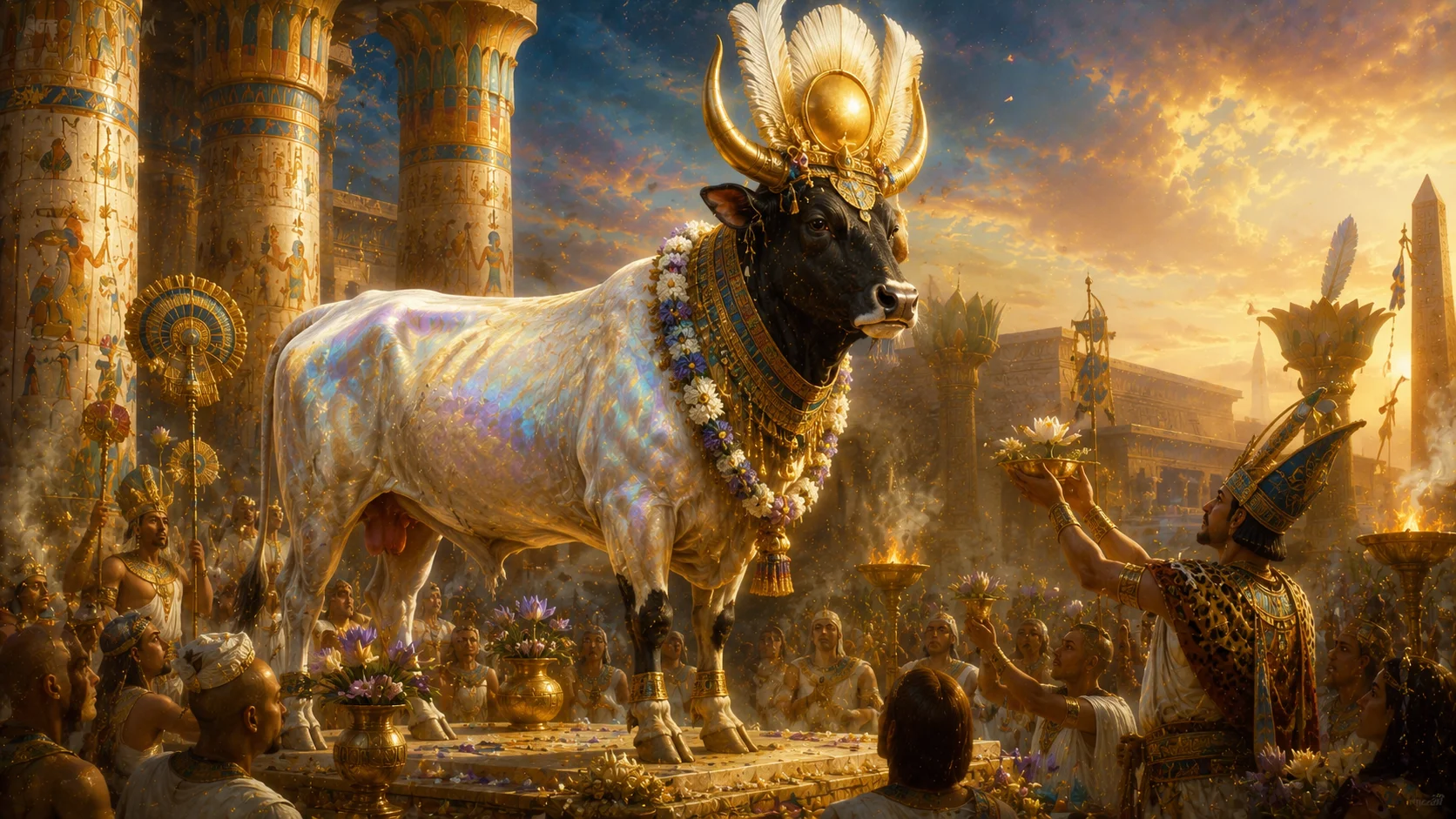
Renenutet's principal domain was the harvest itself, especially the grain harvest whose festivals fell in the months of Khoiak and Pharmouthi. Tomb paintings show threshing-floor and harvest scenes in which cobra effigies of her are deliberately set up beside the heaps of grain, a visual guarantee that the goddess herself stood watch over the crop at its most vulnerable moment, gathered but not yet safely stored. Cobra-shaped amulets and small figurines of her were kept in homes and out in the fields for the same protective purpose, a household precaution as much as a religious offering. When the first grain of a new harvest was cut, it was set aside and dedicated to her before the rest of the crop was touched, a first-fruits offering that marked her as the one to whom the harvest properly belonged before it belonged to anyone else.
Mistress of the Granary
Once the grain was threshed it still needed a protector, and Renenutet's cult followed it into the granary as much as it stayed with it on the threshing floor. She was worshipped especially at granaries and grain stores, where the same cobra amulets and effigies that guarded the harvest in the field continued to guard it once stored. Because the grain reserves of Egypt underpinned the pharaonic administration itself — feeding the state's workforce, its army, its temples — Renenutet's protection of the granary extended by implication to the stability of royal government. A goddess who kept the grain heap safe was, at the same scale that mattered to the state, a goddess who kept the machinery of Egypt fed and running.
Companion of the Grain God
Renenutet was closely associated with Nepri, the god who personified grain itself, and in some traditions she was described as his mother or his close companion. The pairing reflects the same granary theology from two angles: Nepri as the grain, cut, threshed and stored, and Renenutet as the nourishing power that rears the grain into being and then keeps it safe once it exists. Their association placed a mother-and-grain relationship at the center of the harvest cult, giving the abstract cycle of planting, growth and storage a family shape that worshippers could address directly.
The Nurse at the Cradle
Renenutet's nourishing character was not confined to crops. She was regarded, in some royal texts, as protector and nurse of the infant king, and more broadly she was invoked as a household deity for the safety of children in general. The image of the cobra-headed woman suckling a child was not a metaphor layered onto an agricultural goddess after the fact; it was the same nurturing function she performed for the granary, applied directly to a human infant. A household that kept a Renenutet amulet by its stores of grain might just as readily invoke her over a cradle, since both were, in her eyes, things that needed rearing and protection in their most fragile state.
Lady of the Fertile Land
Renenutet carried the epithet Lady of the Fertile Land, a title that ties her directly to the cultivated, irrigated soil of the Nile valley on which the whole harvest cult depended. It is a fitting title for a goddess whose worship moved so easily between the field, the granary and the home: the fertile land was not only the source of the grain she guarded but the ground on which her nurturing extended to households and children as well. The epithet frames her less as a distant sky-power and more as a goddess bound to the productive earth itself.
Fortune Woven Into a Name
In later tradition Renenutet's nourishing role widened into something closer to fate. Her name was linked to the concept of renenet, meaning nurse or fortune, and by the Late Period this had developed into an association with a person's destiny at birth, conceptually paired with the male fate-god Shai in Ptolemaic-era texts. It is worth being precise about the shape of this development: the fate-linkage belongs to the Late Period and does not appear in her earlier attestations, where her identity is anchored far more firmly in grain and nursing than in personal destiny. The later theology did not replace the earlier one so much as grow out of it, reasoning from nurse-of-the-infant to shaper-of-the-infant's-fortune.
The Serpent's Fiercer Face
As a cobra-goddess, Renenutet also carried the fierce, defensive power that Egyptian religion attached to the uraeus and to serpent imagery generally. By the New Kingdom and afterward she was frequently identified with the Eye of Ra complex and merged with other cobra and eye-goddesses, above all Wadjet, whose own cobra form and protective function overlapped closely with hers. The same goddess who nursed a child or guarded a grain heap was, in this aspect, a goddess capable of striking with the deadly speed of the serpent she embodied — nurture and threat held in the same coiled body, protection expressed as much through the capacity for violence as through gentleness.
Renenutet Among the Fayum Gods
The Fayum region held a particularly significant place in Renenutet's cult, and it is there that some of the clearest evidence of her local theology survives. In certain Fayum traditions she was linked with, or identified as the mother of, the crocodile god Sobek — a maternal connection that belongs specifically to this regional tradition rather than to Egyptian religion as a whole. At Medinet Madi in the Fayum, a Ptolemaic-era temple dedicated jointly to Renenutet and Sobek still survives, and it preserved hymns to her composed partly in Greek and partly in Egyptian. Those hymns are among the most substantial surviving primary sources for her cult, and they are studied today as evidence of the blending of Greek and Egyptian religious thought that characterized the Ptolemaic period.
A Goddess Merged Into Others
Renenutet's later career was marked by syncretism as much as by continuity of her own distinct cult. She was merged and identified with other cobra and eye-goddesses, notably Wadjet, and with Isis, producing hybrid cult forms such as Isis-Renenutet attested in Fayum temple contexts. Rather than being absorbed and lost, she persisted precisely by lending her nourishing, protective identity to these composite figures, so that her harvest and nursing functions continued to be addressed even where her own name had folded into another goddess's.
Effigy and Amulet, Field and Home
The same small objects run through every stage of Renenutet's worship: cobra figurines set up at the threshing floor, cobra amulets kept in the granary, cobra amulets kept in the home. Rather than three separate practices, this was one continuous habit of guarding whatever was precious and vulnerable — grain freshly cut, grain in storage, a child in the cradle — by invoking the same serpent presence at each point. It is this repetition, more than any single myth, that shows how thoroughly her protective character was woven into ordinary Egyptian life, from the fields into the household.
The Nourishing Serpent of Fate
Renenutet endures as the Egyptian cobra-goddess of the harvest, nourishment and protective fate — the serpent who guarded the grain and the granaries, nourished and named the newborn child, and in later tradition was called upon to bestow each person's destiny. She embodies the Egyptian linking of harvest, nourishment, nursing and fortune into a single nurturing-yet-fierce goddess, present equally at the threshing floor, in the granary, and beside the cradle. From the Middle Kingdom through the Ptolemaic hymns of Medinet Madi, she stands as the protective serpent who watched over both the food that sustained the body and, in time, the fortune that was said to shape the life.
The nourishing cobra who guards the grain in the granaries and nurses the newborn child — giving each person their name and, in later belief, their fate, the serpent of harvest and destiny.
Sources & traditions
- EncyclopediaWikipedia — Renenutet
- TraditionEgyptian texts, inscriptions and later retellings
Myths change from area to area and from time to time. This chronicle follows the most widely told versions; tellings in other villages, regions and eras may differ.