Anuket was the Egyptian goddess of the Nile cataracts, the flood and the nourishing waters of the south — the gazelle-crowned daughter of the Elephantine triad who embodied the embracing, life-giving waters of the inundation and the fertility they brought. A goddess of the river and its bounty, she is the nourishing waters that embrace and feed the land.
Where the River Is Born
Anuket's domain was the far south of Egypt, at the First Cataract near Aswan and the island of Elephantine, where the Nile churned over granite outcrops before settling into the long, calm course that carried it north through the rest of the land. This was understood as the river's traditional source-region — the mythic origin point of the annual inundation on which all Egyptian life depended. It was also the country's southern frontier, the gateway between Egypt and the lands of Nubia beyond, and Anuket's presence there tied her worship to the guardianship of that border as much as to the waters themselves. Her principal cult centers were Elephantine itself and nearby Sehel Island, both sitting directly in the path of the rushing cataract waters she personified.
The Gazelle of the Rushing Waters
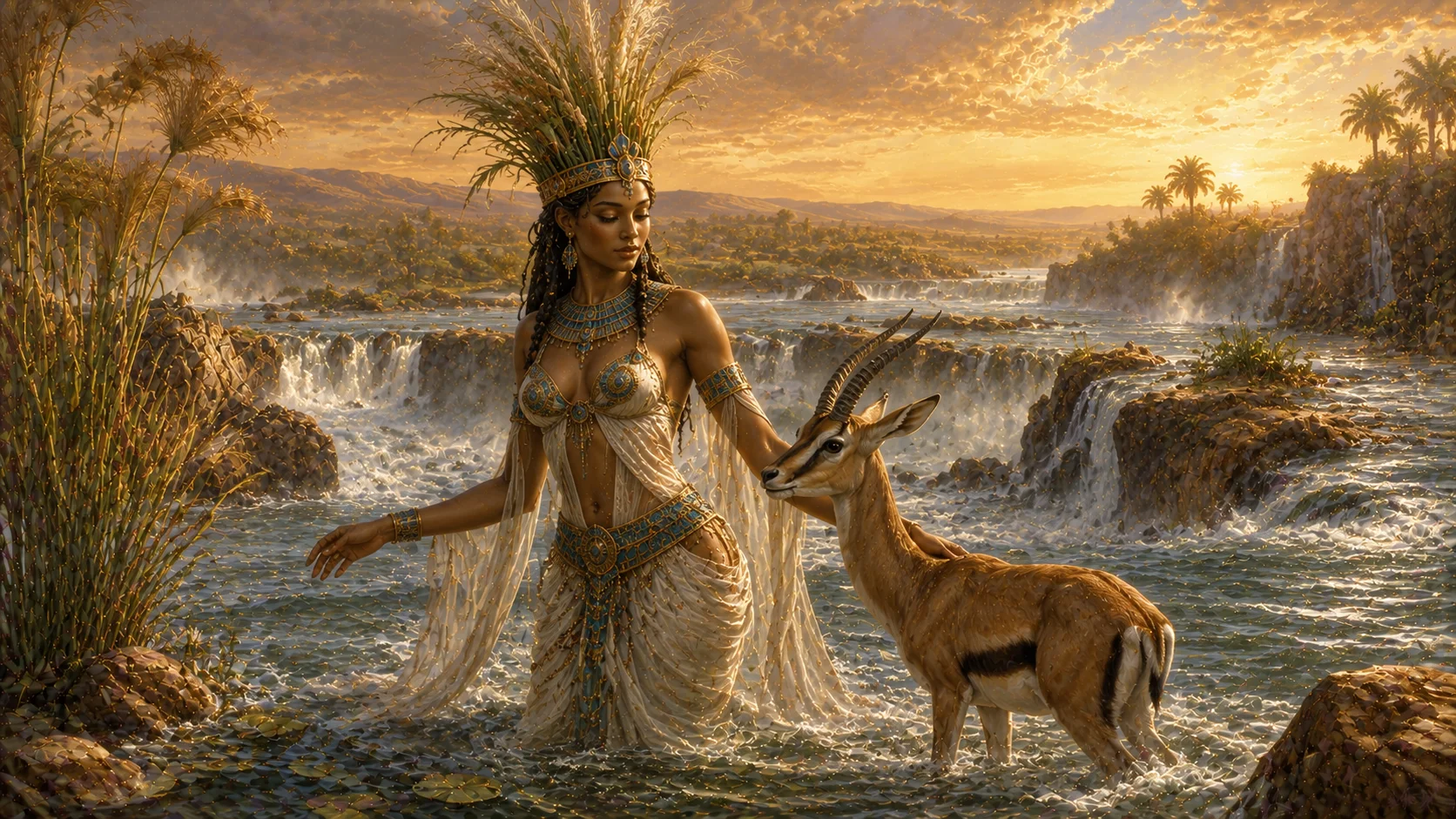
Anuket was shown as a woman crowned with a tall headdress of reeds or ostrich feathers, an image that set her apart from other river and flood deities of the Egyptian pantheon. Her sacred animal was the gazelle, an animal of swiftness, and the association was a deliberate one: the gazelle's speed across the desert margins near the cataracts stood as a fitting emblem for the swift, tumbling rush of water through the rocks at Aswan. Where Khnum's ram-imagery spoke of the river's source and Satet's speeding arrow spoke of the flood's release, Anuket's gazelle spoke of the water's motion itself — quick, alive, and impossible to hold still.
Daughter of the Elephantine Triad
Anuket belonged to the triad of Elephantine alongside Khnum and Satet, the divine family who together governed the Nile at its southern source. The exact nature of her kinship to the other two is not fixed in the surviving sources: she is most commonly described as Khnum's wife, though other accounts make her his daughter instead, and the ancient material itself does not settle the question. What remained constant across the tradition was her place within the triad as the youngest and most intimately tied to the flood's nourishing character, standing beside Khnum, who shaped life at the river's source, and Satet, who released the inundation and watched the frontier.
Mistress of the Nile
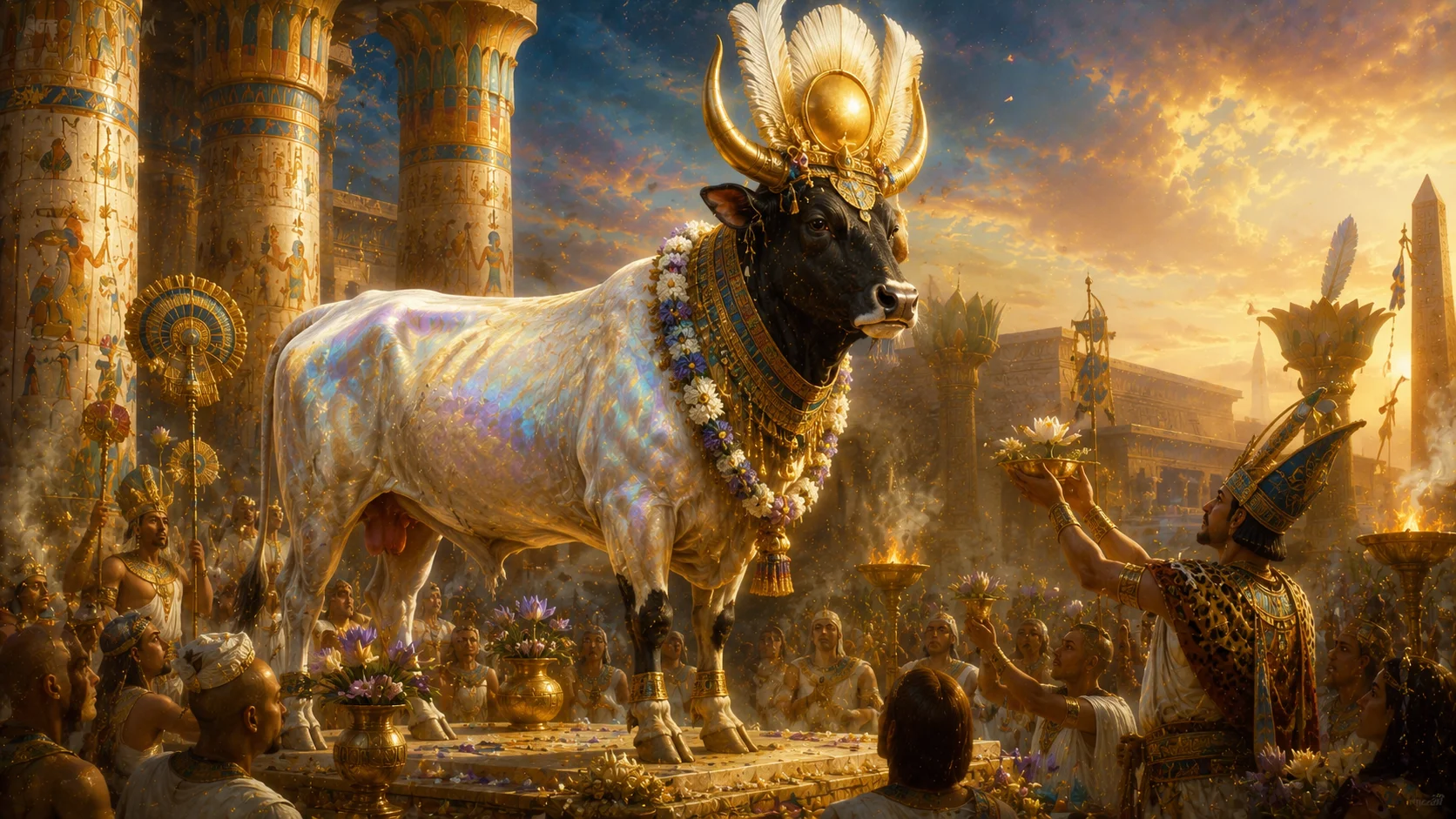
Among Anuket's titles was Mistress of the Nile, a name that placed her authority over the river's waters on a level with the other great deities of the inundation. It was not a decorative epithet: the flood's arrival each year determined whether the coming season would bring abundance or want, and a goddess named its mistress carried real weight in the religious life of the communities along the cataract. Her worship at Elephantine and Sehel Island was bound to the practical rhythm of the flood season, when offerings were made to secure her favor and to give thanks for the waters she was believed to govern.
Nourisher of the Fields
Anuket's other great epithet, Nourisher of the Fields, points to the specific gift attributed to her: the fertilizing silt and moisture that the flood waters carried onto the land as they receded. This was the substance of Egyptian agriculture itself, the dark soil renewed every year by the river's overflow, and Anuket's name was attached directly to that renewal. She was not simply a goddess of water in the abstract but of water in its most consequential form for Egyptian life — the water that made the fields produce.
A Name That Means Embrace
Anuket's name carries an etymological link to the idea of embrace, and this connection shaped how she was understood in relation to the land she watered. The flood did not merely pass over the fields; in the imagery bound up in her name, it embraced them, wrapping around the land the way an arm wraps around what it holds close. This gave her a character distinct from a purely elemental river-goddess — she was cast as an intimate, encompassing presence, one whose waters did not just flow past but took hold of the fields and nourished them from that embrace.
Suckling the King
Temple reliefs preserve a striking image of Anuket nursing the reigning pharaoh, a scene that carried clear meaning within Egyptian ideas of kingship. To be nursed by a goddess of the Nile's flood was to have one's rule legitimized by the very source of the land's abundance — a visual argument that the king's authority flowed from the same waters that fed Egypt itself. This iconography placed Anuket among the deities whose favor underwrote royal legitimacy, linking the fertility she granted the fields to the fertility of the king's own claim to the throne.
Beside Satet, Yet Her Own
In ritual texts concerned with the flood, Anuket was at times conflated or paired closely with Satet, the archer-goddess of the same Elephantine triad, since both were bound up with the inundation's arrival and its meaning for the land. Even so, the two remained distinct goddesses with their own separate identities, iconography, and epithets. Satet's character was tied to the release of the flood and to the guarding of the frontier with her bow; Anuket's was tied to the water's embracing, nourishing character once it reached the fields. Their closeness in ritual practice reflects how tightly bound the whole Elephantine cult was around the single event of the flood, not a merging of the goddesses themselves.
From the Old Kingdom to the Temples of Kom Ombo
Anuket's presence in the Egyptian record reaches back to the Old Kingdom, where she is already attested within the cult life of Elephantine. Her worship did not fade with time; it persisted for millennia, and by the New Kingdom evidence shows her cult extending downstream as far as Kom Ombo, where her imagery appears alongside that of Sobek and Hathor in certain contexts. Her presence at Kom Ombo continued into the Ptolemaic period, when the temple there received extensive decoration, showing that Anuket remained a living part of Egyptian religious practice for a span of time stretching from the earliest dynastic monuments to the last centuries before Egypt's temples fell silent.
Guardian of the Southern Gate
Because Elephantine sat at Egypt's southern border, Anuket's worship there was inseparable from the site's role as guardian of that frontier. The cataract region was where the Nile entered Egypt proper, and the triad based there — Khnum, Satet, and Anuket — carried both a cosmological and a territorial significance: they governed the river at the very point where it became Egypt's river, and by extension stood watch over the boundary between Egypt and the lands to the south. Anuket's part in that guardianship was expressed through the nourishing waters she was believed to send north, waters that in a very real sense defined where Egypt's abundance began.
Offerings at the Turn of the Flood
Anuket received offerings during the season of the Nile flood, when the practical stakes of her favor were at their highest. The timing of these observances was not incidental; they marked the point at which the river's rise either confirmed the promise of a fertile year or threatened its failure, and the communities of the cataract region turned to Anuket, alongside Khnum and Satet, at exactly that moment of uncertainty. Her cult was thus woven into the working agricultural calendar as much as into formal temple ritual, a goddess called upon at the hinge of the year on which everyone's harvest depended.
The Embrace That Fed Egypt
Anuket endures as the Egyptian goddess of the Nile cataracts, the flood and the nourishing waters of the south — the gazelle-crowned daughter of the Elephantine triad, the embracing, life-giving waters of the inundation, the nourisher of the fields. She embodies the Egyptian reverence for the Nile and its flood as the source of all life and abundance; and she completes, with Khnum and Satet, the divine family of the cataracts — the nourishing, embracing waters that wrapped around the land and brought it the fertility on which all Egyptian life depended.
The gazelle-crowned goddess of the embracing, nourishing waters of the Nile — the daughter of the flood-triad whose inundation wrapped around the land and brought it life and abundance.
Sources & traditions
- EncyclopediaWikipedia — Anuket
- TraditionEgyptian texts, inscriptions and later retellings
Myths change from area to area and from time to time. This chronicle follows the most widely told versions; tellings in other villages, regions and eras may differ.