Sobek was the crocodile-god of ancient Egypt — the powerful and fearsome deity of the Nile, of crocodiles, of military might, fertility and protection, who embodied both the danger and the life-giving power of the great river and its most feared creature. A god of raw strength and primal power, he was worshipped with awe as the lord of the waters and the protector against their perils.
The Crocodile God
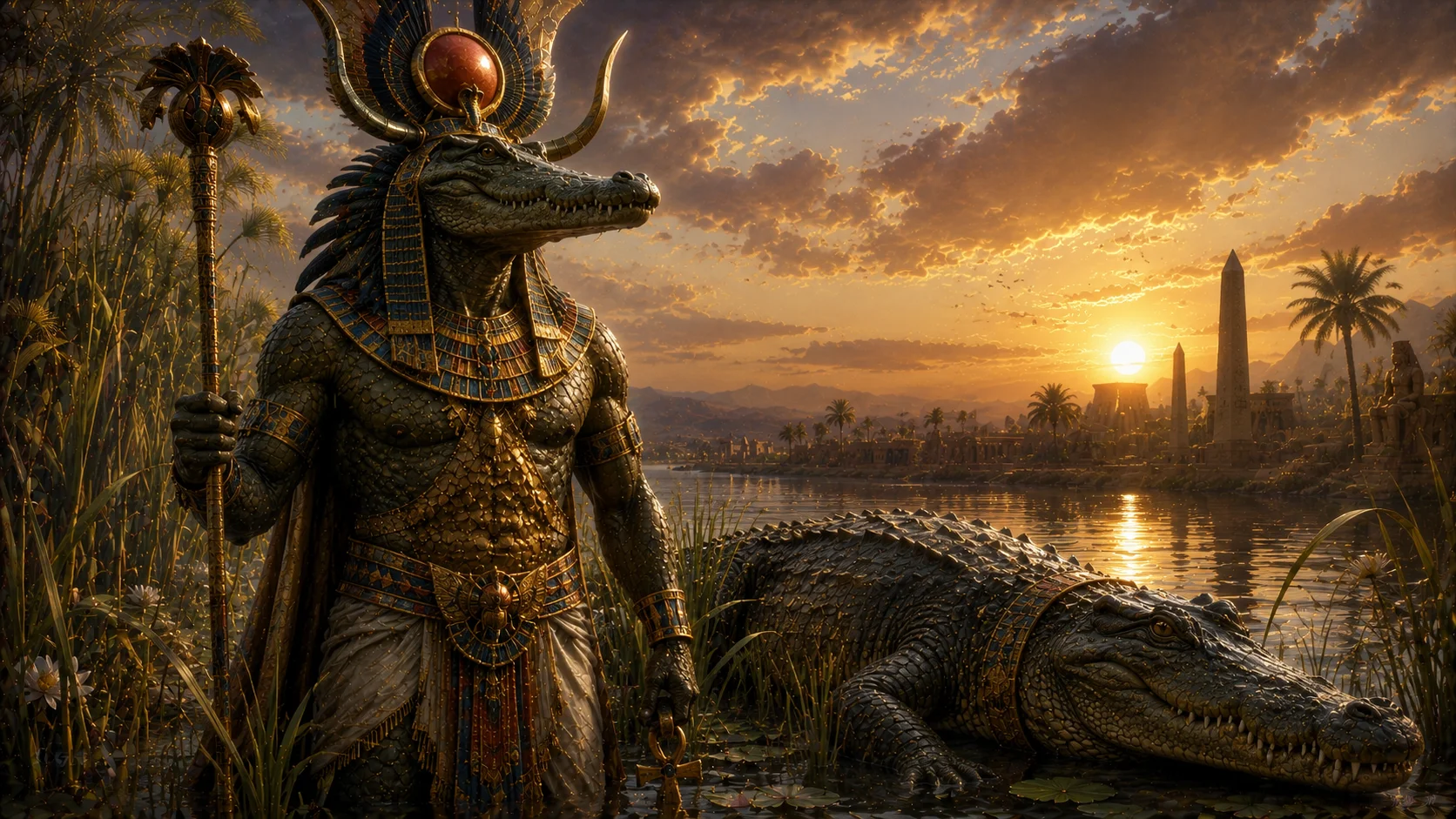
Sobek (Egyptian Sobek) was depicted as a crocodile, or as a man with a crocodile's head, often crowned with a headdress of horns, plumes and the solar disc. He was the god of the Nile, crocodiles, marshes and water, and he embodied the immense power and danger of the crocodile, the most feared predator of the Egyptian river. The Egyptians held the crocodile in a mixture of terror and reverence, and in Sobek they made the dreaded beast a powerful god — turning the danger of the river into a divine protector. Live crocodiles were kept and pampered in his temples (especially at his cult-centers of Crocodilopolis and Kom Ombo), adorned with gold and jewels and mummified at death.
The Power of the Nile
Sobek was deeply associated with the Nile and its life-giving waters. As a god of the river, he was connected to fertility, abundance and the fertile black soil that the Nile's flooding deposited; the river that brought life to Egypt was his domain, and his power was the power of its waters. Some myths even held that the Nile itself flowed from Sobek's sweat, or that he was present at the creation, emerging from the primordial waters. He thus embodied both faces of the Nile — its danger (the lurking crocodile, the drowning flood) and its bounty (the fertility, the abundance, the life it gave to the land).
The God of Strength and Protection
Sobek was a god of military power, strength and protection. His ferocity made him a fitting patron of the pharaoh's might and the army's strength; he was invoked for power and victory, and his crocodilian aggression was turned to the defence of Egypt and its king. He was also a protective god — protecting against the dangers of the river and the bites of crocodiles, and warding off evil. In some traditions he was associated with the sun-god as Sobek-Ra, and he played a role in the Osiris myth, helping to recover the body of Osiris from the waters. His fierce strength, like that of Set or Sekhmet, was dangerous but could be turned to protection and royal power.
The Lord of the Waters
Sobek endures as one of the most powerful and primal of the Egyptian gods — the crocodile-lord of the Nile, the god of water, fertility, military might and protection, who embodied both the terror and the bounty of the great river and its most feared creature. He embodies the Egyptian way of confronting the dangers of their world by making them divine — turning the dreaded crocodile and the perilous river into a mighty god who could protect as well as destroy, the powerful lord of the waters on which all Egyptian life depended.
The dreaded crocodile of the Nile made into a god — the lord of the river's power, both its drowning danger and its life-giving bounty, worshipped with awe and pampered crocodiles adorned in gold.
Green of Plume: Sobek in the Oldest Writing
Sobek is one of the few Egyptian gods whose entrance into the written record can be dated with any confidence. He is named in the Pyramid Texts, the spells carved into the burial chambers of late Old Kingdom pharaohs beginning with the pyramid of Unas around the middle of the twenty-fourth century BCE — the oldest substantial body of religious writing to survive from Egypt. The men who cut those spells were already living in a country where the pyramids at Giza were two centuries old, ancient work by ancient people, and Sobek was in the liturgy they carved.
He does not arrive as a minor river-spirit finding his feet. Two of the Unas spells name him the son of Neith and call him green of plume. Neith is among the oldest deities attested in Egypt, worshipped from the predynastic period onward, and later theology cast her as a creator who arose from the primeval waters. To be called her son is to be given a birth certificate from before the world was finished. The epithet is just as pointed: green, in Egyptian usage, carried the sense of freshness and new growth rather than of danger. The oldest surviving description of the crocodile-god emphasises not his jaws but his greenness — the god of the thing in the water named for the colour of things that grow.
The Kings Who Wore His Name
Few Egyptian gods were bound this tightly to the identity of actual rulers. The Twelfth Dynasty pharaoh Amenemhat III poured royal resources into the Faiyum, the marshy lake basin west of the Nile that was Sobek's heartland: he built his pyramid at Hawara on its edge, and at Medinet Madi he and his successor raised a small temple to Sobek and the cobra-goddess Renenutet that still stands today, one of the very few Middle Kingdom temples to survive substantially intact.
His daughter closed the dynasty. She took the throne name Sobekneferu — “the beauty of Sobek” — and is the earliest woman known to have ruled Egypt as monarch in her own right with a complete royal titulary to prove it. The dynasty that began at her death carried the habit further: a whole run of Thirteenth Dynasty kings called themselves Sobekhotep, “Sobek is satisfied,” one after another, as though the crocodile-god's contentment had become a precondition of legitimate rule. To wear Sobek's name on a throne was to claim the ferocity of the river as the ferocity of the state.
What the Greek Tourists Saw
The strangest thing about Sobek's cult is that it was visible. Foreign visitors did not have to take the theology on trust; they could go and look, and what they wrote down survives.
Herodotus, travelling in Egypt in the fifth century BCE, reported something that clearly puzzled him: reverence for the crocodile was not national but local. In some districts the animals were tame and holy, hand-fed, fitted with ornaments in the ears and bracelets on the forelegs, and embalmed when they died. At Elephantine, a short way along the same river, people hunted and ate them. Four centuries later the geographer Strabo described the sacred crocodile at Crocodilopolis in the Faiyum, whom the priests called Souchos, being coaxed to the water's edge while visitors handed over cakes, roast meat and wine mixed with honey, and a priest held the jaws open to receive it. Few gods anywhere in the ancient world were this literal. Worshippers could travel to look their god in the eye, and did.
A Temple Built for Two
Sobek's cult produced one genuinely unusual building. At Kom Ombo, on a bend of the Nile in Upper Egypt, the temple raised under the Ptolemies and extended by Rome is doubled along its whole length: two entrances, two hypostyle halls, two sanctuaries, mirrored either side of a shared axis. It houses two complete divine families that never have to share a room.
- The southern half belongs to Sobek, with Hathor and their child Khonsu.
- The northern half belongs to Haroeris, Horus the Elder, with Tasenetnofret and their child Panebtawy.
It is an architectural solution to a theological problem, and a rather diplomatic one. Beside the temple stands a small museum of mummified crocodiles recovered locally — a handful of the enormous number embalmed as offerings across Sobek's cult sites, from hatchlings scarcely longer than a hand to full-grown adults.
The Crocodiles That Kept the Paperwork
Those mummies produced one of the odder rescues in the history of scholarship. In December 1899 the papyrologists Bernard Grenfell and Arthur Hunt began digging at Tebtunis in the Faiyum, hoping for human burials. The necropolis gave them crocodiles instead — more than a thousand of them, row upon row, and no manuscripts. One workman, thoroughly disgusted, broke a crocodile apart. It was stuffed with papyrus.
Only around thirty of the thousand-odd animals had been packed and wrapped with waste documents, but those thirty held tax returns, petitions, contracts, letters and accounts — the ordinary paperwork of a Faiyum town, thrown out as rubbish and preserved because it happened to be convenient stuffing for a sacred reptile. The Tebtunis papyri remain one of the richest sources for daily life in Greco-Roman Egypt. Sobek's crocodiles were not merely worshipped; they turned out to be the archive.
Revered and Repelled
It would be neat to say Egypt simply loved its crocodile, and it would be wrong. The same civilisation that crowned Sobek also wrote spells whose entire purpose was to drive a crocodile away from the dead — funerary texts include charms for exactly that, on the reasonable assumption that a crocodile in the afterlife is a problem rather than a blessing. Herodotus found villages that ate the animal a morning's sail from villages that jewelled it. The reptile was food, threat, ward and god depending on which stretch of bank you stood on.
Egypt never resolved that contradiction, and there is no sign it wanted to. Sobek's worship clusters where the water was widest and the crocodiles thickest — the Faiyum above all — which suggests the god grew densest exactly where the danger did. Reverence here was not affection. It was the practical conclusion of people who could not remove the thing in the water and decided instead to learn its name, feed it by hand, and put it on the throne.
Sources & traditions
- EncyclopediaWikipedia — Sobek
- TraditionEgyptian texts, inscriptions and later retellings
Myths change from area to area and from time to time. This chronicle follows the most widely told versions; tellings in other villages, regions and eras may differ.