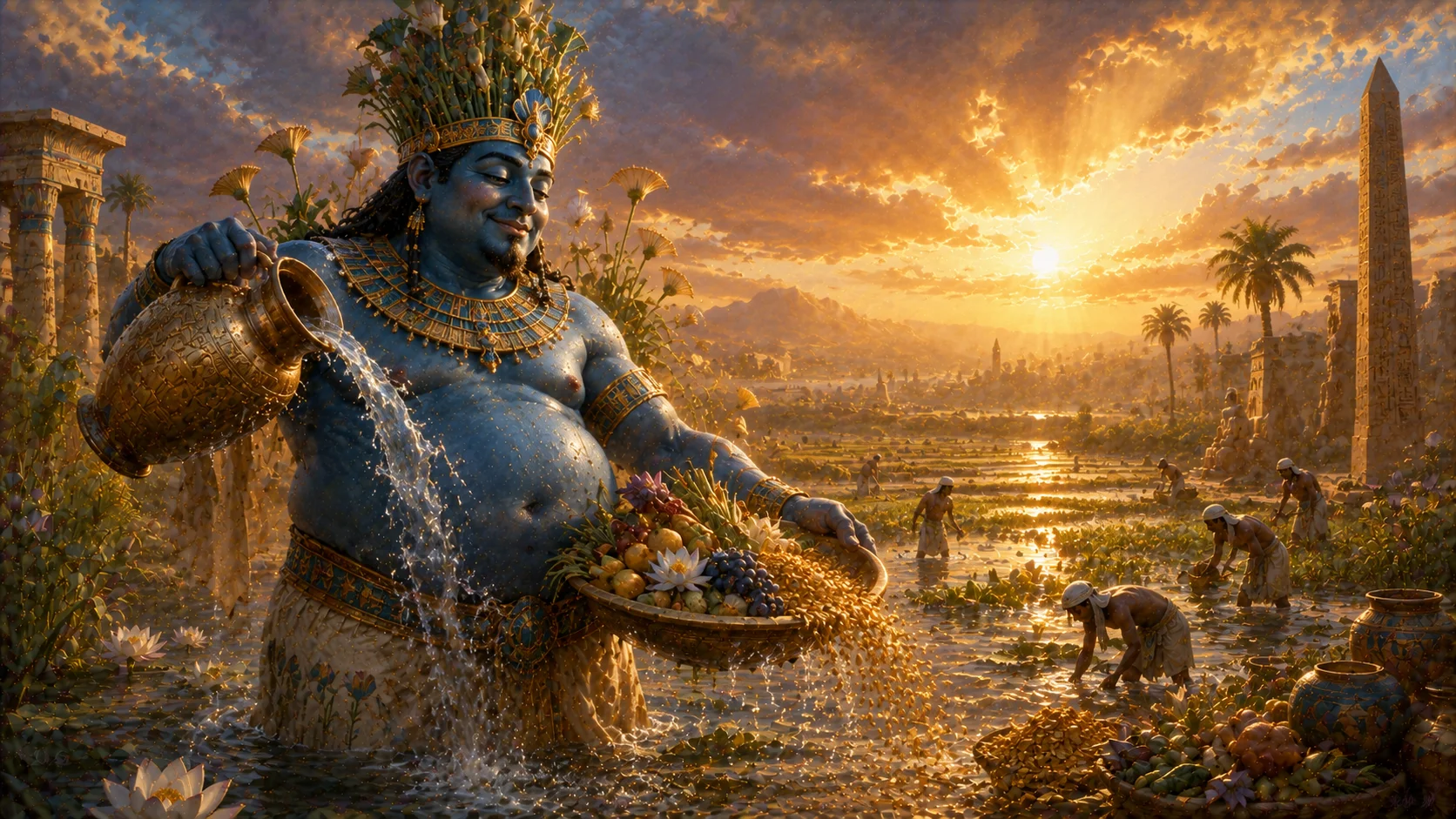
Hapi was the Egyptian god of the annual flooding of the Nile — the deity of the life-giving inundation that brought the fertile black silt to Egypt's fields each year, the bringer of abundance and the very source of Egypt's prosperity and survival. A god of fertility and plenty depicted with a swollen belly and pendulous breasts, he embodied the bounty of the great river on which all Egyptian life depended.
The Waters That Rose Each Year
Hapi was the personification of the annual flooding of the Nile — the inundation, the single most important recurring event in Egyptian life. Each year the river rose, spilled beyond its banks, and receded again, leaving behind a dark, rich layer of silt across the floodplain. It was this cycle, repeated season after season, that made farming possible along a strip of land otherwise hemmed in by desert. Hapi was understood as the force behind that rise: not a king of the gods, not a warrior, not a judge of the dead, but the presence in the water itself that made the flood come.
A Figure Shaped by Nourishment
Hapi's image departed from the lean, youthful, or falcon-headed forms of many Egyptian gods. He was shown as an androgynous, fecund male figure with a large belly and pendulous breasts — features that read, in Egyptian visual language, as nourishing abundance rather than as any specific gender. His skin was rendered blue or green, the colors of Nile water and of the vegetation the flood produced. A headdress of aquatic plants completed the figure: papyrus, lotus, or reeds gathered above his head, marking him unmistakably as a being of the river rather than of the sky or the desert.
Two Figures, One River
In temple relief work Hapi was frequently shown in a doubled form, split according to Egypt's own ancient division into two lands. Hapi of the South wore a crown of papyrus and stood for Upper Egypt; Hapi of the North wore lotus or reeds and stood for Lower Egypt. The pairing was not decorative. It expressed the idea that a single river bound two different regions into one country, and the motif was put to explicit political use: on royal thrones, images of the twin Hapi figures tying together the heraldic plants of north and south illustrated the sema-tawy, the "unification of the two lands," beneath the figure of the reigning king. This particular image — two Hapis knotting reed and papyrus together — became one of the most frequently reproduced pieces of Egyptian royal iconography, precisely because it stated the ideology of a unified Egypt under pharaonic rule in a single, legible picture.
A Dwelling Among the Cataract Caverns
Hapi was believed to dwell in caverns near the First Cataract, close to Elephantine and Aswan, at the traditional southern threshold of Egypt where the river was thought to emerge from underground sources before beginning its long run north. This was mythic geography he shared with another deity, Khnum, who was likewise credited with controlling the release of the flood from that same region. The two figures' roles overlapped rather than competed: both were tied to the same stretch of river and the same belief that the inundation's source could be located, quite specifically, in the rock and water around the First Cataract.
Neither Too Little Nor Too Much
Egyptian farmers depended on the flood arriving in a particular range. A low Nile left fields dry and unfed, and the shortfall in silt and irrigation meant a poor harvest and the threat of famine. A flood that rose too high was equally feared, since it could tear through settlements, destroy stored grain, and damage the very infrastructure the harvest depended on. Hapi was invoked, above nearly everything else, to bring a moderate, well-judged flood — enough to renew the fields, not so much as to destroy them. This narrow target, rather than any dramatic myth of conflict or triumph, was the practical concern at the center of his cult.
A God Without a Cycle of Deeds
Unlike gods such as Osiris or Horus, Hapi does not appear as a protagonist moving through a sequence of events — no birth story, no combat, no trial, no death and restoration attributed to him directly. He was not usually counted among the major named gods with elaborate independent myth cycles. Instead he functioned as a nature-personification: a presence invoked through hymn and ritual at the season when the flood was due, addressed directly as the river's own life-giving quality rather than as a character with a personal history. His importance did not rest on narrative; it rested on the fact that without the event he embodied, nothing else in Egypt's agricultural year could proceed.
The Hymn Raised in His Name
Hapi was the subject of a Middle Kingdom composition known as the Hymn to the Nile, or Hymn to Hapi, which praised him as the sustainer of Egypt's fields and, through them, of life itself. The hymn's language treated the flood not as a mechanical event but as a gift renewed every year, addressing Hapi as the source of the crops, the herds, and ultimately the continued existence of the people who depended on both. Compositions of this kind were part of how the flood's arrival was marked and welcomed, giving formal, repeated voice to a dependence that ran through every household along the river.
Offerings Cast Into the Current
Devotion to Hapi took a tangible, seasonal form. At the start of the inundation season — roughly what corresponds to July in the ancient calendar — people made offerings of food, drink, and small votive figurines, cast directly into the Nile itself rather than left at a temple altar. The act placed the offering into the very element the god personified, timed to the moment when the first signs of the rising water would have been watched for and welcomed. It was a form of worship built around a fixed point in the agricultural year rather than around a temple festival calendar removed from the land.
Tables Laden With the River's Gifts
In processional temple reliefs Hapi was sometimes depicted carrying offering tables heaped with produce — the harvest his own flood had made possible, presented back in image form. The motif reinforced his identity as a bringer of material abundance rather than as a figure of combat or judgment: where other gods were shown with weapons, crowns of authority, or the balance of judgment, Hapi was shown carrying food. It was a visual shorthand consistent with everything else about him — his body, his offerings, his hymn — all oriented toward plenty rather than power.
An Echo in Osiris's Own Story
Hapi was occasionally invoked alongside Osiris in funerary and agricultural symbolism, and Egyptologists have long noted a resonance between the two. Osiris's own mythology — his death, dismemberment, and revival — has often been read as an allegory for the Nile's yearly cycle of flood and recession, the water seeming to "die" as it withdrew and "return" the following year. It is worth being precise about what kind of connection this is: it is an interpretive link drawn by scholars from the shape of the two stories, rather than an explicit shared myth text in which Hapi and Osiris act together. The two figures could be invoked in proximity without their stories ever being fused into one.
A God Without a House of His Own
Hapi appears in the record with no standard spouse and no offspring. He does not sit within a family tree of gods the way many Egyptian deities do, linked by marriage or descent into wider divine households. This absence fits the kind of figure he was: a personification of a natural process rather than a member of a genealogical divine family with relationships to maintain and stories to generate through them. His identity was defined by the river, not by kinship.
What the Twin Image Still Says
Hapi endures most visibly today through that doubled temple motif — the papyrus-crowned figure of the south and the lotus- or reed-crowned figure of the north, binding their plants together beneath a throne. It is a compact statement of everything he represented: a single river running the length of the land, a flood that made no distinction between Upper and Lower Egypt, and a form of divine authority rooted not in conquest but in the reliable, necessary return of water and silt. He was not a god who acted upon the world so much as a god who was the world's own renewal, given a face, a belly, and a crown of reeds so that a hymn could be sung to him and an offering could be given a name to fall toward.
Sources & traditions
- EncyclopediaWikipedia — Hapi (Nile god)
- TraditionEgyptian texts, inscriptions and later retellings
Myths change from area to area and from time to time. This chronicle follows the most widely told versions; tellings in other villages, regions and eras may differ.