Osiris was the Egyptian god of the dead, the afterlife and resurrection — the murdered and resurrected king who became the lord of the underworld and the judge of the dead, whose death and rebirth gave every Egyptian the hope of eternal life. His murder by his brother Set, his resurrection by his wife Isis, and his vindication through his son Horus form the central and most beloved myth of all Egyptian religion.
Child of Earth and Sky
Osiris (Egyptian Wsir) belonged to the Ennead of Heliopolis, the great family of nine gods at the root of Egyptian cosmology. He was the eldest son of Geb, the earth, and Nut, the sky who arched above him — siblings to Isis, who became his sister-wife, and to Set and Nephthys. In this divine household lay the seed of the whole myth: a brother who would murder him, a sister who would mourn and revive him, and another sister, Nephthys, who would help search for him despite being married to Set himself. Osiris became the first great king of Egypt, and in the telling he was a good and beloved ruler who, with Isis at his side, civilised the Egyptian people — teaching them agriculture, law, and the worship of the gods, and lifting them out of savagery into ordered life along the Nile.
The King in Crook and Flail
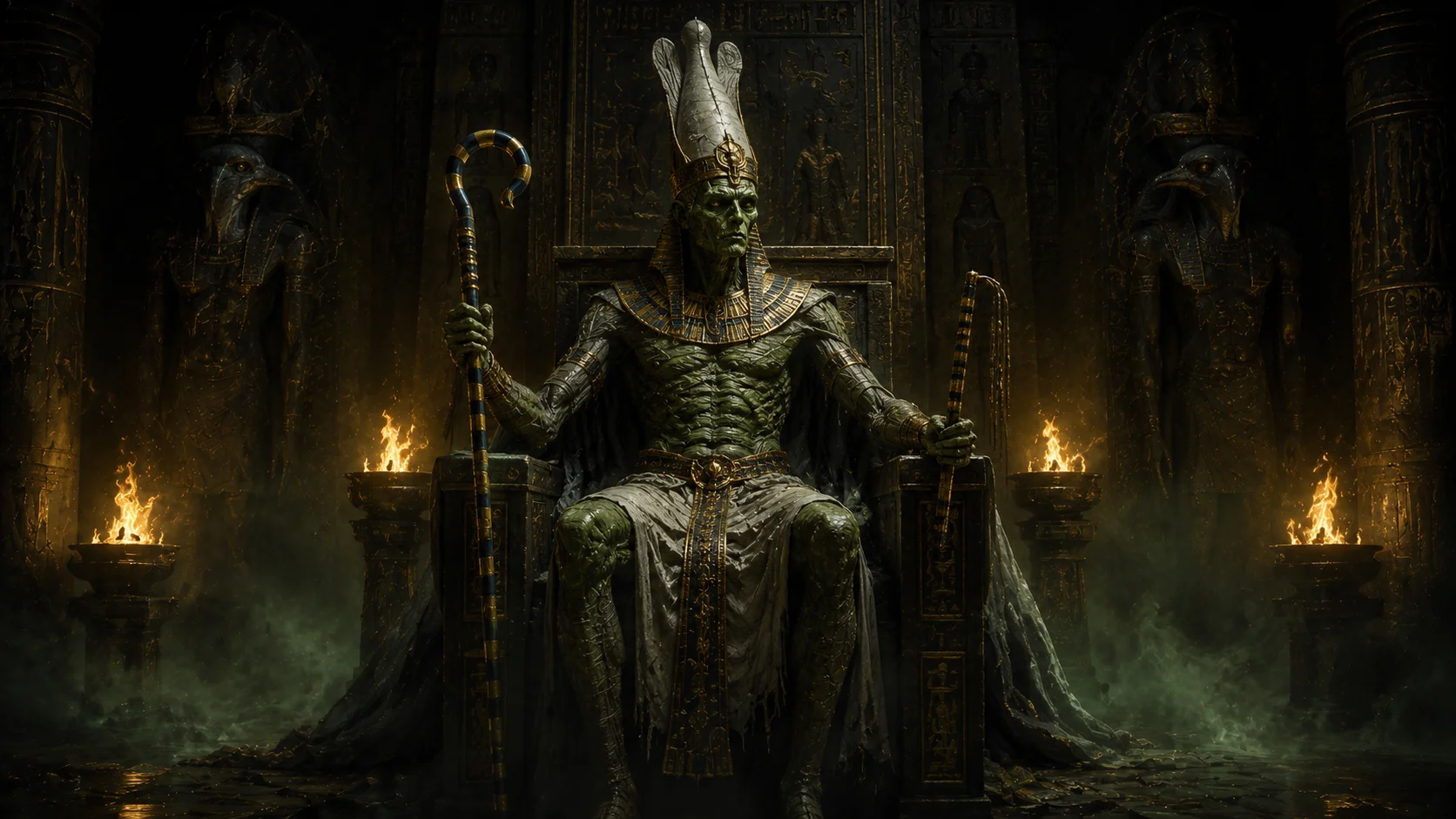
Osiris was depicted as a mummified king, his body wrapped tight in the manner of the dead, yet his hands free to hold the crook and flail — the twin emblems of kingship and of the herdsman's authority over his flock. Upon his head sat the tall white Atef crown, flanked by plumes, marking him as sovereign even in death. His skin was painted green, the colour of new vegetation, or black, the colour of the rich Nile silt left behind by the flood — both colours speaking of fertility and of life renewing itself out of what appears dead. He carried epithets that named his dominion outright: Lord of the Underworld, Lord of Eternity, and Khenti-Amentiu, Foremost of the Westerners — the West being the direction of the setting sun and, for the Egyptians, the land of the dead.
A Chest Built to Measure
Osiris's good kingship earned him the murderous envy of his brother Set, god of chaos and the desert waste. Set plotted with cunning rather than open violence: he had a beautiful chest built exactly to Osiris's measurements, and at a banquet he offered it as a gift to whichever guest it fit. When Osiris, unsuspecting, lay down inside to test it, Set and his fellow conspirators slammed the lid shut, sealed it, and cast it into the Nile. Osiris drowned inside his own coffin, and the chest was carried by the current out of Egypt entirely, coming to rest at last lodged in a tree far away at Byblos. Grief-stricken, Isis went out searching the world for her husband, and in time she found the chest and recovered his body, bringing it home.
Torn and Scattered
The recovery was not the end of Set's cruelty. He found the body again, and this time he would not risk a single, recoverable coffin: he hacked Osiris's body into pieces — ancient sources differ on the exact count, with figures ranging from fourteen to sixteen depending on the telling — and scattered them the length and breadth of Egypt, so that his brother could never again be made whole. It is worth noting that the fullest connected version of this dismemberment and its aftermath survives not in an Egyptian text but in the Greek-language treatise De Iside et Osiride, written by the philosopher Plutarch centuries later; the Egyptian sources themselves — the Pyramid Texts, the Coffin Texts, and various hymns — preserve the myth only in fragments and allusions, so Plutarch's narrative, however invaluable, carries a Hellenizing gloss over material whose original shape scholars must reconstruct piece by piece, much as Isis herself had to.
The Search of Two Sisters
Isis would not be defeated by her husband's dismemberment. Joined by her sister Nephthys — who set aside her marriage to Set to help recover Set's own victim — Isis searched the length of Egypt and gathered up the scattered pieces of Osiris's body, finding all but one, which had been swallowed by a fish in the river. Using her formidable magic, and with the aid of Anubis, who is credited with performing the very first mummification in order to bind the reassembled body together, Isis restored her husband's form. She then breathed life back into him, if only for a moment — long enough to conceive a son. That resurrection was necessarily incomplete: Osiris could not remain among the living, for he had already died. Instead he descended into the underworld to become its king.
A Son Conceived in Death
The child conceived in that brief restoration was Horus, and his birth gave the myth its second act. Where Osiris's story is one of murder and partial resurrection, Horus's is one of vindication: grown to maturity, he challenged his uncle Set for the kingship of Egypt in the long conflict remembered as the Contendings of Horus and Set, avenging his father's murder and reclaiming the throne that was rightfully his. This pairing became the theological engine of Egyptian kingship itself: the living, reigning pharaoh was identified with Horus, vigorous and enthroned, while the pharaoh who had died and passed into the afterlife was identified with Osiris, sovereign now over the dead. Kingship thus renewed itself endlessly along the same pattern that had first been set by father and son, generation succeeding generation exactly as Horus had succeeded Osiris.
Judge Before the Scales
As lord of the Duat, the underworld, Osiris presided over the fate of every soul that came before him. In the great judgement of the dead, the heart of the deceased was weighed on a scale against the feather of Ma'at, goddess of truth and cosmic order, with the god Thoth recording the result and the monstrous Ammit waiting to devour any heart found too heavy with wrongdoing. Osiris sat in judgement over this weighing, and only a heart light with a just life earned its owner passage into the Field of Reeds, the blessed afterlife over which Osiris ruled. To die and be judged before Osiris was, for every Egyptian, the final and most consequential reckoning of an entire life.
Becoming the Osiris
Because Osiris himself had died and been restored, Egyptians reached for identification with him as their surest hope of following the same path. Funerary texts did not merely invoke his name for a departed person — they renamed the dead outright, writing of "the Osiris" followed by the deceased's own name, so that in death an ordinary Egyptian became, ritually, Osiris himself, entitled to share in his resurrection and his eternal life in the afterlife. This was not metaphorical language alone but the operating logic of Egyptian funerary religion: to die well was to become Osiris, and to become Osiris was to live again.
Green Shoots From Black Silt
Osiris's death and return were bound inseparably to the rhythms of the land itself. The annual flooding of the Nile, which deposited the black silt that gave Egypt its fertility, and the yearly cycle by which grain died into the earth only to sprout again, were both understood through Osiris's own story of death and rebirth. Ritual objects known as "corn mummies" — effigies of Osiris shaped and planted with grain that was made to germinate — embodied this connection directly, growing green from a figure modelled on the dead god, a small enacted proof that what had died could live again. In this aspect Osiris was less a distant lord of a separate underworld than the very principle by which the land that fed Egypt renewed itself each year.
The Pilgrimage to Abydos
The city of Abydos stood as Osiris's great cult centre, home to a shrine believed to hold his tomb, or in some traditions a sacred relic of his head. Abydos drew pilgrims from across Egypt, and to be buried there, or at least to erect a cenotaph within its sacred precinct, was among the most desired outcomes an Egyptian could hope to arrange for their own death — a way of remaining, in some symbolic sense, permanently near the god whose fate they hoped to share. The site's importance endured across centuries precisely because it anchored the myth to a real, visitable place: Osiris was not only a figure in recited hymns but a presence one could travel to and stand before.
The Promise That Outlasted Him
Osiris endures as one of the most important and beloved gods of ancient Egypt — the murdered and resurrected king, the lord of the dead, the judge of souls, the promise of eternal life. He embodies the deepest hopes of Egyptian religion: that death is not the end, that the just may live forever, and that resurrection is possible — for the good king who was murdered and torn apart rose again to reign eternally, and offered that same triumph over death to all who followed him.
Murdered by his brother, torn into pieces and scattered across the land, gathered and revived by his wife's love and magic — the risen king became the lord of the dead, and the promise of eternal life to all of Egypt.
Sources & traditions
- EncyclopediaWikipedia — Osiris
- TraditionEgyptian texts, inscriptions and later retellings
Myths change from area to area and from time to time. This chronicle follows the most widely told versions; tellings in other villages, regions and eras may differ.