Anubis was the jackal-headed Egyptian god of embalming, mummification and the dead — guardian of the necropolis, inventor of the embalmer's art, guide of souls through the underworld, and supervisor of the Weighing of the Heart. Among the oldest and most consistently worshipped of Egypt's gods, his rites were attested from the Early Dynastic Period through the Roman era, and his black jackal form remains one of the most recognisable images to survive from the ancient Nile.
The Black Jackal of the Cemetery Edge
Anubis was shown as a black jackal lying in watchful repose, or as a man with a jackal's head, alert and still upon the tomb. The black was never meant as a naturalistic colour for an animal that is in life sandy or grey-brown; it was chosen for what it signified. Black was the colour of the fertile silt the Nile's flood left behind each year, the colour of renewal and of the soil that made Egypt live. It was also, more starkly, the colour that embalmed flesh took on in the process Anubis himself was said to have devised. The god's colouring fused the two ideas the Egyptians held about death: decay, and the rebirth that could follow it if the rites were done correctly.
The choice of a jackal for this office was not incidental either. Jackals ranged the low desert at the margins of settlement, the same ground where cemeteries were dug, and they were drawn there by exactly what a cemetery offered a scavenger. Rather than treat that danger as an enemy to be driven off, Egyptian religious imagination inverted it: the jackal that threatened the dead became the jackal that guarded them, more vigilant than any other creature because it alone understood the threat from the inside. Anubis's iconography carries that inversion in every image of him crouched watchfully atop a tomb or a shrine, facing outward.
Son of Ra, and Later Son of a Different House
Anubis's parentage was not told the same way in every era. In the Old Kingdom he was reckoned a son of Ra, placing him among the oldest tier of the pantheon and giving him a lineage independent of the Osirian family that would later dominate funerary religion. From the Middle Kingdom onward, as the Osiris myth cycle grew into the dominant frame for Egyptian ideas about death and judgment, Anubis was retold as the son of Osiris and Nephthys — conceived, in the fullest surviving version of the story, when Nephthys disguised herself as her sister Isis to lie with Osiris. That account survives in its most complete form in the writing of Plutarch, a Greek author of the second century CE, whose retelling is the source most often cited for the story's details even though the tradition behind it is Egyptian and considerably older than his text. The shift in parentage did not erase Anubis's standing; it wove him structurally into the family whose murder-and-restoration myth he was central to enacting.
The First Mummy and the God Who Made Him
The Osiris myth gave Anubis his defining act. After Osiris was murdered by Seth, it was Anubis who performed the mummification of the god's body — the first embalming ever carried out, according to the myth, and the act that established the template every subsequent Egyptian embalmer would follow. In treating Osiris's corpse so that it could pass into the afterlife whole, Anubis did not simply perform a single sacred labour; he authored the ritual grammar of Egyptian funerary practice itself. Every bandage wound, every resin applied, every incantation spoken over a body in the embalming house afterward traced its authority back to that first working on the body of a murdered god.
This mythic origin gave embalming priests a striking way to make the myth present at every actual burial. Those who performed mummification wore jackal masks in the likeness of Anubis while they worked, so that the god was not merely invoked over the body but was, for the duration of the rite, physically present in the room performing his own foundational act again. The mask collapsed the distance between the mythic first embalming and the embalming happening that day, giving the family of the deceased assurance that the same power that restored Osiris was at work on their own dead.
Lord of the Sacred Land
Among Anubis's epithets, "Lord of the Sacred Land" named him directly as ruler of the necropolis — the strip of desert given over entirely to the dead, set apart from the cultivated land of the living. It was a title of territory as much as of office: the necropolis was his domain in a way no other god's was, and his protection extended over every tomb cut into it, not merely those of the wealthy or the royal.
He Who Is Upon His Mountain
A second epithet, "He Who Is Upon His Mountain," placed Anubis physically at the desert cliffs where tombs were carved, watching from above the burial ground the way a sentinel watches from a height. The image is a natural extension of the jackal that already prowled those same slopes; here the god is imagined as standing sentinel over the very terrain his animal form was drawn from, positioned to see danger approach the tombs below before it arrived.
Foremost of the Westerners, Before the Title Passed On
Anubis also once held the epithet "Foremost of the Westerners" — the west being the direction of the setting sun and, in Egyptian cosmology, the direction of the realm of the dead. In the Old Kingdom this title marked Anubis as chief among the dead themselves, the ranking god of that domain. As Osiris's cult expanded through the Middle Kingdom and he absorbed much of the primary authority over death and the afterlife, this particular epithet largely transferred to Osiris, becoming one of his own standard titles rather than Anubis's. The transfer is a clear marker of the broader realignment in Egyptian funerary religion during that period, in which Anubis moved from being the dead's chief god outright to being their embalmer and guide under Osiris's now-larger authority.
Escort Through the Duat
Beyond the embalming house, Anubis's office extended into the underworld itself. He served as psychopomp, escorting the souls of the dead through the Duat — the perilous underworld realm a soul had to cross — and bringing them at last into the presence of Osiris for judgment. This guiding role was distinct from the embalming role but continuous with it: having prepared the body to endure, Anubis then accompanied the freed soul on the journey the preparation had made possible, seeing it safely to the place where its fate would be decided.
Before the Scale of Truth
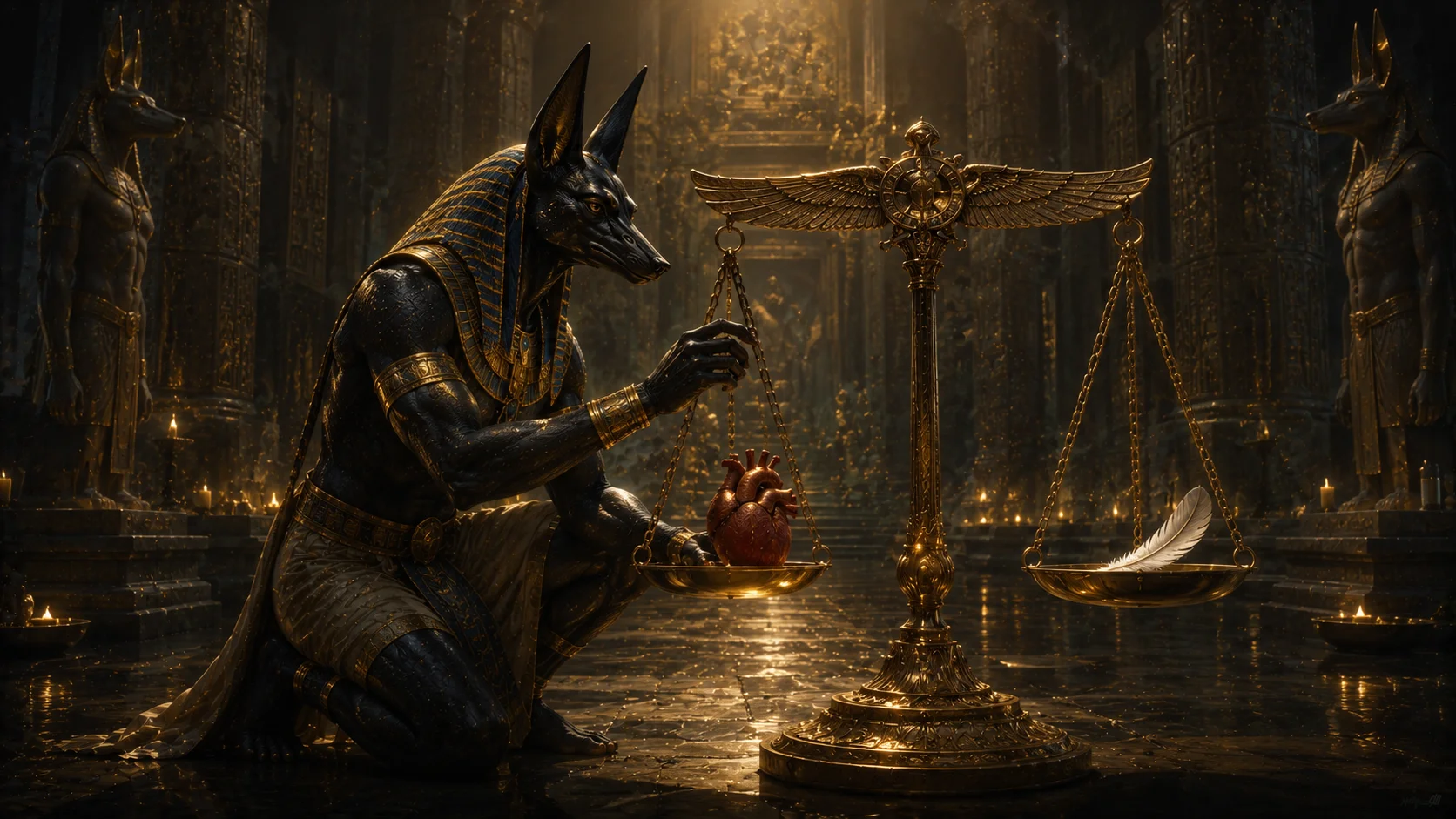
That fate was decided in the ceremony most closely associated with Anubis in the Book of the Dead: the Weighing of the Heart. In the judgment scene, Anubis personally supervised the great balance on which the heart of the deceased was set against the feather of Ma'at, the principle of truth and cosmic order given physical form. He is shown attending the scale directly, the god trusted to conduct the single measurement on which a soul's eternity depended. No other figure in the scene occupies quite that position of procedural authority — the outcome belonged to the deceased's own conduct in life, but the mechanism of judgment was Anubis's to run.
Chief Among the Dogs, Center at Cynopolis
Anubis's principal cult center was at Cynopolis in Upper Egypt — the "Dog City," as Greek visitors later named it, in recognition of the jackal god venerated there above all. Even so, Anubis was not a god confined to a single major state temple the way some Egyptian deities were. His presence belonged wherever the dead were tended, so he was venerated in funerary contexts across the country, present in the practice of nearly every community that buried its own.
The Elder God the New Order Absorbed
It is worth returning to how much Anubis's position changed over Egyptian history, because the change explains much of what looks, at first glance, like a narrowing of his powers. In the Old Kingdom, before Osiris's cult had grown into its later dominance, Anubis was Egypt's primary god of the dead outright — the one whose authority covered the whole territory of death, judgment, and burial together. By the Middle Kingdom, as Osiris rose to become the chief funerary god, Anubis's function narrowed to the roles that remained distinctly his: embalming and the guiding of souls specifically, rather than sovereignty over the dead as a whole. This was not displacement in the sense of eclipse or disgrace; it was a redistribution of an older god's authority into a newer, larger religious structure, with Anubis retaining the offices that were, in the end, the ones no other god could perform in his place. No retelling of the Osiris myth omits him, because the myth's central act — the restoration of a murdered body into a form that could live again — is his to perform.
Hermanubis and the Long Afterlife of the Cult
Anubis's recognisability outlasted native Egyptian rule. When Greek visitors and later Greek and Roman settlers encountered him, they equated his role as guide of souls with that of their own psychopomp, Hermes, and out of that equation grew the syncretic figure Hermanubis, worshipped through the Ptolemaic and Roman periods. That such a fusion could occur, and could persist for centuries afterward, testifies to how legible Anubis's core function remained across cultural boundaries: a god who leads the dead needed no translation to be understood.
The Guardian Who Never Left the Threshold
Across more than three thousand years of continuous attestation, Anubis's essential place did not move. He stood, in image and in ritual, at the threshold between the ordinary world and the sacred ground set aside for the dead — the jackal keeping watch over the tombs he had once been mistaken for threatening, the embalmer whose hands had first made Osiris whole again, the escort who walked the dead through the Duat, and the god who set the scale that measured a life against truth itself. Few Egyptian deities held so many distinct offices within a single funerary sequence, and fewer still held them for so long without the memory of what he did ever growing dim.
Sources & traditions
- EncyclopediaWikipedia — Anubis
- TraditionEgyptian texts, inscriptions and later retellings
Myths change from area to area and from time to time. This chronicle follows the most widely told versions; tellings in other villages, regions and eras may differ.