Ma'at was the Egyptian goddess and personification of truth, justice, balance, order and cosmic harmony — the fundamental principle on which the entire universe, society and morality depended, against whose feather every soul was weighed at death. More than a goddess, she was the very order of the cosmos, the truth and rightness that held chaos at bay and made the world possible.
The Feather Upon Her Head
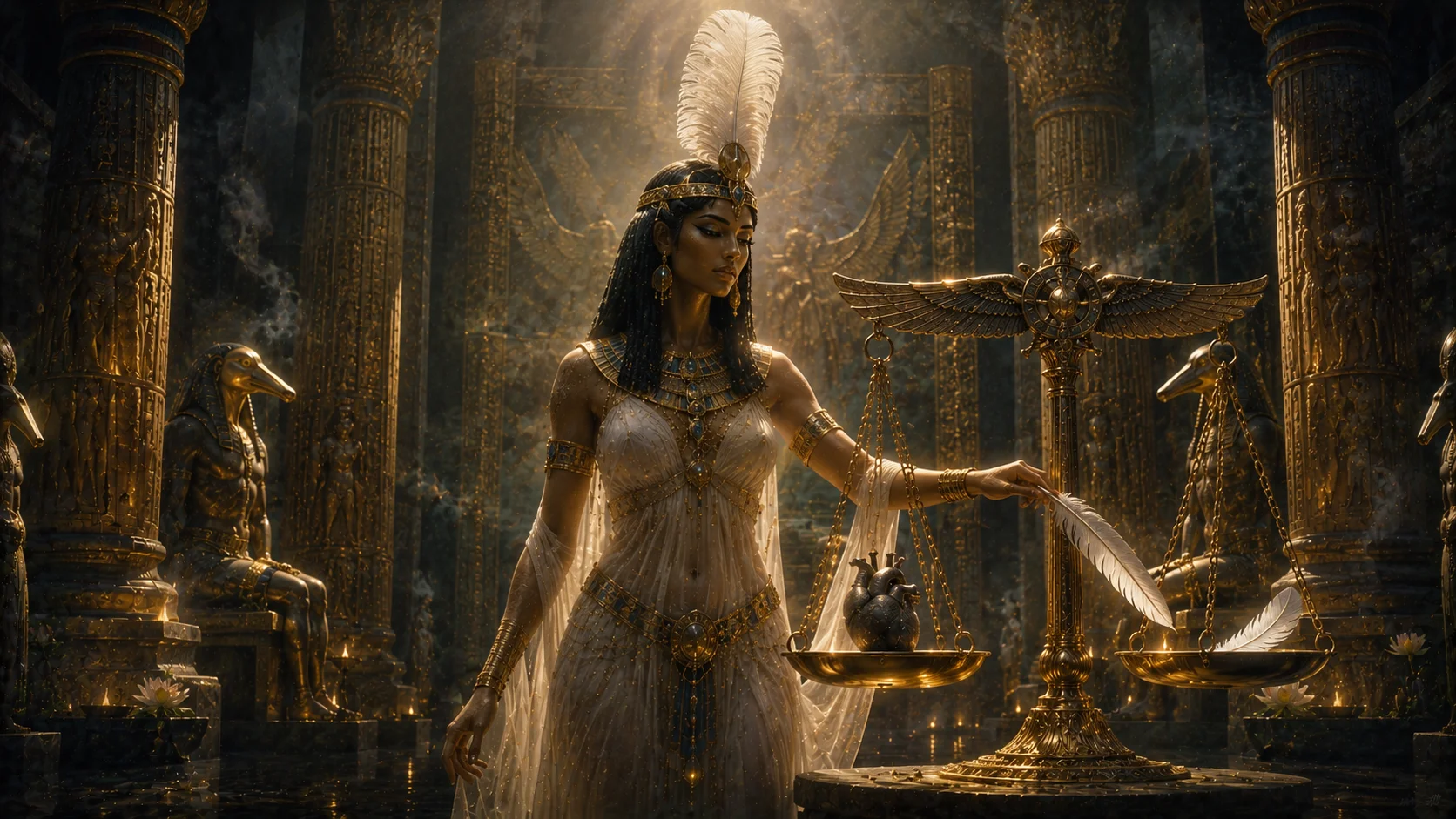
Ma'at was shown as a woman wearing a single ostrich feather standing upright from her brow — and so closely was she bound to that image that Egyptian art and writing often dispensed with her human form altogether and let the feather alone stand for her. A single plume, drawn beside an offering scene or set atop a hieroglyph, was enough to invoke truth, justice and order without a word of explanation needed. Few Egyptian deities were reducible to so spare a sign; fewer still were signs so absolute that a scribe could use the symbol interchangeably with the goddess's name and every reader would understand which was meant, or that both were meant at once.
Goddess and Principle at Once
Modern Egyptologists continue to debate exactly where the goddess ends and the concept begins, and that ambiguity is not a gap in the sources so much as a faithful reflection of how the Egyptians themselves seem to have held the two together. Ma'at was worshipped with offerings and depicted in divine form, yet she was also invoked constantly as an abstract standard — the rightness of a judge's verdict, the honesty of a merchant's scales, the regularity of the star's return each year. She was not merely a deity who presided over order from outside it, the way a patron might oversee a craft; she was frequently treated as continuous with order itself, so that to act with ma'at was, in some sense, to act in her presence and by her measure.
Daughter of the Sun
In the theology centred on Heliopolis, Ma'at was reckoned a daughter of the sun god Ra, and she was described as accompanying him in the solar barque as it crossed the sky and passed through the underworld each night. Her presence at Ra's side was not decorative; it expressed the belief that the sun's unfailing daily journey was itself an act of order, and that order needed her there to continue. She carried the epithets “Daughter of Ra” and “Mistress of the Gods,” titles that placed her near the summit of the pantheon despite her having no lengthy cycle of adventures told about her, as gods like Osiris or Isis did. Her importance was not narrated so much as enacted, repeated in ritual and inscription across the length of Egyptian history.
The Consort Who Shared Her Balance
Ma'at was sometimes described as paired with Thoth, the god of wisdom and writing, and the two were linked through overlapping roles rather than through a single fixed myth of marriage or courtship. Thoth measured and recorded; Ma'at was the standard by which anything could be judged accurate or just; both were associated with balance, and both stood near the scales in the judgment of the dead. Egyptologists treat their pairing as an inference drawn from shared iconography and shared function more than as a settled narrative relationship, but the association was persistent enough across temple art and funerary texts that the two came to feel, to ancient worshippers, like natural companions in the maintenance of cosmic and intellectual order alike.
The King Who Lived by Her
The pharaohs of Egypt were ideologically bound to Ma'at in a way that touched the language of kingship itself: royal inscriptions repeatedly describe a king as one who “lives on Ma'at,” sustained by truth and order as if they were food. A pharaoh's fundamental duty, expressed again and again across dynasties, was to uphold Ma'at — order, justice, truth, the right functioning of the world — against isfet, the chaos, falsehood and injustice that always threatened to break through. This was not abstract praise. It was the framework by which royal legitimacy itself was measured: a king who ruled unjustly was failing the single duty that justified his throne, while a king who upheld Ma'at was, in the Egyptian understanding, holding the entire ordered cosmos together through his conduct.
A Small Figure Placed in Divine Hands
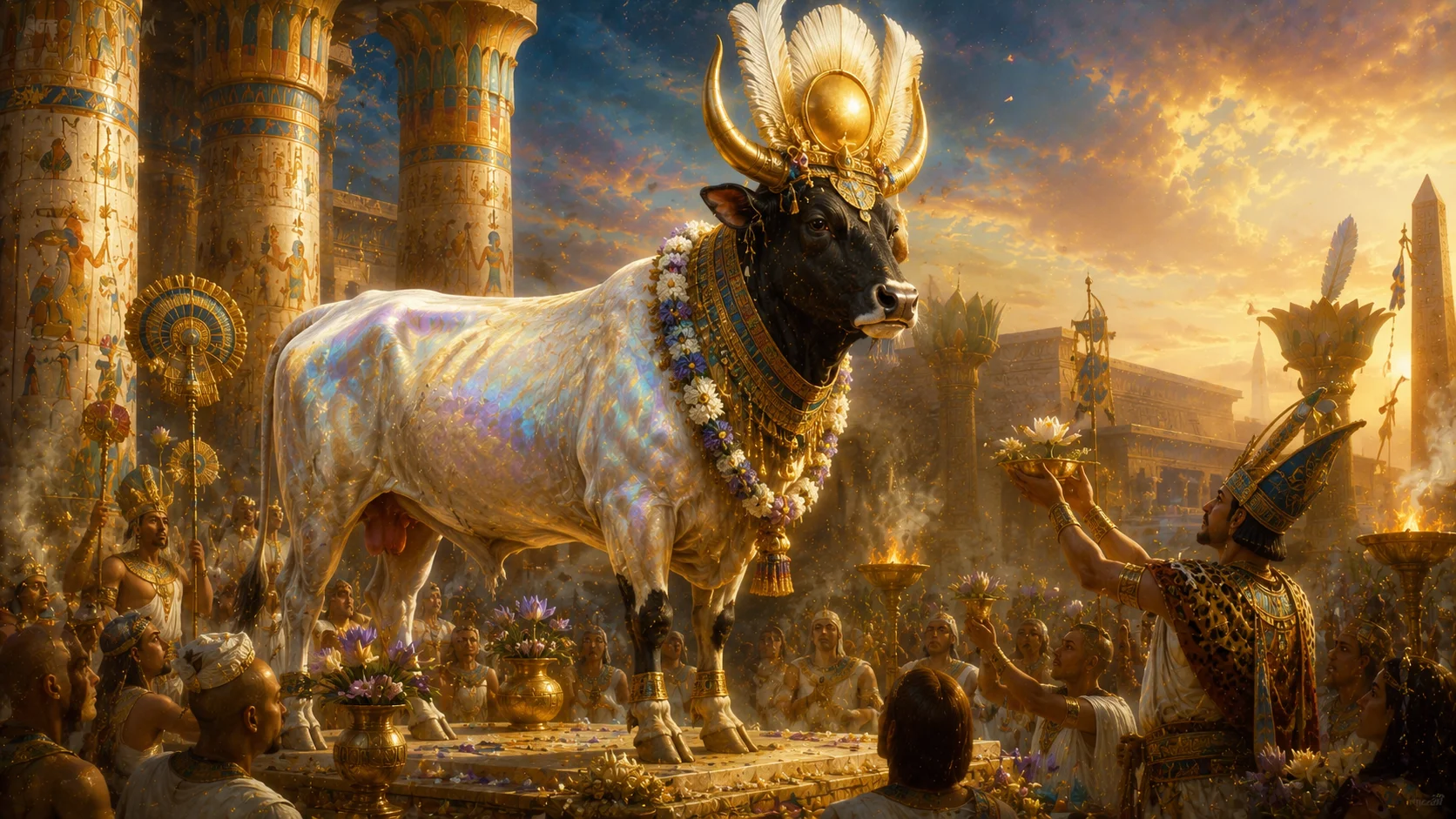
Pharaohs were repeatedly shown in temple reliefs offering a small figure of Ma'at — often little more than the seated goddess or her feather alone — to the gods. The gesture compressed an entire theology into a single image: the king presenting order itself as the most precious thing he had to give, a tribute more meaningful than gold because it represented the successful maintenance of the world under his rule. To offer Ma'at was to declare, publicly and repeatedly, that the king's governance was aligned with the truth the gods required, and that the cosmos remained, because of him, in balance rather than descending into isfet.
The Judge Who Bore Her Title
Ma'at's association with law and judicial integrity was formalised in the office of the vizier, the chief judge and minister of the New Kingdom administration, who bore the title “Priest of Maat.” This was not an honorary flourish. It tied the highest judicial authority in the land directly to the goddess whose feather would, in the end, weigh every soul including the vizier's own, and it meant that Egyptian justice at its most practical, day-to-day level — disputes, verdicts, the administration of law among the living — was framed as an extension of the same principle that governed the fate of the dead.
The Scale in the Hall of Judgment
Ma'at's best known role was in the Weighing of the Heart, the judgment scene central to the Book of the Dead. The heart of the deceased, believed to carry the record of a life's deeds, was placed on one pan of a great scale while Ma'at's feather rested on the other. A heart lighter than or equal to the feather — meaning a life lived in accordance with truth and order — passed the judgment and could proceed toward the afterlife. A heart made heavy by wrongdoing tipped the balance the wrong way, and it was devoured on the spot by Ammit, the composite devourer, ending the deceased's hope of continued existence entirely. The feather was thus not a passive symbol but an active instrument: it was the literal measure against which every soul's worth was tested at the threshold of eternity.
Forty-Two Voices Before the Feather
Preceding the weighing, the deceased recited the 42 Negative Confessions of Book of the Dead spell 125, addressing in turn forty-two assessor gods and declaring innocence of a long list of wrongs — theft, violence, deceit, cruelty, blasphemy, and more. The entire proceeding was conducted under Ma'at's principle: the confessions were themselves an appeal to the standard of truth and order she embodied, and the assessors who heard them sat in judgment as extensions of the same cosmic accounting that her feather would finally render in weight rather than words. Speaking falsely before this tribunal was, in the Egyptian imagination, a direct offence against Ma'at herself.
Order Doubled for Two Lands
Egypt's ancient sense of itself as a union of two originally separate realms, Upper and Lower Egypt, found expression in the image of the “Two Maats,” a dual depiction of the goddess representing the combined order of both lands under a single rule. The doubling was a natural extension of her role: if the unification of Egypt was itself an act of order imposed on what might otherwise have remained divided, then the goddess of order was fittingly shown twice, once for each half of the kingdom she held together as one.
Wisdom Written in Her Name
Ma'at was not primarily a figure of adventure narrative, the way many other Egyptian deities were carried through cycles of myth and conflict. Her presence is instead pervasive in ritual, funerary literature and the ethical wisdom tradition — texts such as the Instructions of Ptahhotep, which taught proper conduct, humility and truthful speech as expressions of living rightly. In this literature Ma'at functions less as a character in a story than as the silent standard the whole of Egyptian ethical teaching was written to serve, present in nearly every instruction on how a person ought to speak, judge, and act toward others.
The Truth That Holds the World Together
Ma'at endures as one of the most profound and important concepts in all of ancient Egyptian thought — the goddess and principle of truth, justice, balance and cosmic order, the foundation of the universe, society and morality, the standard against which every soul was weighed. She embodies the deepest Egyptian conviction: that the world is held together by order, truth and justice, that chaos forever threatens, and that the sacred duty of gods and humans alike is to uphold ma'at — to live truly, judge justly, and maintain the right order of things — for upon ma'at the very existence of the ordered world depends.
She is truth, justice and the order of the cosmos itself — and at the gate of eternity, every soul's heart is weighed against her single feather.
Sources & traditions
- EncyclopediaWikipedia — Maat
- TraditionEgyptian texts, inscriptions and later retellings
Myths change from area to area and from time to time. This chronicle follows the most widely told versions; tellings in other villages, regions and eras may differ.