Wepwawet was the wolf-headed Egyptian god whose name means “Opener of the Ways” — a canine deity of the vanguard and the threshold, carried into battle at the head of armies and invoked to clear the path of the dead through the underworld. Among the oldest gods in the Egyptian pantheon, attested from the Early Dynastic Period, he stood apart from his more famous canine kin by cult center, iconography, and the specific work he was asked to do: not to embalm or watch over the dead, but to go ahead of them and open the road.
A Name That Is Also a Job Description
Wepwawet’s name, rendered in Egyptian as Wepwawet, translates directly as “Opener of the Ways,” and unlike many divine names that have drifted from their original sense over centuries of use, this one describes exactly what the god did in every context where he appears. He was not a general guardian or a vague protector; he was a specialist in beginnings, thresholds, and the specific danger of the first step onto an unknown road. Whether that road led into enemy territory, through a temple forecourt during a royal ceremony, or into the darkness of the Duat, Wepwawet’s function stayed the same — he went first, and by going first, he made the way passable for those who followed.
The Wolf of Asyut
Wepwawet’s chief cult center was Asyut, in Upper Egypt, a city the Greeks later called Lycopolis — “Wolf City” — precisely because of its association with him. This geographic anchor matters: Asyut was Wepwawet’s own territory in a way that distinguished him from other canine gods with their own separate centers elsewhere in Egypt. He carried the epithet “Lord of Asyut,” a title that fixed his primary identity to that city even as his influence in royal and funerary religion extended far beyond it. The strength of this local cult, sustained across dynasties, is part of why Wepwawet survived as a distinct figure rather than being fully absorbed into the worship of other gods who shared his canine form.
Wolf, Not Jackal — A Distinction Worth Keeping
Wepwawet is frequently confused with Anubis in modern retellings, and the confusion is understandable: both gods take canine form, both are tied to death and the passage of the dead, and both were worshipped in ancient Egypt with overlapping imagery. But the distinction the Egyptians themselves maintained was real. Wepwawet is generally identified as a wolf, distinguishing him iconographically from Anubis, who was a jackal. Their cult centers differed as well — Wepwawet at Asyut, Anubis chiefly at Cynopolis and other sites — and their emphasized roles differed too. Anubis’s domain leaned toward embalming and the direct guardianship of the dead; Wepwawet’s leaned toward the martial and the processional, the act of leading rather than the act of tending. In popular religion during certain periods the two were conflated or blurred together, and it is easy to see why an outside observer, ancient or modern, might mistake one canine standard for another. But formally, in temple and priesthood, they remained two separate gods with two separate homes.
Standing Atop the Standard
The image most closely tied to Wepwawet is not a full figure but a standard: a canine, generally understood as the wolf, mounted on top of a pole and carried before processions. This standard is among the oldest attested religious symbols in Egyptian civilization, appearing already in Early Dynastic royal iconography, including on the ceremonial palettes and maceheads that record the earliest phases of pharaonic rule. To see Wepwawet’s image raised on its pole was to see, quite literally, the divine act of opening a way given physical form at the front of a moving column of people. The standard did not merely represent the god; it performed his function, held up and out in front so that whatever came behind it — soldiers, priests, the king himself — followed a path the god had already claimed.
Leading the Army
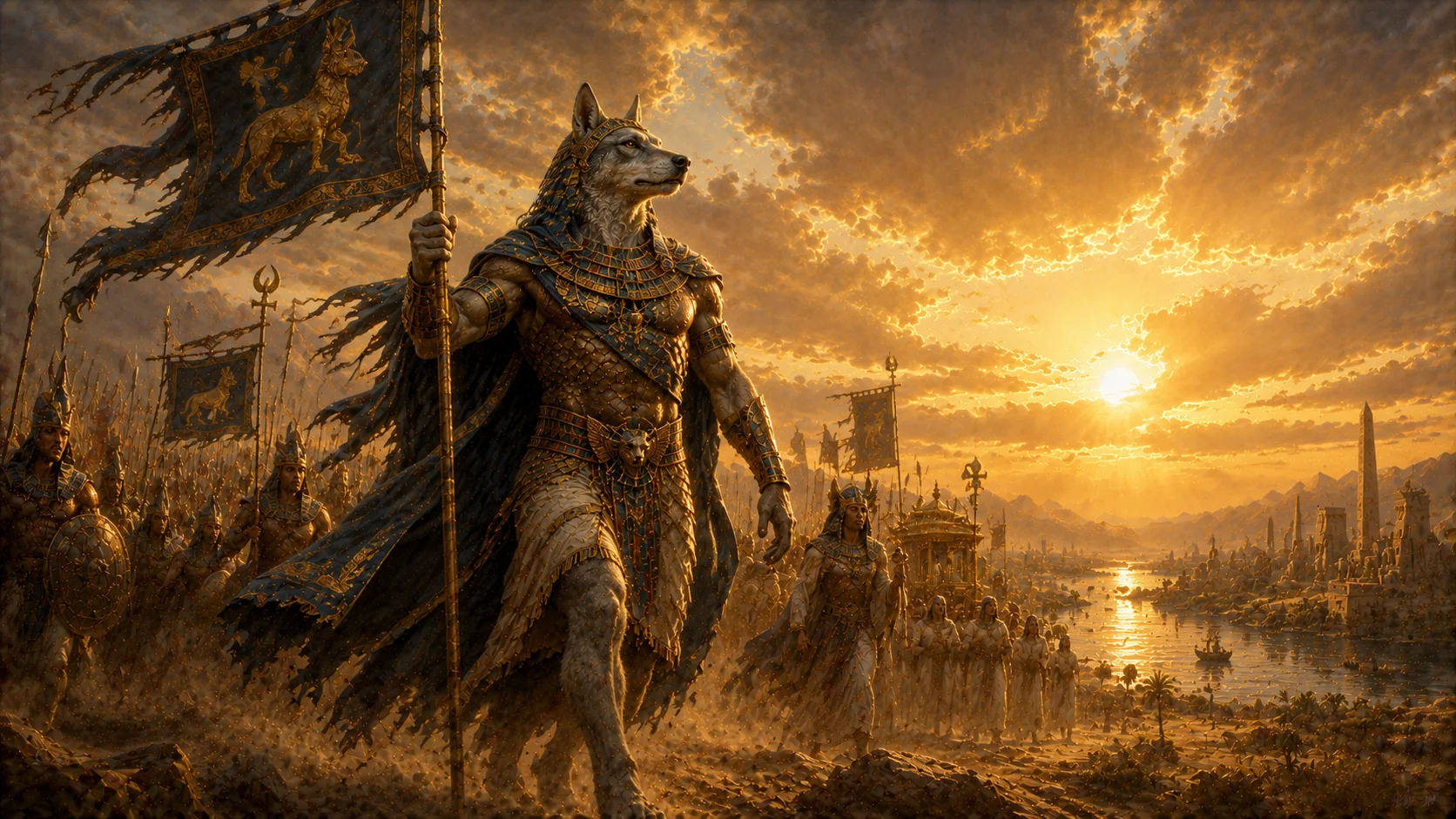
Wepwawet’s martial dimension was one of his most emphasized roles. Royal standards bearing his image were carried before the king’s army as it marched, a visible declaration that the god of the opened way was leading the advance and that victory lay along the path he cleared. This was not incidental symbolism attached to a god who happened to look fierce; it was the core logic of his cult. A wolf standing at the front of a war standard evoked the vanguard itself — the first troops into contested ground, the scouts who determined whether the way ahead was safe. Wepwawet, carried at the head of the army, embodied that first movement into danger, and his presence at the front of the column was meant to ensure the army’s own first movements went well.
Before the King, Not Beside Him
Beyond outright warfare, Wepwawet’s standard appeared in royal ceremonial contexts more broadly, extending his path-opening role into the rituals that marked the calendar and the reign itself. He was associated with “opening” the year and with opening royal ceremonies, a role consistent with his core identity even outside the battlefield. In each case the pattern repeats: Wepwawet does not accompany the king as an equal or stand beside him as a protector in the way some other deities might. He precedes. The structure of these ceremonies placed his image first in line, because the entire point of invoking him was to have something go ahead and secure the opening moment of whatever followed.
Opening the Roads of the Duat
In funerary religion, Wepwawet’s task was to open the ways of the underworld for the deceased, going ahead of the dead as they entered the perilous and unfamiliar landscape of the Duat. This role paralleled the guiding functions associated with Anubis, but it was understood as distinct in emphasis: where Anubis’s funerary role centered on embalming and close guardianship of the body and the deceased’s person, Wepwawet’s centered on the road itself — clearing it, opening it, making the onward journey through the underworld’s dangers possible in the first place. A dead person entering the afterlife faced an unknown route full of hazards; Wepwawet’s presence meant that route had already been opened by a god whose entire nature was built around performing exactly that task.
A Presence in the Rites of Restoration
Wepwawet appears within the tradition of the Opening of the Mouth ceremony, the funerary rite intended to restore the senses of the deceased so that they could see, breathe, eat, and speak again in the afterlife. His association with this ceremony follows naturally from his broader identity: a rite concerned with reopening the deceased’s faculties sits comfortably alongside a god whose entire portfolio was the reopening of paths and possibilities that had otherwise been closed off by death. He also had a place in processions honoring Osiris at Abydos, one of the most important centers of Osiris’s cult, where imagery of Wepwawet preceded the god’s cult statue as it moved — the wolf standard going first, the greater procession following the way he had already opened.
A Genealogy That Shifts With the Telling
Egyptian genealogies were rarely fixed the way a modern family tree is fixed, and Wepwawet’s place within the wider divine family reflects that fluidity. He is sometimes described as a son of Osiris, a filiation that would tie him closely into the Osirian funerary complex and help explain his prominence in rites connected to Osiris’s cult at Abydos. But this parentage is not consistent across sources and periods; different temples, different eras, and different priestly traditions record his lineage differently. Rather than treating any single version as the definitive answer, it is more accurate to say that Wepwawet’s exact place in the divine family tree remained an open question across Egyptian religious history — itself perhaps a fitting uncertainty for a god defined by movement rather than fixed position.
An Old God, Carved Into the Earliest Reigns
Wepwawet’s standard is not a later addition to Egyptian royal symbolism but one of its foundations. It appears already on the ceremonial palettes and maceheads of the Early Dynastic Period, the objects that record the very first phases of pharaonic rule, placing Wepwawet among the oldest attested deities in the Egyptian pantheon rather than a figure who accumulated importance gradually over the centuries. A god present at the founding iconography of kingship itself carried an authority that later, more elaborately mythologized gods could not simply claim; his presence at the beginning of the record mirrors the very role he played within it — going first.
The God Who Goes First
Across war, ceremony, and death, Wepwawet’s identity holds together as a single, coherent function performed in different arenas. He is not a god of the battle itself but of the advance that makes battle possible; not a god of the funeral rites in their entirety but of the road the dead must first travel; not a god of the reign as a whole but of the ceremonial threshold at which a reign, a year, or a procession begins. The wolf on the standard, raised above the heads of a marching column, is the clearest image of what he does: he stands where no one else has yet gone, so that everyone behind him can follow with the way already open.
The wolf-standard raised at the head of the column — the god who is always first onto the road, whether that road leads into battle, into a ceremony, or into the underworld itself.
Sources & traditions
- EncyclopediaWikipedia — Wepwawet
- TraditionEgyptian texts, inscriptions and later retellings
Myths change from area to area and from time to time. This chronicle follows the most widely told versions; tellings in other villages, regions and eras may differ.