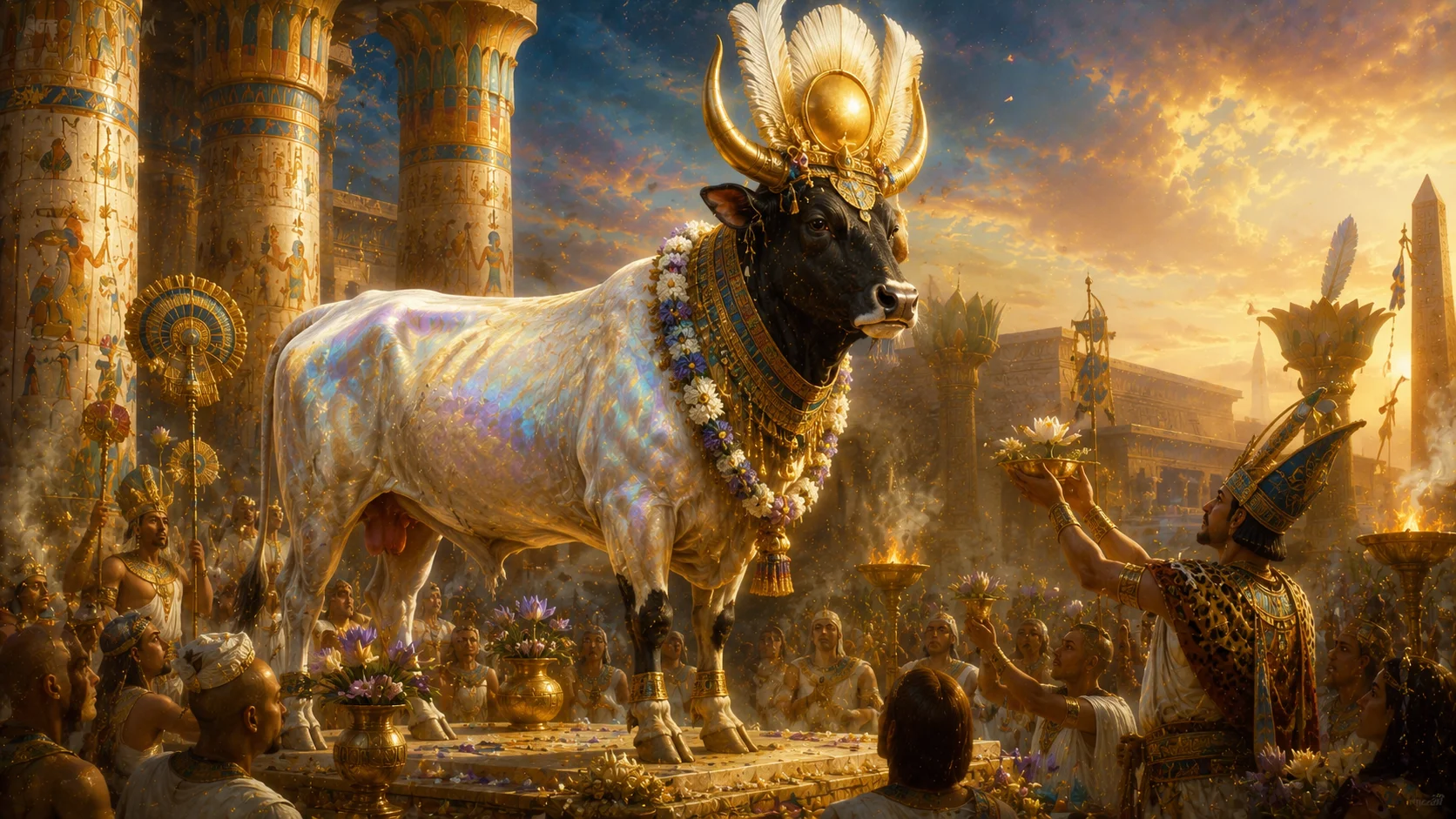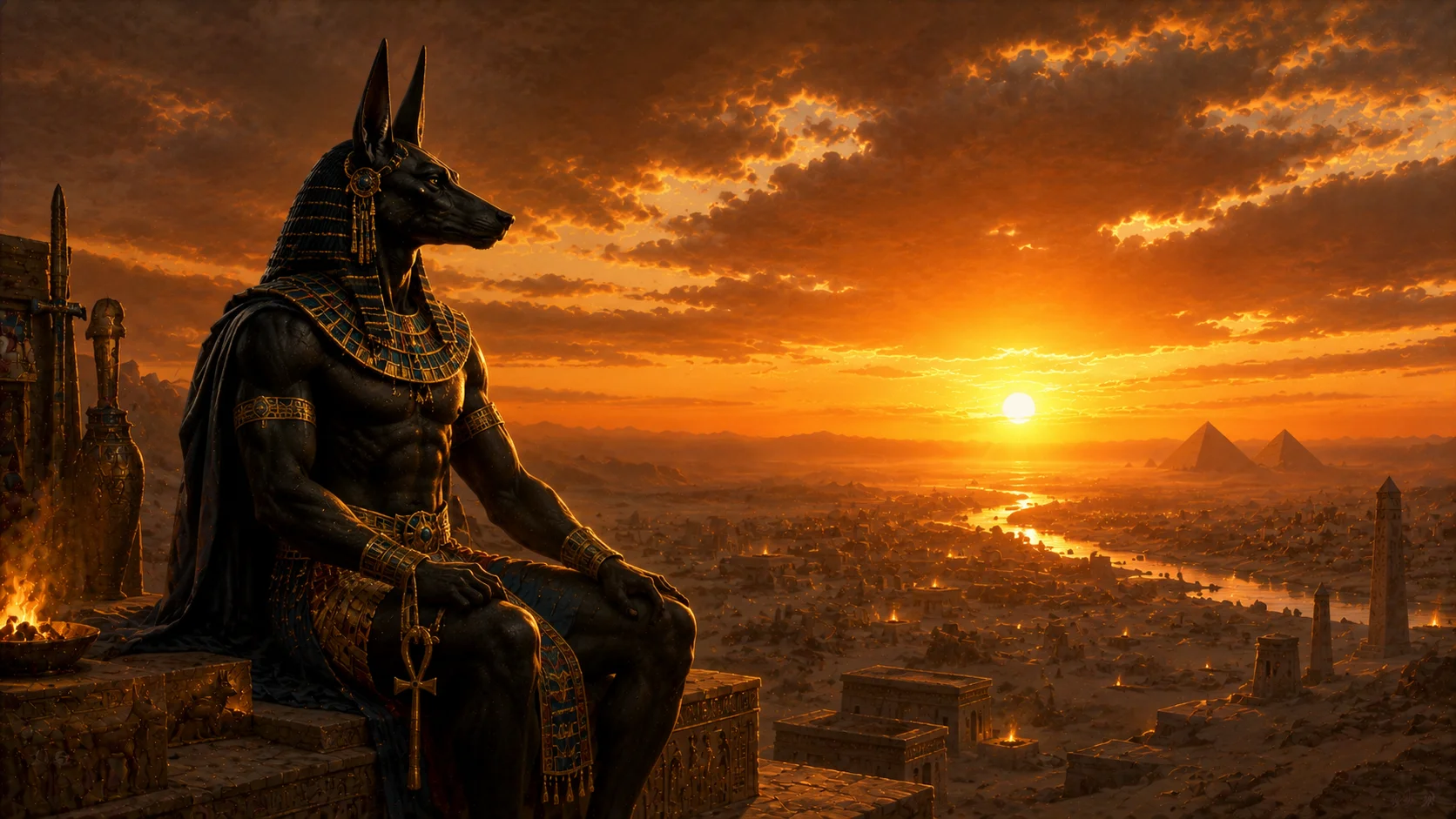
Khentiamentiu, whose name means “Foremost of the Westerners,” was an ancient Egyptian god of the dead and guardian of the necropolis at Abydos, worshipped there from the Early Dynastic period as chief of the cemetery and ruler of the deceased. Depicted as a jackal or a jackal-headed figure, he was one of the earliest textually-attested Egyptian funerary deities — and, by the Middle Kingdom, his identity had been absorbed so completely into Osiris that the greater god took his name as a title: Osiris Khentiamentiu.
What the Name Conceals and Reveals
Khenti-Amentiu — “Foremost of the Westerners” or “Chief of the Westerners” — is a name built entirely from Egyptian funerary geography. The “West” was the traditional direction and realm of the dead, the land where the sun sank each evening and where the deceased were believed to travel. Those who had died and taken up residence there were, collectively, the “Westerners.” To be “Foremost” of them was not a poetic flourish but a functional title: it named a god who stood at the head of the dead, who presided over them as their chief and their protector. Unlike many Egyptian divine names, which describe appearance, origin, or a mythic episode, Khentiamentiu’s name describes a rank held over a population — the population of the deceased themselves.
An Independent God Before the Merger
It is easy, knowing how his story ends, to read Khentiamentiu as though he were always a shadow of Osiris. The evidence says otherwise. Royal inscriptions from the 1st Dynasty onward invoke Khentiamentiu independently, with no reference to Osiris at all, on stelae and in offering formulas at Abydos. These are among the oldest surviving textual attestations of any Egyptian funerary deity. Khentiamentiu’s cult at Abydos was therefore not a late outgrowth of the Osiris myth but predated the classical Osiris myth’s full development and consolidation there. For a considerable span of Egyptian religious history, he was worshipped in his own right, under his own name, as the recognized lord of that necropolis.
The Jackal at the Cemetery’s Edge
Khentiamentiu was shown as a jackal, or as a man with a jackal’s head, placing him within a category of canid necropolis guardians that also included Anubis and Wepwawet — distinct gods, separately attested, who shared this animal form without being identical to one another or to him. The association was not arbitrary invention but observation translated into religion: jackals scavenged at the margins of the desert burial grounds, drawn to the cemeteries that lay at the edge of the cultivated land. Egyptian belief inverted the threat into protection, casting the jackal not as a violator of graves but as their watchman, a creature whose presence at the boundary of life and death made it the natural guardian of that boundary. As a jackal-god, Khentiamentiu embodied this guardianship directly: he watched over the necropolis and over those already claimed by it.
Abydos, Seat of the Chief of the Dead
Abydos was, from the very beginning of Egyptian civilization, one of the country’s most significant necropolis and pilgrimage sites, and Khentiamentiu was its presiding funerary power. To be buried near him, or to have one’s name invoked under his protection, was to secure a place under the authority of the god who ruled the cemetery and its dead. His position there was not that of a minor local spirit tolerated at the margins of a greater cult; the offering formulas and royal stelae that name him treat him as the established, senior authority of the site — guardian and chief of the dead buried at Abydos, in a role that made him, functionally, ruler of the realm the necropolis represented.
Why This God Became a Doorway for Osiris
The very quality that made Khentiamentiu significant — his standing as protector and ruler of the necropolis and of the deceased in general — is what made him a natural point of fusion once Osiris rose to become Egypt’s principal god of the dead and the afterlife. A rising national cult of death and resurrection needed a preeminent cult center and an established claim to rulership over the dead; Khentiamentiu already possessed both, concentrated at Abydos. Rather than displacing him outright, the developing Osiris cult absorbed him: his authority, his cult site, and eventually his very name became vehicles through which Osiris’s own claim to lordship over the dead was expressed and anchored in a place with centuries of prior sanctity.
By the Late Old Kingdom, a Single God
The absorption unfolded across the late Old Kingdom and became especially pronounced by the Middle Kingdom. From that point, Osiris was regularly called by the combined title Osiris Khentiamentiu — Osiris, Foremost of the Westerners — a fusion so complete that it made Abydos the preeminent national cult center of Osiris himself. The merger was not a marginal borrowing of an epithet; it transferred an entire local tradition of necropolis rulership onto the national god, and in doing so transformed Abydos from a site sacred to an older, more localized jackal-god into the holiest ground associated with Egypt’s great myth of death and renewal.
A Myth That Ceased to Be His Own
Once the fusion was complete, Khentiamentiu ceased to have an independent, separately narrated myth cycle. Virtually everything that might be called his later “mythology” survives only as part of Osiris’s own story — the god’s death, his resurrection, and his role as judge of the dead — told under the combined name. There is no surviving Middle Kingdom or later narrative in which Khentiamentiu acts as a distinct character with his own unfolding story; his voice, so to speak, was folded entirely into the far larger and more elaborate myth that Osiris carried.
A Family That Was Never His
One consequence of the merger deserves particular care: Khentiamentiu has no separately attested spouse or offspring of his own outside the Osiris family. The relationships that populate the Osiris myth — with Isis, with Horus, and the rest of that circle — belong properly to Osiris and were inherited by the combined figure only because the two identities had become one. To describe Khentiamentiu as father, husband, or kin to any figure in that family would be to project Osiris’s relationships backward onto a god who, in his independent existence, is not attested as having them. What can be said of him directly is limited to his role: guardian, chief, ruler of the Westerners at Abydos.
The Title That Outlived the God
The epithet “Lord of Abydos” traces this same trajectory of absorption with unusual clarity. It was used first for the combined figure of Osiris-Khentiamentiu, and later for Osiris alone, with the older god’s name eventually dropping away from everyday usage even as his site and his former rank persisted under the newer god’s sole authority. The title survived; the independent bearer of it did not. This transfer is, in miniature, the whole story of Khentiamentiu’s fate — a name and a rank that proved durable even after the god who first held them had been folded into someone greater.
Reading an Older God Inside a Newer Name
Modern study of Egyptian religion treats Khentiamentiu chiefly as a case study in how a local necropolis god could be absorbed into a rising national cult, rather than as a figure with an ongoing independent tradition after the Middle Kingdom. That framing is not a diminishment so much as an accurate description of what the surviving evidence shows: an early, genuinely independent cult with its own inscriptions and its own standing at one of Egypt’s most sacred sites, followed by a merger so thorough that the god’s later existence is legible only inside another god’s name. Wherever “Osiris Khentiamentiu” appears in later texts, an attentive reader is looking at the seam where an older tradition was joined to a newer one.
The Jackal Who Became a Title
Khentiamentiu endures, in the end, as two things at once: an early, independently worshipped jackal-god who ruled the necropolis of Abydos from the dawn of dynastic Egypt, and a name preserved thereafter only as an honor carried by Osiris. He was foremost of the Westerners before Osiris ever bore that title, chief of a cemetery whose sanctity long predated the myth that would eventually absorb him. His guardianship of the dead did not vanish with the merger; it was inherited, renamed, and carried forward inside a far larger story — so that every later invocation of Osiris as Khentiamentiu quietly names an older lord of the dead, still standing foremost at the edge of the western horizon.
Sources & traditions
- EncyclopediaWikipedia — Khenti-Amentiu
- TraditionEgyptian texts, inscriptions and later retellings
Myths change from area to area and from time to time. This chronicle follows the most widely told versions; tellings in other villages, regions and eras may differ.