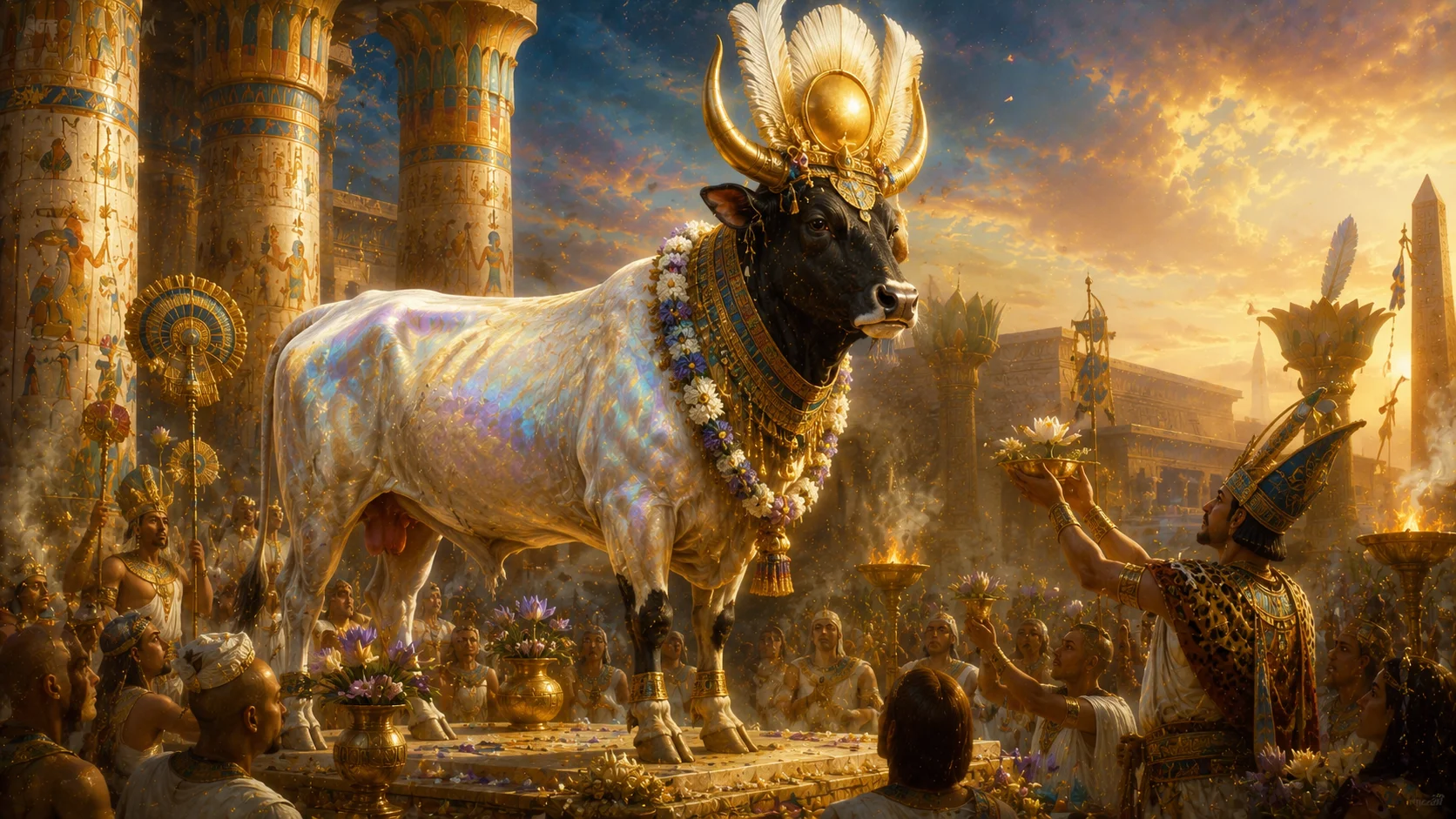
The Buchis bull was a sacred living bull of ancient Egypt, worshipped at Hermonthis (Armant) in Upper Egypt as the living manifestation, the ba, of the falcon-headed war-god Montu. Rendered in Greek as Buchis, from the Egyptian Bakh or Ba-akh — understood to mean something like “the shining one,” a name bound up with the very concept of the ba, the soul or manifestation a god could pour into flesh. Ancient writers marvelled above all at its hide, said to reverse itself, hair by hair, so that the animal seemed to change colour before the eyes of anyone who looked at it.
The Shining One of Armant
Hermonthis, known to modern visitors as Armant, sat a short distance south of Thebes on the west bank of the Nile, and it was Montu's own city. Montu was the region's war-god, shown as a falcon or as a falcon-headed man, and in some periods fused with the sun-god as Montu-Ra, carrying solar force alongside his martial one. Where Montu was pharaonic Egypt's patron of conquest, the Buchis bull was his patron animal, and the bond between them was exclusive: the cult belonged to Montu and to no other god. That distinction mattered to the Egyptians themselves, who kept several sacred-bull cults running in parallel without merging them. The Buchis was not a stray incarnation shared across sanctuaries; it was Montu's own bull, tied to Montu's own city, and it was through this single bull, chosen and honoured one animal at a time, that the war-god was said to walk among his worshippers in a shape they could see.
A Name Carrying the Soul Within It
The name itself was part of the claim being made about the animal. Bakh, or Ba-akh, is generally understood to mean something like “the shining one” — a word bound up with ba, the soul or manifestation that a god could pour into a living body. To name the bull this way was to say, in the naming itself, what the bull was supposed to be: not a symbol standing in for Montu at a distance, but the vessel that actually carried him. Later interpreters have read the name and the bull's reported glow together, as two expressions of the same idea rather than two separate facts about the animal.
A Hide That Turned With Every Hair
What set the Buchis apart in the writing of later observers was its coat. The Roman author Macrobius, in the Saturnalia, describes a bull whose hide seemed to reverse direction with every single hair, so that its colour appeared to shift as it moved or as the light crossed it — a living animal that did not look like other cattle and was not expected to. Ancient accounts also held that the bull could be seen at night, its hide catching or seeming to give off light, a claim later writers tied to the solar current running through Montu's own nature. Whether the bull's colouring was a genuine unusual pigmentation pattern, prized and sought out precisely because it was rare, or an effect described more vividly with each retelling, the result was the same: a living animal whose appearance alone was read as proof that a god had chosen to inhabit it. An ordinary bull did not glow at night or turn its coat inside out with every strand of hair. The Buchis, by report, did both, and that was the point.
Chosen by Sign, Not by Chance
A living god-bull could not simply be selected at random. Egypt already ran a parallel institution for the choosing of the Apis bull at Memphis, sacred to the god Ptah, and the identification of a new Buchis bull followed the same underlying logic even though the two cults, and the two animals, were entirely distinct from one another — Buchis was never the Apis under another name, and the two lines of bulls were never conflated. When a reigning Buchis died a natural death, the search began at once for its successor: a bull carrying the specific physical markings that priests recognised as the signs of the god's chosen vessel, most notably that restless, shifting hide. Once found and confirmed, the new bull was installed at Hermonthis with its own rites, and from that moment it lived out its life as Montu's manifestation, fed, tended, and revered, until in its own time it died and the search began again.
The Mothers Who Bore the God's Vessel
The bull was not honoured alone. The cow that had given birth to a Buchis bull was granted her own sacred status under the title Mother of Buchis, and upon her death she too was mummified, carried through her own rites, and interred not among the bulls themselves but in a separate burial ground known as the Baqaria, near the Bucheum. The arrangement placed the maternal line of the god-bull inside the same structure of reverence as the bull itself, even while keeping its resting place distinct — a second, quieter cemetery running alongside the first, honouring the cows through whom, generation after generation, a new vessel for Montu was born into the world.
Stone Halls Beneath the Desert
At death, each Buchis bull was mummified with the same elaborate care given to the greatest of Egypt's dead and laid to rest in the Bucheum, a subterranean necropolis cut into the desert edge at Armant, where huge stone sarcophagi held the bulls one after another across the centuries. Burials in the Bucheum are attested from the Thirtieth Dynasty, Egypt's last native royal house, and continued through the centuries of Ptolemaic rule and on into the Roman Imperial period. Inscriptions recovered from the site record, bull by bull, when each was installed and when each was laid to rest, giving the cult a chronology unusually solid for a religious practice this old — one of the best-documented animal cults in Egypt precisely because its dated burials survive in such number.
A Chronology Told in Sarcophagi
What the Bucheum offers that most ancient cults cannot is a run of dated burials rather than a single moment frozen in myth. Each sarcophagus, in principle, names its bull and marks its time, so that the succession of animals can be followed the way a king list is followed, one installation and one burial after another, from the last native dynasty through the age of the Ptolemies and into Roman rule. That span is not given as a fixed number of centuries in what survives of the site's own record; what the inscriptions establish is the sequence itself — a chain of individually dated bulls stretching from the Thirtieth Dynasty to the Roman period, documented with a precision few animal cults in Egypt can match.
Buried Beside Kings and Emperors
That the Bucheum's burials run from the last native pharaohs through the Ptolemies and into the age of Roman emperors says something about how deeply the cult was woven into ideas of legitimate rule at Thebes. Montu was a war-god bound to pharaonic military power specifically, not simply a bull-cult like any other, and a bull embodying him at Armant carried associations of conquest and royal strength that the Apis, tied instead to Ptah at Memphis, did not share in quite the same way. Successive rulers of Egypt, whatever their own origin, saw reason to maintain the rites at Hermonthis and to see each new Buchis installed and each departed one honoured in the Bucheum's stone halls, a continuity that persisted through enormous political change in the wider country above it.
A Solar Thread Through the War-God
Montu's fusion with Ra as Montu-Ra gave the war-god a solar dimension he did not carry alone, and later interpretation has drawn a line from that fusion to the Buchis bull's own reported associations with the sun — its coat catching light at night, its very name carrying the sense of “shining.” The bull, on this reading, was not only Montu's martial power made flesh but also a vessel touching the solar current that ran through Montu-Ra, so that the animal's strangeness of appearance and its place in the god's wider nature reinforced one another. It is a thread visible in the ancient descriptions themselves rather than a separate doctrine, but it runs consistently through them: a bull of war that was also, somehow, a bull of light.
A Cult Held Apart From Its Neighbours
Egypt's animal cults were not one undifferentiated practice but many distinct ones, each bound to its own god, its own city, and its own line of chosen animals, and the Buchis sat firmly within that pattern rather than outside it. The parallel with Apis was a parallel of method, not of identity: two separate gods, two separate cities, two separate bulls, each recognised by markings particular to its own tradition. Nothing in what survives of the Buchis cult ties it to any deity but Montu, and nothing ties its bulls to any lineage but its own. The care with which ancient Egypt kept these cults distinct is itself part of what the Bucheum's evidence preserves.
Unearthed From the Armant Sand
The Bucheum lay buried and largely forgotten until the twentieth century, when excavation at Armant under Robert Mond, carried out between 1927 and 1932, uncovered the necropolis and its sarcophagi and recovered the inscriptions that now anchor the cult's chronology. It is that excavation, set beside the surviving testimony of classical authors such as Macrobius, that supplies almost everything known of the Buchis today — without the Bucheum's stone chambers and their carved records, the bull would survive only as a passing mention in a handful of ancient texts, its long sequence of burials invisible. The cult itself did not outlast the world that sustained it; when the old religious order at Hermonthis ended, so did the search for each new bull, and no later tradition carried the Buchis forward under any other name.
The Bull the God Chose to Wear
What survives of the Buchis, then, is a portrait built from stone and inscription as much as from story: a single living bull at Hermonthis, chosen for a hide that seemed to defy an ordinary animal's coat, honoured as Montu's own manifestation and, through Montu-Ra, touched by the sun; a bull whose mother was herself revered and separately entombed; a bull installed and buried according to a rhythm recorded from the last native dynasty through Ptolemaic and Roman rule alike, in the sarcophagi of the Bucheum. It is a rare case among Egypt's animal cults where the dates themselves speak almost as clearly as the myths, naming bull after bull across the long span of time in which Montu was still thought to walk the earth wearing one shining, restless hide.
Sources & traditions
- EncyclopediaWikipedia — Buchis
- TraditionEgyptian texts, inscriptions and later retellings
Myths change from area to area and from time to time. This chronicle follows the most widely told versions; tellings in other villages, regions and eras may differ.