Montu was the falcon-headed Egyptian god of war — the fierce and valiant warrior-god of Thebes, the bringer of victory and the embodiment of the conquering might of the pharaoh, who fell upon Egypt's enemies with the fury of a bull and the swiftness of a falcon. The divine champion of war and royal power, he was the god kings invoked for triumph in battle.
Lord of the Theban Nome Before Amun's Rise
Long before Amun became the great god of Thebes, it was Montu who held that place. Montu was originally the chief deity of the Theban nome, the regional god of the whole area that would later grow into Egypt's greatest religious capital. His principal cult centers were spread across the Theban region of Upper Egypt: Hermonthis (Armant), Thebes itself, Tod, and Medamud. In each of these towns Montu was worshipped as the presiding power, the warlike god of a region that had not yet become synonymous with Amun's name. Only as Thebes rose to national prominence did Amun eclipse him as the city's chief deity — but Montu's older claim to the region never entirely faded, and his cult persisted at his ancient centers for millennia afterward.
The Warrior-God of Thebes
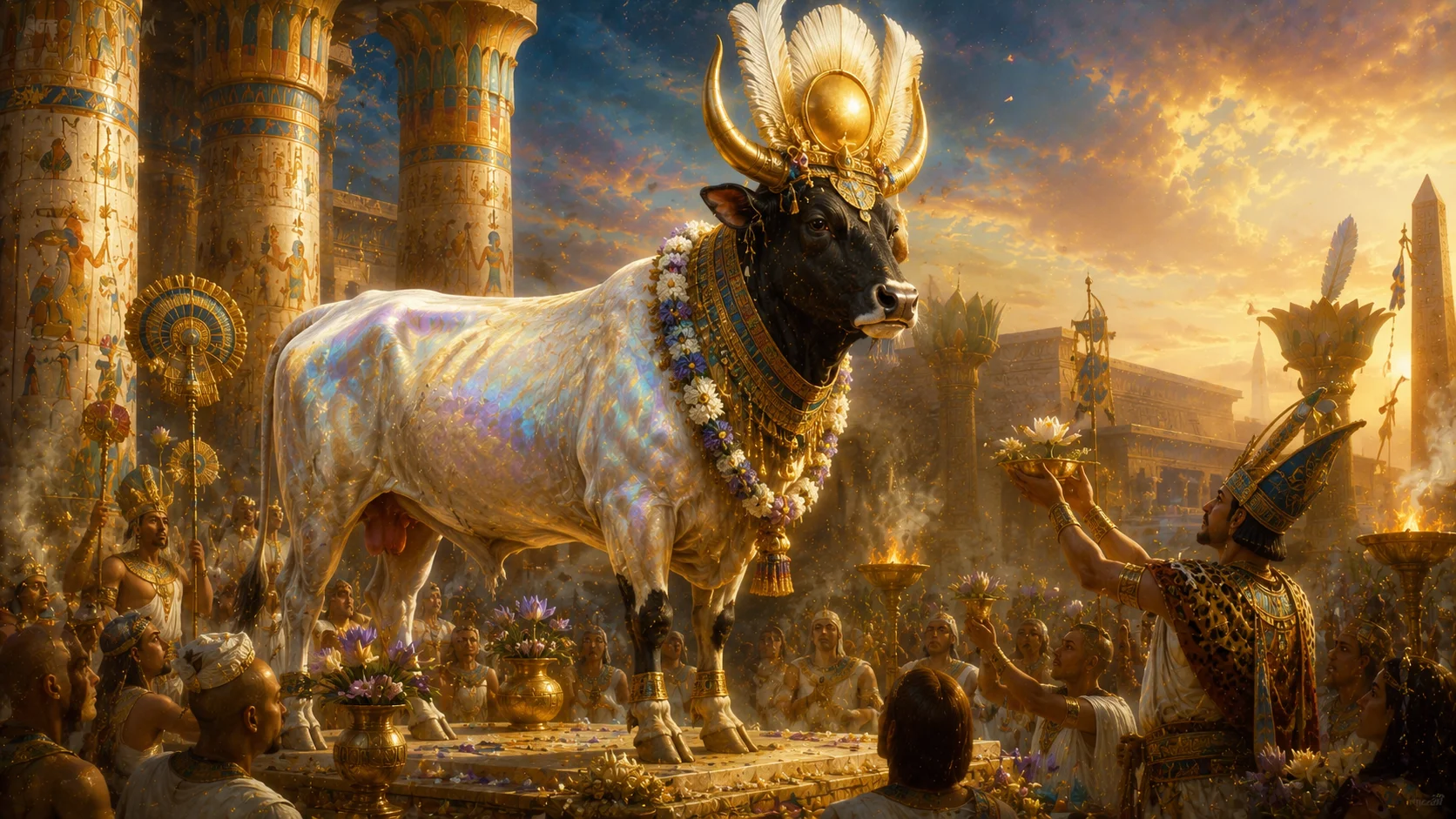
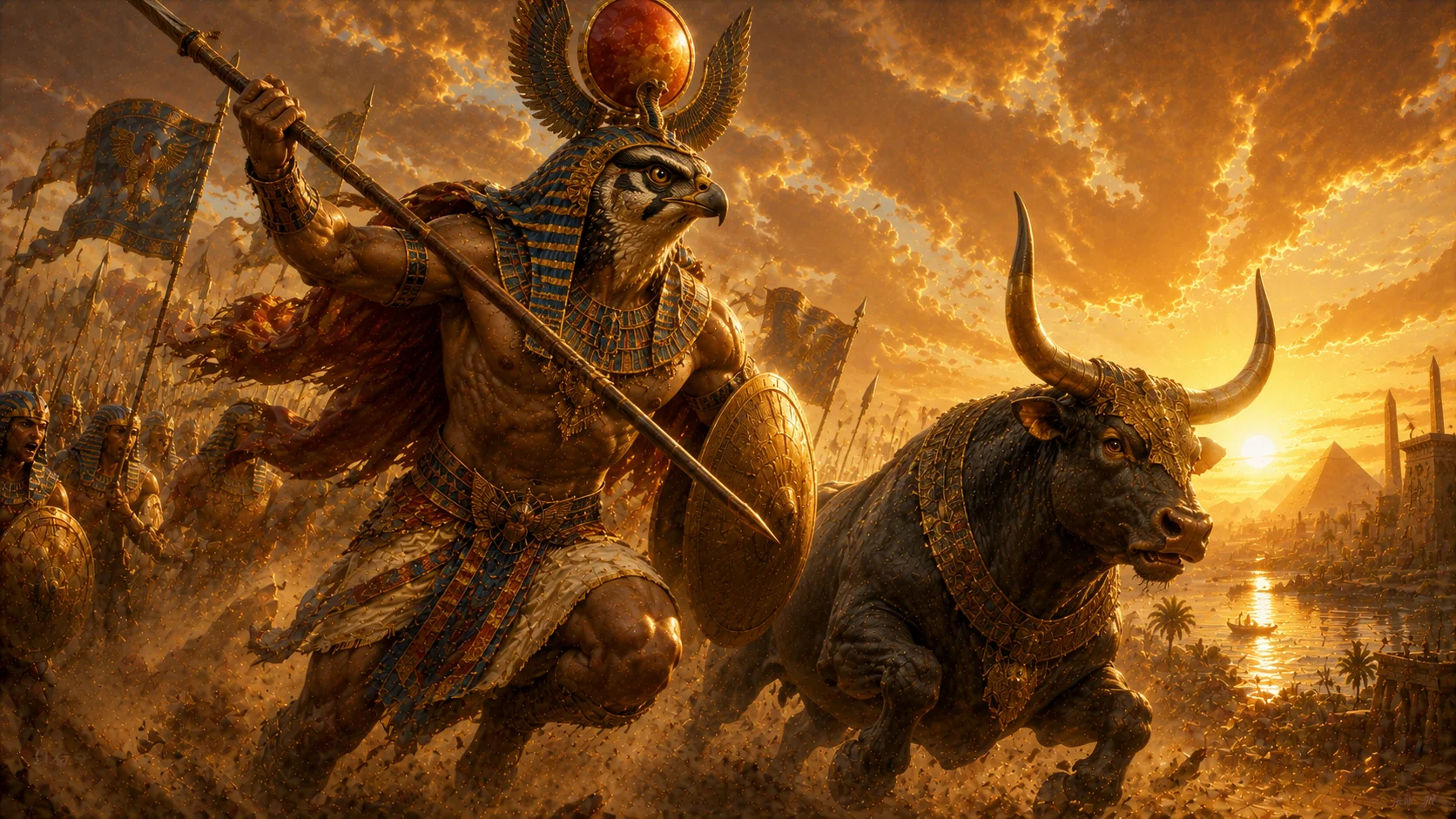
Montu (Egyptian Montu, Mont) was a god of war, valour and victory. He was depicted as a man with the head of a falcon, crowned with the solar disc and two tall plumes, and often shown carrying weapons — a scimitar or a bow — emphasizing his warrior character. He was closely associated with the bull: the sacred Buchis bull, worshipped and buried at Armant in the Bucheum necropolis, was venerated as his living embodiment. Falcon and bull together, the swift, fierce bird of prey and the powerful, raging beast, were the twin emblems of his warlike nature. He embodied the fury and might of battle, the conquering power that fell upon enemies and won victory.
The Age When Montu Ruled Thebes
Montu's supremacy in the Theban region reached its height during the Middle Kingdom, and especially the Eleventh Dynasty, when he stood as Thebes's principal state god. That status is written directly into royal names of the period: several pharaohs took the name Mentuhotep, meaning "Montu is satisfied," binding the king's own identity to the war-god's favor. It was only after this Eleventh Dynasty flowering that Amun rose to displace Montu as the chief god of Thebes — a shift in the city's theology, though never a complete erasure of Montu's older authority, which endured in his own precincts and cult centers.
The Bringer of Victory
Montu was, above all, the god of military victory and the conquering pharaoh. The warrior-pharaohs of Egypt, especially in the great age of New Kingdom conquest, invoked Montu as the god who gave them triumph in battle and made them mighty warriors. Royal inscriptions from the reigns of Thutmose III and Ramesses II praise these kings as being "strong like Montu" or fighting "like Montu" in the heat of battle — Montu served as the very paradigm of royal military might, the standard against which a pharaoh's own valor in combat was measured and celebrated. He fell upon Egypt's foes with overwhelming force, scattering and destroying the enemies of the king and the land, the divine embodiment of conquering royal power.
The Falcon and the Bull
Montu's dual association with the falcon and the bull captured the essence of his warlike power. As a falcon, he was swift, far-seeing, and deadly from above — the bird of prey that strikes without warning. His falcon-headed form iconographically echoes Horus, another great falcon-headed god, since the falcon shape was a common way Egyptian art expressed powerful, sky-associated, kingly divinity, even where the underlying theology of the two gods differed. As a bull, Montu was massively powerful, raging and unstoppable — the beast that tramples and gores, the embodiment of brute conquering force. Together, the swiftness and vision of the falcon and the raw power of the bull made Montu the perfect god of war: deadly, mighty, and triumphant.
Buchis, the Living Bull of Armant
Montu's bull-nature was not only symbolic; it was given flesh in the sacred Buchis bull, worshipped as his living manifestation and buried at Armant in the Bucheum necropolis. Egyptians revered such sacred animals as gods made present in the world, oracular and powerful in their own right, and the Buchis cult carried that living embodiment of Montu forward for an extraordinarily long span of Egyptian religious history — its temple building and burial rites at Armant are attested continuing all the way into the Roman era, making the Buchis cult, and Montu's worship alongside it, one of the longest-lived regional war-god traditions Egypt produced.
Montu-Ra, Warlike Might Wedded to the Sun
Over time Montu absorbed solar characteristics and came to be worshipped in syncretism as Montu-Ra, a fusion that bound his warlike aspect directly to the ideology of solar kingship. This blending was typical of Egyptian regional theology, in which a local god's power was extended and reinforced by identification with the sun god's supreme authority. At certain cult sites Montu was also linked with Harpre, a form connecting Montu-Ra with Horus-Ra — the precise details of these local syncretisms varied from site to site, as was normal for Egypt's many overlapping regional cults, but the underlying pattern was consistent: Montu's martial force was continually reinforced by association with the sun's own supreme, kingly power.
Tjenenyet, Consort of the Hermonthis Cult
In some genealogical and cultic schemes Montu was paired with a consort, Tjenenyet (Tjenenet), a lesser-attested goddess linked to his worship at Hermonthis and at Karnak. She does not appear with the prominence of the great consort-goddesses of other major cults, but her association with Montu at his own principal centers reflects how his cult, like so many in Egypt, built out a fuller divine household around its central warrior figure.
The Precinct at Karnak
North of the great precinct of Amun at Karnak stood Montu's own sacred ground: a precinct containing temples dedicated to Montu and the deities associated with his cult. This complex has been excavated and studied extensively by French Egyptological missions, whose work has done much to recover the details of Montu's worship at what had once been, before Amun's ascendancy, the dominant religious center of the entire Theban region. The very existence of a separate, substantial precinct for Montu within Karnak's sacred landscape is itself a monument to how significant his cult remained even after Amun's rise.
Temple Building Into the Ptolemaic and Roman Ages
Montu's cult was no fleeting phase of early Egyptian religion. It persisted at Armant and Tod well into the Ptolemaic and Roman periods, with continued temple building at both sites long after the pharaonic age that had first exalted him as a paradigm of royal military might had ended. The Buchis bull cult, his living embodiment, is attested at Armant into the Roman era itself. Few regional Egyptian war-god cults can claim so long and continuous a life — from chief god of the Theban nome, through his eclipse by Amun, to temples still rising in his honor under Rome.
The God of Conquering Might
Montu endures as the Egyptian god of war and victory — the falcon-headed, bull-powerful warrior-god of Thebes, the bringer of triumph and the embodiment of the conquering pharaoh. He embodies the martial power of Egypt at the height of its empire, the fury and might of battle, and the warrior-ideal of the king as an invincible conqueror; and he stands as the divine champion to whom the warrior-pharaohs prayed for victory, falling upon their enemies with the swiftness of the falcon and the raging power of the bull.
Swift as the falcon and mighty as the raging bull, the warrior-god fell upon Egypt's enemies with conquering fury — the bringer of victory whom the warrior-pharaohs invoked for triumph.
Sources & traditions
- EncyclopediaWikipedia — Montu
- TraditionEgyptian texts, inscriptions and later retellings
Myths change from area to area and from time to time. This chronicle follows the most widely told versions; tellings in other villages, regions and eras may differ.